

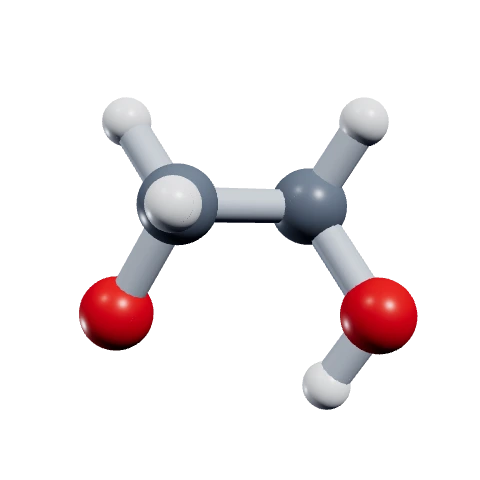


What is ethylene glycol?
Ethylene glycol is a small two-carbon alcohol - formula C₂H₆O₂, structure HOCH₂CH₂OH - that mixes with water in any proportion and refuses to let the mixture freeze at ordinary winter temperatures. Industry shorthand calls it MEG (monoethylene glycol); chemists call it 1,2-ethanediol. At room temperature it is a clear, odorless, faintly syrupy liquid, noticeably denser than water and hygroscopic enough to pull moisture straight out of the air.
Two hydroxyl groups on a two-carbon backbone make it extraordinarily good at hydrogen bonding, and that one structural fact drives nearly everything it does for a living: it disrupts the ice-crystal lattice in water (antifreeze), it holds onto water molecules (a drying agent and humectant in industrial processes), and it condenses with terephthalic acid into the polyester that makes fleece jackets and soda bottles.
CAS 107-21-1 · molar mass 62.07 g/mol · density 1.113 g/mL at 20°C · boiling point 197.3°C (387°F) · pure freezing point about -13°C (9°F) · miscible with water in all proportions. Full record: PubChem CID 174.

What is ethylene glycol used for?
Ethylene glycol earns its keep in two very different worlds: it is the freeze protection in engine coolant and industrial thermal fluids, and it is the raw material behind most of the world’s polyester. The famous use is the smaller one - globally, the large majority of MEG production is consumed making PET plastic and polyester fiber, not filling radiators.
| Where it works | What it does |
|---|---|
| Engine antifreeze / coolant | Blended ~50/50 with water it protects engine blocks from freeze cracking, raises the boiling margin, and carries heat away from the block year-round. |
| HVAC & process chiller loops | Closed chilled-water and heat-transfer loops in commercial buildings, cold-storage warehouses, and process plants run glycol-water blends so outdoor piping and coils cannot freeze. |
| Data-center liquid cooling | Inhibited EG blends are a standard working fluid in facility water systems; see our liquid-cooling guide and the OAT-908 data-center coolant line. |
| De-icing fluids | Ethylene- and propylene-glycol formulations de-ice aircraft, runways, and equipment in winter operations. |
| Natural-gas hydrate inhibition | Pipelines inject MEG so water in the gas stream cannot form solid hydrate plugs at depth and pressure. |
| PET & polyester manufacture | MEG + terephthalic acid → polyethylene terephthalate: bottles, film, and fiber. The largest global end-use. |
The common thread is water management under temperature stress. Wherever water must stay liquid below 32°F, boil later than 212°F, or be pulled out of a process stream entirely, a glycol is usually standing next to it.
Why does ethylene glycol stop water from freezing?
Ethylene glycol works by freezing-point depression: its molecules hydrogen-bond into the water and physically interrupt the orderly crystal lattice that ice needs to form, so the mixture must get far colder before it can solidify. This is a colligative effect - it scales with how much glycol is dissolved - which is why freeze protection is specified as a blend percentage rather than a yes/no.
| EG / water blend (by volume) | Approximate freeze protection |
|---|---|
| 30 / 70 | about 7°F (-14°C) |
| 40 / 60 | about -12°F (-24°C) |
| 50 / 50 | about -34°F (-37°C) |
| 60 / 40 | about -62°F (-52°C) |
| 100 / 0 (pure glycol) | only about 9°F (-13°C) |
Read that last row again, because it is the most useful counterintuitive fact in the glycol business: pure ethylene glycol freezes at a higher temperature than a 50/50 blend. Freeze protection comes from the glycol and the water disrupting each other; take the water away and the protection largely disappears. The curve bottoms out around 60-70% glycol and then climbs back up. Figures are approximate, from published engineering tables; always verify against the manufacturer data for a specific formulated product.

Practical rule: never top a system up with straight concentrate to "add protection." You are moving the blend along the curve, and past ~60% you are making freeze protection worse while thickening the fluid and hurting heat transfer. Blend to the target percentage - or buy the blend pre-mixed.
Is antifreeze the same as ethylene glycol?
Not quite: ethylene glycol is the base fluid, and antifreeze is a formulated product built on it. A jug of automotive antifreeze is typically 90-95% ethylene glycol plus a corrosion-inhibitor package, dye, and - in US retail products - a bittering agent. Most engine antifreeze sold in the United States is still ethylene-glycol based, with propylene-glycol formulas holding the niche where lower toxicity matters more than heat-transfer performance.
The inhibitor package is the real difference between products. Conventional inhibitors (phosphates, silicates) coat the metal; OAT chemistry (organic-acid technology) protects surfaces with carboxylate inhibitors that last far longer in service. The glycol is the same molecule in all of them - what you are choosing is the protection chemistry wrapped around it. For the full comparison against propylene glycol, see our ethylene glycol vs propylene glycol reference and the toxicity-driven fluid selection guide.
Inhibited vs uninhibited ethylene glycol: which do you need?
Inhibited ethylene glycol contains a corrosion-inhibitor package and is the right choice for any system that contains metal and runs for months or years; uninhibited glycol is the pure fluid, chosen when the inhibitors themselves would be a contaminant. This is the single most common specification question we get on glycol orders, and it has a clean answer:
| Choose | When | Why |
|---|---|---|
| Inhibited | Engines, HVAC loops, chillers, data-center facility water, any long-service metal system | As glycol ages in contact with air and heat it slowly oxidizes into organic acids (glycolic, formic). Uninhibited, those acids drop the pH and corrode iron, steel, aluminum, and solder. The inhibitor package buffers the acids and passivates the metal. |
| Uninhibited | Laboratory cold baths, freeze-point standards, gas dehydration, processes where additives would contaminate | The inhibitors are dissolved solids; where fluid purity is the specification, they do not belong. Plan on fluid replacement rather than fluid protection. |
A system filled with uninhibited glycol does not fail on day one - it fails in year two, quietly, from the inside of the pipe. If the system is a closed loop with pumps, welds, and dissimilar metals, specify inhibited concentrate or an inhibited pre-blend and change it on the manufacturer’s schedule.

How toxic is ethylene glycol?
Ethylene glycol is seriously toxic if swallowed, and its danger is aggravated by its sweet taste. The body converts it - through the same enzyme that processes drinking alcohol - into glycolic and then oxalic acid, which acidify the blood and can crystallize as calcium oxalate in the kidneys. Small ingested quantities can be fatal to people and, notoriously, to dogs and cats attracted by the sweetness; the CDC’s toxicology agency publishes the details in its ATSDR ToxFAQs for ethylene glycol. California lists ethylene glycol (ingested) under Proposition 65 as a developmental toxicant.
That is why every US retail antifreeze producer, under a nationwide industry agreement in force since 2012, adds denatonium benzoate - one of the bitterest substances known - to make the sweet liquid undrinkably foul. It is also why the professional rule is absolute: ethylene glycol has no place in food facilities’ product-contact loops, drinking-water systems, beverage chilling, or anywhere a leak could reach something people or animals ingest. For those applications the industry uses propylene glycol instead - that trade-off is exactly what our EG-vs-PG comparison covers.
Handling and spills: wear gloves and eye protection, wipe up spills completely (the sweet residue attracts animals), keep containers closed and clearly labeled, and store away from anything destined for consumption. If ingestion is suspected, contact Poison Control at 1-800-222-1222 immediately - treatment is time-critical.
Is ethylene glycol banned in the US? Can you still buy it?
No - ethylene glycol is not banned in the United States, and yes, you can buy it. It remains the dominant engine-coolant base and a workhorse industrial fluid, sold every day by the quart, pail, drum, and tote. What people half-remember as a "ban" is a cluster of narrower rules: the bittering-agent requirements for retail antifreeze, the California Proposition 65 listing, and disposal regulations - used automotive coolant picks up heavy metals in service and most states require it to be recycled or disposed of as regulated waste, not poured to a drain.
For a commercial buyer the practical picture is simple: no license is required, ground shipping is unrestricted (ethylene glycol is not a DOT-regulated hazardous material), and the compliance obligations that do exist - labeling, safe storage, SDS access for employees, and proper disposal of spent coolant - are ordinary chemical-handling practice.
Is ethylene glycol in Miralax? Untangling EG, PEG, and DEG
No. Miralax and similar products contain polyethylene glycol 3350 - PEG - which despite the family name is a different substance entirely: a large, chain-like polymer that is not absorbed or metabolized the way ethylene glycol is. The confusion is understandable, because three different chemicals share the "glycol" surname and could not behave more differently when swallowed:
| Name | What it is | Role |
|---|---|---|
| Ethylene glycol (EG) | Small molecule, C₂H₆O₂ | Antifreeze and industrial fluid. Toxic if swallowed. Never used in anything ingestible. |
| Diethylene glycol (DEG) | Two EG units joined by an ether bridge | Industrial solvent and intermediate. Also toxic - historically infamous for poisoning incidents when it was substituted into medicines. |
| Polyethylene glycol (PEG) | Long polymer chains (PEG 200 up to PEG 3350+) | Pharmaceutical and cosmetic workhorse, chosen precisely because the large polymer is handled so differently by the body. |
The suffix does the work: polyethylene glycol is to ethylene glycol roughly what a pearl necklace is to a bead - related by name, different in behavior. We cover the polymer side in our PEG 200 guide. The operating rule stays the same regardless: know exactly which glycol your process calls for, and never substitute across the family.
Which grade of ethylene glycol do you need?
Match the grade to the job, not the job to whatever is on the shelf. Alliance Chemical stocks ethylene glycol in four families, all with certificates of analysis available on request:
| Product | Grade | Built for |
|---|---|---|
| 100% Ethylene Glycol Inhibited | Inhibited | Concentrate for engines, HVAC and chiller loops - blend to your target percentage with deionized water. |
| 30/70, 50/50, 60/40 blends | Technical Grade | Pre-mixed with water to the named ratio - fill and go, no on-site blending, protection per the table above. |
| Ethylene Glycol ACS Grade (also inhibited) | ACS Reagent Grade | Laboratory work where purity is certified against ACS specifications. |
| Ethylene Glycol Semiconductor Grade | Semiconductor Grade | High-purity electronics and process applications with tight ionic-contamination limits. |
Two buying notes from the warehouse floor. First, pre-blended product is mixed with deionized water - if you blend concentrate yourself, use DI or demineralized water, because hard-water minerals foul inhibitor packages. Second, for data-center and facility-water systems, the OAT-908 inhibited blends are the long-service option, formulated specifically for that duty.
How much glycol does your system need? A worked example
Sizing a glycol charge is two numbers: the system volume and the coldest temperature the fluid must survive. Suppose a rooftop chilled-water loop holds 500 gallons and the design brief says it must not freeze at -10°F. The table above says 40/60 protects only to about -12°F - too thin a margin for a loop with outdoor piping - so the engineer specifies 50/50, protecting to roughly -34°F. The order is therefore 250 gallons of glycol: either 250 gallons of inhibited concentrate blended on-site with 250 gallons of deionized water, or 500 gallons of 50/50 pre-blend pumped straight in.
Two refinements matter in real systems. First, design margin: freeze protection is usually specified 10-15°F below the historic low, because the published figure is the temperature where ice crystals begin forming, not where pipes burst - a slushy blend still flows and protects against burst damage well below its freeze point. Second, verification: after filling, a $15 glycol refractometer reads the actual blend percentage in seconds. Systems leak, technicians top up with plain water, and three years later the "50/50 loop" is quietly 38% glycol. Measure annually, before the first hard freeze, and correct with concentrate to the target - it is the cheapest insurance in the building.
How should you store ethylene glycol, and does it expire?
Ethylene glycol itself is a stable molecule with an effectively indefinite shelf life when stored sealed - what ages is the inhibitor package, and what degrades glycol in service is heat, air, and metal contact, not time on a shelf. Store it in the original closed container, indoors, away from strong oxidizers and anything destined for consumption, and it will wait patiently for years. Three specifics worth knowing:
| Rule | Reason |
|---|---|
| Keep containers sealed | Glycol is hygroscopic - an open drum slowly pulls water from the air, drifting the blend percentage and diluting inhibitors. |
| Inhibited product: mind the service clock, not the shelf clock | Sealed inhibited glycol keeps for years; the inhibitor package starts its working life once the fluid is circulating hot in a metal system. Follow the in-service test-and-replace schedule. |
| Label and segregate | A clear, sweet, water-like liquid in an unmarked container is exactly how glycol ends up where it must never be. Keep it labeled and stored away from food, feed, and drinking-water equipment. |
Disposal is the flip side: fresh, uncirculated glycol and spent coolant are different waste streams. Coolant drained from an engine or an old loop has picked up metals in service, and most states require it to go to a coolant recycler or regulated disposal - never to a drain or the ground, where its sweetness makes it an animal hazard on top of an environmental-compliance one.
Where did antifreeze come from? A 60-second history
Before ethylene glycol, winter shut cars down. Early motorists drained their radiators every cold night or dosed them with methanol - which worked until it quietly boiled away on the drive, leaving the block unprotected. Glycol changed the arithmetic in the late 1920s: marketed from 1926-27 as "permanent antifreeze," its high boiling point meant one seasonal fill that stayed put, and the all-weather car became an ordinary fact of American life. The same property - a liquid that neither freezes in January nor boils away in July - is why the molecule graduated from radiators to chiller loops, de-icing rigs, and data-center cooling systems that never see a winter at all.

Winter is a deadline. Tell us the system and the coldest night it has to survive, and we’ll spec the blend and grade - so you’re not paying for purity you don’t need, or under-protecting a loop that matters. Certificates of analysis on request at no charge; most orders ship in 1-2 business days.
References & further reading
Primary sources: PubChem CID 174 (ethylene glycol) · ATSDR ToxFAQs: Ethylene Glycol · California OEHHA Proposition 65 listing (ingested). Freeze-protection figures are approximate values from published engineering tables; consult product-specific technical data for design work. On this site: Ethylene Glycol vs Propylene Glycol · Liquid Cooling for AI & GPU Data Centers · EG vs PG: Choosing an Antifreeze Base.
Key numbers and sources
| Fact | Value | Source |
|---|---|---|
| CAS number | 107-21-1 | pubchem.ncbi.nlm.nih.gov |
| Chemical formula | C₂H₆O₂ | pubchem.ncbi.nlm.nih.gov |
| Molar mass | 62.07 g/mol | pubchem.ncbi.nlm.nih.gov |
| Density at 20°C | 1.113 g/mL | pubchem.ncbi.nlm.nih.gov |
| Boiling point | 197.3°C (387°F) | pubchem.ncbi.nlm.nih.gov |
| Pure freezing point | about -13°C (9°F) | pubchem.ncbi.nlm.nih.gov |
| California Proposition 65 listing | ethylene glycol (ingested) under Proposition 65 as a developmental toxicant | oehha.ca.gov |
Related: NOAA Just Called a Very Strong El Niño. Here Is What That Does to a Glycol Loop in Texas — the season-ahead spec: a very strong El Niño winter, freeze vs burst protection, and how much of the blend curve you actually need.
Related: Why Water Splits Iron: The 1784 Quebec Shell Experiments and How Propylene Glycol Keeps Boats, RVs, Cabins and Loops Alive Through Winter — the same freeze-versus-burst reading applied to boats, RVs, cabins and stored equipment.
Frequently asked questions
What is ethylene glycol?
Ethylene glycol (C2H6O2, CAS 107-21-1) is a colorless, odorless, sweet-tasting liquid alcohol, also called MEG or 1,2-ethanediol. Mixed with water it depresses the freezing point sharply, which is why it is the base fluid of most engine antifreeze and industrial coolant. Most global production goes into polyester and PET plastic manufacture.
Is ethylene glycol the same as antifreeze?
Ethylene glycol is the base fluid; antifreeze is a formulated product - typically 90-95% ethylene glycol plus corrosion inhibitors, dye, and (in US retail products) a bittering agent. Most US engine antifreeze is still ethylene-glycol based.
What temperature does 50/50 ethylene glycol protect to?
A 50/50 ethylene glycol and water blend protects to approximately -34 F (-37 C), per published engineering tables. A 60/40 blend reaches roughly -62 F (-52 C). Always verify against the technical data for the specific formulated product.
Does pure ethylene glycol freeze?
Yes - pure ethylene glycol freezes at about 9 F (-13 C), a higher temperature than a 50/50 water blend. Freeze protection comes from glycol and water disrupting each other, so the protection curve bottoms out around 60-70% glycol and worsens beyond it. Never add straight concentrate to "increase" protection past that point.
Is ethylene glycol banned in the US?
No. Ethylene glycol is legal to buy and remains the dominant engine-coolant base. The rules that exist are narrower: bittering-agent requirements for retail antifreeze, a California Proposition 65 listing for ingestion, and state rules requiring spent automotive coolant to be recycled or handled as regulated waste.
Is ethylene glycol in Miralax?
No. Miralax contains polyethylene glycol 3350 (PEG), a large polymer that behaves completely differently in the body. Ethylene glycol (EG), diethylene glycol (DEG), and polyethylene glycol (PEG) are three different substances that share a family name - never substitute one for another.
What is the difference between inhibited and uninhibited ethylene glycol?
Inhibited ethylene glycol contains a corrosion-inhibitor package that buffers the organic acids glycol forms as it ages, protecting metal systems - the right choice for engines, HVAC loops, and chillers. Uninhibited glycol is the pure fluid, used in labs and processes where additives would be a contaminant.
Why does antifreeze taste sweet, and why is that a problem?
Ethylene glycol is naturally sweet-tasting, which makes spills attractive to children and pets despite its serious toxicity when swallowed. Since 2012, US retail antifreeze producers add denatonium benzoate, an intensely bitter compound, under a nationwide industry agreement. Clean up glycol spills completely and store containers closed and labeled.
Related Chemical Collections
About the author
Andre Taki
This article is for informational purposes only.


