

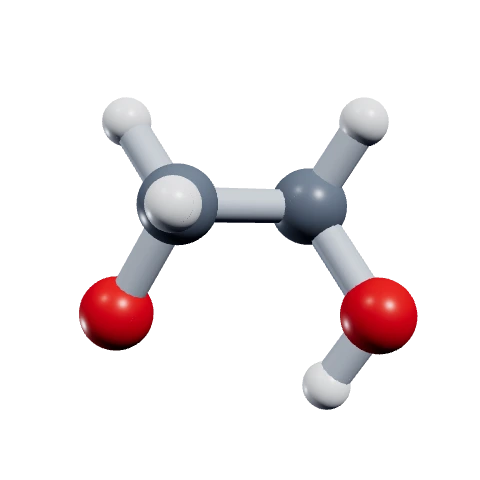


What is polyester made of?
Polyester is made of two chemicals, terephthalic acid and ethylene glycol, bonded end to end into a long chain called polyethylene terephthalate, or PET. "Polyester" is technically a family name for any polymer whose links are ester bonds, but when a clothing label says polyester, it means PET in the overwhelming majority of cases.
The chemistry is a condensation reaction. The acid end of a terephthalic acid molecule reacts with the alcohol end of an ethylene glycol molecule, the two join through an ester bond, and a molecule of water is released. Repeat that tens of thousands of times and the result is a chain that alternates between a flat benzene ring (from the acid) and a short two-carbon bridge (from the glycol). The rings make the chain stiff and strong. The glycol bridges give it just enough flexibility to be spun, stretched and dyed.
The one-third arithmetic. Terephthalic acid (C8H6O4) weighs 166.13 g/mol and ethylene glycol (C2H6O2) weighs 62.07 g/mol. Joining them releases two waters (2 × 18.02), leaving a repeat unit of 192.17 g/mol. One ethylene glycol is consumed per repeat unit, so 62.07 ÷ 192.17 = 0.323 tons of ethylene glycol per ton of PET, before any process losses. The same ton also takes 0.86 tons of terephthalic acid; the extra 0.19 tons of input leaves the reactor as water.
Where do terephthalic acid and ethylene glycol come from?
Both raw materials are made from oil and natural gas. Terephthalic acid is made by oxidizing para-xylene, one of the three xylene isomers, with air over a cobalt-manganese-bromide catalyst in an acetic acid solvent. Ethylene glycol starts as ethylene, which is oxidized over a silver catalyst to ethylene oxide, and the ethylene oxide is then reacted with water. Textile Exchange reports that 88% of polyester fiber made in 2024 was fossil-based. The rest came mostly from recycled bottles.
If you want the background on the glycol itself (freezing points, toxicity, inhibited versus uninhibited grades), our complete guide to ethylene glycol covers it. For the aromatic side, see our guide to xylene.
Is polyester plastic?
Yes. Polyester fabric is a plastic, and it is the same polymer (PET) used to make clear water and soda bottles, the ones stamped with resin identification code 1. The difference between a bottle and a shirt is mostly processing, not chemistry: bottle resin is polymerized to longer chains so it can be blow-molded into a rigid, gas-tight shape, while fiber-grade PET is melted and pulled through tiny holes into filaments finer than a human hair.

That shared chemistry is why recycled bottles can become fleece. Bottles are sorted, washed, shredded into flakes, melted and re-spun into fiber. It is also why "is polyester plastic?" is one of the most-searched questions about fabric: people are often surprised that a soft jacket and a crinkly bottle are, molecularly, the same thing.
How is polyester made?
Polyester is made in five steps: the two raw materials are reacted into short chains, those chains are joined into long ones under heat and vacuum, and the molten plastic is spun into filaments, stretched and finished into yarn.
- Esterification. Terephthalic acid powder is mixed with ethylene glycol into a paste and heated to roughly 250–270 °C. The two react into short chains and give off water, which is distilled away.
- Polycondensation. The short chains are heated further, to about 280–290 °C, under a strong vacuum with a catalyst, most commonly an antimony compound. The chains link end to end, and the excess ethylene glycol released as they join is pulled off by the vacuum and recycled back to step 1.
- Melt spinning. The molten PET is pumped through a spinneret, a metal plate drilled with many fine holes, and the emerging streams cool into continuous filaments.
- Drawing. The filaments are stretched to several times their spun length. Stretching lines the polymer chains up along the fiber, which is where polyester gets its strength.
- Texturing or cutting. The filament is crimped or air-textured to give it bulk, or cut into short staple fiber to be spun like cotton, and then wound onto bobbins for knitting and weaving.

What is fleece made of?
Fleece is made of polyester. Polyester yarn is knitted into fabric, and then the surface is brushed with rollers covered in fine wire, which pulls fiber ends up out of the knit into a soft pile. The pile is sheared to an even height. Those raised fibers trap air, which is what keeps you warm, and because polyester absorbs very little water, fleece stays warm when damp and dries quickly.
Synthetic fleece is a Massachusetts invention. Malden Mills, a textile maker in Lawrence, worked with Patagonia to develop a dense napped polyester fabric, and Patagonia began selling garments made from it, under the name Synchilla, in 1981. Malden Mills later branded its fabric Polartec. In 1993 the two companies introduced the first fleece made from recycled plastic bottles, which works precisely because bottle and jacket are both PET.
That is the reason our social post this week showed a pair of hands holding a worn fleece with the line "a third of this fleece was glycol." It is not a figure of speech. It is the molecular-weight arithmetic above.
Who invented polyester, and what was Terylene?
Polyester fiber was invented by two British chemists, John Rex Whinfield and James Tennant Dickson, working for the Calico Printers’ Association in Accrington, Lancashire. In 1941 they found that terephthalic acid and ethylene glycol could be condensed into a polymer that could be drawn into a fiber, and they patented it in July of that year. Because of wartime secrecy, the invention was not made public until 1946.
Terylene was the British trade name for that fiber, developed and sold by Imperial Chemical Industries (ICI). DuPont bought the United States rights in 1946 and sold the same polymer as Dacron. Both reached the market in the early 1950s. Terylene and Dacron are the same chemistry: PET made from terephthalic acid and ethylene glycol. Only the brand differs.
What is the difference between polyester and nylon?
Polyester and nylon are both melt-spun synthetic fibers, but they are held together by different chemical links. Polyester chains are joined by ester bonds, made from an acid and an alcohol (terephthalic acid and ethylene glycol). Nylon chains are joined by amide bonds, made from an acid and an amine; the common nylon 6,6 uses adipic acid and hexamethylenediamine.
That one difference explains most of how the two fabrics feel. Amide bonds attract water, so nylon absorbs noticeably more moisture than polyester: the standard commercial moisture-regain values in ASTM D1909 are 4.0% for nylon and 0.4% for polyester. That is why polyester is the default for base layers and fleece that need to dry fast, while nylon is chosen where toughness and abrasion resistance matter most, as in pack cloth and hosiery.
| Polyester (PET) | Nylon 6,6 | |
|---|---|---|
| Chain link | Ester | Amide |
| Raw materials | Terephthalic acid + ethylene glycol | Adipic acid + hexamethylenediamine |
| Moisture regain | 0.4% | 4.0% |
| Typical uses | Fleece, athletic wear, bottles, carpet | Hosiery, pack cloth, rope, carpet |
How much ethylene glycol goes into polyester?
Most of the world’s ethylene glycol goes into polyester, not antifreeze. Industry market reports put polyester fiber alone at roughly half to 60% of global monoethylene glycol demand, and PET bottle resin and film take much of the rest. Antifreeze and heat-transfer fluids, the use most people associate with the chemical, are a much smaller slice.
The fiber figures make the scale concrete. Textile Exchange puts 2024 polyester fiber output at about 78 million tonnes, 88% of it fossil-based. At 0.323 tons of glycol per ton of PET, the roughly 69 million tonnes of virgin polyester fiber implies on the order of 22 million tonnes of new ethylene glycol in a single year, for fiber alone.
| Where ethylene glycol ends up | What it becomes | Share |
|---|---|---|
| Polyester fiber | Clothing, fleece, carpet, upholstery, seatbelts, tire cord | Largest single use (roughly half to 60% of demand) |
| PET resin | Bottles and food containers | Second-largest |
| PET film | Packaging film, labels, electrical insulation | Smaller |
| Antifreeze & heat transfer | Engine coolant, HVAC chiller loops, data center cooling | Smaller |
Is there ethylene glycol in polyester clothes?
No, not as a liquid. Once polymerized, ethylene glycol no longer exists as a separate molecule in the fabric. It survives only as the two-carbon –O–CH2–CH2–O– link between the aromatic rings of the chain. That is why we write that a third of a fleece was glycol rather than is glycol: the mass came from ethylene glycol, but the chemical is now part of a solid polymer.
The link can be broken again, which is the basis of chemical recycling. In glycolysis, PET is heated with excess ethylene glycol and a catalyst, which cuts the chains back down to a small ester called BHET that can be purified and re-polymerized. In methanolysis, methanol cuts the chains into dimethyl terephthalate and ethylene glycol. Either way, the glycol that built the polymer is the key to taking it apart.
What grade of ethylene glycol do you need?
The grade you need depends on whether the glycol is going into a reactor, an instrument or a cooling loop. Polyester plants run on fiber-grade monoethylene glycol bought by the railcar and shipload, which is a different supply chain from ours. We don’t sell that. What we supply is ethylene glycol for everyone else who needs the molecule in a specific, documented purity:
| Use | Grade on our storefront |
|---|---|
| Laboratory work, polymer and recycling research, analytical standards | Ethylene Glycol ACS Grade; Ethylene Glycol Inhibited ACS Grade |
| Electronics and semiconductor processing | Ethylene Glycol Semiconductor Grade |
| Chillers, process cooling, HVAC loops | 100% Ethylene Glycol Inhibited; Ethylene Glycol 30/70, 40/60, 50/50 and 60/40 blends |
| Data center liquid cooling | Inhibited Ethylene Glycol with OAT-908 at 30/70, 35/65, 40/60 and 50/50 |
We carry these grades in sizes from 1 quart to 330-gallon IBC totes. Orders ship in 1–2 business days from Texas, the SDS is on the product page, and a certificate of analysis is available on request. If you are not sure which grade your process needs, tell us the application and we will match the grade, so you are not paying for purity you won’t use or under-specifying a step that matters.
- Polyester at 59% of global fiber output, about 78 million tonnes in 2024, 88% fossil-based: Textile Exchange, Materials Market Report 2025.
- Molecular weights used in the one-third calculation: PubChem, ethylene glycol (CID 174) and PubChem, terephthalic acid (CID 7489).
- Whinfield and Dickson, Calico Printers’ Association, July 1941 patent, public in 1946: John Rex Whinfield; Terylene and Dacron commercial history: CAMEO (Museum of Fine Arts, Boston), Terylene.
- Malden Mills and Patagonia, Synchilla (1981), Polartec, first recycled-bottle fleece (1993): Polartec, About and Polar fleece.
- Polyester fiber as the largest share of monoethylene glycol demand: Fibre2Fashion, global MEG market.
- Commercial moisture regain (polyester 0.4%, nylon 4.0%): ASTM D1909, Standard Tables of Commercial Moisture Regains for Textile Fibers; nylon 6,6 monomers: Nylon 66.
- PET chemistry, production route, and glycolysis and methanolysis recycling: Polyethylene terephthalate; para-xylene oxidation route: Terephthalic acid.
Frequently asked questions
What is polyester made of?
Polyester is almost always polyethylene terephthalate (PET), made by reacting purified terephthalic acid with monoethylene glycol. The two join through ester bonds into a long chain, releasing water. About 0.32 tons of ethylene glycol goes into every ton of PET.
Is polyester plastic?
Yes. Polyester fabric is PET, the same plastic used for clear water and soda bottles (resin code 1). Bottle resin is polymerized to longer chains for molding; fiber-grade PET is melt-spun into fine filaments. That shared chemistry is why recycled bottles can be made into fleece.
How is polyester made?
Terephthalic acid and ethylene glycol are reacted at roughly 250 to 270 °C into short chains, then polymerized at about 280 to 290 °C under vacuum with a catalyst. The molten PET is pushed through a spinneret into filaments, stretched to align the chains, then textured or cut into staple fiber.
What is fleece made of?
Fleece is polyester that has been knitted and then brushed and sheared to raise a soft pile that traps air. Malden Mills and Patagonia introduced it as Synchilla in 1981, and in 1993 they launched the first fleece made from recycled plastic bottles.
What is Terylene?
Terylene is the British trade name for the first polyester fiber, patented in 1941 by John Rex Whinfield and James Tennant Dickson of the Calico Printers’ Association and developed commercially by ICI. DuPont sold the same PET polymer in the United States as Dacron.
Is there antifreeze in polyester?
Polyester is made from ethylene glycol, the same molecule used in antifreeze, but there is no liquid glycol in the finished fabric. Once polymerized, the glycol exists only as a two-carbon link inside the solid PET chain. About a third of polyester’s mass came from ethylene glycol.
What is ethylene glycol mostly used for?
Most of the world’s ethylene glycol goes into polyester: fiber alone is roughly half to 60% of monoethylene glycol demand, and PET bottle resin and film take much of the rest. Antifreeze and heat-transfer fluids are a smaller share.
Does Alliance Chemical sell ethylene glycol for making polyester?
No. Polyester plants buy fiber-grade monoethylene glycol by the railcar. Alliance Chemical supplies ethylene glycol in ACS, Inhibited ACS, Semiconductor and Technical grades, plus inhibited heat-transfer blends, from 1 quart to 330-gallon totes, for laboratory, electronics and cooling applications.
Sources
- PubChem, ethylene glycol (CID 174) · PubChem (NIH National Library of Medicine)
- PubChem, terephthalic acid (CID 7489) · PubChem (NIH National Library of Medicine)
- ASTM D1909, Standard Tables of Commercial Moisture Regains for Textile Fibers · ASTM International
Related Chemical Collections
About the author
Andre Taki
This article is for informational purposes only.


