

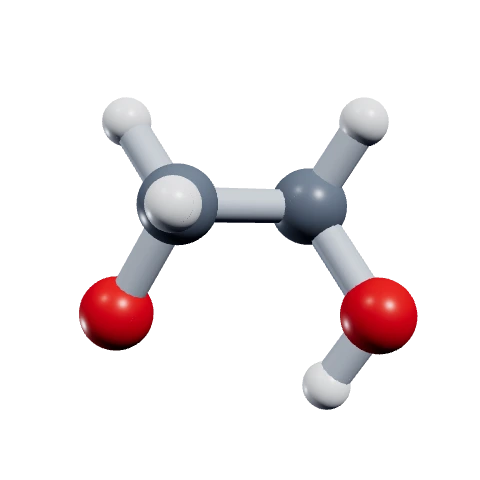


The chemistry that keeps an AI training run from melting itself is not glamorous: it's a 30%-ethylene-glycol coolant moving through copper cold plates at 40 GPM with a corrosion-inhibitor package keeping the metal alive. Get the inhibitor wrong and you replace a fluid loop in eighteen months instead of eight years. Get it right and the fluid will outlast two GPU generations.
This is the procurement guide to Alliance Chemical's Inhibited Ethylene Glycol 30/70 with OAT-908 — the spec sheet, what the inhibitor actually does, when 30% beats 50%, how it stacks up against the legacy IAT and HOAT coolants you're probably trying to replace, and exactly how to order it in the size your facility needs.

- A pre-mixed 30/70 inhibited ethylene glycol coolant is a procurement specification, not a universal recommendation for every loop.
- Confirm concentration, inhibitor package, water quality, materials compatibility, operating temperature, and OEM requirements before purchase.
- A complete sourcing file should include the current TDS, SDS, lot-specific COA, packaging, lead time, and freight plan.
What is OAT-908 and why does it matter for data-center coolant?
OAT-908 is a hybrid Organic Acid Technology corrosion-inhibitor package — meaning it pairs the long-lived aliphatic carboxylate chemistry of pure OAT inhibitors with selected inorganic synergists (sodium nitrite, sodium molybdate, sodium benzoate) to protect every metal commonly found in a modern data-center cooling loop in a single fluid. In a multi-metal hyperscale loop with copper cold plates, brass fittings, mild-steel piping, and aluminum heat-rejection components, that breadth of protection is the difference between a fluid that lasts eight years and a fluid that fails in eighteen months.
The carboxylate component (typically sebacate, 2-ethylhexanoate, and other long-chain organic acids) is the active inhibitor — it adsorbs onto bare-metal pits as they form and shuts down corrosion at the molecular scale. Unlike legacy silicate-based inhibitor additive technology (IAT) packages, carboxylates don't drop out of solution as silicate gel that fouls heat exchangers and chokes pump flow rates over time. The inorganic synergists then layer a complementary protection mechanism on top — molybdate suppresses pitting on stainless and aluminum, nitrite provides aggressive copper and steel protection at low fluid pH excursions, and benzoate acts as a buffer reservoir extending the working pH window.
Hybrid OAT > pure OAT for hyperscale AI loops. Pure OAT excels in low-metal loops with high flow turbulence. Modern AI compute facilities are the opposite — six or seven metal species, complex flow paths through manifolds and CDU heat exchangers, and microbiological growth risk from warm-side temperatures near 50°C. The hybrid synergists give you protection breadth that pure OAT can't match alone.
For a deep technical comparison of OAT vs HOAT vs NOAT inhibitor chemistries, the failure modes of each, and selection rules by cold-plate metallurgy, see our OAT vs NOAT vs HOAT inhibitor reference guide. This guide focuses on the procurement decision: what to buy, in what size, and how to evaluate it for your facility.
The four people building the AI infrastructure wave have been saying the same thing in different words.
- Jensen Huang (NVIDIA) — at GTC keynote presentations covering the Blackwell platform, has positioned liquid cooling as the default architecture for next-generation GPU compute density, not an optional add-on.
- Sam Altman (OpenAI) — in repeated public statements at Davos and in U.S. Senate testimony has named electricity supply, not chip availability, as the binding constraint on AI scaling.
- Elon Musk (xAI) — has publicly tracked the Memphis Colossus buildout from 100,000 H100s to a planned 200,000+ deployment within a single year, one of the fastest large-scale data-center commissionings on record.
- Dario Amodei (Anthropic) — in his October 2024 essay Machines of Loving Grace describes multi-gigawatt facility deployments as the natural endpoint of current compute scaling trajectories.
Each of those statements terminates at the same line item on a facility procurement spreadsheet: a closed-loop coolant fluid in a CDU heat exchanger, holding the metals together for the next eight years.

Why 30/70 specifically — when does 30% ethylene glycol beat 50% in a data center?
The default reflex from HVAC and automotive backgrounds is to spec 50/50 ethylene glycol. In a data center, that reflex usually costs you heat-transfer efficiency and pump head you don't need to spend. A 30/70 blend (30% EG, 70% water by volume) is the better answer for almost every controlled-temperature data-center facility for four reasons:
- Heat-transfer efficiency. Water is the best practical heat-transfer fluid at non-cryogenic temperatures. Every percentage point of ethylene glycol displaces water and reduces both specific heat capacity and thermal conductivity. A 30/70 blend retains ~92% of water's specific heat; 50/50 falls to ~85%. For a 1 MW thermal load, that's 8% more flow demand or 8% larger temperature swing across the loop — neither of which is free.
- Viscosity and pump load. Ethylene glycol is significantly more viscous than water, especially at lower coolant supply temperatures. At 40°C the 30/70 blend is roughly 1.5–2.0 cP versus 3.0–3.5 cP for 50/50. Pump shaft power scales with viscosity at constant flow — moving 30/70 instead of 50/50 saves measurable kW on the pump skid over a year.
- Freight weight and pallet count. Specific gravity at 20°C: 30/70 is 1.040–1.045; 50/50 is 1.067–1.073. On a 275-gallon IBC tote that's about 30 lbs of freight difference. Multiply by a facility commissioning quantity of twenty IBC totes and you've saved a pallet position on the truck.
- Freeze protection that matches reality. Most enterprise and hyperscale data centers run conditioned space inside the white-space envelope. The fluid temperatures and ambient conditions never approach 0°C in steady-state operation. The reason you specify any glycol at all is to protect against winter shutdowns, transport, dry-cooler bypass at low loads, and outdoor heat-rejection equipment exposed below freezing. 30/70 gives you a freeze point of approximately −15°C and a burst-protection point well below that. For a building running 18°C return-water temperatures, that's more than enough.
The exception is outdoor dry-cooler or fluid-cooler systems in cold climates (Toronto, Stockholm, Minneapolis), or air-side economized facilities with redundant glycol coils exposed to sub-zero ambient air. Those facilities should spec 40/60 or 50/50 for freeze headroom — and Alliance carries both. See the decision matrix near the bottom of this article.
Concentration decision matrix at a glance
| Blend | Freeze Pt | Burst Pt | Best for | SKU |
|---|---|---|---|---|
| 30/70 | −15°C (5°F) | ~−28°C (−18°F) | Indoor white-space loops, AI/HPC cold-plate DLC, edge-compute modules, mild climates | Inhibited EG 30/70 |
| 35/65 | −20°C (−4°F) | ~−34°C (−30°F) | Slightly cooler facility ambient, marginal-freeze risk equipment | Inhibited EG 35/65 |
| 40/60 | −24°C (−11°F) | ~−39°C (−38°F) | Outdoor dry-cooler loops, partial economizer systems, cold-region hyperscale | Inhibited EG 40/60 |
| 50/50 | −36°C (−33°F) | ~−52°C (−62°F) | Outdoor heat-rejection in extreme climates, automotive/HD reference applications | Inhibited EG 50/50 |
What's in our 30/70 OAT-908 coolant? The full spec sheet
Procurement engineers spec against a number, not a marketing claim. Here is the typical-values spec sheet for Alliance Chemical Inhibited Ethylene Glycol 30/70 with OAT-908, with the ASTM method called out for each property so your QA lab can independently verify a received lot.
| Property | Typical Value | Method |
|---|---|---|
| Composition | 30% v/v ethylene glycol, balance deionized water, inhibited with OAT-908 | — |
| Appearance | Clear to pale-amber liquid | Visual |
| Specific Gravity at 20°C | 1.040 – 1.045 | ASTM D1298 |
| pH (as supplied) | 8.5 – 10.0 | ASTM D1287 |
| Reserve Alkalinity | 7 – 10 mL 0.1 N HCl | ASTM D1121 |
| Freeze Point | ≤ −15°C (5°F) | ASTM D1177 |
| Boiling Point | ≥ 102°C (215°F) | ASTM D1120 |
| Refractive Index at 20°C | 1.354 – 1.358 | ASTM D1747 |
| Viscosity at 40°C | 1.5 – 2.0 cP | ASTM D445 |
| Thermal Conductivity at 50°C | 0.42 – 0.46 W/m·K | ASHRAE 2017 Ch.31 |
| Specific Heat at 20°C | 0.92 Btu/lb·°F (3.85 kJ/kg·K) | ASHRAE 2017 Ch.31 |
| Corrosion (six-metal stack) | Conforms to ASTM D3306 limits | ASTM D1384 |
Why ASTM D3306 matters. ASTM D3306 is the heavy-duty industrial coolant corrosion standard — it defines the maximum allowable weight loss for each metal in the six-coupon D1384 stack (copper, solder, brass, steel, cast iron, aluminum) after 336 hours at 88°C in an aerated coolant bath. A coolant that conforms to D3306 has bench-test proof that it won't eat your loop. A coolant that doesn't cite D3306 conformance hasn't been tested — or worse, has been tested and didn't conform.
Is it compatible with my CDU's metals and elastomers?
The short answer is yes for every metal and elastomer commonly used in a modern data-center liquid cooling loop. The longer answer matters because the wrong fluid in contact with the wrong material is a six-month corrosion problem disguised as a six-week installation success.
Compatible — safe for continuous service
Metals
Copper (C110, C122), brass (yellow and red), mild steel, cast iron, stainless steel (304, 316), aluminum (3003, 6061), lead-tin solder, nickel, Monel.
Polymers & plastics
Polypropylene, HDPE, PVC, CPVC, PVDF, PTFE, PFA, PEEK, polysulfone, polyamide-imide (Torlon).
Elastomers (seals & gaskets)
NBR (Buna-N), EPDM, FKM (Viton), HNBR, VMQ silicone, neoprene (CR), CSM (Hypalon).
Standard fittings
Brass push-to-connect, stainless compression, victaulic grooved couplings, EPDM-gasketed flanges.
Not recommended — avoid prolonged contact
Natural rubber, magnesium alloys, and zinc-galvanized surfaces are out. Natural rubber swells and degrades in glycol service. Magnesium alloys are attacked by the alkaline pH. Zinc-galvanized steel piping eventually consumes the inhibitor reserve faster than expected — and zinc-galvanized was never the right call for a closed-loop coolant system anyway. If you have legacy galvanized hydronic piping, plan a flush and conversion.
How does it compare to legacy IAT and HOAT coolants?
Most fluid you'd find in a non-AI HVAC chiller plant today is either IAT (Inhibitor Additive Technology — the silicate/phosphate chemistry that came over from automotive in the 1980s) or HOAT (Hybrid Organic Acid Technology — a transitional chemistry from the 2000s that retained some silicates).
Both are workable for HVAC. Neither is the right choice for a modern AI data center cooling loop, and the reasons trace directly to the inhibitor depletion mechanisms.
| Chemistry | Mechanism | Service life | Failure mode |
|---|---|---|---|
| IAT (silicate / phosphate) | Deposits a protective scale on metal surfaces; silicate consumed by deposition | 2–3 years | Silicate gel drops out of solution, fouls heat exchanger plates, chokes flow, accelerates pump wear |
| HOAT (hybrid silicate + carboxylate) | Silicate scale + some long-chain carboxylate protection | 3–5 years | Silicate fouling reduced but not eliminated; mixed with OAT chemistries causes catastrophic precipitation |
| OAT (pure carboxylate) | Carboxylate adsorbs on bare-metal pits; no scale-forming inhibitor | 5–8 years | Slow inhibitor depletion at constant rate; needs annual fluid analysis |
| Hybrid OAT (OAT-908) | Carboxylate base + nitrite/molybdate/benzoate synergists | 5+ years (8+ achievable) | Slow depletion; nitrite drift on copper-rich loops monitored via reserve alkalinity |
Never mix inhibitor technologies. Topping up an IAT-inhibited loop with a HOAT or OAT product (or vice versa) is one of the most common causes of catastrophic heat-exchanger fouling in data-center cooling. The silicate and the carboxylate fight, the silicate drops out as gel, and the loop's effective heat-transfer surface area halves overnight. If you're switching technologies, do a full drain, water flush, and recharge. For the mechanism and the testing protocol, see our OAT vs NOAT vs HOAT reference.
For broader context on how cooling chemistry interlocks with GPU thermal density, see our AI GPU cooling revolution guide and the direct-to-chip vs immersion fluid selection breakdown.

What does the fluid-life math look like — TCO over 8 years?
Coolant fluid is rarely the line item that wins or loses a procurement decision in isolation. But over an 8-year facility-build amortization, a 5-yr-life hybrid OAT fluid versus a 2-yr-life IAT fluid pays for itself many times over in avoided dump-and-refill events.
Here's the simplified math for a 1,000-gallon closed-loop facility:
| Cost element | IAT 2-yr life | Hybrid OAT 5+ yr life |
|---|---|---|
| Initial fill (1,000 gal) | ~$2,800 | ~$3,800 |
| Recharges over 8 yrs | 3–4 times | 1 time |
| Recharge fluid cost (8 yrs) | $8,400–$11,200 | $3,800 |
| Disposal of spent fluid | $1,500×3–4 = $4,500–$6,000 | $1,500×1 = $1,500 |
| Labor & downtime per dump+refill | $6,000×3–4 = $18,000–$24,000 | $6,000×1 = $6,000 |
| Heat-exchanger fouling cleanup | ~$8,000 (silicate gel) | $0 |
| 8-yr total | $41,700–$52,000 | $15,100 |
The numbers shift with facility size, fluid pricing, regional labor rates, and the actual service life realized on your fluid. The qualitative point survives every variation: the higher unit price of a long-life hybrid OAT coolant is more than recovered by avoided dump-and-refill cycles, avoided downtime, and avoided heat-exchanger fouling cleanups. Hyperscale facility teams have made this calculation already — it's why the industry has migrated to hybrid OAT chemistry over the last decade.
Annual fluid analysis is the practice that converts “5+ years” into actual realized life. Pull a 250-mL sample annually and test pH, reserve alkalinity, refractive index, and visual clarity. When reserve alkalinity falls below 5.0 mL 0.1 N HCl or pH falls below 7.0, the fluid is approaching end-of-life and should be replaced. Without the test you're flying blind.
How do I order — pack sizes, lead time, COA / SDS / TDS?
Alliance Chemical Inhibited Ethylene Glycol 30/70 with OAT-908 is available in 16 pack sizes from 1 quart through 330-gallon IBC totes. Sample quantities for engineering evaluation, mid-size facility loops, and bulk pallet orders all ship from the same Taylor, Texas facility, blended under documented batch-control procedures with the lot-specific Certificate of Analysis on request at no charge.
| Size break | Common configurations | Typical use |
|---|---|---|
| 1 quart | 1, 2, 4, 8 quarts | Compatibility bench testing, small modular edge units |
| 1 gallon | 1, 2, 4-gallon case, 4×36 pallet | Top-off jugs, lab loops |
| 5 gallon pail | Single pail, 4-pack, 36-pail pallet | Mid-scale top-up reservoirs |
| 15 gallon drum | HDPE drum | Edge-compute modular loops, small CDUs |
| 55 gallon drum | HDPE drum, 4-drum pallet | Branch-circuit fills, CDU recharges |
| 275-gallon IBC tote | 275-gal tote | Hyperscale CDU initial fills, mid-density rack rows |
| 330-gallon IBC tote | 330-gal tote | Large CDU initial fills, primary loop charges |
For volumes larger than IBC scale (single-tanker orders, multi-tanker facility build-outs), contact sales@alliancechemical.com directly to discuss pricing and dedicated production scheduling.
Documentation included with every order
- Certificate of Analysis (COA) — lot-specific, on request at no charge. Includes measured values for pH, specific gravity, refractive index, and reserve alkalinity against typical-value spec ranges.
- Technical Data Sheet (TDS) — available in the Product Documents tab on the product page.
- Safety Data Sheet (SDS) — finished-product SDS available in Product Documents; OAT-908 inhibitor concentrate SDS available on request for engineering review.
Non-DOT regulated. No hazmat surcharge. Inhibited Ethylene Glycol 30/70 with OAT-908 is classified Non-Hazardous for ground freight in finished form. It ships via standard LTL or full-truckload services with no hazmat documentation requirements, no UN number, and no hazardous-materials surcharge from the carrier. Procurement teams routinely save several hundred dollars per IBC over hazmat-rated competing fluids.
What does the SDS actually say? Hazards, handling, storage
The full Safety Data Sheet ships with the product and is available on the product page. Here's the operationally-relevant summary for facility teams responsible for handling and storage.
Finished coolant hazard profile
- NFPA rating: Health 1 / Flammability 0 / Reactivity 0 / Special 0. Slight health (alkaline pH, ethylene glycol toxicity on ingestion), non-flammable, non-reactive in normal conditions.
- PPE for handling: chemical-resistant gloves (nitrile or neoprene), splash goggles, long sleeves. Add a rubber apron if there's a splash risk.
- Carcinogenicity: Neither the finished coolant nor any of its components are listed as carcinogens by IARC, NTP, OSHA, or ACGIH.
- Storage: tightly-closed containers in a temperature-controlled environment, 4°C to 40°C (40°F to 105°F). Avoid prolonged storage above 50°C as that accelerates inhibitor degradation. Pail and drum stacking per the container manufacturer's rating.
- Spill response: small spills — absorb with inert material (sand, vermiculite, clay) and dispose of in compliant chemical waste container. Large spills — dike, contain, pump to drum, clean residual with water. Do not flush to storm drain.
Pet-safety note. Ethylene glycol itself is highly toxic to dogs, cats, and wildlife if ingested — even small amounts. Inhibited ethylene glycol coolant still contains ethylene glycol as the bulk fluid. Clean up spills immediately, store containers out of reach of animals, and notify facility teams to watch for fluid pooling in unconditioned outdoor enclosures.
Inhibitor concentrate vs finished coolant
The OAT-908 inhibitor concentrate (which we receive from our additive supplier and blend into the finished coolant) is a hazier alkaline solution with higher nitrite, molybdate, and triethanolamine concentrations — appropriate PPE and handling for the concentrate are stricter than for the diluted finished product. What ships to you as the finished coolant is the diluted product, not the concentrate. Your facility team handles the diluted form. The concentrate SDS is available on request if your engineering team wants to review the inhibitor chemistry independently.
When should I choose 35/65, 40/60, or 50/50 instead?
The 30/70 blend is the right answer for the majority of indoor data-center loops. You step up to a higher concentration when freeze protection has to extend outside the building envelope — a dry cooler on the roof in a cold climate, a glycol coil exposed during a building-management failover, a fluid-cooler bypass that strands fluid in unconditioned plenum during a winter shutdown.
35/65 (−20°C freeze)
Bridge concentration. Choose when you want freeze headroom beyond 30/70 without paying the heat-transfer penalty of 50/50. Common in northern-tier US edge-compute deployments.
40/60 (−24°C freeze)
Outdoor dry-cooler default in cold climates. Standard for Toronto / Chicago / Stockholm-class facilities running air-side economizer. Still ~88% of water's specific heat.
50/50 (−36°C freeze)
Extreme climate or automotive-reference applications. Maximum freeze headroom in inhibited EG. Heat-transfer penalty is real; spec only when freeze protection demands it.
Custom concentrations
Need a non-standard ratio for a specific facility? Contact us — we blend on the same line and can quote a custom batch.
Sources & verification notes
- U.S. Department of Energy FEMP: Cooling Water Efficiency Opportunities for Federal Data Centers — WUE definition, cooling-tower water use, direct liquid cooling, and water-saving strategies.
- DOE Best Practices Guide for Energy-Efficient Data Center Design — liquid-cooling architectures, CDUs, glycol-based fluids, dry coolers, and water/energy tradeoffs.
- ASHRAE AI Data Center Energy Performance Framework — current liquid-cooling class terminology and system context.
- Open Compute Project Cooling Environments — current workstreams for cold plates, CDUs, immersion, coolant chemistry, commissioning, monitoring, and maintenance.
- National Laboratory of the Rockies: HPC Data Center Water Usage Efficiency — documented hybrid dry-cooler results; cited as a case study, not a universal performance guarantee.
- ISO/IEC 30134-9:2022 — WUE KPI definition and reporting framework.
- National Weather Service Phoenix climate records — climate claims must be checked against the selected station, period, and design percentile.
- Alliance Chemical inhibited EG/PG and DI-water product pages — product-specific concentration, documentation, availability, and logistics claims require current TDS/SDS/COA confirmation before procurement.
Architecture-level performance values are design- and site-dependent. Product-specific values should be confirmed against the current lot documentation and equipment OEM requirements.
Continue the data-center cooling series
Spec it, sample it, scale it.
From a 1-quart engineering sample to a 330-gallon IBC for a CDU initial fill — same blend, same COA, blended in Taylor, Texas.
Order Inhibited EG 30/70Shop all glycol coolantsReferences & Authoritative Sources
Chemical identity, properties, and safety data sourced from the U.S. National Library of Medicine's PubChem database — the authoritative open-chemistry data resource maintained by the National Institutes of Health.
- PubChem CID 174: Inhibited Ethylene Glycol 30/70 with OAT-908 — Data Center Coolant — National Center for Biotechnology Information, U.S. National Library of Medicine. CAS 107-21-1.
- Ethylene Glycol — thermophysical data — NIST Chemistry WebBook, SRD 69, National Institute of Standards and Technology. Accessed 2026-09-04.
Related: Magnesium Chloride for Energy & Cement: Batteries & Sorel Cement — the coolant chemistry behind modern data centers meets clean-tech: see how magnesium chloride fits.
Related: Sulfuric Acid in Vanadium Flow Batteries — how sulfuric acid serves as the electrolyte in grid-scale vanadium redox flow batteries.
Key numbers and sources
| Fact | Value | Source |
|---|---|---|
| Ethylene glycol concentration in Inhibited Ethylene Glycol 30/70 with OAT-908 | 30% v/v ethylene glycol, balance deionized water | See article text |
| Specific gravity at 20°C (Inhibited Ethylene Glycol 30/70 with OAT-908) | 1.040 – 1.045 | See article text |
| pH (as supplied) for Inhibited Ethylene Glycol 30/70 with OAT-908 | 8.5 – 10.0 | See article text |
| Freeze point for Inhibited Ethylene Glycol 30/70 with OAT-908 | ≤ −15°C (5°F) | See article text |
| Boiling point for Inhibited Ethylene Glycol 30/70 with OAT-908 | ≥ 102°C (215°F) | See article text |
| Viscosity at 40°C for Inhibited Ethylene Glycol 30/70 with OAT-908 | 1.5 – 2.0 cP | See article text |
| ASTM corrosion standard conformance for Inhibited Ethylene Glycol 30/70 with OAT-908 | Conforms to ASTM D3306 limits | See article text |
Frequently asked questions
What is OAT-908 in plain language?
OAT-908 is a hybrid Organic Acid Technology corrosion-inhibitor package. It combines aliphatic carboxylates (the long-lived OAT base) with inorganic synergists — sodium nitrite, sodium molybdate, and sodium benzoate — to protect every metal commonly found in modern data-center cooling loops in a single fluid. It is designed for multi-metal loops including copper cold plates, brass fittings, mild steel, cast iron, and aluminum.
Is Inhibited Ethylene Glycol 30/70 with OAT-908 ASTM D3306 conformant?
Yes. The finished coolant conforms to ASTM D3306 industrial coolant corrosion limits across the full six-metal D1384 coupon stack: copper, solder, brass, steel, cast iron, and aluminum. ASTM D3306 is the bench-test specification cited by most data-center cooling fluid specifications and is the standard procurement engineers should require for any inhibited glycol coolant.
Why 30% ethylene glycol instead of 50%?
In a controlled-temperature data center, 30/70 retains ~92% of water's specific heat capacity versus ~85% for 50/50, with significantly lower viscosity, lower pump load, lower freight weight, and adequate freeze protection (-15°C / 5°F) for indoor loops. Step up to 40/60 or 50/50 only when freeze protection has to extend outside the conditioned building envelope (outdoor dry coolers, cold-climate fluid coolers, air-side economizer coils).
How long does the fluid last in a real data-center loop?
Five-plus years closed-loop service life under design conditions, with eight years routinely achievable for facilities that follow annual fluid analysis protocols. Pull a 250-mL sample annually and test pH, reserve alkalinity, and refractive index. Replace fluid when reserve alkalinity drops below 5.0 mL 0.1 N HCl or pH falls below 7.0.
Can I top up an existing IAT or HOAT coolant loop with this product?
No. Never mix inhibitor technologies. Topping an IAT or HOAT loop with hybrid OAT coolant causes silicate precipitation, heat-exchanger fouling, and catastrophic flow restriction. If you are converting from another inhibitor chemistry, drain the existing fluid completely, flush with deionized water, and recharge with the new fluid. We provide a conversion procedure on request.
What pack sizes are available and what are the lead times?
16 pack sizes from 1 quart through 330-gallon IBC totes are available. Standard pack sizes ship within 1-2 business days from our Taylor, Texas facility. Bulk pallet quantities and IBC totes typically ship in 2-4 business days depending on quantity. Tanker-volume orders are quoted individually with dedicated production scheduling.
Is this product DOT-regulated for shipping?
No. The finished coolant is classified Non-Hazardous for ground freight. It ships via standard LTL or full-truckload services with no UN number, no hazmat documentation, and no hazmat surcharge. This typically saves several hundred dollars per IBC tote compared to hazmat-rated competing fluids.
How do I evaluate this coolant against my current fluid?
Request a 1-quart engineering sample. Compare specifications against your current fluid (especially specific gravity, pH, reserve alkalinity, and inhibitor technology). Run a side-by-side ASTM D1384 corrosion coupon test if your QA lab is equipped, or accept the manufacturer-documented D3306 conformance. For ongoing fluid analysis, the same lab can test received-lot COA values against the typical-value spec ranges.
Related Chemical Collections
About the author
Andre Taki
This article is for informational purposes only.


