

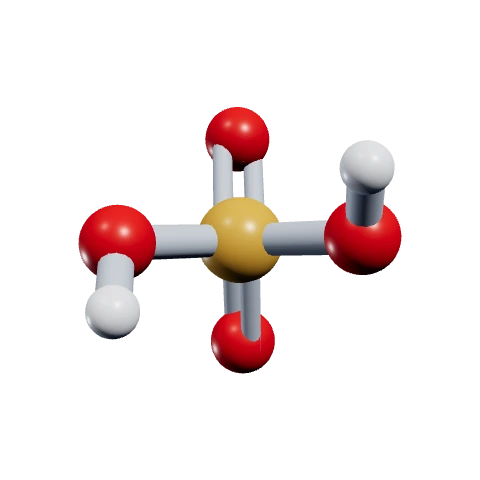


The batteries keeping the AI-era grid alive for hours — not minutes — run on a chemistry most people have never heard of. And the workhorse liquid inside them is one of the oldest industrial chemicals on earth: sulfuric acid.
As solar and wind push past the point where they can power the grid for a few hours at a time, utilities and hyperscale data centers need storage that lasts all night — and that can charge and discharge tens of thousands of times without wearing out. Lithium-ion is brilliant for short bursts, but for 4-to-12-hour stationary duty a different architecture is winning contracts fast: the vanadium redox flow battery. In 2026 the world’s largest flow battery — a 200 MW / 1 GWh system in China — came online, and a gigawatt-hour-scale project in Switzerland was selected specifically to backstop an AI data center. Every one of these systems is, at its core, a carefully purified tank of vanadium dissolved in sulfuric acid. This guide explains exactly what that acid does, what concentration and grade the job demands, and how to source it.
What is a vanadium redox flow battery?
A vanadium redox flow battery is a rechargeable battery that stores energy in two tanks of liquid electrolyte rather than in solid electrodes. Both tanks contain the same element — vanadium — dissolved in sulfuric acid, but at different oxidation states. During charge and discharge, the electrolyte is pumped through a central cell stack where ions swap electrons across an ion-exchange membrane. Because the energy lives in the tanks and the power lives in the stack, you can size energy and power independently: want more hours of storage, add bigger tanks; want more kilowatts, add more stack.
Vanadium is the trick that makes it durable. It is one of the few elements stable in four different oxidation states in solution, so both the positive and negative sides use the same metal. If some electrolyte crosses the membrane over the years, nothing is permanently contaminated — you simply rebalance and recharge. That is why a well-built VRFB can run for 20,000+ cycles and 20–25 years with almost no capacity loss, and why the electrolyte itself is often described as a near-indefinite asset that can be recovered and reused at end of life.
Negative tank: V²⁺ ↔ V³⁺. Positive tank: VO²⁺ (V⁴⁺) ↔ VO₂⁺ (V⁵⁺). One element, two redox couples, zero cross-contamination risk — the structural reason flow batteries barely degrade.
Physically, a VRFB is more plumbing than gadget. Two storage tanks hold the positive and negative electrolyte; pumps circulate each through its own side of a cell stack; and inside the stack, an ion-exchange membrane separates the two liquids while letting protons pass. Charging pushes electrons in and drives the vanadium to its charged states; discharging reverses the flow and delivers current to the grid. Because the reaction happens in flowing liquid rather than in a solid lattice that expands and cracks over time, there is no mechanical degradation of an electrode structure — the failure modes that limit lithium-ion simply don’t apply. The system’s lifespan is governed instead by the durability of the membrane, seals, and pumps, and by keeping the electrolyte clean.

Why does a vanadium flow battery need sulfuric acid?
Sulfuric acid is the supporting electrolyte that makes the whole cell work — it is the medium the vanadium lives in, not a reactant that gets used up. It does three jobs at once. First, it supplies a high concentration of protons (H⁺), which shuttle across the membrane to balance charge every time an electron moves through the external circuit. Second, its acidity keeps the vanadium ions — especially the pentavalent VO₂⁺ species — dissolved and stable instead of precipitating out as vanadium oxides. Third, the free acid gives the solution the ionic conductivity it needs to move current with low internal resistance.
Take the acid away and the battery stops being a battery: the vanadium falls out of solution, the membrane has no protons to conduct, and internal resistance climbs. This is why the sulfuric acid matrix is engineered as carefully as the vanadium loading itself — and why a product literally sold as “electrolyte grade” exists.
The sulfuric acid is not consumed by charge/discharge. It is the proton-conducting, vanadium-solubilizing backbone of the electrolyte — a supporting electrolyte, in electrochemistry terms — so its purity and concentration set the battery’s performance for its entire 20-year life.
What concentration of sulfuric acid goes into VRFB electrolyte?
A standard vanadium flow battery electrolyte contains roughly 1.5–2 mol/L vanadium dissolved in 2–5 mol/L sulfuric acid, with about 1.6 M vanadium and 3–4 M total sulfate being the most common commercial recipe. The two numbers are linked: the acid concentration is chosen to hold as much vanadium in stable solution as possible across the battery’s operating temperature window, because more dissolved vanadium means more energy per liter of tank.
That solubility ceiling — roughly 2 M vanadium in pure sulfuric-acid electrolyte — is the single biggest lever on flow-battery energy density, and it is where most current research is aimed. Mixed-acid formulations (adding a second acid) and, more recently, protic ionic-liquid additives have pushed vanadyl sulfate solubility as high as 6 mol/L in the lab — about 2.5× the sulfuric-only maximum — though at a cost in viscosity and conductivity that keeps plain sulfuric-acid electrolyte the practical workhorse for utility deployments today.
Why does electrolyte-grade purity matter for flow batteries?
Electrolyte purity is critical because a flow battery lives with the same acid for two decades, so any contaminant is a permanent passenger that slowly steals capacity. Unlike a single-use process acid that reacts and leaves, the sulfuric acid in a VRFB is recirculated millions of times — and trace impurities catalyze side reactions, promote unwanted gassing, and drive the gradual capacity fade that operators most want to avoid. A dedicated 2026 review of vanadium electrolyte production names impurity control as one of the central engineering challenges of the entire technology.
The two worst offenders are transition metals and chloride. Trace iron, chromium, and similar metals catalyze hydrogen evolution and parasitic reactions. Chloride is worse still: at the positive electrode it can be oxidized toward chlorine gas and can destabilize the pentavalent vanadium species. That is precisely why a low-chloride, low-metal electrolyte-grade sulfuric acid — not whatever technical acid happens to be on hand — is the right feedstock for building or topping up electrolyte.
Chloride contamination is a known enemy of vanadium electrolyte — it can drive chlorine evolution at the positive electrode and destabilize V⁵⁺. Source a low-chloride sulfuric acid and verify it on the Certificate of Analysis before it ever touches the tanks.
What grade of sulfuric acid should you use for battery and electrolyte work?
Match the grade to the job: use electrolyte-grade or ACS-grade sulfuric acid when purity drives performance, and technical-grade battery acid for routine lead-acid service. The table below maps Alliance Chemical’s sulfuric line to the most common battery and electrolyte tasks. (Note: we supply the sulfuric-acid matrix; the vanadium source — vanadium pentoxide or vanadyl sulfate — is dosed separately when preparing finished VRFB electrolyte.)
| Product | Grade | Best for |
|---|---|---|
| Sulfuric Acid 50% – Electrolyte Grade | Electrolyte | Electrolyte preparation, electrochemical cells, supercapacitor and battery R&D where purity and consistent specific gravity matter |
| Sulfuric Acid 96% ACS Grade | ACS Grade | Highest-purity starting acid to dilute precisely to a target molarity; analytical and reagent work |
| Sulfuric Acid 37% – Battery Acid | Technical | Lead-acid battery service, topping and formation, general acid duty |
All three have a Certificate of Analysis on request at no charge, and our specialists will help you pick the concentration and grade for your specification rather than leaving you to over-pay for purity you don’t need — or under-spec a step where it matters.
How is vanadium flow battery electrolyte actually made?
Vanadium electrolyte is produced by dissolving a vanadium source in purified sulfuric acid and then balancing its oxidation state, and it is one of the most valuable and technically demanding parts of the whole battery. Producers typically start from vanadium pentoxide (V₂O₅) or vanadyl sulfate (VOSO₄), dissolve it into sulfuric acid at the target molarity, and then use electrolytic reduction to bring the average oxidation state to about 3.5 — the balanced 50/50 mix of V³⁺ and V⁴⁺ that lets both half-cells charge symmetrically. The finished liquid is filtered and re-tested, because any particulate or ionic impurity carried in from the acid becomes a permanent part of the system.
This is why the choice of sulfuric acid is not a commodity decision. The electrolyte is engineered to a specification — density, vanadium concentration, acid concentration, and impurity limits — and it holds that specification for the life of the battery. Starting from a clean, well-characterized acid with a Certificate of Analysis removes an entire category of downstream failure modes before the first charge cycle.
A commissioned VRFB electrolyte sits at an average vanadium oxidation state near 3.5 — an equal blend of V³⁺ and V⁴⁺ — so charging drives one tank down to V²⁺ and the other up to V⁵⁺ in perfect balance.
Where are vanadium flow batteries being deployed in 2026?
Vanadium flow batteries are scaling fastest where the grid needs many hours of storage and decades of cycling — utility-scale renewables firming and, increasingly, the power-hungry AI data center. In early 2026 China connected the world’s largest VRFB installation: a 200 MW / 1 GWh system in Xinjiang, paired with a 1 GW solar farm and capable of five hours of continuous discharge, with electrolyte supplied by Dalian-based flow specialist Rongke Power. In Europe, Invinity Energy Systems completed a 20.7 MWh hub in East Sussex — the continent’s largest — and was selected to design a gigawatt-hour-scale flow battery for a technology campus in Switzerland built expressly to combine renewable power with a state-of-the-art AI data center.
That data-center angle is the tell. As hyperscale AI campuses strain local grids, developers want long-duration storage that is non-flammable (a real advantage for siting next to compute halls), tolerant of constant deep cycling, and cheap to run for 20 years. Flow batteries check those boxes — and every megawatt-hour of them is a fresh order for high-purity vanadium electrolyte, and therefore for the sulfuric acid that carries it. It is the same buildout driving demand for our data-center cooling-water chemistry and inhibited-glycol coolants, seen from the storage side.
The U.S. Department of Energy’s Long Duration Storage Shot targets a 90% cost reduction for grid storage that delivers 10+ hours of duration by 2030 — the exact niche where flow-battery chemistry, not lithium-ion, is the front-runner.

Vanadium flow battery vs lithium-ion: when does a flow battery win?
A flow battery wins when you need long duration, very long cycle life, and inherent fire safety in a fixed location; lithium-ion wins when you need high energy density in a small or mobile package. They are complementary, not interchangeable. The comparison below shows why utilities increasingly pair short-duration lithium with long-duration vanadium rather than choosing one.
| Attribute | Vanadium flow (VRFB) | Lithium-ion |
|---|---|---|
| Sweet-spot duration | 4–12+ hours | Minutes to ~4 hours |
| Cycle life | 20,000+ cycles, minimal fade | ~3,000–8,000 cycles |
| Calendar life | 20–25 years | ~10–15 years |
| Fire risk | Non-flammable water-based electrolyte | Flammable; thermal-runaway risk |
| Energy density | Low (large footprint) | High (compact) |
| Scale energy & power | Independently (tanks vs stack) | Coupled |
| End-of-life electrolyte | Recoverable / reusable | Complex recycling |
The footprint is the honest trade-off: a flow battery is physically large for its energy, so it is a stationary technology — you will never put one in a phone or a car. But for a warehouse-sized asset that has to soak up an afternoon of solar and release it across the night, every night, for two decades, the vanadium-in-sulfuric-acid architecture is hard to beat.
Why does the vanadium price matter — and what is electrolyte leasing?
The electrolyte is the single most expensive part of a vanadium flow battery, often 30–40% of total system cost, so the price of vanadium — not the acid — is the main swing factor in a project’s economics. Vanadium is a globally traded commodity with a history of price volatility, which for years was seen as the technology’s Achilles heel. The industry’s answer flips that liability into an advantage: because the electrolyte does not degrade, it can be treated as a durable, recoverable asset rather than a consumable.
That has produced business models you don’t see in lithium-ion. Developers can lease the electrolyte instead of buying it outright, financing the vanadium separately from the hardware and returning it — still fully usable — at end of life. The sulfuric acid matrix and the vanadium in it can both be recovered and re-deployed into new systems. For a buyer, the takeaway is practical: the acid you start with is a small fraction of the electrolyte cost, so there is no economic reason to compromise on its grade or purity to shave a few dollars. The expensive vanadium deserves a clean acid to live in.
Share of total VRFB system cost tied up in the electrolyte — which is why the vanadium market, and the reusability of the electrolyte, drive project economics far more than the sulfuric acid line item.
How do you safely dilute and handle concentrated sulfuric acid?
Always add acid to water — never water to acid — slowly, with cooling and full personal protective equipment. Diluting concentrated sulfuric acid is strongly exothermic: mixing generates enough heat to boil the solution and spatter if done in the wrong order. Adding acid to a larger volume of water lets that heat dissipate safely; adding water to acid can flash-boil at the surface and throw concentrated acid. This is the first rule anyone preparing electrolyte at any concentration must internalize.
Beyond dilution order, treat concentrated H₂SO₄ with the respect a strong, dehydrating acid deserves: acid-resistant gloves, splash goggles or a face shield, an apron, and good ventilation. Store it in compatible containers away from bases, oxidizers, and reactive metals, and keep spill neutralizer (soda ash or a commercial sulfuric-acid neutralizer) on hand. For working procedures, see our guides on safer sulfuric acid storage, neutralizing a sulfuric acid spill, and the chemical compatibility chart for storage planning.
Dilution is exothermic. Always pour acid into water slowly with stirring and cooling — never the reverse — and wear splash goggles, acid-resistant gloves, and an apron. UN 1830.
Buying sulfuric acid for electrolyte and battery applications
Whether you are formulating vanadium electrolyte, running electrochemical R&D, or servicing lead-acid banks, the grade and concentration you start with decide the result. Alliance Chemical stocks the full sulfuric ladder with the lot Certificate of Analysis on request at no charge, in packaging from 1-quart bottles to pails, drums, and 275-gallon totes — with bulk and recurring-supply pricing for production volumes.
Order sulfuric acid by the grade your process needs
Tell us the application and we’ll spec the concentration and grade — so you’re not paying for purity you’ll never use, or under-spec’ing a step that matters. CoA included, fast quotes on bulk.
Key numbers & sources
| Fact | Value | Source |
|---|---|---|
| Vanadium in standard electrolyte | 1.5–2 mol/L | ScienceDirect: VRFB overview |
| Free sulfuric acid in electrolyte | 2–5 mol/L | Electrolyte production & impurities review (2026) |
| Sulfuric acid CAS / UN | 7664-93-9 / UN 1830 | PubChem |
| World’s largest VRFB | 200 MW / 1 GWh (Xinjiang, China) | ESS-News (2026) |
| DOE Long Duration Storage Shot | 90% cost cut, 10+ hr, by 2030 | U.S. Department of Energy |
References & Authoritative Sources
Primary sources consulted for this article. Regulatory and physical-property figures above are drawn from these references.
- PubChem Compound Summary: Sulfuric Acid (CID 1118) — National Center for Biotechnology Information, U.S. National Library of Medicine. Accessed 2026-09-04.
- Sulfuric Acid — thermophysical data — NIST Chemistry WebBook, SRD 69, National Institute of Standards and Technology. Accessed 2026-09-04.
Frequently asked questions
Can you use sulfuric acid in a vanadium flow battery?
Yes — sulfuric acid is the standard supporting electrolyte in a vanadium redox flow battery. The vanadium ions are dissolved in aqueous sulfuric acid, which carries protons for charge balance, keeps the vanadium in solution, and provides ionic conductivity. It is not consumed during charge and discharge.
What concentration of sulfuric acid does VRFB electrolyte use?
A standard vanadium flow battery electrolyte holds about 1.5–2 mol/L vanadium dissolved in roughly 2–5 mol/L sulfuric acid, with ~1.6 M vanadium and 3–4 M sulfate being a common commercial recipe. The acid concentration is tuned to keep as much vanadium dissolved as possible across the operating temperature range.
Why is sulfuric acid used instead of another acid?
Sulfuric acid provides a high proton concentration for charge balance, keeps vanadium species (especially pentavalent V5+) stable in solution, and delivers strong ionic conductivity — all while being inexpensive and widely available. Some advanced formulations add a second acid to raise vanadium solubility, but sulfuric acid remains the practical workhorse.
Does the sulfuric acid get used up in a flow battery?
No. The sulfuric acid is a supporting electrolyte, not a reactant. It is recirculated continuously and is not consumed by charge/discharge, which is why its purity matters over the battery’s full 20-year service life.
What grade of sulfuric acid is best for battery electrolyte?
For electrolyte and electrochemical work, use an electrolyte-grade or ACS-grade sulfuric acid — low in chloride and trace metals, which otherwise cause capacity fade and side reactions. Technical-grade battery acid is appropriate for routine lead-acid service. Alliance Chemical supplies Sulfuric Acid 50% Electrolyte Grade, 96% ACS Grade, and 37% Battery Acid (Technical).
Is car battery acid the same as flow battery electrolyte?
No. Car (lead-acid) battery acid is roughly 37% sulfuric acid used as-is. Vanadium flow battery electrolyte is high-purity sulfuric acid with vanadium salts dissolved in it, and it demands tighter control of chloride and metal impurities. They are different products for different chemistries.
How much sulfuric acid does a grid-scale vanadium battery need?
Because the energy is stored in the electrolyte tanks, a large VRFB uses very large volumes of vanadium-in-sulfuric-acid electrolyte — a gigawatt-hour-scale system contains many thousands of cubic meters. That is why sulfuric acid supply is directly tied to flow-battery deployment growth.
Where can I buy electrolyte-grade sulfuric acid?
Alliance Chemical sells Sulfuric Acid 50% Electrolyte Grade and 96% ACS Grade from 1-quart bottles up to 275-gallon totes, with the Certificate of Analysis on request at no charge and bulk pricing for production volumes. Tell us your application and we will spec the concentration and grade.
Related Chemical Collections
About the author
Andre Taki
This article is for informational purposes only.


