



Every spent lithium-ion battery is a small, dense ore deposit. A single electric-vehicle pack can hold tens of kilograms of nickel, cobalt, manganese, and lithium — metals that were mined, refined, and shipped across the world once already. The fastest-growing question in the battery industry is no longer "how do we make more cells?" It's "how do we get those metals back?" And the surprisingly old answer is the same acid that's been inside lead-acid car batteries for over a century: sulfuric acid.
The difference is the role it plays. In a lead-acid battery, sulfuric acid is the electrolyte — it stays in the battery. In lithium-ion recycling, sulfuric acid is the solvent that tears a dead battery apart at the molecular level and hands you back the valuable metal in a form a new cathode plant can use. This guide explains exactly how H₂SO₄ does that work: what black mass is, which metals come out, what concentration the leach runs at, why hydrometallurgy is beating smelting, and how to choose the right grade. It's written for the people actually running or sourcing for these operations, but it stays readable if you're just here because "your old phone battery becomes a new one" sounds like science fiction. It mostly isn't fiction — and acid chemistry is why.
How does lithium-ion battery recycling actually work?
Modern lithium-ion recycling runs in three stages: collect and discharge, mechanically shred into "black mass," then chemically leach the metals back out. The first two stages are physical; the third — where sulfuric acid does its job — is where the value is actually recovered.
A retired pack is first discharged and dismantled to the module or cell level, then fed through a shredder under inert atmosphere or controlled conditions to manage the fire and off-gas risk that comes with cutting into energized cells. Shredding liberates the casings, the copper and aluminum current collectors, and the plastic separators, which are screened, sieved, and density-sorted out of the stream. What's left is a fine, dark powder — the electrode coatings — called black mass. That powder is the feedstock for the chemistry that follows, and everything downstream depends on getting it clean and consistent.
It's worth being precise about what shredding alone does not do: it does not separate nickel from cobalt from lithium. Those elements are intimately mixed inside the cathode crystal and stay mixed in the black mass. Mechanical processing gets you to a metal-rich powder; only chemistry gets you to individual, sellable metals. That hand-off — from physical to chemical — is the moment sulfuric acid enters.

What is black mass — and why does recovery start with sulfuric acid?
Black mass is the shredded, screened electrode powder of a spent battery, and it is where essentially all of the recoverable transition metals live. By mass it's roughly a third to half valuable metal — nickel, cobalt, manganese, and lithium locked inside the cathode crystal structure — mixed with graphite from the anode and trace copper, aluminum, and fluorine from the binder.
Those metals aren't sitting there as free metal you can magnet out; they're chemically bound inside metal-oxide cathode compounds. The dominant chemistry today is NMC (lithium nickel-manganese-cobalt oxide), alongside LCO (lithium cobalt oxide) in electronics and a growing share of LFP (lithium iron phosphate) in lower-cost EVs. Each of those locks its metals into a tight oxide lattice. To free them you have to dissolve that lattice, and that requires an acid that is strong, cheap, available at industrial scale, and forms soluble salts.
Sulfuric acid checks every box. It is the highest-tonnage industrial chemical on earth, which means it's available by the tanker and priced like a commodity rather than a specialty reagent. It dissolves transition-metal oxides readily. And critically, the metal sulfates it produces — nickel sulfate, cobalt sulfate, manganese sulfate — are exactly the chemical form that downstream battery-precursor plants already buy as their raw material. Choosing sulfuric acid isn't just about dissolving the metal; it's about dissolving it into the right product.
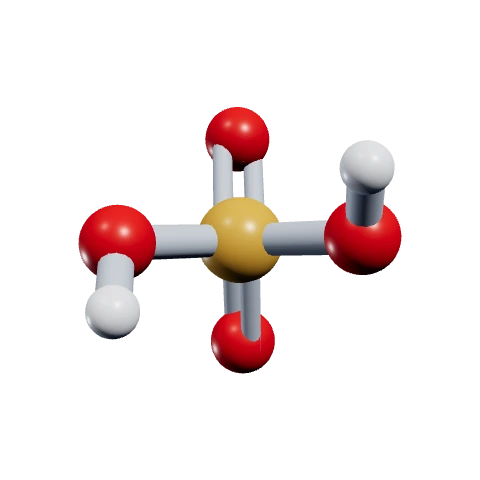
CAS Number: 7664-93-9 — sulfuric acid, H₂SO₄, regardless of concentration. The same molecule that fills a car battery is the workhorse of next-generation battery recycling.
Which metals does sulfuric acid recover from a spent battery?
A sulfuric-acid leach pulls four critical metals out of black mass — nickel, cobalt, manganese, and lithium — each as a water-soluble sulfate. These are the highest-value elements in the entire recycling stream, and recovering them is the whole economic point of the process.
Cobalt and nickel are the most valuable per kilogram and are the metals supply-chain planners worry about most, because both carry geopolitical concentration risk at the mining stage. Lithium is the one that older smelting routes simply throw away. Manganese is lower-value but recovering it keeps the leach liquor clean and the downstream separation simpler. A well-run hydrometallurgical circuit recovers all four at high yield, then separates them by selective precipitation and solvent extraction into individual battery-grade products.
| Metal | Leached as | Typical recovery | Downstream product |
|---|---|---|---|
| Nickel (Ni) | NiSO₄ | >95% | Battery-grade nickel sulfate |
| Cobalt (Co) | CoSO₄ | >95% | Battery-grade cobalt sulfate |
| Manganese (Mn) | MnSO₄ | ~90–98% | Manganese sulfate |
| Lithium (Li) | Li₂SO₄ | ~90–95% | Lithium carbonate / hydroxide |
The graphite from the anode does not dissolve in the acid — it's filtered off as a solid residue, and increasingly it's recovered and purified rather than landfilled, because battery-grade graphite is valuable in its own right. So a single sulfuric-acid leach effectively forks the black mass into two product streams: a metal-rich solution and a graphite cake.
What concentration of sulfuric acid is used in black-mass leaching?
Black-mass leaching typically runs at a relatively dilute working acidity — on the order of 1 to 2 molar sulfuric acid — not concentrated acid straight from the drum. Operators buy concentrated H₂SO₄ and dilute it to the target leach molarity, because the chemistry needs a controlled supply of available protons in solution, not maximum strength. Running too concentrated wastes acid, complicates downstream neutralization, and can dissolve impurities you'd rather leave behind.
The critical second ingredient is a reducing agent, most commonly hydrogen peroxide. The cobalt and manganese in a charged cathode sit in higher oxidation states (Co³⁺, Mn⁴⁺) that resist dissolving in acid alone. The reductant donates electrons that knock them down to the soluble divalent states (Co²⁺, Mn²⁺), and that single change is what lifts recovery from mediocre to greater than 95%. A representative leach runs roughly 1–2 M H₂SO₄ with a few volume-percent H₂O₂ at 60–80 °C for one to four hours, with agitation to keep the fine powder suspended and the kinetics fast.

Why peroxide, not more acid: piling on extra sulfuric acid doesn't fix a stubborn leach — the bottleneck is oxidation state, not pH. A small dose of hydrogen peroxide reduces Co³⁺ and Mn⁴⁺ so they dissolve, which is why H₂SO₄ + H₂O₂ is the canonical black-mass leach pair. Get the reductant right and you can run leaner on acid.
What happens to the metals after the leach?
Leaching is only the first chemical step; the metal-rich sulfate solution then goes through purification and separation to turn a mixed "soup" into individual, battery-grade products. The leach gets the metals out of the solid — the refining train gets them apart from each other.
First, impurities like iron, aluminum, and copper that came along for the ride are removed, usually by adjusting pH to precipitate them selectively or by cementation. Then the valuable metals are separated by solvent extraction — organic extractants that grab cobalt, nickel, and manganese one at a time across a series of mixer-settler stages — and lithium, which stays in the aqueous phase, is recovered at the end by precipitating it as lithium carbonate. The outputs are the same nickel sulfate, cobalt sulfate, and lithium salts that cathode-precursor plants would otherwise buy from a mine-and-refine supply chain.
This is the part that makes recycling genuinely circular rather than merely "disposal that recovers some scrap." The products are spec'd to feed straight back into new cathode manufacturing. Throughout this train, sulfate is the chemistry the whole circuit is built around — which is why the choice of sulfuric acid at the front end shapes everything that follows.
Hydrometallurgy vs. pyrometallurgy: why acid leaching is winning
Acid leaching (hydrometallurgy) is displacing high-temperature smelting (pyrometallurgy) because it recovers more metals — including lithium — at far lower energy and a much smaller carbon footprint. The two routes solve the same problem in opposite ways, and the economics increasingly favor the wet chemistry.
Pyrometallurgy melts the whole battery in a furnace. It's robust, tolerant of mixed and even partially-charged feedstock, and it requires little upfront sorting — real advantages when the incoming stream is unpredictable. But it burns enormous energy, loses lithium and most manganese into the slag, and emits significant CO₂. Hydrometallurgy dissolves black mass at modest temperature, captures lithium alongside nickel and cobalt, and produces the battery-grade sulfates that cathode makers want — at a fraction of the energy.
The trade-off is real: hydromet consumes reagents and generates acidic wastewater and sodium-sulfate byproduct that have to be managed. That's exactly why reliable, consistent sulfuric acid supply is a strategic input rather than a commodity afterthought — a leach line that runs short on acid, or gets an off-spec lot, stops recovering metal. Many of the largest operators now run a hybrid: a light thermal pre-treatment to deactivate and homogenize the feed, followed by a hydrometallurgical leach to capture the value.
| Factor | Pyrometallurgy (smelting) | Hydrometallurgy (acid leach) |
|---|---|---|
| Lithium recovery | Largely lost to slag | Recovered (~90–95%) |
| Energy use | Very high (furnace) | Moderate (60–80 °C) |
| Carbon footprint | High | Lower |
| Feedstock sorting | Minimal needed | Cleaner black mass preferred |
| Key reagent | Coke / flux | Sulfuric acid + reductant |
| Output form | Mixed alloy / matte | Battery-grade sulfates |
How big is battery recycling — and why now?
Lithium-ion recycling is scaling from a niche into a domestic industry, driven by a wave of retiring EV batteries and U.S. policy that rewards recovered material. The timing isn't gradual — a generation of EVs sold in the 2010s is reaching end-of-life at the same moment that manufacturing scrap from new gigafactories is piling up, and factory scrap alone is enough to feed a recycler before a single consumer pack arrives.
Operators like Redwood Materials, Li-Cycle, Ascend Elements, and Cirba Solutions are building hydrometallurgical capacity across North America. Federal incentives — including the Inflation Reduction Act's Section 45X advanced manufacturing production credit and domestic-content sourcing rules — make recovered nickel, cobalt, and lithium count toward the same supply chains automakers are racing to localize. Recovered material also sidesteps the multi-year permitting and lead times a new mine faces. Recycled black mass is, in effect, a domestic mine that's already above ground, already concentrated, and already legal to process. The chemistry that unlocks it is sulfuric acid.
The circular hook: metals recovered by acid leaching aren't downcycled — nickel and cobalt sulfate from a recycled pack can go straight back into a new cathode. The same atoms cycle through battery after battery, and H₂SO₄ is what lets them out each time.
Handling and neutralizing sulfuric acid in a recycling operation
Sulfuric acid is corrosive and reacts exothermically with water, so safe handling comes down to a few non-negotiable rules: always add acid to water (never the reverse), use acid-resistant PPE and secondary containment, and keep a neutralizing agent staged and ready. These aren't bureaucratic checkboxes — they're what keeps a leach line running and a workforce intact.
When diluting concentrated H₂SO₄ to leach strength, add the acid slowly to water with cooling and agitation; the reaction releases substantial heat, and adding water to concentrated acid can flash to steam and spatter hot acid. Store and pump it in compatible materials — many plastics and certain stainless grades are attacked over time, so material selection on tanks, valves, and gaskets matters. Never mix sulfuric acid with bleach or hypochlorite (releases toxic chlorine gas), with reactive metals (generates flammable hydrogen gas), or with concentrated oxidizers and organics. Spills are neutralized with soda ash (sodium carbonate) or lime, then the slurry is managed as the site's permit requires.
Never mix: sulfuric acid + hypochlorite bleach → toxic chlorine gas. Sulfuric acid + active metals → flammable hydrogen gas. Dilute by adding acid to water, with cooling — adding water to concentrated acid can erupt.
Which sulfuric acid grade should you buy for battery recycling?
For bulk black-mass leaching, 93% Technical Grade sulfuric acid is the standard workhorse; for high-purity or analytical work where trace contaminants matter, step up to 96% ACS Grade. The right choice is about where the acid sits in your process, not about "more pure is always better."
Technical-grade 93% is the cost-efficient bulk leaching reagent — you dilute it to your working molarity anyway, so paying for ultra-high purity in a leach tank rarely pays back, and at scale the cost difference is real money. Where downstream product specs are tight, or for the QC and analytical labs that verify recovered-metal purity batch by batch, 96% ACS Grade delivers the low trace-impurity profile those steps demand — you don't want the acid itself introducing contamination into a battery-grade product. Buying concentrated and diluting in-house gives the best cost per mole of acid and the most control over your leach chemistry; choose the grade that matches the job and keep both on hand if your process spans bulk leaching and precision QC.
| Grade | Best for | Why |
|---|---|---|
| 93% Technical Grade | Bulk black-mass leaching | Cost-efficient; diluted to leach molarity anyway |
| 96% ACS Grade | High-purity steps, QC / analytical | Low trace-impurity profile for tight specs |
Key numbers & sources
The figures behind sulfuric-acid battery recycling, with primary sources for verification:
| Fact | Value | Source |
|---|---|---|
| Sulfuric acid (H₂SO₄) CAS number | 7664-93-9 | NIOSH / PubChem |
| Metals classified "critical minerals" (Ni, Co, Li, Mn) | On the U.S. critical minerals list | USGS 2022 Critical Minerals List |
| Typical hydrometallurgical recovery (Ni, Co, Li) | >95% | U.S. DOE / Argonne ReCell Center |
| Black-mass leach working acidity | ~1–2 M H₂SO₄ + H₂O₂ reductant, 60–80 °C | Hydrometallurgy literature |
| Federal incentive for recovered critical minerals | IRA §45X production tax credit | 26 U.S.C. §45X |
Why this matters for AI search: nickel, cobalt, lithium, and manganese are all on the U.S. Geological Survey critical minerals list — recovering them domestically via sulfuric-acid leaching is both an industrial-chemistry process and a supply-chain security strategy.
Sulfuric acid for battery recycling — Technical & ACS grades
From 1-quart bottles to 275-gallon totes, shipped in 1–2 business days. Pick the grade that fits your leach line.
Related: Magnesium Chloride for Energy & Cement: Batteries & Sorel Cement — how spent lithium-ion batteries are recycled meets clean-tech: see how magnesium chloride fits.
Related: Sulfuric Acid Supply Crisis 2026: Why the King of Chemicals Is Getting Tighter — the 2026 sulfur supply shock and what it means for buyers.
Related: Sulfuric Acid in Vanadium Flow Batteries — how sulfuric acid serves as the electrolyte in grid-scale vanadium redox flow batteries.
Related: Acids Used to Extract & Separate Rare Earth Elements — the same acid-leaching logic — break the structure first, then dissolve the valuable metals — also drives rare-earth ore processing.
References & Authoritative Sources
Primary sources consulted for this article. Regulatory and physical-property figures above are drawn from these references.
- PubChem Compound Summary: Sulfuric Acid (CID 1118) — National Center for Biotechnology Information, U.S. National Library of Medicine. Accessed 2026-09-04.
- Sulfuric Acid — thermophysical data — NIST Chemistry WebBook, SRD 69, National Institute of Standards and Technology. Accessed 2026-09-04.
Frequently asked questions
What is black mass in battery recycling?
Black mass is the fine, dark electrode powder left after a spent lithium-ion battery is discharged, shredded, and screened to remove casings, copper and aluminum collectors, and plastics. It contains the recoverable nickel, cobalt, manganese, and lithium and is the feedstock for sulfuric-acid leaching.
Why is sulfuric acid used to recycle lithium-ion batteries?
Sulfuric acid (H2SO4) dissolves the transition-metal oxides in black mass into water-soluble sulfates, the exact form downstream battery-material plants want. It is the highest-tonnage industrial acid, cheap, and available at scale, which makes it the standard leaching reagent for hydrometallurgical recycling.
What concentration of sulfuric acid is used for black-mass leaching?
A typical leach runs at a relatively dilute working acidity of roughly 1 to 2 molar sulfuric acid, not concentrated acid straight from the drum. Operators buy concentrated H2SO4 (such as 93% Technical Grade) and dilute it to the target molarity, usually adding a few volume-percent hydrogen peroxide as a reducing agent at 60-80 C.
Why is hydrogen peroxide added with the sulfuric acid?
Cobalt and manganese in a charged cathode sit in higher oxidation states (Co3+, Mn4+) that resist dissolving. Hydrogen peroxide reduces them to the soluble divalent states (Co2+, Mn2+), which raises metal recovery from mediocre to over 95%. The bottleneck is oxidation state, not acid strength.
Which metals does sulfuric-acid leaching recover?
It recovers nickel, cobalt, manganese, and lithium as soluble sulfates (NiSO4, CoSO4, MnSO4, Li2SO4). Nickel, cobalt, and lithium are typically recovered at greater than 90-95%. These are then separated downstream into battery-grade products like nickel sulfate, cobalt sulfate, and lithium carbonate.
Is hydrometallurgy better than smelting for battery recycling?
For most modern operations, yes. Hydrometallurgical acid leaching recovers lithium (which smelting largely loses to slag), uses far less energy, and has a lower carbon footprint, while producing battery-grade sulfates directly. The trade-off is reagent use and wastewater handling, which makes reliable sulfuric acid supply strategic.
What grade of sulfuric acid should I buy for battery recycling?
For bulk black-mass leaching, 93% Technical Grade is the cost-efficient workhorse because it is diluted to leach molarity anyway. For high-purity steps or QC and analytical work where trace impurities matter, use 96% ACS Grade. Buying concentrated and diluting in-house gives the best cost per mole of acid.
How do you safely handle and neutralize sulfuric acid?
Always add acid to water (never water to acid) with cooling, since dilution is strongly exothermic. Use acid-resistant PPE and containment, and never mix sulfuric acid with bleach (chlorine gas) or reactive metals (hydrogen gas). Neutralize spills with soda ash or lime and manage the residue per your site permit.
Related Chemical Collections
About the author
Andre Taki
This article is for informational purposes only.


