

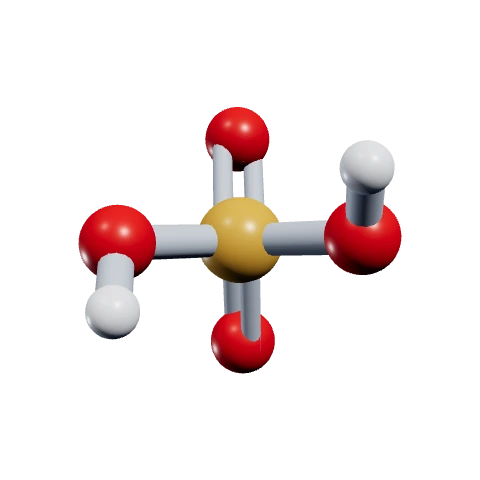


Sulfuric acid is the most-produced industrial chemical on Earth — roughly 280 million tonnes a year, more than ammonia, more than phosphoric acid, more than every chlorine derivative combined. The 96% ACS Grade variant is the reference standard: the concentration analytical chemists reach for when they need pure, fully characterized, exactly-spec'd H2SO4 for digestions, titrations, and quantitative work where the chemistry has to be perfect. This is the definitive reference for what 96% ACS Grade actually is, why it is 96% (not 98% or 100%), and how to use, handle, and source it.


What is sulfuric acid 96% ACS Grade?
Sulfuric acid 96% ACS Grade is concentrated H2SO4 at 96.0–98.0% assay, certified to the American Chemical Society analytical-reagent specification. The name carries three pieces of information at once: a chemical identity (sulfuric acid, the diprotic mineral acid with formula H2SO4), a concentration (96% by weight in water — practically the most concentrated form sold as a stable, characterized liquid), and a purity certification (ACS Reagent Chemicals spec, the highest commercial purity tier).
It is a dense, clear, colorless to very faintly yellow liquid with a thick, oily appearance — which is where the historical name oil of vitriol comes from. Modern synonyms still in active use include vitriol, hydrogen sulfate, dipping acid, and the trade nickname BOV (battery-of-vehicles, though 96% is too concentrated for direct battery use). The fuming variant — sulfuric acid charged with extra dissolved sulfur trioxide — is called oleum, and behaves as a distinct, even more reactive substance.
Identity reference.
Formula: H2SO4 CAS: 7664-93-9 MW: 98.08 g/mol UN: 1830 Class 8 (corrosive)
The "96%" is not an arbitrary number — it is the practical maximum stable concentration for the aqueous acid before behavior shifts toward the fuming oleum regime. Higher-purity figures you sometimes see on labels (97%, 98%) sit inside the same ACS Grade specification window of 96.0–98.0%, which is why the same SKU can be labeled and certified within that range without quality drift between batches.
Why 96%? The chemistry of concentrated H₂SO₄
Concentrated sulfuric acid is sold at 96% rather than 100% because pure H2SO4 is, surprisingly, harder to keep than the 96% dilution. The acid forms a maximum-boiling azeotrope with water at approximately 98.3% by weight, meaning a hot pure 100% acid will boil off water selectively and pull itself back toward ~98% until the azeotropic equilibrium is reached. The 96% commercial concentration sits comfortably below that azeotrope, is easy to manufacture by direct contact-process synthesis, and is stable in storage.
At 96%, almost every H2SO4 molecule still has the four percent water it needs for thermodynamic stability, but the molecule starts to express three chemical personalities at the same time. This is the trait that makes concentrated sulfuric acid different from every other common laboratory acid.
Donates two protons per molecule. The first dissociation (H2SO4 → H+ + HSO4−) is essentially complete; the second (HSO4− → H+ + SO42−) has pKa2 ≈ 1.99. This is the chemistry behind titration, pH adjustment, and salt-formation reactions.
Hot concentrated H2SO4 behaves as an oxidizing acid, generating SO2 gas as it dissolves copper, mercury, lead, and other metals that the dilute acid cannot touch. This is also why it digests organic matter for analytical Kjeldahl nitrogen determination.
Strips chemically bound water out of carbohydrates, alcohols, and even paper. The classic demo — dropping concentrated H2SO4 onto granulated sugar produces a column of pure black carbon — is a real chemical reaction (C12H22O11 + H2SO4 → 12C + 11H2O + H2SO4·H2O steam), not a curiosity.
If extra SO3 is dissolved into 100% H2SO4, the result is fuming sulfuric acid — oleum — labeled by free SO3 content (e.g. 20% oleum = 20% free SO3). Oleum is regulated separately, transported separately, and is not what you want unless a specific reaction calls for it.
Most laboratory protocols call for 96% (or, equivalently, 95–98% labeled stock) because the three personalities are all expressed at once, the density is exactly known (1.84 g/mL), and the molarity is reliably 18.0 mol/L. Recipes written against this concentration are reproducible across batches and suppliers in a way that less-concentrated stocks are not.
What does "ACS Grade" mean — and how is it different from Technical?
ACS Grade is the gold standard for analytical chemistry. The specification is maintained by the American Chemical Society Committee on Analytical Reagents and published in the volume Reagent Chemicals, now in its 12th edition. The point of the specification is that a reagent sold as "ACS Grade" carries an assay range and a list of trace-impurity ceilings tight enough that the reagent itself does not contribute meaningful error to an analytical measurement — even at parts-per-billion sensitivity.
For sulfuric acid 96% ACS Grade, the spec includes the following limits:
| Parameter | ACS Spec (96% H2SO4) | Typical Technical Grade |
|---|---|---|
| Assay (H2SO4) | 96.0 – 98.0% | 93 – 98% (loose) |
| Residue after ignition | ≤ 0.0005% | ≤ 0.05% |
| Chloride (Cl) | ≤ 0.0001% | ≤ 0.005% |
| Nitrate (NO3) | ≤ 0.00005% | not specified |
| Ammonium (NH4) | ≤ 0.0002% | not specified |
| Heavy metals (as Pb) | ≤ 5 ppm | ≤ 50 ppm |
| Iron (Fe) | ≤ 0.0001% | ≤ 0.005% |
| Mercury (Hg) | ≤ 5 ppb | not specified |
| Reducing substances | passes test | not specified |
Practically, this means the ACS Grade is the right reagent for analytical digestion of soil and biological samples for ICP-MS, the right titrant standard, the right Kjeldahl-block acid, and the right vehicle for sample-prep work where any trace iron or chloride would distort the result. Technical Grade sulfuric is fine — and significantly cheaper — for pickling, drain cleaning, pH control of process water, fertilizer manufacture, and anywhere the trace-element profile of the reagent is not part of the measurement. The wrong direction to economize is to substitute Technical Grade into an analytical workflow; the right direction is to substitute Technical Grade into industrial work that does not need ACS performance.
When ACS Grade is mandatory. Kjeldahl nitrogen, ICP-MS sample digestion, trace-metal analysis, USP/EP/JP pharmaceutical-water testing, semiconductor pre-clean (often together with hydrogen peroxide in piranha), and any titration where the standard itself is being calibrated. If trace impurities in the acid would land inside the analytical signal window, ACS Grade is required.
How dense is sulfuric acid 96%? Density, specific gravity, and why it matters
Sulfuric acid 96% has a specific gravity of 1.84 g/mL at 25 °C — about 84% denser than water and one of the densest common liquid reagents in a working laboratory. The density carries practical consequences that touch shipping, dilution math, spill response, and personal injury risk all at once.
The first practical consequence is that, for sulfuric acid, weight matters more than volume. A 5-gallon pail of 96% H2SO4 weighs about 79 lb (without the pail), where a 5-gallon pail of water weighs 42 lb — almost double. Hazmat freight quotes, secondary-containment sizing, and forklift attachment ratings all need to be planned against the acid weight, not the water-equivalent volume.
| Concentration | Specific gravity (25 °C) | Molarity | Weight of 1 gallon |
|---|---|---|---|
| 10% | 1.066 g/mL | 1.09 M | 8.89 lb |
| 30% | 1.219 g/mL | 3.73 M | 10.17 lb |
| 37% (battery) | 1.280 g/mL | 4.83 M | 10.68 lb |
| 50% (electrolyte) | 1.395 g/mL | 7.11 M | 11.64 lb |
| 70% | 1.611 g/mL | 11.50 M | 13.44 lb |
| 93% (technical) | 1.831 g/mL | 17.36 M | 15.28 lb |
| 96% (ACS) | 1.836 g/mL | 17.97 M | 15.32 lb |
| 98% | 1.836 g/mL | 18.34 M | 15.32 lb |
Notice the density plateau between 93% and 98%: above ~93%, additional H2SO4 content barely moves the density needle — meaning a hydrometer cannot reliably distinguish 93% from 96% from 98% acid. This is also why every concentrated-acid quality measurement past 93% has to be done by titration assay, not specific gravity.
The second practical consequence is the dilution rule. Concentrated sulfuric releases roughly 95 kJ per mole when diluted into water — a strongly exothermic event. If water is poured into the acid, the small water layer floats on the much denser acid, absorbs the heat of dilution, and instantly boils. Steam carries droplets of concentrated acid back up at the face. Always add acid to water, slowly, with stirring, and never the reverse. The density chemistry is the reason this rule is non-negotiable.
Never add water to acid. Density layering plus exothermic dilution equals a boiling steam burst of concentrated sulfuric at face level. Always pour acid into water; the heat is absorbed safely by the larger water mass below.
What is the pH of sulfuric acid 96%?
Sulfuric acid 96% is so concentrated that the everyday pH concept barely applies — it operates in a regime called the Hammett acidity function (H0) instead of the familiar pH scale. The Hammett scale was developed in the 1930s precisely because chemists needed to describe acids that are stronger than pure water can express on the standard 0-to-14 pH range.
For practical numbers: pure 96% sulfuric acid has a Hammett acidity of H0 ≈ −11.0. The H0 value is conceptually the equivalent of a pH for very strong acids: an H0 of −11 means the acid is roughly 1011 times more acidic, in proton-donating ability, than a 1 molar HCl solution that sits at H0 ≈ 0. This is the acidity regime that protonates compounds that water cannot — alkenes, alcohols, and even some hydrocarbons — which is how concentrated sulfuric drives Friedel-Crafts-type chemistry, alkylation reactions in petroleum refining, and the dehydration reactions that turn sugar into carbon.
For dilute working solutions, the familiar pH scale comes back, and the numbers are predictable:
| Dilution from 96% stock | Approximate molarity | Approximate pH |
|---|---|---|
| 1:10 dilution | 1.8 M | ~ −0.3 |
| 1:100 dilution | 0.18 M | ~ 0.5 |
| 1:1,000 dilution | 0.018 M (1.8 × 10⁻²) | ~ 1.5 |
| 1:10,000 dilution | 1.8 × 10⁻³ M | ~ 2.5 |
| 1:1,000,000 dilution | 1.8 × 10⁻⁵ M | ~ 4.5 |
The first dissociation of H2SO4 is functionally complete in any dilute solution. The second dissociation (HSO4− → H+ + SO42−) has pKa2 ≈ 1.99, so it only contributes meaningfully when the bulk pH is above about 2 — which is why the dilute-pH numbers above are slightly higher than naive single-proton math would predict.
What is sulfuric acid 96% ACS Grade used for? Six applications
Sulfuric acid is sometimes called the Queen of Acids, a name that goes back to 18th-century European chemistry and still applies for a reason: a country's per-capita sulfuric acid consumption tracks closely with its level of industrialization. About half of all H2SO4 produced ends up in phosphate fertilizer, but the rest spreads across nearly every chemical-driven industry on Earth. The 96% ACS Grade specifically — the analytical-purity tier — concentrates in six applications where reagent purity matters.
1. Analytical digestion and Kjeldahl nitrogen
The classical method for determining nitrogen in food, soil, and biological samples is Kjeldahl digestion: heat the sample in concentrated H2SO4 with a catalyst (CuSO4 or K2SO4) until all organic nitrogen is converted to ammonium sulfate. The chemistry only works at very high acid concentration, very high temperature (~370 °C with K2SO4 boiling-point elevation), and the trace-element profile of the acid has to be tighter than the detection limit downstream. This is the textbook ACS Grade application.
2. Acid-base titration as primary or secondary standard
Sulfuric acid at 96% ACS Grade is used to prepare 0.1 N and 1.0 N titration standards. The dilution math is straightforward (1 mL of 96% acid into a 1 L flask gives approximately 0.018 M H2SO4 ≈ 0.036 N), and the assay range is tight enough that the prepared standard does not need additional standardization against sodium carbonate for most undergraduate and quality-control work.
3. Piranha solution for semiconductor and glassware cleaning
"Piranha" — a 3:1 mix of concentrated H2SO4 with 30% hydrogen peroxide — is the standard wet-clean for removing organic residues from silicon wafers and laboratory glass. It is dangerously reactive: ACS Grade matters here not for analytical reasons but for trace-metal cleanliness, because the goal is to leave the surface free of contaminants. Piranha solution is freshly prepared, used once, and never stored in a sealed container.
4. Petroleum refining and alkylation
Concentrated sulfuric acid is the catalyst in alkylation, the refining step that combines small unsaturated hydrocarbons into branched-chain gasoline-range molecules. The reaction happens because at H0 ≈ −11 the acid is strong enough to protonate alkenes — generating the carbocations that drive the carbon-carbon bond formation. This is a Technical-Grade application at industrial scale but ACS Grade at refinery-laboratory scale for catalyst-quality control.
5. Metal pickling, anodizing, and surface preparation
Sulfuric acid is the workhorse acid in steel mill pickling, sulfuric anodizing of aluminum (the Type II anodize process that produces a transparent oxide layer for hard-coating), and copper-foil etching for PCB manufacture. Concentration varies by application (15% for sulfuric anodize, 5–10% for steel pickling), all derived by dilution from 93–96% stock. For analytical control of the bath chemistry, ACS Grade is used as the titration standard.
6. Battery electrolyte refining
Lead-acid battery electrolyte is sulfuric acid at 30–37% (the specific gravity range 1.220–1.280) and is manufactured by diluting concentrated stock with deionized water. Pure 96% ACS Grade is not the right product to pour directly into a battery — that would destroy the plates. The right product is the pre-blended Sulfuric Acid 37% Battery Acid or, for forklift and stationary cells, the Sulfuric Acid 50% Electrolyte Grade. The 96% ACS material in this category is reserved for the analytical lab that measures and verifies battery electrolyte quality.
Don't pour 96% into a battery. If you arrived at this article looking for battery-acid refill, the right products are 37% (most automotive) or 50% (forklift / stationary). See our battery-acid deep dive for the chemistry behind why.
How do you safely handle and neutralize sulfuric acid?
Sulfuric acid 96% is a class-8 corrosive that causes severe chemical burns on contact, generates substantial heat on dilution, and reacts violently with reducing agents (especially metals, organic peroxides, and chlorate salts). The handling protocol is well-developed, and a properly equipped lab works with concentrated sulfuric routinely and safely — but every step matters.
Personal protective equipment
The minimum PPE for handling 96% sulfuric acid in any volume is: chemical splash goggles plus a face shield, a chemical-resistant apron or full body suit, chemical-resistant gloves (nitrile rubber is adequate for short exposures; butyl rubber or Viton is preferred for sustained handling), closed-toe shoes, long pants. A laminar-flow fume hood or local exhaust is required for any operation that generates fumes — diluting acid in air, heating with the acid, mixing with organic solvent. Eyewash and safety shower must be functional and within 10 seconds of the work.
Storage
Store in the original tightly-closed polyethylene-lined drum, pail, or glass bottle, in a cool dry area, with secondary containment sized to capture the full primary volume. Keep away from metals (especially zinc, aluminum, alkali metals), reducing agents, organic peroxides, water leaks or condensation drip points, and any reactive nitrogen source (nitrates, nitrites, ammonia compounds). Concentrated sulfuric attacks concrete slowly; a polyethylene or HDPE secondary-containment pan is the standard solution.
Spill response (the HowTo procedure)
The sequence below is the standard small-spill protocol for sulfuric acid in a lab environment. For large industrial spills (>5 gallons), the appropriate response is evacuation and HazMat-team activation, not in-house cleanup.
Do not use water alone on a concentrated acid spill. The exotherm of dilution will heat the puddle to boiling and atomize droplets. The correct sequence is dry containment, controlled neutralization with a buffered base, then water rinse — in that order.
The correct neutralizer for sulfuric acid spills is sodium bicarbonate (baking soda) or sodium carbonate (soda ash). Both react with H2SO4 to produce sodium sulfate, water, and carbon dioxide:
Lime (Ca(OH)2) is sometimes used in industrial settings but produces calcium sulfate (gypsum), which is poorly water-soluble and clogs drains; bicarbonate is preferred for indoor spills. Sodium hydroxide is technically correct but releases too much heat and risks splash-back; it should be avoided for acid neutralization in spill response.
First aid
Skin contact: immediately flush the affected area with copious water for at least 15 minutes; remove contaminated clothing during flushing. Eye contact: flush with eyewash for at least 15 minutes, holding eyelids open. Inhalation: move to fresh air. Ingestion: do not induce vomiting; rinse mouth with water, drink water or milk to dilute, seek emergency care immediately. All meaningful exposures should be evaluated by emergency medicine — sulfuric acid burns can continue developing for hours after the visible reaction stops.
Sulfuric vs hydrochloric vs nitric — which acid for which job?
The three workhorse strong mineral acids have overlapping but distinct chemistries, and choosing the right one for a given application is one of the most common questions in laboratory and industrial chemistry. Sulfuric and hydrochloric are both strong-acid proton donors at dilute concentrations, but they diverge on volatility, oxidizing power, and side-chemistry. Nitric acid is the odd one out — a strong proton donor, a powerful oxidizer at concentration, and the only one of the three that can dissolve silver and copper outright.
| Property | H2SO4 96% | HCl 37% | HNO3 70% |
|---|---|---|---|
| Strength (pKa1) | ~ −3 | ~ −7 | ~ −1.4 |
| Protons per molecule | 2 (diprotic) | 1 | 1 |
| Volatility | Non-volatile (BP 337 °C) | Highly volatile (HCl gas) | Volatile (red-brown NO2 fumes) |
| Oxidizer behavior | Hot conc. only | No | Yes, even cold |
| Dehydrating power | Strong | None | Weak |
| Best at | Digestion, titration, dehydration, pickling, fertilizer | Etching, descaling, pH control, food acid | Metal dissolution, nitration, aqua regia, fertilizer |
| Avoid for | Reactive metals (Zn, Al at conc.) | Stainless steel pitting | Organics (oxidizing risk) |
The rule of thumb: choose sulfuric when you need protons without volatile loss (titration standards, fertilizer manufacture, dehydration, sustained heating in an open beaker); choose hydrochloric when you need a clean proton donor that washes out without trace residue (food-grade pH control, glass etching, swimming pool chemistry); choose nitric when you need to oxidize as well as protonate (dissolving copper, silver, or noble metals; preparing nitrate salts; making ammonium nitrate).
How to buy sulfuric acid 96% ACS Grade
Alliance Chemical ships Sulfuric Acid 96% ACS Grade in 16 pack configurations, from a 1-quart amber-glass laboratory bottle to a 330-gallon IBC tote for industrial-scale users. Every container ships with a Safety Data Sheet (SDS) compliant with OSHA HazCom 2012 and DOT-compliant labeling for class-8 corrosive freight; the current Certificate of Analysis is on request at no charge. All sulfuric-acid shipments move by ground only — air transport of class 8 above limited quantity is prohibited.
| Pack size | Container | Net weight (approx.) | Best for |
|---|---|---|---|
| 1 quart | Amber glass bottle | ~ 2 lb acid | Bench analysis, titration standards |
| 1 gallon | HDPE container | ~ 15 lb acid | Routine lab work, small QA shop |
| 4 × 1 gallon case | Cube with safety inserts | ~ 61 lb acid | Mid-volume lab, monthly draw |
| 5 gallon pail | HDPE pail with vented lid | ~ 79 lb acid | Production analytical, multi-bench labs |
| 15 gallon drum | HDPE drum | ~ 237 lb acid | Large lab, R&D, anodizing-bath makeup |
| 55 gallon drum | HDPE drum | ~ 871 lb acid | Pilot plant, industrial QA |
| 275 gallon IBC tote | HDPE/PE in steel cage | ~ 4,355 lb acid | Production-scale industrial users |
| 330 gallon IBC tote | HDPE/PE in steel cage | ~ 5,225 lb acid | Plant-scale users with closed-system dispense |
For most laboratory needs the 4-gallon case or 5-gallon pail is the practical sweet spot — enough working stock to last a quarter without expiry, small enough to handle by hand, and packaged to ship safely as standard ground hazmat. For analytical applications where pack-to-pack lot consistency matters, the 1-gallon size from a single lot can be specified and locked at order time.
Sulfuric Acid 96% ACS Grade — In Stock
1 quart to 330-gallon IBC tote. ACS Reagent specification. SDS shipped with every order; COA on request, no charge. Ground hazmat to all 48 states.
Shop Sulfuric Acid 96% ACSRelated: Sulfuric Acid in Lithium-Ion Battery Recycling — the high-purity grade for recycling QC.
Concentrations & grades: Sulfuric Acid Concentrations (30–96%) Guide
Applications: Sulfuric Acid in Semiconductor Fabrication • Concrete Stain Removal with 93% Sulfuric • Sulfuric Acid Anodizing (Type II)
Battery & recycling: Battery Acid (37% Sulfuric): What It Is • Battery Acid vs. Battery Water • Where to Find Battery Acid • Sulfuric Acid in Lead-Acid Battery Recycling • Sulfuric Acid in Li-Ion Battery Recycling
Safety & handling: Safer Sulfuric Acid Storage • How to Neutralize a Sulfuric Acid Spill • How to Read a Safety Data Sheet (SDS)
Shop & documents: Shop Sulfuric Acid — all grades & sizes • Sulfuric Acid Safety Data Sheets (SDS)
Sourcing for this job? See our sulfuric acid supplier page — every grade and strength we stock, with live pricing from quarts through drums and totes.
Related: Sulfuric Acid Supply Crisis 2026: Why the King of Chemicals Is Getting Tighter — the 2026 sulfur supply shock and what it means for buyers.
Related: Sulfuric Acid in Vanadium Flow Batteries — how sulfuric acid serves as the electrolyte in grid-scale vanadium redox flow batteries.
References & Authoritative Sources
Primary sources consulted for this article. Regulatory and physical-property figures above are drawn from these references.
- Sulfuric acid (CAS 7664-93-9) — compound summary — PubChem, National Center for Biotechnology Information. Accessed 2026-09-02.
- Sulfuric acid — thermochemical and phase data — NIST Chemistry WebBook, SRD 69. Accessed 2026-09-02.
- 49 CFR 172.101 — Hazardous Materials Table (UN numbers, hazard classes and packing groups) — Electronic Code of Federal Regulations, U.S. Department of Transportation. Accessed 2026-09-02.
- 29 CFR 1910.1200 — Hazard Communication (GHS hazard classification, labels and safety data sheets) — Electronic Code of Federal Regulations, Occupational Safety and Health Administration. Accessed 2026-09-02.
- 29 CFR 1910.1000 — Air contaminants (Tables Z-1, Z-2 and Z-3 permissible exposure limits) — Electronic Code of Federal Regulations, Occupational Safety and Health Administration. Accessed 2026-09-02.
Key numbers and sources
| Fact | Value | Source |
|---|---|---|
| Chemical formula | H 2 SO 4 | pubchem.ncbi.nlm.nih.gov |
| CAS number | 7664-93-9 | pubchem.ncbi.nlm.nih.gov |
| Molar mass | 98.08 g/mol | pubchem.ncbi.nlm.nih.gov |
| Specific gravity (25 °C) | 1.836 g/mL | webbook.nist.gov |
| Assay (ACS Grade) | 96.0–98.0% | See article text |
| Iron (Fe) maximum (ACS Grade) | ≤ 0.0001% | See article text |
| DOT UN number | 1830 | ecfr.gov |
Related: Who Wins the 2026 Chemistry Nobel? Three Picks, and the One Made on a Bench — sulfuric acid in surface preparation, and the 2026 Nobel pick built on clean substrates.
Related: Piranha Solution: Ratio, How It Works, Mixing Order, PPE and Disposal (Sulfuric Acid + 30% Hydrogen Peroxide) — the full piranha guide: ratio, mixing order, PPE and disposal.
Frequently asked questions
Is sulfuric acid 96% the same as 98% sulfuric acid?
For most practical purposes, yes — the ACS Reagent specification for sulfuric acid covers an assay range of 96.0–98.0%, and product within that window all qualifies as ACS Grade. The density, molarity, and chemistry are essentially identical across that range. Above 98% you enter the azeotrope region; above 100% you enter oleum territory, which is a distinct product class.
What is the pH of 96% sulfuric acid?
The standard pH scale does not apply to acids at 96% concentration; instead the Hammett acidity function H₀ ≈ −11 is used. For practical dilutions, a 1:10 dilution of 96% acid gives roughly 1.8 M and pH ≈ −0.3, a 1:100 dilution gives ~0.18 M and pH ≈ 0.5, and a 1:10,000 dilution gives ~2.5.
Can I dilute 96% sulfuric acid down to make battery acid?
Technically yes (battery acid is just 30–37% sulfuric), but it is rarely the right approach. The exotherm of diluting 96% acid down to 37% is substantial, requires careful temperature control and gradual addition with stirring, and demands chemically pure makeup water. For battery applications it is faster, safer, and cheaper to buy Sulfuric Acid 37% Battery Acid directly — the dilution work is already done correctly.
What is the difference between ACS Grade and Reagent Grade sulfuric acid?
In modern usage the terms are often used interchangeably — both refer to the American Chemical Society Reagent specification. Technically "ACS Reagent" is the certified spec name; "ACS Grade" is the marketing label used to indicate compliance. Either label, applied to sulfuric acid 96%, points to the same impurity ceilings: assay 96.0–98.0%, residue ≤0.0005%, iron ≤0.0001%, chloride ≤0.0001%.
Why does the density of sulfuric acid not change from 93% to 96%?
Above about 92% concentration the density curve flattens dramatically — moving from 93% to 96% to 98% changes the specific gravity from 1.831 to 1.836 to 1.836 g/mL. The implication is that a hydrometer cannot reliably distinguish between concentrated acids in that range; quality measurement requires titration assay instead. The flattening reflects the limited additional packing density of H₂SO₄ molecules once water is largely displaced.
How do I neutralize a sulfuric acid spill?
For small lab spills (under 1 liter), apply dry sodium bicarbonate or sodium carbonate to the spill, allowing it to absorb and neutralize. The reaction releases CO₂ as harmless effervescence. Once bubbling has ceased and the spill area tests neutral with pH paper, mop up with water and dispose as chemical waste. Never use water alone — the exotherm of dilution can boil the puddle and atomize acid droplets. For large spills (>5 gallons), evacuate and call a hazmat response team.
Is sulfuric acid 96% an oxidizing acid?
Yes, but only when hot and concentrated. Cold 96% sulfuric acid behaves primarily as a strong proton donor (the diprotic acid personality). When heated above about 200 °C, the same acid becomes a powerful oxidizer that liberates SO₂ as it dissolves copper, mercury, and other unreactive metals. The dual behavior — proton donor when cold, oxidizer when hot — is the chemical hallmark of concentrated sulfuric acid.
What is the molarity of 96% sulfuric acid?
Sulfuric acid 96% with specific gravity 1.836 g/mL and molecular weight 98.08 g/mol works out to a molarity of approximately 18.0 mol/L. This figure is the standard reference for dilution math; to make a 1.0 M working solution, slowly add 55.6 mL of 96% acid into roughly 800 mL of cold deionized water, allow to cool, then dilute to 1.0 L final volume.
Related Chemical Collections
About the author
Andre Taki
This article is for informational purposes only.


