

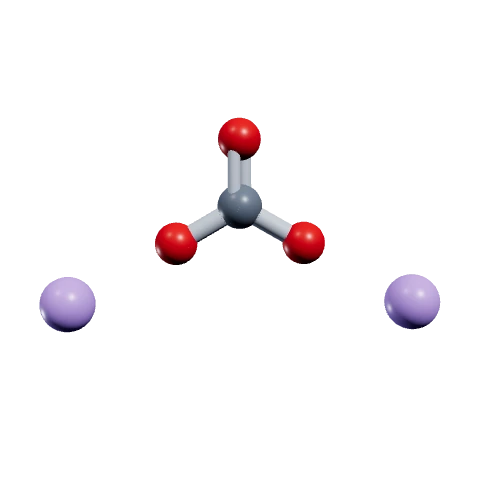


Soda ash is sodium carbonate (Na₂CO₃), a white, odorless powder with a strongly alkaline pH of about 11.4 in a 1% solution. It is also sold under the names washing soda and sal soda. According to the U.S. Geological Survey, of the soda ash consumed in the U.S. in 2025, glass took 45 percent, followed by chemicals at 28 percent, soap and detergents at 5 percent, flue gas desulfurization at 4 percent, and pulp, paper and water treatment at about 1 percent each. The remaining 16 percent is miscellaneous uses (9 percent) and sales through distributors (7 percent).
If you are looking for a clear explanation of what soda ash does, how to dose it correctly for specific applications, and what grade to buy, this guide covers the subject without unnecessary complexity. Alliance Chemical supplies technical-grade soda ash in bulk for industrial, water-treatment, and craft applications.
What Is Soda Ash?
Soda ash is the industry name for anhydrous sodium carbonate, Na₂CO₃ (CAS 497-19-8), a white alkaline powder that dissolves in water to about pH 11.4. So yes, soda ash and sodium carbonate are the same compound; "soda ash" usually means the dry, water-free form sold in bags for glassmaking, water treatment, pools and dyeing.
What is the chemical formula of soda ash?
The chemical formula of soda ash is Na₂CO₃: two sodium ions (Na⁺) for each carbonate ion (CO₃²⁻), molar mass 105.99 g/mol. It is sometimes typed as "NaCO3", which is wrong; carbonate carries a 2− charge, so it takes two sodium ions to balance it. The crystal form sold as sal soda is the decahydrate, Na₂CO₃·10H₂O (CAS 6132-02-1).
Sodium carbonate is an inorganic salt produced commercially through two primary methods: the Solvay process (synthetic) and trona ore mining (natural). The United States is the world's largest producer of natural soda ash, with major deposits in Wyoming's Green River Basin. Natural soda ash is generally preferred for its lower environmental footprint compared to synthetic production.
Where does soda ash come from? All U.S. soda ash is natural. In 2025, four companies ran five plants on Wyoming trona ore and one company ran a plant on California lake brine, producing about 12 million metric tons, more than half of it exported (USGS Mineral Commodity Summaries 2026). The Green River Basin holds the world's largest known trona deposit. China is the largest producer overall, at about 38 million tons in 2025, most of it synthetic.

Key Chemical Properties
- Chemical formula: Na₂CO₃
- Molecular weight: 105.99 g/mol
- Appearance: white, granular powder
- pH in solution: about 11.4 (1% solution, 11.37 at 25°C)
- Solubility in water: 21.5 g per 100 mL at 20°C
- Melting point: 851°C (1564°F)
- CAS number: 497-19-8
Soda ash is hygroscopic, meaning it absorbs moisture from the air. In humid conditions, it can form lumps or convert partially to sodium carbonate decahydrate (washing soda crystals). Proper sealed storage prevents this.
Soda Ash vs. Washing Soda vs. Baking Soda
Is soda ash the same as baking soda? No. Soda ash is sodium carbonate (Na₂CO₃); baking soda is sodium bicarbonate (NaHCO₃). A 1% soda ash solution is about pH 11.4, while baking soda solution is about pH 8.3, a gap of three pH units, which means more than 1,000 times the hydroxide concentration. Washing soda is sodium carbonate too, usually meaning the crystal decahydrate.
These three names create persistent confusion. Here is the clear distinction:
| Property | Soda Ash | Washing Soda | Baking Soda |
|---|---|---|---|
| Chemical name | Sodium carbonate (anhydrous) | Sodium carbonate decahydrate | Sodium bicarbonate |
| Formula | Na₂CO₃ | Na₂CO₃·10H₂O | NaHCO₃ |
| CAS number | 497-19-8 | 6132-02-1 | 144-55-8 |
| Molar mass | 105.99 g/mol | 286.14 g/mol (63% water) | 84.01 g/mol |
| pH in solution | 11.37 (1%, 25°C) | Same carbonate chemistry; a 1% solution by weight is weaker, since 63% of the crystal is water | 8.3 (0.1 M, 25°C) |
| Appearance | Fine white powder | Larger crystalline form | Fine white powder |
| Best uses | Tie-dye, pool pH, industrial | Laundry, household degreasing | Baking, mild cleaning |
Is washing soda the same as soda ash? Chemically, yes: both are sodium carbonate. The Merck Index uses "sal soda" and "washing soda" for the decahydrate crystal, Na₂CO₃·10H₂O, which is 63% water by weight, so it takes about 2.7 g of crystals to deliver the sodium carbonate in 1 g of soda ash. Some products sold as washing soda are the anhydrous powder; the formula on the SDS tells you which one you have.
Can I make my own soda ash?
Yes. Heat baking soda (sodium bicarbonate) above 100°C and it turns into soda ash, giving off water and carbon dioxide (2 NaHCO₃ → Na₂CO₃ + H₂O + CO₂). The Merck Index puts the onset at about 50°C and full conversion at 100°C; OECD data give complete decomposition at 270°C. By molar mass, 100 g of baking soda yields about 63 g of soda ash.
Is soda ash the same as borax or OxiClean?
No to both. Borax is sodium tetraborate decahydrate (Na₂B₄O₇·10H₂O), a boron compound with a milder pH of about 9.2. OxiClean Versatile Stain Remover is a mixture: its safety data sheet lists 55 to 70% sodium carbonate (soda ash) and 30 to 40% sodium percarbonate, which splits in water into sodium carbonate and hydrogen peroxide.
| Product | Chemistry | CAS | pH (1%) | Hazard class (GHS) |
|---|---|---|---|---|
| Soda ash | Na₂CO₃ | 497-19-8 | 11.37 | Warning, H319 eye irritation |
| Borax | Na₂B₄O₇·10H₂O | 1303-96-4 | 9.2 | Danger, H360FD reproductive toxicity (EU harmonized) |
| Sodium percarbonate (oxygen bleach) | 2Na₂CO₃·3H₂O₂ | 15630-89-4 | — | Danger; H272 oxidizer, H302, H318 (per the OxiClean SDS) |
What is the pH of sodium carbonate?
Sodium carbonate solutions are strongly alkaline: pH 11.37 at 1%, 11.58 at 5% and 11.70 at 10% by weight, all at 25°C (Kirk-Othmer, via PubChem). The pH climbs only slowly with concentration because carbonate is a weak base, which makes soda ash a controllable alkali for pools and dye baths.
Solubility rises steeply with temperature: about 6.4, 9.3, 20.5 and 39 g per 100 g of water at 0, 10, 20 and 30°C (Kirk-Othmer, converted from 6, 8.5, 17 and 28 wt%), and 30.7 g per 100 g at 25°C (CRC Handbook). Warm water dissolves a tie-dye or pool dose much faster than cold.
How Much Soda Ash for Tie-Dye?
For fiber-reactive dyes (Procion MX and similar), soda ash is the chemical that drives the covalent bond between dye and cellulose fiber. Without it, color washes out within a few launderings. The standard pre-soak is straightforward:

The chemistry: soda ash raises the pH of the pre-soak to roughly 11.5 (1 cup per gallon is about a 6% solution; a 5% solution is pH 11.58 at 25°C), which deprotonates the hydroxyl groups in cellulose and lets the dye molecule chemically bond to the fiber. At lower pH, dyes can only deposit on the surface — they wash out.
- Water temperature: warm (80-100°F) dissolves soda ash faster; cold water works but takes longer
- Soak time: 15-20 minutes is the sweet spot; longer doesn't help and can weaken some fabrics
- Wear gloves: at pH 11.5 prolonged contact dries skin
- Reuse the solution: save and re-use the soak for 2-3 batches before pH starts to drift
How Much Soda Ash to Raise Pool pH?
What does soda ash do to a pool? It raises the pH, and it raises total alkalinity along with it, because it adds carbonate. Baking soda raises total alkalinity with a much smaller pH change, so pool operators use soda ash when pH is low and baking soda when alkalinity is low. To bring pH down instead, see how to lower pool pH with muriatic acid.
Soda ash is the standard chemical for raising pool pH when readings drop below 7.2. It works fast and at much lower doses than sodium bicarbonate would require for the same pH shift.

| Pool Size | Dose for +0.2 pH | Dose for +0.4 pH | Notes |
|---|---|---|---|
| 10,000 gal | 6 oz (170 g) | 12 oz (340 g) | Average residential |
| 15,000 gal | 9 oz (255 g) | 18 oz (510 g) | Larger residential |
| 20,000 gal | 12 oz (340 g) | 24 oz (680 g) | Large residential / small commercial |
| 30,000 gal | 18 oz (510 g) | 36 oz (1.0 kg) | Commercial / community |
Other Common Uses for Soda Ash
How do you use soda ash in laundry?
Dissolve about 1/2 cup of soda ash in warm water and add it with your detergent at the start of the wash. It raises the wash-water pH and ties up the calcium and magnesium in hard water as insoluble carbonates, so the detergent works on soil instead of on minerals.
Wear gloves when handling the powder or strong solutions: sodium carbonate is classified as an eye irritant (GHS H319), and alkaline solutions dry skin. Keep it away from aluminum, which alkaline solutions attack.
How Do You Safely Handle Soda Ash?
Soda ash is a mild irritant — far less aggressive than caustic soda (sodium hydroxide) but still warrants basic precautions. The powder is a respiratory and eye irritant; in solution, prolonged skin contact will cause dryness and irritation.
Is soda ash toxic? It is classified as a hazardous chemical, but a mild one: the EU harmonized GHS classification is Warning, H319 (causes serious eye irritation). There is no substance-specific OSHA PEL or NIOSH REL; the dust falls under OSHA's limits for particulates not otherwise regulated, 15 mg/m³ total dust and 5 mg/m³ respirable fraction (29 CFR 1910.1000, Table Z-1). Read the SDS before handling.
- Gloves: nitrile or rubber for handling solutions; cotton/leather for handling dry powder
- Eye protection: safety glasses for pouring or scooping
- Respiratory: avoid creating dust; use an N95 if scooping bulk quantities
- Spills: sweep up dry powder; mop up solution with plenty of water
- Storage: sealed container in a dry location; indefinite shelf life
- Disposal: dilute solutions can usually be drain-disposed (check local regs); large quantities require hazardous-waste handling
What Grade of Soda Ash Should You Buy?
Most applications need only technical grade (95-99% pure Na₂CO₃). Higher purity grades exist (USP, reagent) but are unnecessary outside of pharma or precision analytical work.
| Grade | Purity | Typical Use | Cost Indicator |
|---|---|---|---|
| Technical / industrial | 95-99% | Tie-dye, pool, laundry, water treatment, soap | $ — standard supply |
| Food grade | ≥99.0% | Cocoa Dutch-processing, regulated food production | $$ |
| USP / reagent | ≥99.5% | Pharmaceutical, lab analytical work | $$$$ |
Alliance Chemical supplies natural-source technical-grade soda ash in 2 lb and 5 lb packs and 50 lb bags, up to 40-bag (2,000 lb) lots. Need the Certificate of Analysis? Just ask, we send it at no charge.
Ready to Order?
Alliance Chemical ships fast. Need the Certificate of Analysis? Just ask, we send it at no charge.
Shop Soda AshReferences & Sources
Related: Sodium Hydroxide in Direct Air Capture — how caustic soda pulls CO2 straight out of the air (the product the DAC-to-soda-ash route makes).
Key numbers and sources
| Fact | Value | Source |
|---|---|---|
| Chemical formula | Na₂CO₃ | See article text |
| CAS number | 497-19-8 | See article text |
| Molecular weight | 105.99 g/mol | See article text |
| Melting point | 851°C | See article text |
| pH (1% solution) | 11.37 at 25°C | pubchem.ncbi.nlm.nih.gov |
| Solubility in water at 20°C | 21.5 g per 100 mL | See article text |
| Percentage of US soda ash used in glass manufacturing | 45% (2025); earlier EPA profile ~47% | usgs.gov; epa.gov |
| US soda ash production, 2025 | ~12 million metric tons | usgs.gov |
| GHS classification (EU harmonized) | Warning, H319 | pubchem.ncbi.nlm.nih.gov |
Related: Soda Ash and Boric Acid Come Out of the Same Lake — the market-structure story behind the sodium carbonate you buy.
Related: Lake Erie Is Green Again. Did the Phosphate Ban Fail? — soda ash as the phosphorus-free builder that replaced phosphate in consumer cleaners.
Frequently asked questions
Is soda ash the same as baking soda?
No. Soda ash is sodium carbonate (Na₂CO₃); baking soda is sodium bicarbonate (NaHCO₃). A 1% soda ash solution is about pH 11.4 (11.37 at 25°C), while baking soda solution is about pH 8.3. That three-unit gap means soda ash delivers more than 1,000 times the hydroxide concentration. They are not interchangeable without changing the dose, and baking soda cannot reach the pH that tie-dye fixation needs.
What is the chemical formula of soda ash?
Soda ash is sodium carbonate, chemical formula Na₂CO₃, CAS 497-19-8, molar mass 105.99 g/mol. Each carbonate ion carries a 2− charge, so it pairs with two sodium ions; "NaCO3" is a common typo, not a real compound. The crystal form called sal soda or washing soda is the decahydrate, Na₂CO₃·10H₂O, CAS 6132-02-1, which is 63% water by weight.
Is washing soda the same as soda ash?
Chemically, yes. Both are sodium carbonate. Chemistry references use washing soda and sal soda for the decahydrate crystal, Na₂CO₃·10H₂O, which is 63% water, so about 2.7 g of crystals equals 1 g of soda ash. Some retail washing soda is the anhydrous powder, the same as soda ash. Check the formula on the product's SDS to know which form you have and dose accordingly.
Is soda ash the same as borax or OxiClean?
No. Borax is sodium tetraborate decahydrate (Na₂B₄O₇·10H₂O), a boron compound with a pH of about 9.2 that the EU classifies as a reproductive toxicant. OxiClean Versatile Stain Remover is a mixture; its SDS lists 55 to 70% sodium carbonate and 30 to 40% sodium percarbonate, which releases hydrogen peroxide in water. Plain soda ash contains no peroxide and no boron.
Can I use baking soda instead of soda ash for tie-dye?
No. Baking soda does not raise the pH high enough for fiber-reactive dyes such as Procion MX to form permanent covalent bonds with cotton and other cellulose fibers. The result is pale color that washes out. You can convert baking soda to soda ash by heating it above 100°C, which drives off water and carbon dioxide, but buying soda ash is simpler and gives a known strength.
How much soda ash do I need for tie-dye?
The standard ratio is 1 cup (8 oz, 227 g) of soda ash per 1 gallon of warm water. This makes a pre-soak of roughly pH 11.5 (a 5% solution is pH 11.58 at 25°C), high enough for fiber-reactive dyes to bond to cellulose. Soak the garments, wring them out without rinsing, then apply dye to the damp fabric. One gallon of solution is enough for about 10 to 12 adult XL t-shirts.
How much soda ash do I need to raise pool pH?
Use about 6 ounces (170 g) of soda ash per 10,000 gallons of pool water to raise pH by roughly 0.2 units. Soda ash raises total alkalinity along with pH, so test both. Always pre-dissolve it in a bucket of pool water before adding, broadcast it with the pump running, and retest after an hour of circulation before adding more.
Is soda ash safe to handle?
Soda ash is a mild but classified hazardous chemical. Its EU harmonized GHS classification is Warning, H319, causes serious eye irritation. There is no substance-specific OSHA PEL or NIOSH REL; the dust falls under OSHA's particulates-not-otherwise-regulated limits of 15 mg/m³ total and 5 mg/m³ respirable. Wear gloves and eye protection, avoid breathing the dust, and review the Safety Data Sheet before use.
Where does soda ash come from?
All U.S. soda ash is natural. According to the USGS, in 2025 four companies ran five plants on trona ore in Wyoming's Green River Basin, the world's largest known trona deposit, and one company ran a plant on California lake brine, producing about 12 million metric tons. Outside the U.S. and Turkey, most soda ash, including most of China's, is synthetic, made from salt and limestone.
Can soda ash damage my pool equipment?
At normal doses, pre-dissolved and added gradually, soda ash does not damage pool equipment. Adding too much at once creates localized high-pH zones that precipitate calcium carbonate, which clouds the water and, in hard water, can leave scale. Add in small steps, keep the pump running, and retest pH and total alkalinity between additions.
What is the shelf life of soda ash?
Soda ash keeps indefinitely in a sealed container in a dry place. It does not break down chemically in storage. The concern is moisture: soda ash is hygroscopic and can absorb about 15% water from air to form the monohydrate, which causes clumping and slightly lowers the sodium carbonate content per scoop. Keep bags closed and off damp floors.
Can I use soda ash in my washing machine?
Yes. Dissolve about 1/2 cup of soda ash in warm water and add it with your detergent at the start of the wash. It raises the wash-water pH and binds the calcium and magnesium in hard water, which helps the detergent on greasy soil. Wear gloves when handling the powder, since sodium carbonate is classified as an eye irritant.
Related Chemical Collections
About the author
Andre Taki
This article is for informational purposes only.


