

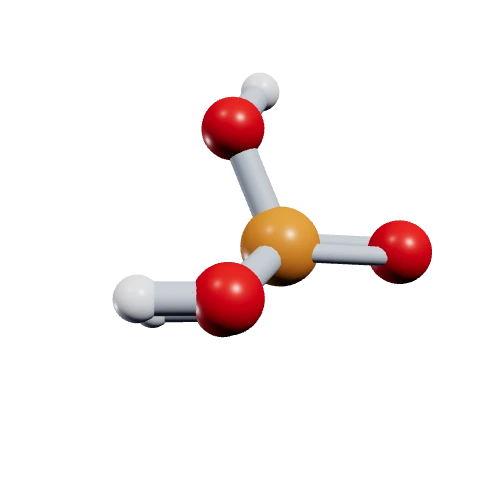


It is in the can of cola on your desk. It is in the rust converter on your garage shelf. And the same family of molecule — phosphate — sits at the heart of the lithium iron phosphate battery that may be powering your next electric car. Phosphoric acid is one of the most quietly versatile industrial chemicals on Earth, and it hides in plain sight across more industries than almost any other acid.
What is phosphoric acid, and what is it used for?
Phosphoric acid is a colorless, odorless inorganic acid with the chemical formula H₃PO₄, also called orthophosphoric acid. It is a medium-strength triprotic acid, meaning each molecule can donate three hydrogen ions in sequence, which is why it behaves so differently from a sharp single-proton acid like hydrochloric acid. That staged, buffered release of acidity is exactly what makes it useful for jobs where you want controlled, predictable chemistry rather than a violent reaction.
In practical terms, phosphoric acid does four big jobs in the real world: it converts and removes rust on steel, it acidifies food and beverages as additive E338, it supplies phosphorus for fertilizers and hydroponic nutrient solutions, and it is the chemical starting point for the phosphate compounds inside modern LFP batteries. It also descales boilers and heat exchangers, brightens and passivates aluminum, and serves as an electrolyte and catalyst in dozens of niche processes.
CAS: 7664-38-2 · Formula: H₃PO₄ · Molar mass: 97.99 g/mol · Dissociation constants: pKa₁ 2.15, pKa₂ 7.20, pKa₃ 12.35 · Food additive code: E338 · Appearance: clear, syrupy liquid at high concentration.
How is phosphoric acid made? Wet process vs. thermal process
Phosphoric acid is produced two ways, and the method determines the purity — which is exactly why grade matters so much downstream. The overwhelming majority of the world's supply comes from the wet process, in which mined phosphate rock (calcium phosphate) is digested with sulfuric acid. This is cheap and high-volume, and it is the route that feeds fertilizer production, but it leaves behind trace impurities that have to be cleaned up for higher grades.
The thermal process takes the opposite approach: elemental phosphorus is burned to phosphorus pentoxide, then hydrated to phosphoric acid. It costs more, but it yields a far purer product — the basis for food-, technical-, and reagent-grade material once further refined. When you see "Food Grade" or "ACS Grade" on a label, you are paying for the purification steps that strip the heavy metals and contaminants a raw wet-process acid would carry. That is the difference between an acid that can legally go into a soda and one that can only clean a boiler.
Phosphoric acid grades and concentrations: food, technical, and ACS
The right phosphoric acid is defined by two numbers and one word: the concentration (how much H₃PO₄ is in the water), the grade (how pure and how tightly specified it is), and the application. Buying "phosphoric acid" without those three is how people end up with food-grade acid for a job that only needed technical, or technical acid for a job that legally required food grade.
| Grade | What it guarantees | Typical jobs | Concentrations we stock |
|---|---|---|---|
| Food Grade (USP/FCC) | Meets food-additive purity (E338) per USP/FCC; low heavy-metal limits for food and beverage use | Beverage acidulant, food processing, brewing pH, supplement manufacturing | 5%, 10%, 15%, 20%, 45%, 50%, 75%, 85% |
| Technical Grade | Industrial purity; cost-effective for non-ingestible work | Rust removal, metal cleaning, descaling, water treatment, pH down | 5%, 10%, 15%, 20%, 45%, 50%, 85% |
| ACS Grade | Tightest spec; lot-traceable reagent purity for analytical work | Laboratory reagent, QC, research, buffer prep | 5%, 10%, 15%, 20%, 45%, 50%, 75%, 85% |
Concentration is the second lever. The 85% material is the standard "concentrated" phosphoric acid — thick and syrupy — that you dilute down to a working strength. Mid-range strengths (10–50%) are convenient ready-to-use solutions for rust and cleaning so you skip the dilution math. Our 30% product is sold pre-tuned as a rust remover; our 75% and 85% Food Grade are the workhorses for beverage and food formulators.
If a human will eat or drink the end product, you need Food Grade. If a lab instrument will measure it, you need ACS Grade. For everything else — rust, descaling, metal prep, water treatment — Technical Grade does the job for less.
The cutting-edge story: how phosphoric acid powers LFP (lithium iron phosphate) batteries
Phosphate is the "P" in LFP — lithium iron phosphate, LiFePO₄ — the battery chemistry that has quietly taken over the affordable end of the electric-vehicle and grid-storage market. Standard-range Teslas, BYD's Blade pack, and the overwhelming majority of stationary grid-storage installations now run on LFP cells, and every one of those cathodes is built on a phosphate backbone that traces back to phosphoric acid. (For the lead-acid side of the story — and why battery acid got scarce — see the great battery-acid vanishing act.)

Why phosphate? The PO₄ group in LiFePO₄ forms an extraordinarily strong, stable crystal framework. The phosphorus-oxygen bonds hold their oxygen tightly even at high temperature, so an LFP cell is far less prone to the runaway thermal decomposition that can affect nickel-rich chemistries. That stability is the whole pitch of LFP: the cells resist thermal runaway, tolerate being charged to 100% every day, and routinely last several thousand charge cycles — at the cost of slightly lower energy density than the nickel-manganese-cobalt (NMC) chemistry used in long-range premium EVs.
For years that energy-density gap kept LFP on the sidelines. Two things flipped it. First, cell- and pack-engineering advances (cell-to-pack designs like the Blade) clawed back much of the range deficit. Second, LFP uses no cobalt and no nickel — the two most expensive, most supply-constrained, most ethically fraught metals in a battery — so it is dramatically cheaper and more scalable. The result: LFP has gone from niche to the default for affordable EVs and very nearly the entire stationary grid-storage market. Demand for the phosphate feedstocks behind it is climbing fast, and in the United States new domestic cathode plants are being stood up to onshore a supply chain that was almost entirely overseas just a few years ago.
Battery cathode synthesis demands ultra-high-purity phosphoric acid (typically >99.99%, with iron and metal contaminants in the parts-per-billion range) sourced through a purpose-built electronic/battery supply chain. Alliance Chemical does not sell battery-grade cathode feedstock. We carry Food, Technical, and ACS phosphoric acid for rust, food and beverage, agriculture, lab, and metal-finishing work. We include the LFP story here because it is the clearest illustration of why the humble phosphate ion matters — not a claim that our drum will end up in a cell.
How does phosphoric acid remove rust?
Phosphoric acid removes rust by chemically converting it: it dissolves the loose orange iron oxide and reacts with the underlying iron to form a hard, stable, dark-gray iron phosphate layer that is bonded to the metal. This is the key difference between phosphoric acid and an abrasive or a strong acid like hydrochloric — instead of just stripping rust and leaving bare, flash-rusting steel behind, phosphoric acid leaves a passivating phosphate coating that resists further corrosion and gives primer and paint something to grip.

That dual action — dissolve the rust, passivate the steel — is why phosphoric acid is the active ingredient in most "rust converter" and "rust reformer" products on the shelf. It is the standard pre-paint treatment in auto restoration, fabrication, and equipment maintenance. For a head-to-head against oxalic, citric, and muriatic, see our ranked guide to rust-removing acids. Chemically, the acid reacts with iron oxide (Fe₂O₃, the orange rust) and with the fresh iron beneath it to produce ferric phosphate (FePO₄), the inert, tightly adhering dark coating you can see form as the treated surface darkens from orange to near-black. Because that ferric phosphate film is itself insoluble and protective, the steel underneath is shielded from the moisture and oxygen that drive new corrosion.
The trade-off to understand is that phosphoric acid is a converter, not a magic eraser. On thin surface rust it works beautifully; on deep pitting or scale, it darkens and stabilizes what's there but won't restore metal that has already been eaten away. For badly pitted parts, mechanical removal plus acid treatment beats acid alone.
Step by step: removing rust with phosphoric acid
- Clean and degrease the surface. Knock off heavy scale with a wire brush and remove oil or grease — phosphoric acid will not penetrate a greasy film.
- Apply the acid. Brush, wipe, or spray a working solution (commonly 10–30%) onto the rusted steel. Keep it wet; reapply as it dries.
- Let it react. Allow roughly 15–30 minutes. The rust darkens as it converts to iron phosphate. Heavier rust needs longer dwell or a second pass.
- Rinse or wipe per your product. Light-duty converters are designed to be left and painted over once dry; for a clean metal finish, rinse with water and let dry fully.
- Prime promptly. Bare steel flash-rusts. Prime and paint the same day the surface is dry for the best, longest-lasting bond.
A 10–30% technical solution covers most rust jobs. Our 30% Rust Remover is sold pre-mixed so you skip the dilution; the 85% Technical lets you mix your own working strength and stretch the cost much further across a big project.

Is phosphoric acid in Coca-Cola? Food and beverage uses
Yes — phosphoric acid is the ingredient that gives cola its sharp, tangy bite, and it appears on labels worldwide as additive E338. Unlike the citric acid in most fruit-flavored sodas, phosphoric acid delivers a cleaner, sharper acidity without a fruity note, which is exactly the flavor profile cola formulators want. It is also a workhorse acidulant and pH-control agent across brewing, dairy, sugar refining, and supplement manufacturing.
For any of this, the grade is non-negotiable: it must be Food Grade (USP/FCC), which guarantees the low heavy-metal limits and purity required for human consumption. Our 75% USP Food Grade and 85% Food Grade are the concentrations most beverage and food formulators reach for, then dilute to recipe.


Is the phosphoric acid in soda bad for you? In the small amounts used as a beverage acidulant it is recognized as safe, but it is acidic, and like any dietary acid, frequent sipping of acidic drinks contributes to dental enamel erosion over time — which is a consumption-habit issue, not a defect of the ingredient. There is also long-running discussion about high cola intake and bone-mineral density, though the evidence points more to soda displacing milk in the diet than to phosphoric acid itself. As a manufacturing ingredient at label-level doses, it remains one of the most widely used and well-characterized food acids in the world.
Phosphoric acid is classified Generally Recognized As Safe (GRAS) by the U.S. FDA when used as a food additive within established limits (21 CFR 182.1073). The food additive code is E338.
Phosphoric acid uses in agriculture and hydroponics
In agriculture, phosphoric acid is both a direct phosphorus source and a precise pH-control tool. The vast majority of the world's phosphoric acid output goes into fertilizer manufacturing — it is the raw material behind MAP and DAP (mono- and di-ammonium phosphate) and other phosphate fertilizers that supply the "P" in N-P-K. Phosphorus drives root development, flowering, and fruiting, which is why it is one of the three primary plant macronutrients.
On a smaller scale, growers and hydroponic operators use dilute phosphoric acid as a "pH down" agent to bring alkaline water and nutrient reservoirs into the slightly acidic range where plants absorb nutrients best. A little goes a long way, and it adds phosphate while it corrects pH — a two-for-one that citric or sulfuric pH-down products don't match. Most hydroponic crops take up nutrients most efficiently in a fairly narrow window around pH 5.5–6.5, and tap water is frequently more alkaline than that, so a precise pH-down tool is a daily-use item in serious grows.
A practical caution: because phosphoric pH-down also adds phosphate to the reservoir, growers running phosphate-sensitive feeding programs sometimes alternate it with a nitric- or sulfuric-based pH-down to avoid stacking up too much P over a long grow. For most operators, though, the convenience and the bonus phosphorus make phosphoric acid the default choice.
Phosphoric acid vs. citric acid: which should you use?
Use phosphoric acid when you need stronger, faster rust conversion and a passivating finish; use citric acid when you want a gentler, food-safe, more biodegradable descaler. They overlap on a lot of cleaning and rust jobs, but they are not interchangeable, and the right pick depends on speed, finish, and how the residue is handled.
| Factor | Phosphoric Acid | Citric Acid |
|---|---|---|
| Rust removal speed | Faster, more aggressive | Slower, gentler |
| Leaves passivating layer | Yes — iron phosphate coating | No — leaves bare metal |
| Pre-paint prep | Excellent (paint grips phosphate) | Needs separate primer step |
| Food/beverage safe (food grade) | Yes (E338) | Yes (E330) |
| Best for | Heavy rust, metal prep, descaling, beverage tang | Light descaling, espresso machines, eco-priority cleaning |
What else is phosphoric acid used for? Descaling, metal finishing, and water treatment
Beyond rust, food, and fertilizer, phosphoric acid quietly runs a long list of industrial jobs that all exploit the same controlled, passivating acidity. It is one of the most general-purpose mineral acids precisely because it cleans, brightens, and protects in a single step rather than just stripping.
- Descaling boilers and heat exchangers. Phosphoric acid dissolves the calcium and mineral scale that chokes water-side surfaces, restoring heat transfer without the aggressive metal attack of stronger acids.
- Metal brightening and passivation. In aluminum finishing it brightens and smooths the surface (chemical and electropolishing), and on steel it leaves the protective phosphate film that paint and powder coat adhere to. Phosphating is a standard pre-treatment line in automotive and appliance manufacturing.
- Concrete and masonry etching. A dilute phosphoric solution etches and cleans concrete to prep it for coatings and sealers, with less fuming and surface damage than muriatic (hydrochloric) acid.
- Water and wastewater treatment. Phosphoric acid adjusts pH and supplies phosphate for corrosion-inhibition and biological treatment programs.
- Dental and pharmaceutical use. Reagent- and pharma-grade phosphoric acid appears in dental etching gels and as a pH adjuster in medicines — uses that demand the tightest purity specifications.
Phosphoric acid is among the highest-volume industrial acids produced worldwide, behind only sulfuric acid in the mineral-acid category by tonnage. The large majority of global output goes into fertilizer; the remainder fans out across the food, metal-treatment, detergent, and specialty markets described here.
Which grade and concentration of phosphoric acid do you need?
Match the grade to the end use, then pick the concentration that saves you the most handling. The quick decision path: choose Food Grade if it touches food or drink, ACS Grade for the lab, and Technical Grade for rust, cleaning, and treatment. Then go concentrated (85%) to mix your own and cut cost on big jobs, or mid-strength/pre-mixed (10–50%) for grab-and-go convenience.
Buy phosphoric acid by the grade your job actually needs
Pints to 275-gallon totes. Same chemistry the pros use — shipped on a 1–2 business day handling target with COA and SDS on request.
Phosphoric acid safety and common mistakes
Phosphoric acid is corrosive and demands respect, even though it is milder than hydrochloric or sulfuric acid. Concentrated H₃PO₄ causes skin and eye burns and damages many metals and surfaces. The single most important handling rule applies here as with every strong acid:
Always add acid to water — never water to acid. Adding water to concentrated acid can boil and spatter. Wear chemical-splash goggles and acid-resistant gloves, work in ventilation, and keep an alkaline neutralizer (like sodium bicarbonate) on hand for spills. Store in tightly closed, compatible containers away from incompatible chemicals.
Common mistakes
- Using technical grade in food or beverage work. Only Food Grade (USP/FCC) is legal and safe for anything ingested.
- Skipping the prime step after rust removal. Bare or freshly treated steel flash-rusts — prime the same day it dries.
- Over-diluting for pH down. Phosphoric acid is potent; add it slowly and re-measure pH, especially in small hydroponic reservoirs.
- Buying 85% when you wanted ready-to-use. If you don't want to dilute, a 10–50% solution or our pre-mixed 30% rust remover saves the step.
Related: Sulfuric Acid in Vanadium Flow Batteries — how sulfuric acid serves as the electrolyte in grid-scale vanadium redox flow batteries.
Related: What Phosphoric Acid Actually Does in Food — the leavening, emulsifying and water-holding chemistry behind the phosphates on a food label.
References & Authoritative Sources
Primary sources consulted for this article. Regulatory and physical-property figures above are drawn from these references.
- Phosphoric acid (CAS 7664-38-2) — compound summary — PubChem, National Center for Biotechnology Information. Accessed 2026-09-02.
- Phosphoric acid — thermochemical and phase data — NIST Chemistry WebBook, SRD 69. Accessed 2026-09-02.
- 21 CFR 182.1073 — Phosphoric acid (substances generally recognized as safe) — Electronic Code of Federal Regulations, U.S. Food and Drug Administration. Accessed 2026-09-02.
- Phosphate rock — Mineral Commodity Summaries 2025 — U.S. Geological Survey. Accessed 2026-09-02.
Key numbers and sources
| Fact | Value | Source |
|---|---|---|
| CAS number | 7664-38-2 | pubchem.ncbi.nlm.nih.gov |
| Chemical formula | H₃PO₄ | pubchem.ncbi.nlm.nih.gov |
| Molar mass | 97.99 g/mol | pubchem.ncbi.nlm.nih.gov |
| Dissociation constants (pKa) | pKa₁ 2.15, pKa₂ 7.20, pKa₃ 12.35 | pubchem.ncbi.nlm.nih.gov |
| Food additive code | E338 | ecfr.gov |
| Appearance at high concentration | clear, syrupy liquid | See article text |
| Concentration range stocked | 5% to 85% | See article text |
Related: Why the USS Abraham Lincoln Rusted Above the Waterline and Not Below It — the rust-removal chemistry in action on a warship, and what Naval Jelly actually is.
Frequently asked questions
Is phosphoric acid the same as orthophosphoric acid?
Yes. Orthophosphoric acid is simply the full chemical name for phosphoric acid, formula H3PO4. The two terms are interchangeable; "phosphoric acid" is the common name and "orthophosphoric acid" distinguishes it from related condensed forms like pyrophosphoric or polyphosphoric acid.
Does phosphoric acid remove rust?
Yes. Phosphoric acid dissolves loose iron oxide (rust) and reacts with the underlying steel to form a hard, dark-gray iron phosphate layer that passivates the metal and gives paint a surface to grip. This is why it is the active ingredient in most rust converters. A 10-30% technical solution handles most rust jobs.
Is phosphoric acid in Coca-Cola?
Yes. Phosphoric acid (additive E338) is what gives cola its sharp, tangy bite, distinct from the fruity acidity of citric acid in other sodas. In any food or beverage use it must be Food Grade (USP/FCC), which guarantees the low heavy-metal limits required for human consumption.
What grade of phosphoric acid is safe for food and beverages?
Only Food Grade phosphoric acid (USP/FCC), which meets food-additive purity for additive E338. Technical and ACS reagent grades are not intended for ingestion. Alliance Chemical stocks Food Grade from 5% up to 85%.
Phosphoric acid vs. citric acid for rust — which is better?
Phosphoric acid removes rust faster and leaves a passivating iron phosphate layer that resists re-rusting and accepts paint, making it the better pre-paint metal prep. Citric acid is gentler, more biodegradable, and food-safe but slower and leaves bare metal that needs a separate primer step.
What concentration of phosphoric acid removes rust?
A 10-30% solution covers most rust removal. Our 30% Rust Remover is sold pre-mixed so you skip dilution; 85% Technical lets you mix your own working strength and stretch cost across a large project. Heavier rust needs longer dwell time or a second application.
Is phosphoric acid used in batteries?
Phosphate is the "P" in LFP (lithium iron phosphate, LiFePO4), the battery chemistry now used in standard-range EVs and most grid storage. However, battery cathode synthesis requires ultra-high-purity phosphoric acid (>99.99%) from a specialized supply chain. Alliance Chemical supplies Food, Technical, and ACS grades for rust, food, agriculture, lab, and metal-finishing work — not battery-grade cathode feedstock.
Where can I buy phosphoric acid?
Alliance Chemical stocks phosphoric acid in Food, Technical, and ACS grades from 5% to 85%, in sizes from pints to 275-gallon totes, with COA and SDS available on request and a 1-2 business day handling target.
About the author
Andre Taki
This article is for informational purposes only.


