

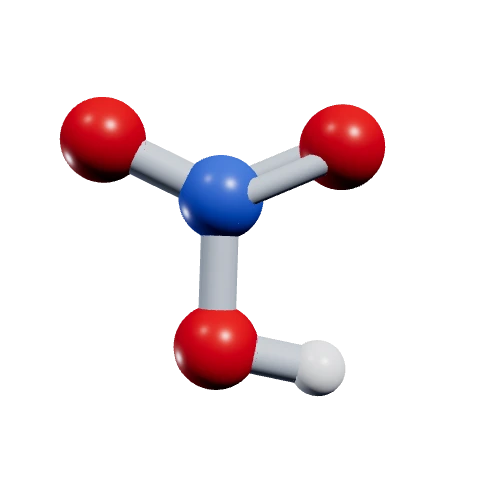


Nitric acid is one of the most quietly important industrial chemicals on Earth. It is a fertilizer factory, a rocket-engine oxidizer, an explosives precursor, and a gold-dissolving reagent — all from the same colorless bottle on the same chemistry-supply pallet. This is the story of how one molecule fed half the world, got Apollo to the Moon, made Alfred Nobel rich enough to fund a Peace Prize, and turned up in a flask in Copenhagen at the worst moment of the twentieth century.

The Fertilizer Equation: how one molecule feeds 4 billion people
Plants need nitrogen. The atmosphere is 78% nitrogen gas, N2 — and yet plants cannot use a single molecule of it. The triple bond between the two nitrogen atoms in N2 is one of the strongest covalent bonds in nature; cracking it open requires either the high temperature of a lightning strike or the high pressure of an industrial reactor. For most of human history, nitrogen-fixing bacteria living in the roots of legumes did the cracking, and the rest of agriculture was rate-limited by how much of their nitrogen could be persuaded to circulate through the soil.
Then in 1909 Fritz Haber demonstrated that you could combine atmospheric nitrogen with hydrogen at 400°C and 200 atmospheres of pressure to make ammonia (NH3) directly. Carl Bosch industrialized the process. By 1913 BASF was producing ammonia at scale. The Haber–Bosch process is now considered the single most important industrial process of the twentieth century: it removed the nitrogen ceiling from agriculture, and global crop yields tripled.
But ammonia by itself is a difficult fertilizer to handle. It is a gas at room temperature, highly soluble in water, alkaline, corrosive to the eyes and lungs, and a controlled material under DOT and DHS rules. To make it shippable, storable, and field-applicable at industrial scale, you turn it into a salt. And the easiest, cheapest, most water-soluble salt of ammonia happens to be the one you get when you combine it with nitric acid:
Ammonium nitrate. Roughly 80% of all nitric acid produced worldwide is consumed in that one reaction, and most of that ammonium nitrate goes directly into fertilizer pellets that end up on a corn field, a wheat field, or a soybean field somewhere on the planet. ~50% of the world’s food calories currently exists because synthetic nitrogen fertilizer exists, and most of that synthetic nitrogen is shipped to farms in the form of ammonium nitrate. Nitric acid is the molecule that closes the loop.
The receipt. Smil (2001) and the IPCC AR6 working group both estimate that roughly half of the nitrogen atoms in the protein in your body right now started as N2 in the air and were pulled out of the sky by a Haber–Bosch reactor, processed through nitric acid, applied as ammonium nitrate, and fixed into grain you ate this year.
How is nitric acid manufactured? The Ostwald process explained
Wilhelm Ostwald patented the industrial route to nitric acid in 1902 — seven years before Haber’s ammonia work and a decade before Bosch made it work at scale. The two inventions click together like puzzle pieces. Haber-Bosch gives you ammonia; Ostwald converts that ammonia into nitric acid. Together they convert nitrogen from the air into nitrogen on a corn-field.
The Ostwald process is a three-step catalytic oxidation:
The first step is the interesting one. Ammonia mixed with air is passed over a platinum-rhodium gauze catalyst at about 900°C. The contact time is about 1 millisecond. Without the catalyst the ammonia would just burn to nitrogen and water. With the catalyst, the selectivity flips: nitric oxide forms instead of dinitrogen, and at >95% yield. It is one of the great pieces of industrial catalysis ever discovered.
The product of the absorption tower is roughly 65–68% nitric acid in water. To go higher (the 98%+ “fuming” concentrations) you have to break the azeotrope, typically with magnesium nitrate dehydration or sulfuric-acid drying. Most fertilizer-grade and industrial-grade nitric acid stops at the 65–70% level — which is exactly the strength of the bottles on our pallet today.
Why this matters for procurement. The Ostwald process sets the price floor for every grade of nitric acid in the market. Energy and ammonia costs — both ultimately tied to natural-gas prices — drive Ostwald operating cost. When natural gas spikes (as in Europe 2022), nitric acid prices follow, and so do ammonium-nitrate fertilizer prices, and so do global grain prices. The molecule is structurally tied to energy.

Why 80% of all nitric acid becomes ammonium nitrate
You could in principle make nitrogen fertilizer in many ways. Urea (CO(NH2)2) is the largest single nitrogen fertilizer by tonnage worldwide. Anhydrous ammonia is injected directly into US corn-belt soils at scale. Calcium ammonium nitrate (CAN), urea-ammonium nitrate (UAN), and ammonium sulfate all see real volume. But ammonium nitrate has properties no competitor matches:
| Property | Value | Why it matters |
|---|---|---|
| Nitrogen content | 34.5% by mass | One of the highest of any solid N-fertilizer |
| Solubility in water | 118 g per 100 mL at 0°C | Dissolves quickly when irrigated or rained on |
| Half-and-half N forms | 50% NH4+, 50% NO3− | Plants use both forms; nitrate is fast, ammonium slow |
| Storage stability | Hygroscopic but stable to ~210°C | Bulkable in dry climates; cakes in humidity |
| Prill / granule form | 2–4 mm beads | Spreader-compatible, blends with other fertilizers |
The same properties that make ammonium nitrate useful as a fertilizer also make it useful as an oxidizer in mining explosives (ANFO, ammonium-nitrate-fuel-oil) and gave it its other historical fame as the active ingredient in fertilizer-bomb tragedies (Oklahoma City 1995, Beirut Port 2020). Most countries now regulate retail ammonium-nitrate sales heavily; in the US it is governed by the Ammonium Nitrate Security Program under DHS. That regulation is part of why the chemistry feels invisible: the same nitrogen atoms feeding your dinner plate are tracked by Homeland Security on the way to the warehouse.
The hidden global supply chain. The top five ammonium-nitrate-producing countries are China, Russia, the United States, Ukraine, and Egypt. When Russia restricted fertilizer exports in 2022 and Ukrainian production was disrupted by war, global ammonium-nitrate prices roughly tripled, and the resulting food-price shock landed hardest in the cereal-importing countries of North Africa and the Middle East. The nitric-acid molecule sits at the bottom of that dependency stack.
Apollo’s quiet oxidizer: how a nitric acid bottle got the lunar module home
Every NASA Apollo mission depended on engines that could be fired with absolute reliability after a week in cislunar space. There is no second chance at lunar-orbit insertion, and there is no second chance at trans-Earth injection. The propellant has to ignite the instant the valves open.
The class of propellant that does this is called hypergolic: the fuel and oxidizer ignite on contact without a spark plug or igniter. No ignition system means nothing to break. For Apollo’s Service Module engine (the AJ10-137, designed by Aerojet) the fuel was Aerozine-50 (a 50/50 mix of unsymmetrical dimethylhydrazine and hydrazine), and the oxidizer was nitrogen tetroxide (N2O4) — a compound that lives in equilibrium with two NO2 molecules and that is produced industrially from nitric acid by a controlled dehydration step.
The Titan II ICBM, which was repurposed as the Gemini launch vehicle, used a closely related propellant called Aerozine-50 / IRFNA. The acronym is worth decoding: Inhibited Red Fuming Nitric Acid — concentrated nitric acid (typically 83% HNO3 + 14% N2O4 + 2% H2O + 0.6% HF as a corrosion inhibitor). The HF was the inhibitor that gave the “I” in IRFNA; without it the acid would eat through the propellant tanks during the rocket’s long missile-silo standby life. With the HF, IRFNA could sit in a Titan II silo for years and still ignite on contact when the valves opened.
The chemistry is the same chemistry that sits in our 70% bottle today. The 70% concentration we ship is the working concentration for laboratory and industrial use, not propellant grade — the rocket version was a much narrower spec and is no longer manufactured for civilian use. But the molecule is identical. Every time you pour a beaker of HNO3 you are handling a small piece of the same compound that sent Neil Armstrong to the lunar surface and brought him home.
The shift to safer oxidizers. Modern spacecraft are mostly moving away from N2O4 / IRFNA propellant in favor of nontoxic alternatives like hydrogen peroxide / kerosene or methalox (methane + liquid oxygen). SpaceX’s Crew Dragon is the major exception — its SuperDraco abort engines still use hypergolic MMH / NTO chemistry, because nothing else lights up that fast.
From glycerin to dynamite: Alfred Nobel’s bottle that started the Nobel Prize
In 1846 the Italian chemist Ascanio Sobrero, working in Turin, slowly added glycerin to a chilled mixture of concentrated nitric and sulfuric acid. He recovered an oily, slightly sweet liquid — nitroglycerin — that he then promptly demonstrated would detonate if struck. Sobrero was so disturbed by his discovery that he buried the notebooks and spent the rest of his life warning against any practical use of the compound.
Twenty years later a Swedish industrialist named Alfred Nobel was running a small chemical works in Stockholm. His younger brother Emil died in a nitroglycerin explosion at the family laboratory in 1864. Most people would have stopped. Nobel doubled down and looked for a way to stabilize the compound so that it could be shipped and handled safely on construction sites.
His insight, in 1867, was that nitroglycerin absorbed into a porous mineral called kieselguhr (diatomaceous earth) became a stable, shapeable putty that could be cut, shipped, drilled into rock, and detonated reliably with a percussion cap. He patented the product as “dynamite” — from the Greek dynamis, “power.” Within a decade dynamite was building railroads, harbors, and tunnels on six continents. Nobel became one of the richest men in Europe.
When Alfred Nobel died in 1896, his will directed that the bulk of his fortune be used to establish prizes in physics, chemistry, medicine, literature, and peace. The endowment fund the prizes still come from in 2025 traces directly to the dynamite he sold — which means it traces directly to the nitric acid he used to make it. The chemistry-supply pallet in our warehouse is two steps removed from the Nobel Peace Prize.
Do not try this with our 70% bottle. Nitroglycerin synthesis requires concentrated (90%+) nitric acid mixed 1:2 with concentrated sulfuric acid, careful temperature control below 30°C, controlled glycerin feed, and a great deal of nerve. Our 70% nitric acid is well below the working concentration. The chemistry is here for the history, not the lab manual.
Aqua regia and the Nobel medal: Niels Bohr’s WWII escape
The 8th-century Persian alchemist Jābir ibn Hayyān recorded a mixture of nitric and hydrochloric acids that he called aqua regia — royal water — because it was the only solvent known that could dissolve gold and platinum, the “royal” metals. Twelve centuries later, the chemistry of aqua regia is still doing what Jābir noticed.
Mix 1 part concentrated nitric acid with 3 parts concentrated hydrochloric acid by volume and the two acids react to produce nitrosyl chloride and chlorine gas:
The nitric acid oxidizes the gold, ripping electrons off the metal surface; the chloride ions immediately bond to the gold cations to form the soluble [AuCl4]− ion. Neither acid can do this alone — the gold is too noble for HCl to attack, and the gold cations formed by HNO3 alone would immediately reduce back to metal. The combination breaks the stalemate.
In April 1940 the German army occupied Denmark. The physicist Niels Bohr was at his institute in Copenhagen, holding the gold Nobel medals of two German physicists (Max von Laue and James Franck) who had smuggled them out of Nazi Germany for safekeeping. Exporting Nobel-gold from Germany was punishable by death; possession of it in occupied Denmark was nearly as risky.
Bohr’s colleague George de Hevesy — a Hungarian chemist working in the same building — suggested a chemistry solution. They dissolved both medals in aqua regia. Bohr left the unlabeled bottle of orange-brown solution on a laboratory shelf and walked out of the building with the Nazis searching room by room. The bottle sat untouched for the rest of the war. In 1950 de Hevesy returned to Copenhagen, precipitated the gold out of solution, and shipped it to the Royal Swedish Academy, who recast the medals and returned them to Laue and Franck.
What aqua regia cannot dissolve. Iridium, ruthenium, osmium, tantalum, niobium, hafnium, and titanium are resistant or fully immune. Iridium spark plugs in racing engines are made of iridium specifically because the combustion-chamber chemistry is mild compared to aqua regia, and the metal can’t corrode. That is the practical legacy of the alchemists: the periodic table’s nobility ladder, ordered by what aqua regia can and cannot eat.

The grades of nitric acid at Alliance
Alliance Chemical stocks nitric acid at seven concentration points across three certified grades. The chemistry is the same molecule (HNO3) at every concentration; the difference is what you certify it against.
| Product | Concentration | Grade | Typical use |
|---|---|---|---|
| Nitric Acid 5% | 5% HNO3 in water | Technical | Lab pH adjustment, dilute etching, food-equipment cleaning |
| Nitric Acid 20% | 20% HNO3 | Technical | Stainless-steel passivation (ASTM A967 Type II) |
| Nitric Acid 25% | 25% HNO3 | Technical | Industrial cleaning, metal-finishing prep |
| Nitric Acid 40% | 40% HNO3 | Technical | Stainless passivation (Type VI), heat-exchanger descaling |
| Nitric Acid 65% ACS Grade | 65% HNO3 | ACS Grade | Sample digestion, ICP/AA prep, electronics-grade work |
| Nitric Acid 70% ACS Grade — Low Particle | 70% HNO3 | ACS Grade | Semiconductor wafer cleaning, photoresist etch |
| Nitric Acid ACS 69% — 55-Gallon Drum | 69% HNO3 | ACS Reagent Grade | Pharma synthesis, large-scale ACS-spec compounding |
Technical Grade meets internal Alliance Chemical specifications and is the right choice for industrial applications where the certificate of analysis confirms identity and approximate purity. ACS Grade meets American Chemical Society reagent specifications — tested against the canonical ACS test methods for heavy metals, residue on ignition, color, and chloride. ACS Reagent Grade in the 55-gallon drum format ships with a lot-traceable certificate against the same ACS methods, scaled for production use.
What grade of nitric acid should you buy?
Buyer’s rule of thumb: match the grade to the downstream specification, not to the upstream price. For most industrial cleaning, passivation, and pH-adjustment work, Technical Grade at the right concentration is correct and cost-effective. ACS Grade is justified when your downstream process specifies ACS by name, when trace metals would interfere with analytical work, or when you need lot-traceability against the canonical reagent-grade test methods.
| If your application is… | Buy this grade / concentration |
|---|---|
| Stainless-steel passivation (food/medical) | Nitric Acid 20% or 40% Technical Grade |
| Fertilizer-manufacturing intermediate | Technical Grade, 65–70% (bulk) |
| ICP / AA sample digestion | Nitric Acid 65% or 70% ACS Grade |
| Semiconductor wafer cleaning | Nitric Acid 70% ACS Grade Low-Particle |
| Pharma compounding intermediate | Nitric Acid ACS 69% (Reagent Grade) |
| Stone / concrete etching, masonry prep | Nitric Acid 25% or 40% Technical Grade |
| Metal-recovery hydrometallurgy | Technical or ACS, 65–70% depending on downstream spec |
| Aqua regia preparation | Nitric Acid 70% ACS + Hydrochloric Acid 37% ACS (1:3 v/v) |
If you’re not sure. Request the Certificate of Analysis (CoA) for the SKU before you order. The CoA tells you the exact concentration, assay method, and impurity profile of the specific lot. For ACS-grade work, the CoA is the contract document — not the product label.
Never mix: 4 contraindications for nitric acid
Nitric acid is a strong acid and a strong oxidizer. The two properties give it twice the contraindication list of an ordinary mineral acid. Four combinations to avoid:
1. Nitric acid + bleach (sodium hypochlorite). Releases chlorine gas (Cl2) and nitrosyl chloride (NOCl) — the same NOCl that forms aqua regia, but here as an uncontrolled fume. Lethal in confined spaces. Never mix in a sink, drum, or floor drain.
2. Nitric acid + organics (alcohols, acetone, ethers, paper, sawdust, rags). Strong oxidation of organic matter is exothermic and can ignite spontaneously. The Wikipedia talk page is full of decommissioned-lab fires from old nitric-acid-contaminated rag piles.
3. Nitric acid + reactive metals (zinc, magnesium, aluminum powder, copper turnings). Generates copious nitrogen-oxide fumes (NO, NO2) plus hydrogen gas. The brown NO2 fume is the visible signature; the invisible NO is more toxic. Work in a ventilated hood at small scale.
4. Nitric acid + ammonia (gaseous or aqueous). The two combine spontaneously to ammonium nitrate — useful at the factory, dangerous in a lab spill where the heat of neutralization is uncontrolled and the resulting salt is an oxidizer. Spill response is soda ash or lime, not ammonia.
Storage rule: keep nitric acid in its labeled corrosives cabinet, away from organic solvents and reducing agents, on a secondary containment tray, with a dedicated spill kit (soda ash + acid-resistant absorbent pad) within arm’s reach.
Need nitric acid by tomorrow morning?
Alliance Chemical ships Technical, ACS, and ACS Reagent grades from 1-gallon bottles through 55-gallon drums. CoA on request, no charge. Hazmat documentation included. Get a quote or speak with a chemist about grade selection.
Shop Nitric AcidReferences & Authoritative Sources
Chemical identity, properties, and safety data sourced from the U.S. National Library of Medicine's PubChem database — the authoritative open-chemistry data resource maintained by the National Institutes of Health.
- PubChem CID 944: Nitric Acid 5% — National Center for Biotechnology Information, U.S. National Library of Medicine. CAS 7697-37-2.
- Nitric Acid — thermophysical data — NIST Chemistry WebBook, SRD 69, National Institute of Standards and Technology. Accessed 2026-09-04.
Sourcing for this job? See our nitric acid supplier page — every grade and strength we stock, with live pricing from quarts through drums and totes.
Related: Where to Buy Nitric Acid: Grades, Concentrations, Licensing and Shipping — for what you can actually buy today, in what grades and at what concentrations.
Key numbers and sources
| Fact | Value | Source |
|---|---|---|
| Chemical formula | HNO 3 | See article text |
| CAS number | 7697-37-2 | pubchem.ncbi.nlm.nih.gov |
| Percent of nitric acid used for synthetic nitrogen fertilizer | roughly 80% | See article text |
| Percent concentration in ACS Grade nitric acid (as supplied by Alliance Chemical) | 65%, 70% | See article text |
| Percent concentration in Technical Grade nitric acid (as supplied by Alliance Chemical) | 5%, 20%, 25%, 40% | See article text |
| Percent concentration in ACS Reagent Grade nitric acid (as supplied by Alliance Chemical) | 69% in 55-gallon drum | See article text |
| DOT hazmat training regulation | 49 CFR 172.704 | See article text |
Related: What Fuel Launched Freedom 7? The Alcohol, Water and Hydrogen Peroxide Behind America’s First Astronaut — the fuel that came before the hypergolics: Alan Shepard rode alcohol and liquid oxygen, and NASA chose it over a more powerful, more toxic hydrazine blend.
Related: The Army Made a Man Fly on Hydrogen Peroxide, Then Walked Away: The Bell Rocket Belt, the X-15 and the Machine That Trained Neil Armstrong — before the hypergolics flew the lunar module, hydrogen peroxide rockets flew the machine Armstrong practised on.
Frequently asked questions
What is nitric acid used for?
Roughly 80% of nitric acid is consumed making ammonium nitrate, the dominant high-nitrogen fertilizer. The rest goes to metal passivation, sample digestion, semiconductor cleaning, organic-synthesis nitration (dyes, pharmaceuticals, explosives precursors), and aqua-regia gold recovery.
Is nitric acid a strong acid?
Yes — nitric acid is a strong mineral acid that dissociates essentially completely in water (pKa around −1.4). It is also a strong oxidizer, which means it can drive reactions beyond simple proton transfer (for example, oxidizing copper to copper nitrate while releasing nitrogen-oxide fumes).
What concentration of nitric acid do I need?
Match the concentration to the downstream process. Stainless-steel passivation runs at 20% or 40% Technical Grade. Lab sample digestion and ICP work runs at 65–70% ACS Grade. Pharma compounding and ACS-spec laboratory reference work uses 69% ACS Reagent Grade in 55-gallon drums for production scale.
Can you use nitric acid directly as fertilizer?
In principle yes — dilute nitric acid is sometimes applied to soil for pH adjustment in greenhouse and hydroponic systems. In practice, the global fertilizer industry first neutralizes nitric acid with ammonia to make ammonium nitrate, because the salt is far safer to handle, transport, and apply in dry granule form.
Why is nitric acid an oxidizer?
The nitrogen atom in nitric acid is in its highest oxidation state (+5). When it reacts with a reducing agent, the nitrogen accepts electrons and is reduced — often to nitrogen dioxide (+4) or nitric oxide (+2). That electron-accepting behavior is what makes it more reactive than a non-oxidizing strong acid like hydrochloric.
Besides aqua regia, what dissolves gold?
Cyanide leaching (the industrial gold-mining method) and selenic acid plus chloride media are the main alternatives. Iodine-iodide complexes also dissolve gold under specific conditions. Aqua regia (3:1 HCl:HNO3) remains the bench-scale standard.
How is nitric acid shipped?
Nitric acid is regulated as UN 2031 (or UN 2032 for fuming variants), Class 8 corrosive, Packing Group I or II depending on concentration. Alliance Chemical ships in DOT-compliant containers (HDPE jugs through UN-rated steel drums) with hazmat documentation included on every shipment.
How is nitric acid different from nitrous acid?
Nitric acid is HNO3 — the nitrogen is in oxidation state +5, the acid is strong and storable. Nitrous acid is HNO2 — nitrogen in oxidation state +3, the acid is weak and unstable, existing only briefly in cold solution before disproportionating to nitric acid and nitric oxide. They are different compounds with different uses; only nitric acid is shippable as a finished product.
Related Chemical Collections
About the author
Andre Taki
This article is for informational purposes only.


