

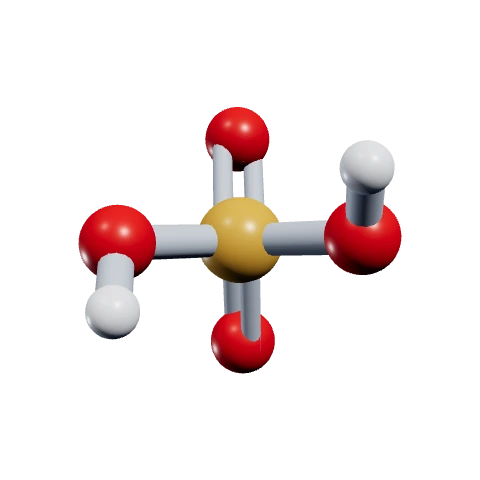


It is the most-produced chemical on Earth, and for a century economists have used it as a stethoscope on the industrial economy: when a country makes and consumes more sulfuric acid, it is building more. In 2026, that stethoscope is picking up a stress signal — and the cause is not demand, but a raw-material shock that starts with a war.
Sulfuric acid rarely makes headlines. It is not a consumer product; it is the invisible reagent behind fertilizer, refined metals, batteries, paper, pigments, and water treatment. But this year a chain of disruptions in the global sulfur trade — the feedstock that dominates sulfuric acid’s cost — has pushed prices up across multiple regions and put procurement teams on notice. This briefing lays out what is happening, why the supply is structurally fragile, who is most exposed, and what it means for buyers in North America. It is written for people who purchase this chemical, not to alarm anyone: the aim is a clear read of the map.
New to the chemical itself? Our Understanding Sulfuric Acid primer and complete concentration guide cover the fundamentals and grade ladder. This article is about the market shock sitting on top of them.
Why is sulfuric acid getting more expensive in 2026?
Sulfuric acid is getting more expensive in 2026 because its main raw material, elemental sulfur, is caught in a simultaneous supply squeeze from war and export restrictions — and since sulfur accounts for roughly 80% of the acid’s production cost, a sulfur shock passes almost directly into the price of the acid. Several disruptions landed at once, which is why analysts describe it as a compound or “triple” shock rather than a single event.
The trigger that drew the most attention is geopolitical. Much of the world’s sulfur is recovered in the Persian Gulf, and the war in Iran has disrupted production and the tanker trade that moves it. According to reporting by the American Chemical Society’s Chemical & Engineering News, about half of the seaborne sulfur trade normally passes through the Strait of Hormuz — the narrow waterway off Iran’s coast — citing the International Energy Agency. When that choke point tightens, sulfur cargoes are delayed or rerouted, and importers scramble.
On top of the Gulf disruption, three major suppliers moved to restrict exports at roughly the same time, each protecting its own domestic industries. The combination is what turned a regional problem into a global one.
The Strait of Hormuz carries roughly half of the world’s seaborne sulfur. Sulfur is the feedstock for sulfuric acid, and more than half of all sulfuric acid becomes fertilizer — so a shipping-lane disruption in the Gulf can echo all the way to global food-supply chains. Source: C&EN, citing the IEA.
What is sulfuric acid, and why is it called “the king of chemicals”?
Sulfuric acid (H2SO4) is a strong, dense mineral acid that is the single most widely produced chemical in the world — a status that earns it the nickname “the king of chemicals.” The label is not marketing. According to the U.S. Geological Survey, more sulfuric acid is produced in the United States every year than any other chemical, and the USGS notes that consumption of sulfuric acid has long been regarded as one of the best indexes of a nation’s industrial development.
It holds that position because it is a workhorse rather than a specialty. Sulfuric acid makes fertilizers, refines metals, fills lead-acid batteries, leaches metals from ore, pickles steel, treats water, and produces countless downstream chemicals, pigments, and detergents. In the words of sulfur analyst Freda Gordon of Acuity Commodities, quoted by C&EN, it is “the king of chemicals because it’s used in so many different applications.” That ubiquity is exactly why a supply shock is worth watching: when the king’s feedstock gets scarce, the effects fan out across the whole economy.
Formula: H2SO4 • CAS: 7664-93-9 • Molar mass: 98.08 g/mol • strong diprotic acid, highly hygroscopic, dilution is strongly exothermic (always add acid to water). Properties: PubChem CID 1118.
Where does sulfur come from — and why is the supply so fragile?
Almost all industrial sulfur is a byproduct, which is the hidden reason the supply is fragile: producers cannot simply make more sulfur when demand rises, because they do not make it on purpose in the first place. Most elemental sulfur is recovered from crude oil and natural gas during refining, where it must be stripped out as an impurity; a smaller share (roughly a third of sulfuric acid) comes as a byproduct of smelting sulfur-bearing copper, zinc, and lead ores.
Because sulfur output is tied to refining and smelting rather than to sulfur demand, the world cannot quickly ramp supply in response to a price spike — and it is geographically concentrated. The Persian Gulf is a major source, which is precisely why a Gulf conflict reverberates. The chemistry that turns that sulfur into acid is the century-old contact process:
S → burn → SO2 → catalytic oxidation → SO3 → absorbed into existing acid & diluted → H2SO4. The rate-limiting input is the sulfur at the very start — and that is the link the 2026 shock has strained.
There is a downstream dependency that makes the stakes global. More than half of the world’s sulfuric acid is used to make phosphoric acid for fertilizer, and major fertilizer producers such as Morocco rely on both Gulf sulfur and imported acid; India sourced an estimated 87% of its sulfur from the Middle East in 2023, per C&EN. That is why analysts warn that a prolonged sulfur disruption could ripple through phosphate-fertilizer supply chains and, ultimately, food prices in import-dependent regions.

What is the “triple shock” hitting sulfur supply?
The 2026 squeeze is not one event but several overlapping ones, each removing supply from the open market at the same time. Laid side by side, the pattern is clear: a physical trade disruption in the Gulf stacked on top of policy-driven export restrictions from three of the largest players.
| Disruption | What changed | Effect on the market |
|---|---|---|
| Iran war / Strait of Hormuz | Gulf sulfur production & tanker transit disrupted; ~half of seaborne sulfur normally moves through Hormuz (IEA) | Physical cargoes delayed or rerouted; importers short |
| China export restrictions | A major acid exporter curbing outbound volumes to protect domestic supply | Removes a large export stream buyers relied on |
| Russia sulfur ban | Sulfur export restriction extended through mid-2026 | Tightens elemental-sulfur availability further |
| Turkey export limits | Sulfur export restrictions signaled for Q2–Q3 2026 | Another supply stream constrained |
Any one of these on its own would be manageable; the market routinely absorbs single-country policy shifts. The problem in 2026 is coincidence — they arrived close together, while the Gulf disruption removed the flexibility that would normally cushion them. That is what moved prices, and why the exact figures vary by region and by week. Rather than repeat a single spot number that will be stale by the time you read it, the sourced range and primary references are collected in the Key numbers & sources table below.
What does the sulfur crunch mean for buyers?
For most buyers the practical effect is twofold: firmer prices and longer or less-certain lead times, with the degree of exposure depending on where your acid and its feedstock originate. The chemical itself is not disappearing — this is a cost-and-logistics squeeze, not a physical drought — but the industries that lean hardest on globally traded sulfur and acid feel it first.
| Sector | Why it’s exposed |
|---|---|
| Fertilizer & agriculture | ~56% of sulfuric acid demand; more than half goes to phosphoric acid. Most import-dependent, most exposed to Gulf sulfur. |
| Mining & battery metals | Acid leaches copper and processes battery-metal ores; growing battery demand adds pressure. See our battery-recycling leaching guide. |
| Metal finishing & steel | Pickling and descaling rely on technical-grade acid; price sensitive, high volume. |
| Batteries & electrolyte | Lead-acid and electrolyte formulations. Related: battery acid vs. battery water. |
| Water treatment & general industry | pH control and countless processes; broad but usually lower-intensity exposure. |
If you buy sulfuric acid, this is a reasonable moment to confirm your grade and concentration are correct for the job (over-specifying purity you do not need is a quiet cost in a tight market), to review lead times with your supplier, and to understand where your material actually originates. Our battery-acid “vanishing act” explainer covers a related availability story buyers have already been navigating.

Is the US sulfuric acid supply exposed to the crisis?
The United States is comparatively insulated from the sulfur shock, because most of its sulfur is produced domestically rather than imported through the Strait of Hormuz. The reason is structural: US sulfur is overwhelmingly recovered from domestic oil and gas refining. Per the USGS, elemental sulfur was recovered at 86 operations across 26 states in 2025, with Louisiana and Texas alone accounting for about 54% of domestic production — a Gulf-Coast, not Persian-Gulf, supply base.
That does not make North American buyers immune. Prices are set in a connected global market, so international tightness still exerts upward pressure, and specialty or high-purity grades can have their own supply dynamics. But it does mean the physical risk profile here is very different from that of an import-dependent fertilizer producer. For a domestic distributor, the practical implication is that supply continuity is largely a matter of sourcing and logistics discipline rather than exposure to a single overseas choke point.
US sulfur is a refinery byproduct, concentrated on the Gulf Coast (LA + TX ≈ 54% of output). Alliance Chemical ships from Taylor, Texas, drawing on that domestic base — the honest read is insulated, not immune. Source: USGS National Minerals Information Center.
How do I secure a reliable sulfuric acid supply?
Securing supply in a tight market comes down to three practical moves: match the grade to the application, confirm lead times and documentation with your supplier, and prefer a domestic source with transparent provenance. The first move is often the most overlooked — buying a higher purity than a process requires wastes money in any market and more so in a tight one, while under-specifying can quietly compromise a step that matters. Sulfuric acid is sold across a wide concentration ladder, and the right rung depends entirely on the job.
| Grade / concentration | Typical use |
|---|---|
| 30% | Diluted applications, general pH adjustment, dosing |
| 37% Battery Acid | Lead-acid battery electrolyte (fill/top-up) |
| 50% Electrolyte Grade | Electrolyte and process applications needing mid concentration |
| 70% | Industrial processing, higher-strength dosing |
| 93% Technical | Metal pickling, descaling, high-volume industrial use |
| 96% ACS | Lab / reagent work needing certified high purity. See the 96% ACS reference. |
Whatever the grade, handling discipline does not change: sulfuric acid is corrosive and its dilution is strongly exothermic, so storage, containment, and dispensing matter — our safer storage guide covers the essentials. On documentation, insist on a Certificate of Analysis for the lot you are buying so you can verify concentration and quality against your spec; it is a same-day request from any serious supplier, and it is your paper trail when a process depends on the number being right.
Sulfuric acid, any grade — from a Texas domestic base
30% through 96% ACS, quart to tote, with the Certificate of Analysis on request at no charge. Tell us the application and we’ll help you spec the right concentration — so you’re not overpaying for purity you don’t need in a tight market.
How long will the sulfuric acid squeeze last?
There is no clean end date, because the relief valves are slow and partly political — but the structural picture argues for firm prices while the disruptions persist rather than a runaway shortage. Two features of the sulfur market shape any outlook. First, sulfur is a byproduct of refining and smelting, so the world cannot rapidly add supply in response to high prices the way it might for a purpose-made commodity; new volume arrives on the timeline of new refineries and smelters, not on the timeline of a price signal. Second, a large share of the current tightness is policy-driven — export restrictions that can loosen when the issuing countries judge their domestic needs are met, or tighten further if they do not.
That means the plausible paths back toward balance are a de-escalation that restores normal Gulf sulfur flows through the Strait of Hormuz, a rollback of the China, Russia, and Turkey export limits, or demand cooling — and, more slowly, new sulfur and acid capacity coming online in various regions. Until several of those move together, most analysts expect prices to stay elevated and lead times to stay less predictable than usual. For a buyer, the takeaway is not to panic-buy against a forecast, but to build a little more slack into planning: confirm grades, keep documentation current, and know your source. The market has absorbed sulfur shocks before; this one is notable for how many arrived at once.
Key numbers & sources
The figures behind this briefing, with primary references. Regional spot prices move week to week; treat single numbers as directional and check the linked sources for current detail.
| Fact | Figure | Source |
|---|---|---|
| Most-produced chemical in the US | Sulfuric acid, #1 | USGS MCS 2026, Sulfur |
| US elemental sulfur production (2025) | ~7.6 million tons | USGS |
| US sulfur from Louisiana + Texas | ~54% of domestic output | USGS |
| Seaborne sulfur via Strait of Hormuz | ~50% | C&EN (IEA) |
| Sulfuric acid demand that is fertilizer | ~56% | C&EN (CRU) |
| Sulfur share of sulfuric acid production cost | ~80% | Trade-market analysis, 2026 |
| India’s sulfur sourced from Middle East (2023) | ~87% | C&EN |
This briefing is for general information and reflects sources available as of July 2026; it is not procurement, financial, or political commentary. Market figures move — verify current pricing and lead times with your supplier. For grade-selection help, contact Alliance Chemical.
Related: Acids Used to Extract & Separate Rare Earth Elements — bulk sulfuric acid supply is directly tied to rare-earth refining capacity, since the sulfuric bake-leach route accounts for over half of world REE production.
Related: Two Rivers Hit Bottom: Record-Low Rhine and Mississippi Levels — the 2026 sulfur shock was a feedstock story; record-low water on the Rhine and Lower Mississippi is a pure logistics one, and the two can stack on the same delivered price.
Frequently asked questions
Why is sulfuric acid getting more expensive in 2026?
Its main raw material, elemental sulfur, is in a supply squeeze. Sulfur is about 80% of sulfuric acid production cost, so a sulfur shock passes almost directly into the acid price. In 2026 the shock is compound: the war in Iran has disrupted Persian Gulf sulfur that transits the Strait of Hormuz (about half of seaborne sulfur trade, per the IEA via C&EN), while China, Russia, and Turkey moved to restrict exports at roughly the same time.
Why is sulfuric acid called the king of chemicals?
Because it is the single most widely produced chemical in the world and is used across an enormous range of industries: fertilizers, metal refining and mining, batteries, steel pickling, water treatment, pigments, and downstream chemicals. The USGS notes that more sulfuric acid is produced in the US than any other chemical, and that its consumption has long been treated as one of the best indexes of a nation industrial development.
Where does the sulfur to make sulfuric acid come from?
Almost all industrial sulfur is a byproduct. Most is recovered from crude oil and natural gas during refining, where sulfur must be removed as an impurity; roughly a third of sulfuric acid comes from smelting sulfur-bearing copper, zinc, and lead ores. Because it is a byproduct, producers cannot quickly make more sulfur when demand or prices rise, which is a key reason supply is fragile.
How does the Strait of Hormuz affect sulfuric acid?
About half of the world seaborne sulfur trade normally passes through the Strait of Hormuz off the coast of Iran, according to the IEA as reported by C&EN. Much of the world sulfur is produced in the Persian Gulf, so when conflict disrupts Gulf production and tanker transit through that choke point, sulfur cargoes are delayed or rerouted. Since sulfur is the feedstock for sulfuric acid, that disruption pushes acid prices up.
Is the US sulfuric acid supply affected by the crisis?
The US is comparatively insulated because most of its sulfur is produced domestically as a refinery byproduct rather than imported through the Gulf. The USGS reports sulfur was recovered at 86 operations in 26 states in 2025, with Louisiana and Texas alone about 54% of domestic output. US buyers still feel global price pressure because the market is connected, but the physical supply risk is very different from an import-dependent region. Insulated, not immune.
What is sulfuric acid mostly used for?
More than half of global sulfuric acid goes to making phosphoric acid for fertilizer (about 56% of demand). Other major uses include mining and metal processing (leaching copper and battery metals), steel pickling and metal finishing, lead-acid batteries and electrolyte, water treatment, and the manufacture of other chemicals, pigments, and detergents.
Which grade of sulfuric acid do I need?
It depends on the application. Common rungs are 30% for diluted/general use, 37% battery acid for lead-acid electrolyte, 50% electrolyte grade, 70% for industrial processing, 93% technical for pickling and high-volume industrial use, and 96% ACS for lab and reagent work needing certified purity. Buying more purity than the process needs wastes money, especially in a tight market; tell your supplier the application and ask them to help spec the concentration.
Will the sulfuric acid shortage cause a fertilizer or food problem?
Analysts warn it could add pressure. More than half of the world sulfuric acid becomes phosphate fertilizer, and major producers such as Morocco and importers such as India depend heavily on Middle East sulfur. A prolonged sulfur disruption could strain phosphate-fertilizer supply chains and, in import-dependent regions, contribute to higher food prices. It is a risk analysts are tracking, not a certainty, and it is why a Gulf shipping disruption matters far beyond chemistry.
Sources
- Chemical & Engineering News · American Chemical Society
- U.S. Geological Survey · U.S. Geological Survey
- PubChem Compound Summary: Sulfuric Acid (CID 1118) · PubChem (NIH National Library of Medicine)
- USGS National Minerals Information Center · U.S. Geological Survey
Related Chemical Collections
About the author
Andre Taki
This article is for informational purposes only.


