



There is a rare-earth mine sitting in your junk drawer right now. That dead laptop, the hard drive you meant to shred, the earbuds in a landfill somewhere — every one of them holds a sliver of neodymium-iron-boron magnet, and neodymium is exactly the element at the center of a supply chain China controls almost completely. The tool that unlocks it back out is not exotic. It is acid, run through a process that is over a century old.
That fact gets buried under the geopolitics. Export controls, critical-minerals policy, and reshoring headlines dominate the rare-earth conversation in 2026, but almost none of that coverage explains the chemistry a metallurgist, recycler, or process engineer actually needs: which acid, at what concentration, at what point in the process, and why it works on a scrapped magnet exactly the same way it works on freshly mined ore. This guide fills that gap — and keeps coming back to that hard drive, because the chemistry really is the same story at both ends.
The tell nobody mentions: refined rare-earth oxides are not the dull grey powder you would expect. Neodymium oxide is a pale blue-violet, praseodymium oxide is light green, samarium oxide is pale yellow — refiners have used these true, distinctive colors as a purity check for decades. The color change from dark ore to a mound of lilac powder is, quite literally, the visible proof the chemistry worked.
What acids are used to extract rare earth elements from ore?
Sulfuric acid and hydrochloric acid do almost all of the extraction work, and which one leads depends on the ore. Monazite ore is processed with a concentrated sulfuric-acid bake; bastnäsite — the dominant ore at Mountain Pass, California, and Bayan Obo, China — is roasted and then leached with either hydrochloric or sulfuric acid, depending on the plant's downstream separation circuit.
Neither acid works alone. Extraction is a sequence: crush and concentrate the ore, roast or bake it with acid to break the crystal lattice, leach the roasted material with water or dilute acid to pull the rare earths into solution, then precipitate and separate the individual elements — a process that runs on oxalic acid and, again, hydrochloric acid. The two industrial acids show up at different stages doing different jobs, which is the part most rare-earth explainers skip.
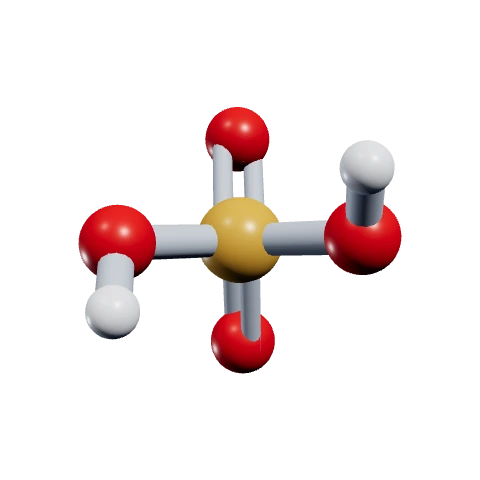
Sulfuric acid at a glance: H₂SO₄ · CAS 7664-93-9 · the primary leaching acid for monazite ore. Hydrochloric acid at a glance: HCl · CAS 7647-01-0 · leaches bastnäsite and redissolves precipitated rare-earth oxalates for separation. Sources: PubChem — sulfuric acid, PubChem — hydrogen chloride.
One distinction worth knowing before you get deep into process specs: chemists split the 17 rare-earth elements into “light” (lanthanum through europium, including neodymium and praseodymium) and “heavy” (gadolinium through lutetium, plus yttrium) groups, because their solubility behavior in acid solution shifts across the series. That shift is exactly what makes solvent-extraction separation possible at all — each element partitions between the acid solution and an organic extractant slightly differently, and running that partition hundreds of times in sequence is how a mixed chloride or sulfate solution eventually becomes 17 separate, individually pure oxide streams.

Why does bastnäsite need roasting before acid leaching?
Raw bastnäsite is a fluorocarbonate mineral, and its crystal structure locks the rare-earth atoms in too tightly for acid to reach them at room temperature. Roasting breaks that lattice open first.
The concentrate is roasted at high temperature, which drives off carbon dioxide and converts the fluorocarbonate structure into rare-earth oxides and oxyfluorides — a form the leaching acid can actually dissolve. Only after roasting does hydrochloric or sulfuric acid get a real shot at pulling the rare-earth content into solution efficiently. Skip the roast, and leaching yields drop sharply; the acid spends its capacity fighting an intact mineral structure instead of dissolving liberated oxides.
This two-step pattern — thermal pretreatment, then acid leach — is the same logic used across hydrometallurgy, including the black-mass leaching used in lithium-ion battery recycling: break the structure first, then let the acid do the dissolving.
What is the sulfuric acid bake-and-leach process?
Monazite ore is baked with concentrated sulfuric acid at roughly 150–200°C, then leached with water to pull the resulting rare-earth sulfates into solution. This route — not a footnote process — accounts for more than half of world rare-earth production, running at scale at Bayan Obo in China and Mt Weld in Australia.
The sequence in practice:
- Bake: finely ground monazite concentrate is mixed with concentrated sulfuric acid and heated to 150–200°C, converting the rare-earth phosphates into soluble rare-earth sulfates (and releasing phosphoric acid as a byproduct).
- Water leach: the baked cake is leached with water, dissolving the rare-earth sulfates while leaving thorium and other insoluble residues behind — a step that also isolates a low-level-radioactive byproduct stream that has to be managed.
- Precipitate: oxalic acid is added to the pregnant leach solution, precipitating the rare earths out as rare-earth oxalates.
The alternative to sulfuric bake-leach is caustic (NaOH) cracking, which trades acid consumption for higher reagent cost and a different waste stream. Most large-scale monazite operations still run the sulfuric route because the reagent economics favor it at volume — which is also why bulk sulfuric acid supply is directly tied to rare-earth refining capacity; see our 2026 sulfuric acid supply-crisis coverage for the upstream sulfur picture.
What role does HCl play after oxalate precipitation?
Hydrochloric acid redissolves the rare-earth oxalate precipitate so the individual elements — neodymium, praseodymium, dysprosium, cerium, and the rest — can actually be separated from one another.
Precipitating the rare earths as a group with oxalic acid gets them out of the leach solution and away from iron, aluminum, and thorium impurities, but the result is still a mixed rare-earth concentrate. HCl dissolves that oxalate cake back into a chloride solution, which is the feedstock for solvent extraction — hundreds of extraction stages that exploit the tiny chemical differences between adjacent rare earths to separate them one at a time. Without the HCl redissolution step, there is no clean feed for that separation train.
Why this matters for buyers: a recycling or pilot-scale refining operation typically needs BOTH acids on site — sulfuric (or a sulfate-based route) for the initial leach, and hydrochloric for the downstream redissolution/separation feed. Sourcing both from one supplier simplifies specs and COA tracking across the process.
Is sulfuric acid or hydrochloric acid better for rare-earth processing?
Neither is universally “better” — the ore and the plant's separation circuit decide which acid leads, and most operations use both at different stages. Here is how the choice actually breaks down:
| Factor | Sulfuric acid (H₂SO₄) | Hydrochloric acid (HCl) |
|---|---|---|
| Best-fit ore | Monazite (bake-leach route) | Bastnäsite (post-roast leach), oxalate redissolution |
| Process role | Primary leaching acid; breaks down phosphate structure | Leaching agent + redissolves precipitated oxalates for separation |
| Byproduct stream | Thorium-bearing insoluble residue; phosphoric acid co-product | Chloride solution feeding solvent extraction |
| Scale of use | >50% of world REE production (bake-leach route) | Universal in the downstream separation step regardless of leach acid used |
| Alliance grades available | 37% Battery Acid, 93% Technical Grade | 31% Technical Grade |
For process engineers specifying reagent grade and concentration, our complete sulfuric acid concentration guide and hydrochloric acid grade comparison cover the practical differences between our stocked concentrations.
Why does China dominate rare-earth refining?
China controls roughly 85–90% of global rare-earth refining and separation capacity — not because rare earths are geologically rare there, but because it built out the acid-intensive processing infrastructure at scale while other countries let theirs lapse. The US Geological Survey tracks this concentration annually in its Mineral Commodity Summaries.
The ore itself is not the bottleneck. Deposits exist across the US, Australia, and elsewhere. The bottleneck is the capital-intensive, chemically demanding separation infrastructure — the acid bake-leach circuits, the hundreds-of-stage solvent-extraction trains, and the environmental permitting to handle thorium-bearing residue streams. That infrastructure is expensive to build and slow to permit, which is exactly why the 2026 policy push (export-control responses, reshoring incentives, and Department of Energy funding for domestic processing) is aimed at rebuilding acid-based refining capacity, not just mining more ore.
Mountain Pass, California — the largest US rare-earth mine — mines bastnäsite domestically but has historically shipped a meaningful share of its concentrate overseas for the acid-processing and separation step, because that capacity did not exist at scale in the US. Rebuilding it is the current policy target.
Can rare earth elements be recycled from old electronics?
Yes — and that dead hard drive from the lede is not a metaphor. Pull the small dark rectangular magnet out of nearly any spinning hard drive and you are holding a neodymium-iron-boron alloy, the exact magnet chemistry that also runs EV motors and wind-turbine generators, just scaled down to fit a laptop. Acid-based recycling of scrapped magnets is now one of the fastest-moving parts of the 2026 domestic supply-chain push, and it runs on the same two acids covered in this guide.
Hydrochloric-acid-based closed-loop leaching has demonstrated roughly 93% recovery of neodymium and praseodymium from scrapped hard-drive magnets. Acid dissolves the magnet, the rare-earth chlorides are separated out of solution, and — unlike a one-way industrial leach — the acid itself is regenerated in-loop via electro-extraction and reused on the next batch. The dark magnet goes in; a pale blue-violet mound of neodymium oxide comes out the other side of the process, the same visible color change that happens at a mine, just starting from e-waste instead of rock.
2026 funding signal: the US Department of Energy is offering $24 million in 2026 to fund prototype-scale magnet-scrap-to-rare-earth recycling projects — a direct bet that acid-based recycling can supplement mined and imported supply. Sources: Investing News Network, Metal Tech News.
For recyclers and pilot operations evaluating this route, the acid economics are simpler than ore processing: no roasting step, a much smaller and more concentrated feedstock, and a closed HCl loop that reduces per-batch reagent consumption — though pilot and lab-scale runs still need a reliable, documented acid supply while the process is being tuned.

Is rare-earth mining and refining happening in the US in 2026?
Yes, at a growing but still limited scale. Mountain Pass, California remains the only significant rare-earth mine in active US production, and domestic separation/refining capacity is being expanded in response to 2026 export-control pressure and critical-minerals policy, but it still trails China's installed base by a wide margin.
What is changing in 2026 is the acid-processing side specifically: new and expanded facilities aimed at doing the bake-leach and separation chemistry domestically, rather than shipping bastnäsite concentrate overseas for that step. Magnet-scrap recycling (see above) is the other half of the push — it does not require new mining permits, which makes it faster to scale than a new mine.
For chemical buyers, the practical implication is straightforward: whether the feedstock is fresh ore concentrate or scrapped magnets, a domestic rare-earth operation needs a reliable supply of both sulfuric and hydrochloric acid, at the right concentration, with documentation — which is exactly the sourcing problem a bulk chemical supplier solves.
What safety and handling precautions does rare-earth acid processing require?
Treat both acids as fully corrosive at process concentrations, and treat the leach residue as a separate hazard from the acid itself. Concentrated sulfuric acid and hydrochloric acid both carry OSHA permissible exposure limits (PEL) that reflect real respiratory and skin-contact risk — acid-resistant gloves, splash goggles or a face shield, and adequate ventilation or fume extraction are baseline, not optional, for any bake-leach or redissolution step run above bench scale.
The rare-earth-specific wrinkle is the residue stream, not the acid. Monazite ore naturally contains thorium, and the sulfuric bake-leach process concentrates that thorium into an insoluble residue left behind after the water leach — a low-level radioactive material stream that has its own handling, storage, and disposal requirements separate from ordinary acid waste neutralization. This residue-management burden is a real part of why rare-earth refining capacity is capital-intensive and slow to permit, not just a footnote.
Never mix leach-stage waste streams casually. Spent sulfuric leach liquor, HCl redissolution liquor, and thorium-bearing residue should be segregated and neutralized/disposed of according to their own profiles — combining them can create unexpected reactions, complicate radioactive-material compliance, or simply make an otherwise manageable waste stream harder to characterize and dispose of correctly. When in doubt on a pilot-scale setup, consult your acid supplier's SDS and a qualified environmental compliance resource before scaling up.
Magnet-scrap recycling sidesteps the ore-specific thorium problem entirely — scrapped neodymium magnets do not carry the same residue burden as mined monazite — which is part of why it scales faster than new mining or ore-processing capacity, alongside the permitting advantage noted above.
Every Alliance Chemical acid order ships with a Safety Data Sheet. Need the Certificate of Analysis? Just ask — we send it at no charge. Our team can point you to the specific PPE and ventilation guidance for the grade and concentration you are running.
Buying smart: sourcing sulfuric and hydrochloric acid for rare-earth work
Alliance Chemical stocks both leaching acids used in this process, in the concentrations that matter for lab-to-pilot-scale rare-earth work:
| Product | Typical role | Price |
|---|---|---|
| Sulfuric Acid 93% Technical Grade | Bake-leach process work, concentrated leaching | $29.15 |
| Sulfuric Acid 37% - Battery Acid | Dilute leaching, pH adjustment, smaller-scale lab work | $29.00 |
| Hydrochloric Acid 31% Technical Grade | Post-roast leaching, oxalate redissolution, magnet-scrap recycling | $18.00 |
One note from the product-specialist side of the desk: tell us the process step (bake-leach, redissolution, recycling pilot) and we will help confirm the right concentration and pack size — so you are not overpaying for a concentration you will just dilute, or under-spec'ing a step where purity actually matters. Need the Certificate of Analysis? Just ask — we send it at no charge. 1–2 business day dispatch is standard on in-stock pack sizes.
This matters more at pilot scale than it sounds. A lab or bench-scale recycling operation testing magnet-scrap leaching does not need a tanker-truck relationship with a bulk acid producer — it needs a supplier who will sell a 5-gallon pail or 55-gallon drum with documentation, ship it fast, and answer the phone when the next test run needs a different concentration. That is the gap a chemical distributor fills between a one-time lab reagent purchase and a full industrial supply contract.
Running a metals-recovery, e-waste recycling, or critical-minerals pilot program? Ask about recurring drum and tote programs — both acids are also used across our battery black-mass recycling and general metal-processing product lines, so a single account can cover multiple leach chemistries.
Key numbers & sources
The load-bearing facts from this guide in one place, with primary sources:
| Fact | Value | Source |
|---|---|---|
| Sulfuric acid identity | H₂SO₄, CAS 7664-93-9 | PubChem |
| Hydrochloric acid identity | HCl, CAS 7647-01-0 | PubChem |
| Monazite bake-leach temperature | 150–200°C with concentrated H₂SO₄ | Encyclopaedia Britannica — ore processing |
| Sulfuric-bake share of world REE production | >50% | Hydrometallurgy journal, bake-leach review |
| China share of global REE refining | ~85–90% | USGS Mineral Commodity Summaries — rare earths |
| Magnet-scrap Nd/Pr recovery via HCl leach | ~93% | Metal Tech News, 2026 |
| DOE magnet-recycling funding, 2026 | $24 million | Investing News Network, 2026 |
| Refined rare-earth oxide colors | Nd₂O₃ pale blue-violet, Pr₂O₃ light green, Sm₂O₃ pale yellow | Royal Society of Chemistry, periodic table |
Frequently asked questions
What acids are used to extract rare earth elements from ore?
Primarily sulfuric acid and hydrochloric acid. Monazite ore is baked with concentrated sulfuric acid at 150-200C then water-leached. Bastnasite ore is roasted and leached with either hydrochloric or sulfuric acid. Downstream, oxalic acid precipitates the rare earths from solution, and hydrochloric acid redissolves that precipitate to feed solvent-extraction separation.
Why does bastnasite need roasting before acid leaching?
Raw bastnasite is a fluorocarbonate mineral whose crystal structure locks in the rare-earth atoms too tightly for acid to dissolve efficiently at room temperature. Roasting converts the structure into rare-earth oxides and oxyfluorides that the leaching acid can actually dissolve, which is why skipping the roast sharply reduces leaching yield.
Is sulfuric acid or hydrochloric acid better for rare-earth processing?
Neither is universally better - the ore and the plant separation circuit decide. Sulfuric acid leads for monazite bake-leach (over 50% of world production runs this route). Hydrochloric acid leaches bastnasite after roasting and, separately, redissolves precipitated rare-earth oxalates to feed solvent extraction. Most operations use both acids at different stages.
What is the sulfuric acid bake-and-leach process?
Monazite concentrate is mixed with concentrated sulfuric acid and heated to roughly 150-200C, converting rare-earth phosphates into soluble sulfates. The baked material is then leached with water, dissolving the rare-earth sulfates while leaving thorium-bearing residue behind, and oxalic acid precipitates the rare earths out of the resulting solution.
Why does China dominate rare-earth refining?
China controls roughly 85-90% of global rare-earth refining and separation capacity, mainly because it built the acid-intensive processing and solvent-extraction infrastructure at scale while other countries let theirs lapse - not because rare earths are geologically concentrated there. Rebuilding that acid-processing capacity, not just mining more ore, is the focus of 2026 reshoring policy.
Can rare earth elements be recycled from old electronics?
Yes. Hydrochloric-acid-based closed-loop leaching has demonstrated about 93% recovery of neodymium and praseodymium from scrapped hard-drive magnets, with the acid regenerated in-loop rather than consumed. The US Department of Energy is offering $24 million in 2026 to fund prototype-scale magnet-scrap-to-rare-earth recycling projects.
Is rare-earth mining and refining happening in the US in 2026?
Yes, at a growing but still limited scale. Mountain Pass, California remains the only significant active US rare-earth mine, and domestic acid-based separation and refining capacity is expanding in response to 2026 export-control pressure, alongside a parallel push into magnet-scrap recycling, which does not require new mining permits.
What concentration of sulfuric or hydrochloric acid do rare-earth processes use?
It varies by step - concentrated sulfuric acid (near 93-98%) is typical for the initial monazite bake, while leaching and redissolution steps often use more dilute acid. Alliance Chemical stocks Sulfuric Acid 93% Technical Grade and 37% Battery Acid, plus Hydrochloric Acid 31% Technical Grade, covering both the concentrated and dilute ends of the process.
What color are refined rare earth oxides?
Refined rare-earth oxides are not grey - they have real, distinctive colors that refiners use as a purity check. Neodymium oxide is pale blue-violet, praseodymium oxide is light green, and samarium oxide is pale yellow. The visible color change from dark ore or a scrapped magnet to a mound of colored oxide powder is direct evidence the acid leach and separation worked.
What safety precautions does rare-earth acid leaching require?
Both sulfuric and hydrochloric acid are fully corrosive at process concentrations and require acid-resistant gloves, splash protection, and adequate ventilation per OSHA exposure limits. The rare-earth-specific concern is the leach residue: monazite ore concentrates naturally occurring thorium into a low-level radioactive residue during sulfuric bake-leach, which requires separate handling and disposal from ordinary acid waste. Magnet-scrap recycling does not carry this thorium residue burden.
Sources
- PubChem — sulfuric acid · PubChem (NIH National Library of Medicine)
- PubChem — hydrogen chloride · PubChem (NIH National Library of Medicine)
- Hydrometallurgy journal, bake-leach review · ScienceDirect
- USGS Mineral Commodity Summaries — rare earths · U.S. Geological Survey
- Royal Society of Chemistry, periodic table · Royal Society of Chemistry
Related Chemical Collections
About the author
Andre Taki
This article is for informational purposes only.


