

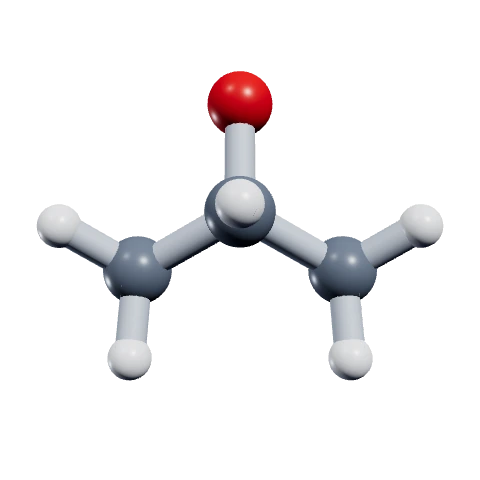


The number on the bottle tells you how much of the liquid is isopropyl alcohol and how much is water. Below are the specification limits from our own certificates for each strength, which strength fits which job, how to dilute 99% correctly (the usual recipe gets it slightly wrong), and what the percentage does not change.
What is the difference between 70%, 91% and 99% isopropyl alcohol?
Isopropyl alcohol (CAS 67-63-0) is the same molecule in every bottle; the strengths differ in how much water is mixed in. That water is the slower-evaporating part of the mixture, which is why a 70% film stays wet longer than a 99% one, and why the water left behind matters on electronics and optics. The table compares the four strengths we sell, using the limits on our own published sample Certificates of Analysis and the flash points on our Safety Data Sheets.
| Strength | What the % means | Water | Nonvolatile residue, max | Flash point |
|---|---|---|---|---|
| 70% USP Grade | 68.0–72.0% by volume | 28.0–32.0% by volume | 0.01% | 18–22°C |
| 91% USP Grade | 91.0–93.0% by volume | about 7–9% (by difference) | 0.005% | 14–18°C |
| 99% Technical Grade | 99.0% minimum by weight | 0.2% maximum | 5 mg per 100 mL | 12°C |
| 99.9% ACS Reagent Grade | 99.5% minimum by weight | 0.2% maximum | 0.001% | 12°C |
Which strength should you buy?
| Strength | Good fit | Not the right pick if |
|---|---|---|
| 70% | General wipe-downs where slower drying is fine | the surface is water-sensitive or must dry fast |
| 91% | General cleaning, degreasing, glass, adhesive residue | you are cleaning bare circuit boards or optics and can use 99% |
| 99% | Electronics, flux, resin prints, diluting to any lower strength | your method calls for a certified reagent |
| 99.9% | Lab and analytical work, precision optics | it is for general cleaning (you pay for a specification you will not use) |
Two things in that table surprise most buyers. First, the percentages are not all on the same scale: our 70% and 91% state concentration by volume, while our 99% and 99.9% state it by weight. By weight, a 70% by-volume solution is only about 62–63% isopropyl alcohol; the worked calculation is in Is Rubbing Alcohol the Same as Isopropyl Alcohol?. Second, the 99% grades leave the least behind: the residue limits are lower than for 70%, and there is almost no water to dry off.
Why do isopropyl alcohol percentages stop at 70%, 91% and 99%?
70% is the rubbing alcohol strength. The USP–NF monograph for Isopropyl Rubbing Alcohol says it contains NLT 68.0% and NMT 72.0% of isopropyl alcohol by volume, with the remainder consisting of water, with or without suitable stabilizers, perfume oils, and color additives. Our 70% USP Grade has the same 68.0–72.0% range, with water as the only other ingredient.
91% sits just above a wall in the chemistry. Isopropyl alcohol and water form an azeotrope at 87.7% isopropyl alcohol by weight, boiling at 80.37°C (PubChem), which is roughly 90% by volume. Ordinary distillation of a water mixture cannot go past that point, so a strength in the low 90s is the natural "wet" grade, and getting to 99% takes a different separation step. The full story is in why isopropyl alcohol stops at 91% and how isopropyl alcohol is made.
99% and 99.9% are the dry grades. If you see a 90% bottle, it is a by-volume strength between the two; check the label for "by volume" or "by weight" before comparing it with anything else.
What percent isopropyl alcohol is best for cleaning?
Pick the strength by how much water the job can tolerate, then by the specification you need.
| Job | Strength | Read more |
|---|---|---|
| Circuit boards, flux, connectors, thermal paste | 99% or 99.9% | Isopropyl alcohol for electronics |
| Wafers, MEMS, precision optics | 99.9% ACS Reagent | IPA in semiconductor manufacturing |
| Solar panels, MC4 connectors, cable terminations | depends on the part | Solar panel cleaning chemicals |
| Glass, mirrors, general hard surfaces | 70% or 91% | see the table above |
| Sticker and tape residue | 99%, as the clean-up wipe | How to remove sticker residue |
| Drying steel after a phosphoric acid rust dip | 99% | How to prevent flash rust |
| Windshield de-icer | 70% or 91%, mixed with water | DIY windshield de-icer |
| Making your own 70% or 91% | buy 99% and dilute | the dilution section below |
What is 91% isopropyl alcohol used for?
Mostly general cleaning: degreasing, glass, tools and adhesive residue, where you want it to dry faster than 70% and a trace of water is acceptable. On bare circuit boards, connectors and optics, 99% leaves less behind, and it is also the better starting point if you want to mix your own 70% or 91%.
Can I use isopropyl alcohol to disinfect?
We sell isopropyl alcohol as a chemical and solvent and make no germ-killing, disinfecting or antiseptic claims for any strength. Our isopropyl alcohol is sold as a chemical, not as an over-the-counter drug, so it is not for use on skin. If disinfecting is your goal, use a product whose label carries an EPA registration number and follow that label.
How do you dilute 99% isopropyl alcohol to 70% or 91%?
Measure the strong alcohol, then add water up to the final volume. Do not add a calculated volume of water: isopropyl alcohol and water shrink when they mix, so the two volumes do not add up.
Our own 70% shows the effect. Its formulation record lists its composition as 68.3 volumes of 99.9% isopropyl alcohol and 31.7 volumes of deionized water, and the reference result on the certificate is 70.2% by volume. Without shrinkage, those volumes would give only about 68.2%. Run the usual recipe the other way (707 mL of 99% plus 293 mL of water) and the batch comes out slightly stronger than 70%, because it ends up a little under 1,000 mL.
| Start with | To make | Measure | Add distilled or deionized water up to |
|---|---|---|---|
| 99% | 70% | 707 mL | 1,000 mL |
| 99% | 91% | 919 mL | 1,000 mL |
| 91% | 70% | 769 mL | 1,000 mL |
- Measure the isopropyl alcohol in a graduated cylinder and pour it into a container marked at the final volume.
- Add deionized or distilled water to just below the mark (tap water leaves mineral residue; see distilled vs deionized water).
- Mix, let it stand at room temperature, then top up to the mark and mix again.
- Close and label it with the strength and the date.
For other strengths and volumes, use our isopropyl alcohol dilution calculator or the step-by-step guide to making 70% isopropyl alcohol from 99%.
Is 70% isopropyl alcohol less flammable than 99%?
Not in any way that changes how you handle it. Our Safety Data Sheets give every strength the same classification, H225 Highly flammable liquid and vapor, with closed-cup flash points of 18–22°C for 70%, 14–18°C for 91% and 12°C for 99% and 99.9%. All of those are at or below room temperature, so every strength gives off vapor that can ignite at room temperature. Our 70% still ships as a Class 3 flammable liquid (UN1219).
- Storage: keep away from heat, hot surfaces, sparks and open flames, keep the container tightly closed, and store it in a well-ventilated place.
- Transfers: ground and bond the container and receiving equipment.
- Protection: chemical safety goggles or a face shield and chemical-resistant gloves, per section 8 of the SDS, with adequate ventilation.
- Exposure limits: OSHA PEL 400 ppm (8-hour average); NIOSH REL 400 ppm averaged over a shift, with a 500 ppm short-term limit; ACGIH TLV 200 ppm, with a 400 ppm short-term limit.
Read the SDS for the strength you buy: 70%, 91%, 99%.
USP, Technical or ACS: which grade do you need?
Grade and strength are separate choices. The grade names the specification the product is tested against: our 70% and 91% are USP Grade, our 99% is Technical Grade, and our 99.9% is ACS Reagent Grade. Choose USP where your process calls for the pharmacopeial specification, ACS where a lab method calls for a reagent, and Technical for cleaning and industrial use. More on grade names in understanding chemical grades, and on the other "rubbing alcohol", 1-propanol, in n-propyl alcohol vs isopropyl alcohol.
All four come in quarts through 275- and 330-gallon IBC totes; see every isopropyl alcohol size and grade, or what a 55-gallon drum weighs and costs to ship. A certificate for a specific lot is available on request. For other solvents, see Acetone Technical Grade and Methanol Technical Grade, and our aerospace cleaning application guides.
How we researched this
Concentrations, water content and residue limits come from the specification limits on our own published sample Certificates of Analysis for each strength. Those are sample documents showing specification limits and reference values; they are not certificates for any lot or for stock on hand. Flash points, hazard classes and handling come from our Safety Data Sheets. The rubbing alcohol definition is quoted from the public preview of the USP–NF monograph for Isopropyl Rubbing Alcohol; the azeotrope and exposure limits come from PubChem (National Library of Medicine), which compiles NIOSH, OSHA and ACGIH values. Video visuals are AI-generated illustrations. Last reviewed 5 November 2026. This is product information, not medical, legal or regulatory advice.
References
- Isopropyl Rubbing Alcohol, USP–NF monograph (public preview), United States Pharmacopeia.
- Isopropanol (CID 3776), PubChem, National Library of Medicine.
- Isopropyl alcohol, NIOSH Pocket Guide to Chemical Hazards.
- Isopropyl alcohol, OSHA Occupational Chemical Database.
- Isopropyl Alcohol 70% USP Grade, sample Certificate of Analysis, Alliance Chemical.
- Isopropyl Alcohol 91% USP Grade, sample Certificate of Analysis, Alliance Chemical.
- Isopropyl Alcohol 99% Technical Grade, sample Certificate of Analysis, Alliance Chemical.
- Isopropyl Alcohol 99.9% ACS Reagent Grade, sample Certificate of Analysis, Alliance Chemical.
Related: What Happens If You Drink Rubbing Alcohol? Why Your Body Turns It Into Acetone, and What to Do — concentration matters if it is swallowed too: a mouthful of 99% carries more isopropyl alcohol than a mouthful of 70%.
Frequently asked questions
What is the difference between 70%, 91% and 99% isopropyl alcohol?
The water. Our 70% isopropyl alcohol is 28 to 32% water by volume, our 91% is about 7 to 9%, and our 99% grades allow no more than 0.2% water. Use 99% where water must not be left behind, such as electronics, optics and resin, and 70% or 91% for general cleaning. All three are highly flammable liquids.
What percentage is rubbing alcohol?
The USP monograph for Isopropyl Rubbing Alcohol sets it at 68.0 to 72.0% isopropyl alcohol by volume, with the rest water, and allows stabilizers, perfume oils and color additives. Bottles labeled 91% are also sold; the percentage on the label is normally by volume.
Which isopropyl alcohol percentage should I use to clean electronics?
Use 99% or 99.9%. They contain almost no water (0.2% maximum on our specifications), so there is very little left to dry off. Power the device off, apply the alcohol to a lint-free wipe rather than spraying the device, and let it evaporate completely before switching it back on.
How do I dilute 99% isopropyl alcohol to 70%?
Measure 707 mL of 99% isopropyl alcohol, then add distilled or deionized water up to a final volume of 1,000 mL, mix, and top up again. Do not simply add 293 mL of water: alcohol and water shrink when they mix, so that batch comes out slightly stronger than 70%.
Is 70% isopropyl alcohol less flammable than 99%?
Not in a way that changes handling. Our Safety Data Sheets classify every strength as a highly flammable liquid (H225). Closed-cup flash points are 18 to 22°C for 70%, 14 to 18°C for 91% and 12°C for 99%, all at or below room temperature. Keep every strength away from heat, sparks and flames.
Is 99% isopropyl alcohol measured the same way as 70%?
No. Our 70% and 91% state concentration by volume, while our 99% and 99.9% state it by weight. By weight, a 70% by-volume solution is only about 62 to 63% isopropyl alcohol, so compare labels on the same basis.
Can I use isopropyl alcohol to disinfect?
We sell isopropyl alcohol as a chemical and solvent and make no germ-killing, disinfecting or antiseptic claims for it, and it is not sold as an over-the-counter drug. For disinfecting, use a product whose label carries an EPA registration number and follow that label.
Related Chemical Collections
About the author
Andre Taki
This article is for informational purposes only.


