



🔧 Cleaning electronics? See Isopropyl Alcohol for Electronics — the right concentration for PCBs, flux, and thermal paste (and why 70% is the wrong call).
Using isopropyl alcohol for semiconductors, MEMS, or precision optics?
See Isopropyl Alcohol in Semiconductor Manufacturing — how IPA cleans + Marangoni-dries silicon wafers, and which grade (99% Technical vs 99.9% ACS) fits the job.
There are two propanols, and most people only know one. n-Propyl alcohol (1-propanol) is the linear-chain primary alcohol that contract manufacturers, print shops, and ACS-grade labs prefer for a long list of jobs where isopropyl is "close, but not quite." A field guide to 1-propanol: chemistry, the side-by-side comparison with isopropyl, six industrial uses, grade selection, and how to specify it on a purchase order.
Walk into any drugstore and you will find isopropyl alcohol — 70%, 91%, and 99% — on the shelf marked "rubbing alcohol." What you will not find is its straight-chain cousin, n-propyl alcohol, even though it is a standard reference alcohol in European hand rub testing and a pharmaceutical process solvent worldwide. The two molecules share the same formula, the same atoms, and almost the same molecular weight, yet they sit on opposite sides of the consumer-versus-industrial divide for reasons that have more to do with mid-century paperwork than with chemistry.
For anyone spec'ing a primary alcohol — a contract manufacturer, a print shop, a hospital pharmacy compounder, a lab manager — n-propyl alcohol is often the right pick, and the wrong one to confuse with isopropyl. We stock n-Propyl Alcohol (1-Propanol) in two purity grades and field these specification questions every week. This guide answers them in one place: what 1-propanol actually is, how it compares atom-for-atom to 2-propanol, which six industries use it daily, how to choose between Technical and ACS Grade, and how to substitute it for isopropyl without surprises.
What is the difference between propyl and isopropyl?
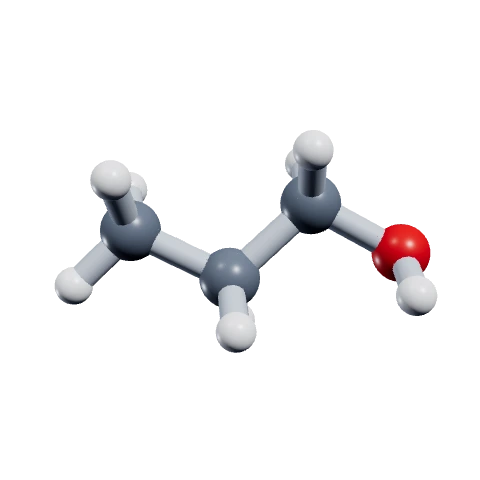
Both are three-carbon groups (C3H7) taken from propane; the difference is the carbon they attach through. A propyl (n-propyl) group attaches through an end carbon, -CH2CH2CH3, and an isopropyl group attaches through the middle carbon, -CH(CH3)2. Put an -OH on each and you get two different alcohols with the same formula, C3H8O.
The attachment point decides the chemistry. The isopropyl attachment carbon holds two other carbons, which is why isopropyl is also called sec-propyl (secondary propyl) and why isopropyl alcohol is a secondary alcohol that oxidizes to acetone. n-Propyl alcohol is a primary alcohol and oxidizes to propanal, then propionic acid. The same naming runs through other compounds: isopropyl acetate carries the branched group, n-propyl acetate the straight one. So "isopropyl vs propyl" questions about a group and "isopropyl vs propyl alcohol" questions come down to the same picture: end carbon or middle carbon.
Is n-propanol the same as isopropanol?
No. n-Propanol (1-propanol, CAS 71-23-8) and isopropanol (2-propanol, CAS 67-63-0) are structural isomers: the same atoms arranged into two different molecules, with different CAS numbers, different DOT identification numbers (UN1274 vs UN1219) and different exposure limits. What is the same: isopropanol, isopropyl alcohol, 2-propanol and IPA are four names for one chemical.
The word "propanol" on its own is ambiguous, so a label, SDS or purchase order should carry the CAS number. Other names in use, per PubChem: n-propanol is also sold as 1-propanol, propan-1-ol, propyl alcohol, n-propyl alcohol and ethyl carbinol; isopropanol appears as propan-2-ol, sec-propyl alcohol, dimethylcarbinol and 1-methylethanol. Neither is the alcohol in drinks, which is ethanol (C2H6O).
What should you never mix with isopropyl or n-propyl alcohol?
Keep both away from strong oxidizers. NIOSH lists the incompatibles for isopropyl alcohol as strong oxidizers, acetaldehyde, chlorine, ethylene oxide, acids and isocyanates, and for n-propyl alcohol as strong oxidizers. HSDB records that isopropanol forms explosive mixtures with hydrogen peroxide, and it is a peroxide-forming solvent in long storage, so date opened containers and do not distill old stock to dryness.

| Attribute | n-Propyl Alcohol (1-Propanol) | Isopropyl Alcohol (2-Propanol) |
|---|---|---|
| IUPAC name | Propan-1-ol | Propan-2-ol |
| Structural class | Primary alcohol | Secondary alcohol |
| Boiling point | 97.2°C | 82.3°C |
| Structure | CH3CH2CH2OH (straight chain) | (CH3)2CHOH (branched) |
| CAS number | 71-23-8 | 67-63-0 |
| Vapor pressure at 25°C | 21.0 mm Hg | 45.4 mm Hg |
| Flash point, closed cup | 15 to 23°C (59 to 74°F), by source | 12°C (53°F) |
| DOT identification number | UN1274, Class 3 | UN1219, Class 3 |
| ICH Q3C residual solvent class | Class 3 | Class 3 |
| Density (g/mL) | 0.803 | 0.786 |
| Oxidation product | Propanal → propionic acid (carboxylic) | Acetone (ketone) |
| Hepatic metabolism | Via alcohol dehydrogenase → propionate | Via alcohol dehydrogenase → acetone |
| FDA antiseptic monograph | Not an ingredient in FDA's OTC hand rub review | In FDA's OTC review at 70 to 91.3% (1994 tentative monograph; final action deferred in 2019) |
| EU hand rub test standards | 60% v/v is the reference alcohol in EN 12791 (surgical hand rub test) | 60% v/v is the reference alcohol in EN 1500 (hygienic hand rub test) |
| Drugstore availability | Industrial / pharma channel only | Widely retail |
| NIOSH REL (TWA) | 200 ppm | 400 ppm |
| OSHA PEL (TWA) | 200 ppm | 400 ppm |
| NIOSH IDLH | 800 ppm | 2,000 ppm |
Why n-propyl is a European hand rub reference but not a US OTC ingredient
The honest answer is regulatory history, not chemistry. The European hand rub test standards use both alcohols as yardsticks: EN 12791, the surgical hand rub test, uses 60% v/v n-propanol as its reference, and EN 1500, the hygienic hand rub test, uses 60% v/v 2-propanol (isopropanol). In the United States, alcohol hand rubs sit in FDA's OTC Drug Review, which covers ingredients marketed on or before May 11, 1972. The 1994 tentative final monograph listed isopropyl alcohol at 70 to 91.3%, and FDA's 2019 final rule on consumer rubs deferred its decision on ethanol, isopropyl alcohol and benzalkonium chloride. n-Propyl alcohol is not among them, and an ingredient outside the review needs FDA approval, through a new drug application or, since the 2020 OTC monograph reform, an OTC monograph order, before it can be sold as a US hand rub.
For US procurement, this means n-propyl alcohol is reserved for industrial and pharmaceutical uses: a process solvent in API manufacturing, a coating and ink carrier, and a cosmetics-grade fragrance and emollient solvent. The "consumer antiseptic" application that drives most isopropyl tonnage simply isn't the lane n-propyl operates in.
When to pick n-propyl over isopropyl. If your downstream process needs (a) a higher boiling point for slower evaporation, (b) a primary-alcohol oxidation pathway (propanal vs acetone), or (c) an ICH Q3C Class 3 process solvent, n-propyl is the right call. If you need a US-retail OTC antiseptic, a fast-evaporating cleaner for electronics, or a cheap solvent for general cleaning, isopropyl is correct.
Why isn't n-propyl alcohol in the drugstore?
Why isn't 1-propanol sold next to rubbing alcohol at US pharmacies? Short answer: a paperwork accident from 1972. When the FDA wrote the rules for over-the-counter antiseptics, it kept the two alcohols already in wide US use (ethanol and isopropanol) and said anything new had to go through a full New Drug Application review; since the 2020 CARES Act reform, an OTC monograph order is a second route. No manufacturer has taken n-propanol through either, so it never got onto the consumer aisle here, even though European hand rub testing uses it as a reference alcohol.
The chemistry was always fine. The chemistry is still fine. n-Propyl alcohol is in printing inks you read every day, perfumes you smell, lacquers on furniture you own, and pharmaceuticals you take. You just never see it on the ingredient line because it sits one step upstream of the finished product.
What is n-propyl alcohol used for? 6 industries that run on 1-propanol
Outside the drugstore, 1-propanol is a workhorse solvent. Each of these six sectors uses it as the standard input for a different downstream process.

n-Propyl alcohol is a process solvent used in active pharmaceutical ingredient (API) synthesis and crystallization. It is a Class 3 ICH Q3C residual solvent — the lowest-toxicity classification — making it acceptable in finished pharmaceuticals at higher residual limits (5,000 ppm) than Class 2 solvents like methanol or acetonitrile.
n-Propyl alcohol is one of the workhorse solvents in flexographic and rotogravure printing. Its 97.2°C boiling point gives press operators a slower drying tail than ethanol or isopropyl, improving registration and dot gain on high-speed presses. Ink chemists also exploit 1-propanol's superior solvency for nitrocellulose and shellac resins. It evaporates cleanly without leaving the residue isopropyl can leave on metalized substrates.
1-Propanol appears in cosmetic fragrance carriers, hairspray formulations, aerosol propellant blends, and skin-care emollient delivery systems. It is on the EU CosIng database as approved for cosmetic use and is widely cited in formulary references. Its slower evaporation rate vs isopropyl lets fragrance top-notes develop more fully on the skin before the carrier flashes off.
n-Propyl alcohol is used as a flow-control solvent in nitrocellulose lacquers, polyurethane coatings, and specialty wood finishes. Its higher boiling point relative to ethanol or isopropyl gives a smoother leveling profile, reducing orange-peel defects. It is fully water-miscible, which makes it valuable as a solvent bridge in formulations transitioning from solvent-borne to water-borne chemistry.
1-Propanol's polarity sits between ethanol and acetone, making it useful for extracting moderately polar phytochemicals — alkaloids, glycosides, flavonoids, and certain essential-oil fractions — that don't partition cleanly with ethanol. As a Class 3 ICH solvent, it is acceptable in nutraceutical processing where residual-solvent limits matter. Botanical-extract labs increasingly specify ACS-grade 1-propanol for analytical-method reference and small-batch finished-product work.
In contract electronics manufacturing and optics work, n-propyl alcohol serves as a precision-cleaning solvent where isopropyl evaporates too quickly to fully lift soils. The slower flash gives the wipe time to dissolve and pick up residues. ACS-grade 1-propanol's low water content (≤0.2%) and low non-volatile-residue (NVR) make it suitable for cleanroom-class wipes on optics and lens surfaces.
Is n-propyl alcohol safer than isopropyl alcohol?
Short answer: n-propyl alcohol has the tighter workplace limits. OSHA's PEL is 200 ppm against 400 ppm for isopropyl, NIOSH's IDLH is 800 ppm against 2,000 ppm, and NIOSH gives n-propyl a skin notation. Its rat oral LD50 is 1.87 g/kg (HSDB). Both are Class 3 flammable liquids handled routinely with ventilation, gloves and eye protection; read the SDS before use.
The numbers that actually matter
| Concern | n-Propyl Alcohol | Isopropyl Alcohol |
|---|---|---|
| Workplace air limit (8-hour avg) | 200 ppm | 400 ppm |
| Rat oral LD50 | 1.87 g/kg (HSDB) | 11.3 g/kg (T3DB); published values vary by source |
| What the body turns it into | Propanal → propionic acid | Acetone |
| Skin sensitizer? | No | No |
| Cancer classification | Not classified by IARC; ACGIH A4 | IARC Group 3 (1999); ACGIH A4 |
| Short-term limit (NIOSH, 15 min) | 250 ppm, with skin notation | 500 ppm |
| Immediately dangerous (NIOSH IDLH) | 800 ppm | 2,000 ppm (10% of the LEL) |
Neither alcohol is a classified carcinogen. n-Propyl alcohol does not appear on IARC's list of classified agents, and IARC evaluated isopropyl alcohol as Group 3, not classifiable, in 1999. (IARC does list isopropyl alcohol manufacture by the strong-acid process as Group 1; that is an exposure inside the production plant, not a property of the product.) ACGIH rates both alcohols A4, not classifiable as a human carcinogen, and EPA's provisional assessment for n-propanol found inadequate information to assess carcinogenic potential. The hazards that drive handling are flammability and vapor exposure, covered below.
n-Propyl alcohol grades: Technical vs ACS — which do you need?
Alliance Chemical supplies n-Propyl Alcohol in two grades: Technical (high-purity industrial spec) and ACS Grade (American Chemical Society certified). Both are CAS 71-23-8 and both clear >99% assay; the difference is in specific impurity certifications and in which downstream processes accept each.
| Specification | Technical Grade | ACS Grade |
|---|---|---|
| Assay (GC area %) | ≥99.0% | ≥99.5% |
| Water content | ≤0.5% | ≤0.2% |
| Non-volatile residue (NVR) | ≤10 ppm | ≤5 ppm |
| Acidity (as propionic acid) | ≤0.002% | ≤0.001% |
| Aldehydes & ketones | Pass test | ≤0.001% as carbonyl |
| Color (APHA) | ≤10 | ≤10 |
| Refractive index (20°C) | 1.384–1.386 | 1.385 |
| 2-Propanol contamination | ≤0.05% | ≤0.01% |
| Certificate of Analysis | Per lot | Per lot, ACS-method certified |
| Typical buyers | Coatings, inks, cleaning, extraction | Pharma compounding, ACS-spec labs, electronics |
For most industrial applications — printing inks, coatings, general extraction, surface cleaning — Technical Grade is the right pick at the right price. ACS Grade is justified when you need traceable certification to ACS test methods (the canonical reference for laboratory reagent purity), when your downstream process specifies "ACS grade" by name, or when trace 2-propanol contamination would interfere with analytical work or compounded pharmaceutical specifications.
Procurement rule of thumb. If your method, SOP or customer spec calls for ACS reagent-grade specifications, order ACS Grade. ACS Grade is not a USP-NF or Ph. Eur. compendial grade, so if a pharmacopeia reference appears in your spec, ask us before you order. If the downstream is a finished industrial product (coating, ink, cleaning concentrate) where the alcohol is consumed in process, Technical Grade is correct and cost-effective.
Substituting n-propyl for isopropyl: what changes downstream
If you're considering swapping isopropyl alcohol for n-propyl alcohol in an existing formulation, the substitution is rarely 1:1 by volume. Four properties shift in ways that affect process behavior:
- Evaporation rate. n-Propyl evaporates ~50% slower than isopropyl at room temperature (vapor pressure 21.0 mm Hg vs 45.4 mm Hg at 25°C). For a fast-drying wipe or a quick-flash cleaner, the substitution will leave residue lingering longer. For a slow-tail printing ink, that's the point.
- Solvency profile. n-Propyl's slightly higher polarity changes resin solubility. Nitrocellulose and shellac dissolve better; some acrylic resins dissolve worse. Always run a small-batch compatibility test before bulk substitution.
- Azeotrope with water. Both alcohols form positive azeotropes with water, but at different compositions. n-Propyl/water azeotrope is 71.7% n-propyl by weight at 87.7°C; isopropyl/water azeotrope is 87.7% isopropyl by weight at 80.4°C. If your process relies on azeotropic distillation, the new operating point changes both temperature and composition.
- Regulatory paperwork. Swapping in n-propyl changes your SDS, your TSCA inventory CASRN, your DOT shipping description (both are Class 3 flammable liquids, but n-propyl is UN1274 and isopropyl is UN1219, so the proper shipping name and UN number change on every document), and any USP/EU monograph references. For pharma and food-contact processes, document the change formally.
Approximate substitution table for common uses
| Use case | Isopropyl spec | n-Propyl equivalent | Notes |
|---|---|---|---|
| Flexo printing ink solvent | 10–20% IPA | 8–15% n-propyl | Slower dry; reduce by ~15–20% |
| Lacquer thinner blend | IPA portion | Equal weight n-propyl | Improves flow control; check resin compatibility |
| Cosmetic fragrance carrier | IPA in alcohol-water blend | 1:1 n-propyl swap | Longer top-note development |
| Electronics precision wipe | 99% IPA | ACS-grade n-propyl | Slower flash, better residue lift |
| API crystallization solvent | 2-propanol | 1-propanol | Different crystal habit; recharacterize |
Handling, storage, and shipping n-propyl alcohol
n-Propyl alcohol is a flammable liquid with a closed-cup flash point of 15 to 23°C depending on the source, meaning a sealed bottle in a warm warehouse already has ignitable vapor in the headspace. Handling and storage are essentially the same as isopropyl alcohol, with one tightening: n-propyl's workplace air limits are half those of isopropyl, and NIOSH gives it a skin notation.
PPE for routine use
Splash goggles, nitrile or butyl gloves, lab coat. Add a face shield when pouring more than five gallons. A NIOSH-approved organic-vapor respirator only if the air smells of solvent and ventilation cannot clear it.
Storage rules
- Tightly closed containers, cool location, away from heat and ignition sources.
- Compatible with steel, glass, polyethylene, and PTFE. Avoid prolonged contact with copper or brass.
- Keep away from oxidizers (peroxides, nitric acid) and strong acids.
- Bond and ground all transfer equipment for any quantity above five gallons.
The static-electricity surprise. Both n-propyl and isopropyl alcohol build up static charge when poured because the liquid is electrically very poor at carrying it away. The combination of flammable vapor and a static spark has started real-world fires during simple container-to-container pours. The fix is mechanical: physically bond the two containers with a wire clip before you start pouring. Standard practice in any operation that moves five gallons or more at a time.
Where to buy n-propyl alcohol: pack sizes & specifications
Alliance Chemical stocks n-Propyl Alcohol in both Technical Grade and ACS Grade, supporting orders from single 1-quart laboratory bottles through 55-gallon drums and small-tote quantities. We ship from our Texas warehouse via LTL freight for bulk and via standard ground for individual containers. Hazmat documentation is included with every shipment.

| Pack size | Container | Best for |
|---|---|---|
| 1 quart | Amber glass laboratory bottle | Bench-scale lab work, method development, analytical reference |
| 1 gallon | Amber glass or steel can | Small batch compounding, pilot runs, R&D |
| 5 gallon | Steel pail (UN-rated) | Small-volume production, contract manufacturing |
| 55 gallon | Steel drum (UN-rated) | Full-scale industrial production |
| Bulk tote (270 gal) | UN-rated IBC tote | High-volume continuous-use processes |
n-Propyl Alcohol from Alliance Chemical
Both Technical Grade and ACS Grade, with the lot CoA on request at no charge and same-day quote turnaround for industrial accounts.
Shop n-Propyl AlcoholReferences & Authoritative Sources
Chemical identity, properties, and safety data sourced from the U.S. National Library of Medicine's PubChem database — the authoritative open-chemistry data resource maintained by the National Institutes of Health.
- PubChem Compound Summary: 1-Propanol (CID 1031) — National Center for Biotechnology Information, U.S. National Library of Medicine. CAS 71-23-8.
- 1-Propanol — thermophysical data — NIST Chemistry WebBook, SRD 69, National Institute of Standards and Technology. Accessed 2026-09-04.
- PubChem Compound Summary: Isopropanol (CID 3776) — National Center for Biotechnology Information, U.S. National Library of Medicine. Accessed 2026-09-04.
- Isopropanol — thermophysical data — NIST Chemistry WebBook, SRD 69, National Institute of Standards and Technology. Accessed 2026-09-04.
- Q3C Tables and List, Guidance for Industry (ICH Revision 3, June 2017), U.S. Food and Drug Administration. Accessed 2026-09-28.
- Safety and Effectiveness of Consumer Antiseptic Rubs, 84 FR 14847 (April 12, 2019), U.S. Food and Drug Administration, Federal Register. Accessed 2026-09-28.
- IARC Monographs: List of Classifications, International Agency for Research on Cancer. Accessed 2026-09-28.
- Evaluation of World Health Organization-Recommended Hand Hygiene Formulations (EN 12791 reference alcohol), Emerging Infectious Diseases, via PubMed Central, U.S. National Library of Medicine. Accessed 2026-09-28.
- Over-the-Counter (OTC) Drug Review: OTC Monograph Reform in the CARES Act, U.S. Food and Drug Administration. Accessed 2026-09-28.
Sourcing for this job? See our rubbing alcohol supplier page — every grade and strength we stock, with live pricing from quarts through drums and totes.
Related: How Isopropyl Alcohol Is Made: From Refinery Gas to the First Petrochemical Ever Sold — the propylene route, the 1920 origin, and what Technical, USP and ACS Reagent Grade actually certify.
Key numbers and sources
| Fact | Value | Source |
|---|---|---|
| CAS number (n-Propyl alcohol) | 71-23-8 | pubchem.ncbi.nlm.nih.gov |
| Boiling point (n-Propyl alcohol) | 97.2°C | pubchem.ncbi.nlm.nih.gov |
| Density (n-Propyl alcohol) | 0.803 g/mL | pubchem.ncbi.nlm.nih.gov |
| Boiling point (isopropyl alcohol) | 82.3°C | pubchem.ncbi.nlm.nih.gov |
| Density (isopropyl alcohol) | 0.786 g/mL | pubchem.ncbi.nlm.nih.gov |
| NIOSH REL (TWA) for n-Propyl alcohol | 200 ppm | pubchem.ncbi.nlm.nih.gov |
| OSHA PEL (TWA) for isopropyl alcohol | 400 ppm | pubchem.ncbi.nlm.nih.gov |
Frequently asked questions
What is the difference between n-propyl alcohol and isopropyl alcohol?
n-Propyl alcohol (1-propanol, CAS 71-23-8) is a primary alcohol with the -OH on an end carbon; isopropyl alcohol (2-propanol, CAS 67-63-0) is a secondary alcohol with the -OH on the middle carbon. They share the formula C3H8O but differ in boiling point (97.2 °C vs 82.3 °C), evaporation rate, oxidation product (propanal vs acetone), DOT number (UN1274 vs UN1219) and workplace air limit (200 vs 400 ppm).
Is n-propanol the same as isopropanol?
No. n-Propanol (1-propanol) and isopropanol (2-propanol) are structural isomers: the same atoms arranged into two different molecules, with different CAS numbers (71-23-8 vs 67-63-0), different UN numbers and different exposure limits. Isopropanol, isopropyl alcohol, 2-propanol and IPA are four names for the same chemical. The word 'propanol' alone is ambiguous, so specify by CAS number on labels and purchase orders.
What is the chemical formula of n-propyl alcohol?
n-Propyl alcohol has the molecular formula C3H8O and the structural formula CH3-CH2-CH2-OH. Its IUPAC name is propan-1-ol, and its CAS number is 71-23-8. Molecular weight is 60.10 g/mol. Isopropyl alcohol has the same molecular formula and weight but the structure (CH3)2CHOH.
What are other names for 1-propanol and isopropyl alcohol?
Per PubChem, 1-propanol (CAS 71-23-8) is also called n-propanol, n-propyl alcohol, propyl alcohol, propan-1-ol and ethyl carbinol. Isopropyl alcohol (CAS 67-63-0) is also called isopropanol, 2-propanol, propan-2-ol, IPA, sec-propyl alcohol, dimethylcarbinol and 1-methylethanol. Because 'propyl alcohol' and 'propanol' are used loosely, the CAS number is the only unambiguous identifier.
What is n-propyl alcohol used for?
n-Propyl alcohol is used as a pharmaceutical process solvent (an ICH Q3C Class 3 residual solvent), printing-ink carrier (flexographic and gravure), cosmetic fragrance solvent, coatings flow agent, natural-product extraction solvent, and electronics precision-cleaning solvent. Its slower evaporation than isopropyl alcohol is the usual reason to pick it. It is also a coupling solvent that mixes fully with water, which lets formulators bridge water-borne and solvent-borne systems.
Is n-propyl alcohol safer than isopropyl alcohol?
By exposure limits, n-propyl alcohol is the more hazardous of the two: its OSHA PEL and NIOSH REL are 200 ppm versus 400 ppm for isopropyl, its NIOSH IDLH is 800 ppm versus 2,000 ppm, and NIOSH gives it a skin notation. Its rat oral LD50 is 1.87 g/kg (HSDB). Neither is a classified carcinogen: IARC has not classified n-propanol and rates isopropanol Group 3. Both are Class 3 flammable liquids; read the SDS before use.
What grade of n-propyl alcohol should I buy?
Order ACS Grade if your method, SOP or customer spec calls for ACS reagent-grade specifications. ACS Grade is not a USP-NF or Ph. Eur. compendial grade, so ask us first if your spec cites a pharmacopeia. Order Technical Grade for general industrial use such as printing inks, coatings, cleaning and extraction, where 99% GC purity is sufficient. Need the Certificate of Analysis? Just ask, we send it at no charge.
Can I substitute n-propyl alcohol for isopropyl alcohol?
Sometimes, but the substitution is rarely 1:1 by volume. n-Propyl evaporates about half as fast as isopropyl (vapor pressure 21.0 vs 45.4 mm Hg at 25 °C), has slightly higher polarity that changes resin solubility, and forms a different water azeotrope. Run a small-batch compatibility test first, and update the SDS, UN number and any regulated-process documentation when you switch.
Why is n-propyl alcohol not sold as rubbing alcohol?
It is a US regulatory artifact. Alcohol hand rubs are handled in FDA's OTC Drug Review, which covers ingredients marketed on or before May 11, 1972. Ethanol and isopropyl alcohol are in that review (FDA deferred its final decision on both in a 2019 rule), but n-propyl alcohol is not, so a US hand rub based on it would need FDA approval through a new drug application or an OTC monograph order under the 2020 CARES Act reform.
What should you never mix with isopropyl alcohol?
NIOSH lists the incompatibles for isopropyl alcohol as strong oxidizers, acetaldehyde, chlorine, ethylene oxide, acids and isocyanates; for n-propyl alcohol it lists strong oxidizers. HSDB records that isopropanol forms explosive mixtures with hydrogen peroxide, and isopropanol can form peroxides in long storage. Store both away from oxidizers and ignition sources, and check the SDS incompatibility section before combining either with another chemical.
How do I store n-propyl alcohol safely?
Store in tightly closed UN-rated containers in a cool, well-ventilated area away from ignition sources and oxidizers. n-Propyl alcohol is a Class 3 flammable liquid (DOT UN 1274) with a closed-cup flash point reported between 15 and 23 °C depending on the source. Bond and ground all transfer equipment for quantities above 5 gallons to prevent static-discharge ignition. Compatible with steel, glass, polyethylene, and PTFE; avoid prolonged contact with copper and brass.
Related Chemical Collections
About the author
Andre Taki
This article is for informational purposes only.


