

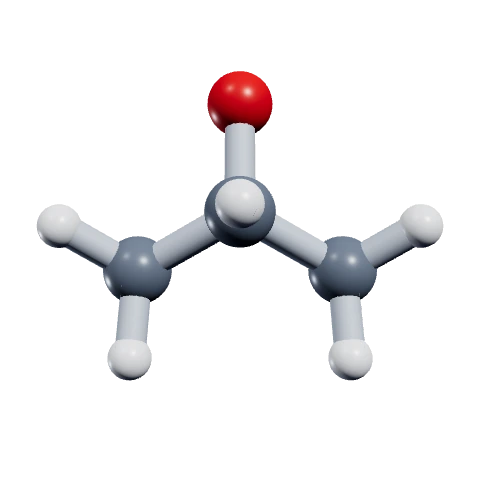


Someone finds a gallon of isopropyl alcohol at the back of a cabinet, the date on the label passed two years ago, and they want to know if it is still any good. We get some version of that question every week, about everything from a quart bottle to a half-used drum. The short answer is that the alcohol has not gone bad. The longer answer is more useful: depending on its strength, an opened container of isopropyl alcohol drifts in one of two opposite directions, and the physics that decides which way is the same physics that makes 91% a standard grade.
The short answer
Isopropyl alcohol is a simple, stable molecule. It does not ferment, it does not grow anything, and it does not break down into something else sitting in a sealed container at room temperature. Our own safety data sheets put it plainly in Section 10: stable under recommended storage conditions. A tightly sealed, factory-filled container that has been kept out of heat and sunlight will usually still meet its original specification years after it was filled.
The trouble starts when the container is opened. Isopropyl alcohol and water are completely miscible and both evaporate at room temperature, and the two do not leave at the same rate. Every time the cap comes off, the ratio in the bottle moves a little. Leave the cap loose, or pour it into an open tray, and it moves a lot.
| Situation | What changes | What to do |
|---|---|---|
| Sealed, original container, kept cool and dark | Essentially nothing | Use it. For regulated work, check the lot's certificate for its dates |
| Opened 70%, cap kept tight | Slow loss of alcohol with each opening | Check specific gravity if strength matters |
| Opened 70%, cap loose or left off | Alcohol evaporates faster than water; the solution gets weaker | Test it, or replace it |
| Opened 99% or ACS reagent, humid room | Picks up water from the air | Karl Fischer test before any water-sensitive job |
| Any strength, cloudy, colored or leaves residue | Contaminated, not aged | Do not use it; dispose of it properly |
| Years old, repeatedly opened, partly empty | Concentration drift; for 91% and stronger, possible peroxide formation | Do not heat, distill or evaporate it to dryness |
Why the bottle has a date at all
If the alcohol does not go bad, why is there an expiration date stamped on every bottle at the pharmacy? Because that bottle is not legally just a solvent. Rubbing alcohol sold for first aid is an over-the-counter drug in the United States. It is marketed under FDA's first aid antiseptic monograph (M003), which covers isopropyl alcohol from 50% to 91.3% by volume in water. It carries a Drug Facts panel, and it is made under FDA's current good manufacturing practice regulations.
Under 21 CFR 211.137, a drug product "shall bear an expiration date determined by appropriate stability testing," so that it meets its standards of identity, strength, quality and purity at the time of use. The rule also says FDA will not enforce it for over-the-counter products whose labels carry no dosage limitations and that are stable for at least three years. Rubbing alcohol labels give directions such as "apply 1 to 3 times daily," and in practice the bottles on the shelf are dated.
So the date is a promise, not a prediction of spoilage. It says the manufacturer has shown that the sealed product stays inside its labeled strength until at least that day. Retail bottles are commonly dated about two to three years from manufacture. That is a stability window the manufacturer chose to test and stand behind, not the moment something happens to the liquid.
If you use rubbing alcohol as a first-aid product, follow the label date. That date is the only strength claim the manufacturer is making, and past it they are not making one.
Industrial isopropyl alcohol works differently. A drum of 99% technical grade sold as a solvent is not a drug product, so no regulation writes a date on it. What stands behind it is the lot's Certificate of Analysis, which lists the specification the lot was released against and the lot's dates. When a process is sensitive to concentration or water, that certificate, plus a test of what is in the container today, is what tells you whether the material is still fit for the job. You can see the specifications we release against on our sample certificates for 70% USP, 99% technical and 99.9% ACS reagent.
One distinction matters here. Our Isopropyl Alcohol 70% USP is sold as a chemical that meets the USP monograph specifications. It is not labeled or sold as an over-the-counter first-aid drug, and the drug-labeling rules above describe the retail bottle, not a drum of solvent.
What actually happens inside an opened bottle
Here is the part the label never explains. Whether an opened container gets weaker or wetter depends on which side of the isopropanol–water azeotrope it starts on.
An azeotrope is a mixture whose vapor has exactly the same composition as the liquid underneath it. For isopropyl alcohol and water it sits at 87.7% isopropanol by weight, roughly 91% by volume, boiling at 80.37 °C. We wrote the whole story of that number in Why Isopropyl Alcohol Stops at 91%, because it is the reason distillation cannot make anything stronger. It also decides how an open bottle ages.
above 87.7 wt% → vapor richer in water → liquid gets drier, but it also absorbs moisture
70% gets weaker
Seventy percent by volume is well below the azeotrope. On that side of the curve, the vapor above the liquid carries a larger share of isopropanol than the liquid itself does. That is partly because isopropanol is the more volatile of the two, at about 33 mmHg of vapor pressure at 20 °C against 17.5 mmHg for water, so every bit of evaporation removes alcohol out of proportion to water. The liquid left behind is a little weaker each time.
In a sealed bottle that effect is tiny, because the headspace saturates and evaporation stops. In a bottle that is opened daily, stored half-empty, or has a cracked cap, it adds up. A tray or open dish of 70% left out overnight is a different liquid by morning. This is why the USP specification for Isopropyl Rubbing Alcohol is a range, 68.0% to 72.0% by volume, and why the bottom of that range is what an aged, much-opened bottle drifts toward and eventually through.
91% barely moves on composition
Ninety-one percent by volume sits close to the azeotrope itself, so the vapor leaving it is close to the same composition as the liquid. Published measurements at 60 °C show how narrow the gap is: a liquid at an isopropanol mole fraction of 0.63, a little under 91% by volume, gives off vapor at 0.66, while a liquid near 70% gives off vapor with roughly half again as much isopropanol as it contains. It evaporates more nearly as a unit, losing volume rather than strength. It is not immune: it still absorbs water from humid air, and the azeotrope composition shifts somewhat with temperature, but of the three common strengths it is the one whose concentration drifts least from evaporation alone.
99% gets wetter
Above the azeotrope, the direction reverses. The vapor over 99% isopropyl alcohol is richer in water than the liquid, so evaporation by itself would slowly dry it. In practice that is not what happens, because isopropyl alcohol is hygroscopic, as manufacturers' safety data sheets note: it pulls water vapor out of the surrounding air and dissolves it. On a humid day an open container of 99% gains water faster than evaporation could remove it.
The amounts involved are small in absolute terms and large relative to the specification. Our 99% technical grade and our 99.9% ACS reagent grade are both released with water at 0.2% maximum. Reference results on those certificates run well below that, at 0.08% and 0.04%. A container that has been opened again and again through a Texas summer can pass 0.2% without any visible change at all, and for work where water matters, such as electronics cleaning, analytical dilutions or water-sensitive reactions, that is the difference between in spec and out.
The container decides more than the calendar. Headspace is the enemy. A drum drawn down to a quarter full holds a large volume of air that trades moisture and vapor with the liquid every time it breathes. If you use isopropyl alcohol slowly, buy it in the size you will finish, or decant into smaller full containers with tight caps.
What about the alcohol itself breaking down?
Isopropanol is a secondary alcohol, and secondary alcohols can oxidize to ketones. In this case the product is acetone. Our grades are specified for carbonyl compounds, reported as acetone, with limits from 0.0013% on 70% USP to 0.02% on 99% technical; that limit is mostly about what the lot left the plant with. Air, light and headspace are what drive that slow oxidation; sealed, dark storage keeps isopropyl alcohol stable. Shell, one of the large producers, says in its product data sheet that it would expect isopropyl alcohol to be technically stable for at least 12 months, and that is a conservative producer's floor, not a cliff. What makes an old bottle weaker is concentration drift, not oxidation.
How to tell if old isopropyl alcohol is still good
You cannot judge concentration by eye or by smell. Isopropyl alcohol and water are both colorless, and 60% smells as sharp as 99%. What you can do, in rising order of effort and precision:
- Look at it. It should be water-clear and colorless. Cloudiness, a yellow tint, particles or a film on the surface mean contamination, usually from the container or something that was dipped into it. That is a disposal problem, not a strength problem.
- Put a few drops on clean glass and let them dry. Good isopropyl alcohol leaves nothing behind. The USP specification for 70% allows no more than 0.01% nonvolatile residue, which you will not see. A visible ring or sticky spot means something dissolved in it that should not be there.
- Measure specific gravity with a hydrometer. This is the check that actually answers the strength question for 70%. Isopropanol is much lighter than water, so as a solution loses alcohol, it gets heavier. Measure at 20 °C (68 °F), or correct for temperature, because warm alcohol reads lighter than it is and will flatter the bottle.
- For 99% and ACS grades, test water by Karl Fischer titration. A few tenths of a percent of water barely moves specific gravity, so a hydrometer cannot resolve it. If your process cares about water, Karl Fischer is the practical test.
| Product | Specification it was released to | Reading that says "out of spec" |
|---|---|---|
| Isopropyl Alcohol 70% USP | 68.0–72.0% by volume; specific gravity 0.872–0.883 at 20 °C | Specific gravity above 0.883 at 20 °C (below 68% alcohol) |
| Isopropyl Alcohol 91% USP | 91.0–93.0% by volume | Assay below 91.0% by volume |
| Isopropyl Alcohol 99% Technical | 99.0% minimum; water 0.2% max; specific gravity 0.784–0.794 at 20 °C | Water above 0.2% by Karl Fischer |
| Isopropyl Alcohol 99.9% ACS Reagent | 99.5% minimum; water 0.2% max | Water above 0.2% by Karl Fischer |
These limits come straight from our current certificates of analysis. If your container came from another supplier, ask them for the certificate for your lot and test against that.
If it tests weak, do not try to fix it by distilling. Ordinary distillation cannot take isopropyl alcohol past the azeotrope, so the best you could get is about 91%, and heating an old container carries the risk described in the next section. If you have 99% on hand and need 70%, the arithmetic for going the other way, diluting down, is in How to Make 70% Isopropyl Alcohol from 99%.
Is old isopropyl alcohol dangerous?
Not more dangerous than new isopropyl alcohol, with one exception worth knowing about.
It is still flammable. Age does not make it safe. Pure isopropanol flashes at 53 °F (11.7 °C) closed cup, and our 70% USP solution is still a flammable liquid with a flash point of 65 °F (18.3 °C). An old gallon in a hot garage is the same fire hazard it was the day it was filled.
It can form peroxides over long storage. Isopropanol appears on the peroxide-former lists that university safety departments use, in Group B: chemicals that become hazardous when peroxides are concentrated, for example by distillation or evaporation. The published case is a 99.5% sample stored for several months in a partly full clear glass bottle in strong daylight, which built up a measurable peroxide load. The same lists note that isopropanol and water mixtures below 91% do not form explosive concentrations of peroxides under normal storage, so this is a concern for old high-purity stock, not for a bottle of 70%. In a sealed container kept out of the light it is slow and rarely a practical concern. The rule that follows is simple: never distill, boil down or evaporate an aged container of isopropyl alcohol to dryness, because that is how peroxides are concentrated in the residue. Laboratories that follow these lists date high-purity containers when they are opened, test them for peroxides every six months or so, and dispose of them at about twelve months unless testing shows none; some schools are stricter. A lab that uses isopropanol only for wiping and cleaning is often exempted from routine testing.
Disposal. Do not pour isopropyl alcohol down a drain or into a storm sewer. It is a flammable liquid. Household quantities go to your local household hazardous waste program; commercial quantities go through your waste contractor under your state's rules. Your SDS, Section 13, is the starting point.
Storage that keeps it on spec
Everything that slows concentration drift comes down to limiting how much the liquid can trade with the air around it.
- Keep the original container and keep it closed. The cap is doing most of the work. Replace a cracked or missing one immediately.
- Minimize headspace. A container that is mostly air ages faster than one that is mostly liquid. Decant slow-moving stock into smaller, full containers made of a compatible material.
- Keep it cool and out of sunlight. Heat raises vapor pressure and speeds every loss. Light and air are what drive oxidation and peroxide formation.
- Keep it dry. For 99% and ACS grades, avoid opening containers in humid areas, and never return unused material to the original container.
- Keep it away from ignition sources and oxidizers. Store it as a flammable liquid, in a flammable-liquid cabinet or storage area in the quantities your fire code requires.
- Date it on receipt and again on opening. The date on the label tells you when it was made. The date you write tells you how long it has been breathing.
Buying so it never ages on the shelf
The cheapest way to deal with expired isopropyl alcohol is not to have any. Most aging problems we see are really sizing problems: a drum bought for a job that uses a gallon a month, or a case of 99% opened one bottle at a time in a humid shop.
Match the concentration to the job first. If the application does not need 99%, 91% is the steadiest strength to keep open on a shelf, for the reasons above. Our comparison of 70%, 91% and 99% covers which one fits which work. Then match the package to how fast you use it. A quart or gallon for occasional use, cases for steady use, drums and totes only when the material turns over. If your process is concentration-sensitive, ask for the certificate for the lot you receive and keep it with the container.
Common questions
Does isopropyl alcohol expire?
Isopropyl alcohol does not spoil. Sealed, it is chemically stable for years. What changes once a container is opened is its concentration: 70% loses alcohol to evaporation faster than it loses water and gets weaker, while 99% pulls moisture out of the air. The date on a drugstore bottle is the manufacturer's stability claim for a product sold as an over-the-counter drug.
Why does rubbing alcohol have an expiration date?
Rubbing alcohol sold in drugstores is labeled and regulated as an over-the-counter drug, and FDA's current good manufacturing practice rules (21 CFR 211.137) generally require drug products to carry an expiration date backed by stability testing. The date is how long the manufacturer has shown the product stays within its labeled strength in the sealed container, not the day the liquid goes bad.
How can I tell if old isopropyl alcohol is still good?
Check that it is clear, colorless and leaves no residue when a few drops evaporate on glass, then measure specific gravity with a hydrometer at 20 °C (68 °F). Isopropyl Alcohol 70% USP should read 0.872 to 0.883; a higher reading means more water and less alcohol than the 68 to 72% USP range. For 99%, water content is the real test and needs a Karl Fischer titration.
Does 70% isopropyl alcohol get weaker after opening?
Yes. Below the 87.7 wt% azeotrope, the vapor above an isopropyl alcohol and water mixture is richer in isopropanol than the liquid, so an open or loosely capped 70% bottle loses alcohol faster than water and drifts toward a weaker solution.
Does 99% isopropyl alcohol absorb water?
Yes. Isopropyl alcohol is hygroscopic. An open container of 99% picks up moisture from humid air, and because the water specification on 99% and ACS reagent grades is 0.2% maximum, a bottle that has been opened repeatedly can fall out of spec for water-sensitive work without any visible change.
Is expired isopropyl alcohol still flammable?
Yes. Age does not make isopropyl alcohol safe to handle carelessly. Pure isopropanol has a closed-cup flash point of 53 °F (11.7 °C) and 70% is still a flammable liquid at 65 °F (18.3 °C). Store old stock the same way as new stock.
Can I distill old isopropyl alcohol to make it stronger?
No. Ordinary distillation cannot pass the azeotrope at about 91% by volume, and heating aged isopropanol concentrates any peroxides it has formed in the residue. Never evaporate or distill an old container to dryness. Replace it instead.
References & Authoritative Sources
Regulatory text, physical properties and specification limits above are drawn from these sources.
- 21 CFR 211.137, Expiration dating — Electronic Code of Federal Regulations, U.S. Food and Drug Administration. Paragraph (a) requirement and paragraph (h) OTC exemption.
- OTC Monograph M003: First Aid Antiseptic Drug Products for Over-the-Counter Human Use — U.S. Food and Drug Administration. Isopropyl alcohol 50 to 91.3% by volume in aqueous solution.
- DailyMed: Isopropyl rubbing alcohol 70% (retail OTC label) — U.S. National Library of Medicine. Example Drug Facts label filed as an OTC monograph drug.
- USP Monograph: Isopropyl Rubbing Alcohol — United States Pharmacopeia (USP 35). Not less than 68.0% and not more than 72.0% isopropyl alcohol by volume; preserve in tight containers, remote from heat.
- PubChem: Isopropanol (CID 3776) — National Center for Biotechnology Information. Vapor pressure 45.4 mmHg at 25 °C; peroxide formation case report on long daylight storage.
- NIOSH Pocket Guide to Chemical Hazards: Isopropyl alcohol — Centers for Disease Control and Prevention. Flash point 53 °F; vapor pressure 33 mmHg.
- NIST Chemistry WebBook: Saturation properties of water — National Institute of Standards and Technology. 2.3393 kPa (17.5 mmHg) at 20 °C.
- Pavlíček et al., isothermal vapor–liquid equilibrium of 2-propanol + water — Chemical and Biochemical Engineering Quarterly 36(4), 2022, Table 1. At 60 °C: liquid x = 0.357 (about 70% by volume) gives vapor y = 0.553; x = 0.632 gives y = 0.656, close to the azeotrope; x = 0.945 (about 98% by weight) gives y = 0.917, vapor leaner in isopropanol above the azeotrope.
- Merck Index: Isopropyl Alcohol — Azeotrope with water at 87.7% (w/w), bp 80.37 °C; closed-cup flash point 11.7 °C (53 °F).
- Peroxide-Forming Chemicals (after Kelly 1996 and Clark 2001) — California State University, Sacramento, Environmental Health and Safety. Isopropanol in Group B; mixtures with water below 91% do not form explosive peroxide concentrations under normal storage.
- Peroxide-Forming Chemicals List — Texas Christian University Environmental Health and Safety. Test every 6 months after opening; dispose after 12 months unless testing shows no peroxides.
- Shell Chemicals: Isopropyl Alcohol product data sheet — Shell. Expected to be technically stable for at least 12 months.
- Alliance Chemical: Isopropyl Alcohol 70% USP sample Certificate of Analysis — Assay 68.0–72.0% by volume, specific gravity 0.872–0.883 at 20 °C, nonvolatile residue 0.01% max. Companion certificates for 99% technical and 99.9% ACS reagent give water 0.2% max.
Buying isopropyl alcohol in volume?
Every concentration and grade we stock, with pricing from pails through drums and IBC totes, is on our bulk supplier page. Tell us how fast you use it and we will help you pick a package size that gets used before it has a chance to drift.
See bulk isopropyl alcoholRelated: DIY Windshield De-Icer: The Rubbing Alcohol Recipe, the Right Ratio and How Cold It Works — using that bottle in winter: the rubbing-alcohol windshield and lock de-icer recipe.
Frequently asked questions
Does isopropyl alcohol expire?
Isopropyl alcohol does not spoil. Sealed, it is chemically stable for years. What changes once a container is opened is its concentration: 70% loses alcohol to evaporation faster than it loses water and gets weaker, while 99% pulls moisture out of the air. The date on a drugstore bottle is the manufacturer's stability claim for a product sold as an over-the-counter drug.
Why does rubbing alcohol have an expiration date?
Rubbing alcohol sold in drugstores is labeled and regulated as an over-the-counter drug, and FDA's current good manufacturing practice rules (21 CFR 211.137) generally require drug products to carry an expiration date backed by stability testing. The date is how long the manufacturer has shown the product stays within its labeled strength in the sealed container, not the day the liquid goes bad.
How can I tell if old isopropyl alcohol is still good?
Check that it is clear, colorless and leaves no residue when a few drops evaporate on glass, then measure specific gravity with a hydrometer at 20 °C (68 °F). Isopropyl Alcohol 70% USP should read 0.872 to 0.883; a higher reading means more water and less alcohol than the 68 to 72% USP range. For 99%, water content is the real test and needs a Karl Fischer titration.
Does 70% isopropyl alcohol get weaker after opening?
Yes. Below the 87.7 wt% azeotrope, the vapor above an isopropyl alcohol and water mixture is richer in isopropanol than the liquid, so an open or loosely capped 70% bottle loses alcohol faster than water and drifts toward a weaker solution.
Does 99% isopropyl alcohol absorb water?
Yes. Isopropyl alcohol is hygroscopic. An open container of 99% picks up moisture from humid air, and because the water specification on 99% and ACS reagent grades is 0.2% maximum, a bottle that has been opened repeatedly can fall out of spec for water-sensitive work without any visible change.
Is expired isopropyl alcohol still flammable?
Yes. Age does not make isopropyl alcohol safe to handle carelessly. Pure isopropanol has a closed-cup flash point of 53 °F (11.7 °C) and 70% is still a flammable liquid at 65 °F (18.3 °C). Store old stock the same way as new stock.
Can I distill old isopropyl alcohol to make it stronger?
No. Ordinary distillation cannot pass the azeotrope at about 91% by volume, and heating aged isopropanol concentrates any peroxides it has formed in the residue. Never evaporate or distill an old container to dryness. Replace it instead.
Related Chemical Collections
About the author
Andre Taki
This article is for informational purposes only.


