



Someone finds a brown bottle of hydrogen peroxide under the sink, or a half-used pail in the back of the shop, and wants to know whether it is still any good. We get that question about every size we sell. The honest answer is that the peroxide has been changing since the day it was made, sealed or not, and it will keep changing at a rate you can mostly control. Here is what is happening inside the container, how fast, and how to measure what is left.
The short answer
Hydrogen peroxide expires in the sense that it gets weaker. It does not grow anything, go rancid or turn into something harmful. It breaks down into plain water and oxygen gas, so an old bottle is not dangerous residue. It is gradually becoming water.
The breakdown never stops completely, which is the difference between peroxide and most chemicals on a shelf. A sealed bottle of isopropyl alcohol can sit for years without changing much. We covered that in a companion article. A sealed bottle of hydrogen peroxide is decomposing the whole time. What a good manufacturer, a good container and good storage do is slow that rate down until it barely matters.
| Situation | What happens | What to do |
|---|---|---|
| Sealed, stabilized, stored cool and dark | Slow loss, typically under 1–2% of its strength per year | Use it. For concentration-sensitive work, check the lot certificate and test |
| Stored warm: a hot shed, a truck, a sunny window | Loss multiplies with temperature: about 1% a week at 151 °F | Assume it is weaker than the label and test before use |
| Opened and used often, cap kept on | Each opening adds a chance of dust or metal contamination | Pour out what you need; never pour anything back |
| Contaminated: dirty dipper, rusty tool, returned liquid | Metals and other contaminants speed decomposition sharply; the container can build pressure | Stop using it, vent it safely and dispose of it |
| Made alkaline (mixed with soda ash, ammonia, caustic) | Becomes unstable quickly | Mix only what you will use right away |
| Bulging container, or bubbles rising in a still bottle | Active decomposition, often from contamination or heat | Do not open it toward your face; vent it slowly, move it somewhere cool, and contact the supplier |
Why the bottle has a date at all
The brown pint at the pharmacy is not legally just a chemical. Hydrogen Peroxide Topical Solution is listed as an active ingredient in FDA's OTC Monograph M003 for first aid products, so the retail bottle is an over-the-counter drug with a Drug Facts panel, made under FDA's drug manufacturing rules.
Under 21 CFR 211.137, a drug product "shall bear an expiration date determined by appropriate stability testing" so that it meets its standards of identity, strength, quality and purity at the time of use. The rule waives enforcement only for OTC products that carry no dosage limitations and are stable for at least three years. Retail peroxide labels give directions such as applying it one to three times daily, and in practice the bottles on the shelf are dated.
The United States Pharmacopeia sets the strength that date is promising. Its monograph allows Hydrogen Peroxide Topical Solution to contain 2.5 to 3.5 grams of H₂O₂ per 100 mL, with no more than 0.05% of a preservative, and tells manufacturers to "preserve in tight, light-resistant containers, at controlled room temperature." A label that says 3% is promising something inside that window until the date printed on it. Past the date, the manufacturer is no longer making that promise, which is different from the liquid suddenly failing.
Industrial peroxide works differently. A pail of 12% technical grade bought for a process is not a drug product, and no drug regulation dates it. What stands behind it is the lot's Certificate of Analysis: the specification the lot was released against, the result, and the lot's dates. Our own 3% technical grade specification calls for an assay of 3.0 to 3.5%, a pH of 2 to 4 and no more than 0.05% preservative. The certificates we issue carry a 24-month date from manufacture.
One distinction matters here. Our Hydrogen Peroxide 3% Technical Grade is sold as an industrial chemical. It is not labeled or sold as the OTC topical solution, and the drug-labeling rules above describe the retail bottle, not a pail or drum.
What is happening inside the bottle
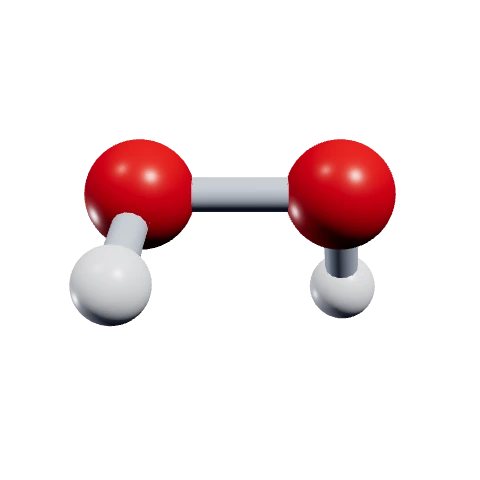
Hydrogen peroxide is water with one extra oxygen atom, held on by a weak oxygen–oxygen bond. Given any opportunity, the molecule falls apart into the two most stable things it can become:
The reaction gives off heat, and it is thermodynamically downhill all the way. Nothing in the bottle can stop it; a manufacturer can only slow it. Two things follow from that.
First, every container of hydrogen peroxide is making oxygen. Old references describe peroxide strength in "volumes": the volume of oxygen gas a unit volume of solution can release, measured at 0 °C and one atmosphere. Three percent peroxide works out to about 10 volumes: a liter of it can release about 10 liters of oxygen. Thirty-five percent is rated at 130 volumes, so a single gallon of 35% can release roughly 130 gallons of oxygen over its life. Released slowly, that gas is harmless. Trapped, it is pressure.
Second, the heat feeds the reaction. Warmer peroxide decomposes faster, and decomposition makes it warmer. In dilute solutions the water soaks up that heat and nothing dramatic happens. In concentrated or badly contaminated solutions it can run away; one producer notes that even 10% peroxide can boil if it is grossly contaminated. That is why shelf life and safety are the same subject for this chemical.
The four things that make it expire faster
1. Heat, the big one
Temperature dominates everything else. USP Technologies, a peroxide producer, puts the rate increase at about 2.2 times for every 10 °C (18 °F) rise between 20 and 100 °C. Evonik's handling training shows what that compounding looks like for stabilized peroxide:
| Storage temperature | Approximate strength loss |
|---|---|
| 72 °F (22 °C) | About 1% per year |
| 151 °F (66 °C) | About 1% per week |
| 218 °F (103 °C) | About 2% per day |
Those losses are relative: 1% of a 3% solution is 0.03 percentage points, so a cool year takes 3.00% to about 2.97%. The point of the table is the slope. Moving a bottle from a climate-controlled room to a closed shed in a Texas summer does not cost a little more strength. It can cost dozens of times more.
2. Light
Hydrogen peroxide absorbs ultraviolet light, and when it does, the O–O bond splits into two hydroxyl radicals: H₂O₂ + light → 2 •OH. NASA's Jet Propulsion Laboratory data shows absorption is strongest in the deep UV and falls off steeply toward visible light, by a factor of more than a thousand between 190 and 350 nanometers. Daylight still carries enough UV to do damage over months. That is why USP requires light-resistant containers and why peroxide is sold in brown or opaque packaging. Pouring it into a clear spray bottle and leaving it on a windowsill undoes that protection.
3. Contamination, especially metals
Traces of transition metals act as catalysts. Solvay's handling guide lists nickel, chromium, copper and iron salts, and notes that some contaminants can trigger rapid decomposition at concentrations as low as 0.1 part per million. Contact with copper, brass, zinc or mild steel causes decomposition at the surface. Rust is enough. So is organic matter, dust and anything that was in a reused container.
That is why reagent grades put such tight limits on metals. Our 30% ACS grade specification allows no more than 0.00005% iron, half a part per million. It is also why the single most common way a good bottle goes bad is someone pouring unused liquid back into it.
4. pH
Peroxide is most stable slightly acidic. Evonik recommends a pH below 4.5 for optimum stability and notes that above pH 5 decomposition increases sharply; Solvay warns that alkaline hydrogen peroxide "may be very unstable." Commercial grades are made slightly acidic for that reason; our 3% technical grade specification is pH 2 to 4. Mixing peroxide with anything alkaline, like soda ash, ammonia or lye, starts a clock that runs in hours, not months, so mix those solutions fresh.
What the stabilizers do. Commercial peroxide carries a small dose of stabilizer, traditionally metal-binding agents such as stannates, pyrophosphates and organophosphonates. They tie up stray metal ions before those ions can act as catalysts. Stabilizers buy time against light contamination; they cannot overcome heat, a dirty container or a returned pour.
Why peroxide containers are built to breathe
Because peroxide is always giving off oxygen, a perfectly gas-tight container is the wrong container. Regulators and manufacturers both build around that.
- DOT allows venting for exactly this case. 49 CFR 173.24(g) permits vented packagings "to reduce internal pressure which may develop by the evolution of gas from the contents," with conditions: no air shipment, and the packaging must not let liquid escape.
- Totes must vent. Hydrogen peroxide solutions from 8% upward carry special provision IP5 in the DOT hazardous materials table: "IBCs must have a device to allow venting."
- International rules go further. The UN Model Regulations' packing instructions for hydrogen peroxide state that "packagings shall be vented."
- Producers vent their drums. Solvay's guide says each drum "is equipped with a continuous vent to prevent internal pressure buildup. Do not block this vent."
How much gas is involved? In a paper prepared for the International Civil Aviation Organization's dangerous goods panel, one liter of 59% hydrogen peroxide stored at 40 °C (104 °F) produced 5.3 liters of oxygen over six months. That is a container's worth of gas from a container's worth of liquid, from material that was decomposing normally.
Never transfer peroxide into a container you can seal tight, and never tape over or block a vented cap. Decomposition generates heat and gas, and Solvay warns that this "can result in rapid pressure buildup leading to pressure bursts of inadequately vented containers." Keep peroxide in its original container, upright, with the cap it shipped with.
How to tell if your hydrogen peroxide is still good
The fizz test: yes or no
Catalase, an enzyme in raw potato and yeast, breaks peroxide down fast enough to see:
- Pour a small amount into a clean glass. Never test in the original bottle, and never return anything to it.
- Add a slice of freshly cut raw potato or a pinch of active dry yeast.
- Watch the surface. Steady bubbling means active peroxide is still there. No bubbles means it has essentially turned to water.
What the fizz test cannot do is tell you the strength. Classroom enzyme labs run this same reaction on solutions as dilute as 0.38%, and the enzyme's measured kinetics mean a weaker solution simply bubbles more slowly, not differently. A bottle that has dropped from 3% to 1.5% still fizzes. If strength matters, you need a number.
The titration: the actual number
The USP assay for 3% peroxide is a potassium permanganate titration, routine on any wet-chemistry bench. Two milliliters of sample go into 20 mL of water with 20 mL of 2 N sulfuric acid, and the mix is titrated with 0.1 N potassium permanganate until a faint pink color holds. Each milliliter of titrant equals 1.701 mg of H₂O₂.
a 2 mL sample that takes 30 mL → 51 mg → about 2.6 g per 100 mL
Peroxide test strips give a quicker, rougher reading and are useful for checking a working dilution. For process-critical work, ask for the lot's Certificate of Analysis on receipt, write the receiving date on the container, and test before use once it has been open a while.
Storage that actually extends shelf life
- Cool. The biggest single lever. Keep it away from boilers, compressors, sunny walls and vehicles. Every 10 °C you take off roughly halves the loss.
- Dark. Original brown or opaque container, cap on, away from windows. Do not decant into clear bottles for storage.
- Original container, original cap. If it came with a vented cap, the vent is part of the product. Never store peroxide in metal containers.
- Never pour back. Pour out what you need into a clean container; whatever leaves the bottle stays out.
- Clean tools only. Glass, or plastics rated for peroxide. No brass fittings, steel dippers or reused jugs that held something else.
- Upright, with room around it. Peroxide is an oxidizer. Store it away from flammables, solvents, organics and fine metal powders.
- Date it. Write the date on receipt and on opening. The label tells you when it was made; your date tells you how long it has been working.
Buying so it never sits long enough to fade
Most of the expired peroxide we hear about was a sizing problem: a drum bought for a job that uses a gallon a month, or a pail opened weekly in a hot building for a year. Match the package to the rate you use it. Quarts and gallons for occasional use, cases and pails for steady use, drums and totes only when they turn over.
Concentration is the other lever. Buying a stronger grade and diluting to working strength costs less per unit of active peroxide and means less volume sitting around. Our dilution calculator does the math, and our peroxide cleaning recipes give working strengths. The trade-off is that concentrates are regulated and demand more care:
| Concentration | DOT shipping status | What that means for you |
|---|---|---|
| Under 8% | Not regulated as a hazardous material | Ships as ordinary freight; even 3% can cause serious eye damage, so wear eye protection |
| 8% to under 20% | UN2984, Class 5.1 oxidizer, Packing Group III | Oxidizer storage rules; splash goggles and gloves |
| 20% to 40% | UN2014, Class 5.1 with corrosive subsidiary hazard, Packing Group II | Corrosive to skin and eyes; full PPE, careful dilution |
| Over 40% to 60% | UN2014, Packing Group II, forbidden by air | Specialist handling |
| Over 60% | UN2015, Packing Group I | Not a product for general use |
Safety. Concentrations of 8% and above are DOT-regulated oxidizers, and 20% and above can cause serious skin and eye burns. Wear splash goggles and chemical-resistant gloves, and read the SDS for your concentration before use. Our full SDS library is free to download.
Key numbers and sources
| Fact | Value | Source |
|---|---|---|
| Decomposition | 2 H₂O₂ → 2 H₂O + O₂, about −98 kJ per mol H₂O₂ | usptechnologies.com |
| Strength loss, stabilized, stored cool | Under 1–2% of its strength per year | solvay.com |
| Strength loss by temperature | ~1%/year at 72 °F · ~1%/week at 151 °F · ~2%/day at 218 °F | evonik.com |
| Rate increase per 10 °C (18 °F) | About 2.2× | usptechnologies.com |
| Most stable pH | Below 4.5; decomposition rises sharply above pH 5 | evonik.com |
| Oxygen available from 3% / 35% | About 10 / 130 volumes of O₂ per volume of liquid | solvay.com |
| USP Topical Solution strength | 2.5–3.5 g H₂O₂ per 100 mL; light-resistant containers | USP 35 |
| DOT classification | Under 8% not regulated · UN2984 8–<20% · UN2014 20–60% · UN2015 >60% | ecfr.gov |
| CAS number | 7722-84-1 | pubchem.ncbi.nlm.nih.gov |
Common questions
Does hydrogen peroxide expire?
Yes, but it does not spoil. Hydrogen peroxide slowly decomposes into water and oxygen gas, even in a sealed bottle, so it gets weaker over time. Commercially stabilized peroxide stored cool typically loses less than 1 to 2% of its strength per year. Heat, light, metal contamination and alkaline conditions all speed that up.
How long does hydrogen peroxide last?
It depends mostly on temperature. Evonik's handling data for stabilized peroxide shows about 1% strength loss per year at 72 °F, about 1% per week at 151 °F and about 2% per day at 218 °F, and the rate rises roughly 2.2 times for every 10 °C increase. A sealed container kept cool and dark stays close to its labeled strength for a long time; one kept in a hot shed or vehicle does not.
Why does hydrogen peroxide have an expiration date?
Retail 3% Hydrogen Peroxide Topical Solution is sold as an over-the-counter drug under FDA's OTC Monograph M003, and 21 CFR 211.137 requires drug products to carry an expiration date determined by stability testing. The USP monograph allows 2.5 to 3.5 g of H2O2 per 100 mL. The date is how long the manufacturer has shown the sealed product stays in that range.
Is it safe to use expired hydrogen peroxide?
Expired peroxide is mostly weaker, not harmful: it breaks down into water and oxygen. The practical risk is that it no longer does the job you bought it for. If strength matters, test it. If the container is bulging, or bubbles are rising in a still bottle, it is actively decomposing; vent it carefully and do not use it.
How can I test if hydrogen peroxide is still good?
Pour a little into a clean glass and add a slice of raw potato or a pinch of yeast. Bubbling means some peroxide is left, but a weaker solution simply bubbles more slowly, so the test cannot give you a strength. For a number, use a potassium permanganate titration, the USP assay method, where each mL of 0.1 N permanganate equals 1.701 mg of H2O2.
Why is hydrogen peroxide sold in brown bottles?
Hydrogen peroxide absorbs ultraviolet light, which splits it into hydroxyl radicals and speeds its decomposition. The USP monograph requires light-resistant containers for that reason. Keep peroxide in its original brown or opaque container and away from windows.
Why do hydrogen peroxide containers have vented caps?
Decomposing peroxide constantly releases oxygen. DOT rules (49 CFR 173.24(g)) allow packagings to be vented for gas evolved by their contents, totes of 8% and stronger must have a venting device under special provision IP5, and producers fit drums with a continuous vent. Never move peroxide into a container that seals tight, and never block a vent.
Does opened hydrogen peroxide go bad faster?
Opening it does not change the chemistry by itself; what changes is the chance of contamination. Dust, metal from a tool, or liquid poured back into the bottle can catalyze decomposition at concentrations as low as 0.1 part per million. Pour out what you need and never return any to the container.
References & Authoritative Sources
Regulatory text, decomposition rates, physical data and specification limits above are drawn from these sources.
- Solvay: Safety and Handling of Hydrogen Peroxide (HH-2323) — Commercial grades lose less than 1% relative strength per year; rate roughly doubles per 10 °C; contaminants active at 0.1 ppm; volume-strength 130 for 35%; drums carry a continuous vent; alkaline peroxide may be very unstable.
- USP Technologies: Hydrogen Peroxide Safety and Handling Guidelines — Decomposition increases about 2.2 times per 10 °C from 20 to 100 °C; under 1% per year in tanks and under 2% per year in drums at ambient temperature; catalytic metals.
- USP Technologies: H2O2 Self-Accelerated Decomposition — Decomposition enthalpy 23.44 kcal/mol (98 kJ/mol); even 10% can boil if grossly contaminated.
- Evonik: Hydrogen Peroxide FAQs — Under 2% per year at 20 °C; a 50% solution is at least 49% after one year; stabilizers include stannates, pyrophosphates and organophosphonates.
- Evonik: Hydrogen Peroxide Safety and Handling — Optimum stability below pH 4.5; decomposition increases sharply above pH 5.
- Evonik Active Oxygens: Hydrogen Peroxide Safety & Handling training — The effect of heat: about 1% per year at 72 °F, 1% per week at 151 °F, 2% per day at 218 °F.
- USP Monograph: Hydrogen Peroxide Topical Solution — United States Pharmacopeia (USP 35). 2.5 to 3.5 g H₂O₂ per 100 mL; preservative 0.05% max; tight, light-resistant containers; permanganate assay, 1 mL of 0.1 N KMnO₄ = 1.701 mg H₂O₂.
- FDA OTC Monograph M003 — U.S. Food and Drug Administration. Lists hydrogen peroxide topical solution USP as an OTC active ingredient; directions of 1 to 3 times daily.
- 21 CFR 211.137, Expiration dating — Electronic Code of Federal Regulations. Paragraph (a) requirement and paragraph (h) OTC exemption.
- 49 CFR 173.24(g), Venting — Electronic Code of Federal Regulations. Conditions under which packagings may be vented to relieve gas evolved by the contents.
- 49 CFR 172.101, Hazardous Materials Table and 172.102 special provisions — UN2984, UN2014 and UN2015 entries; IP5, "IBCs must have a device to allow venting."
- ICAO Dangerous Goods Panel, DGP-WG/11-WP/64 (2011) — UN packing instructions state "packagings shall be vented"; 1 L of 59% hydrogen peroxide produced 5.3 L of oxygen over six months at 40 °C.
- NASA JPL Publication 19-5: Chemical Kinetics and Photochemical Data — H₂O₂ photolysis to two OH radicals; continuous UV absorption decreasing from 190 nm toward longer wavelengths.
- PubChem: Hydrogen Peroxide (CID 784) — National Center for Biotechnology Information. Stability and shelf life; stabilizers such as sodium stannate counter trace iron and copper; measured pH of commercial concentrations.
- NIST Chemistry WebBook: Hydrogen peroxide — National Institute of Standards and Technology. Molecular weight 34.0147; thermochemical data.
- Ogura & Yamazaki, J. Biochem. 1983 — Catalase Michaelis constant about 1.3–1.4 M; first-order kinetics below 100 mM, so reaction rate tracks concentration.
- Hofstra University MiSP: Enzyme Action worksheet — Catalase reaction run on a dilution series from 3.0% down to 0.38%.
- Alliance Chemical: Hydrogen Peroxide 3% Technical Grade sample specification — Assay 3.0–3.5%, pH 2–4 at 20 °C, preservatives 0.05% max. Companion 30% ACS specification: iron 0.00005% max.
Buying hydrogen peroxide by the pail, drum or tote?
Tell us the concentration you work at and how fast you use it, and we will help you pick a strength and package size that gets used up long before it has a chance to fade.
Request a volume quoteRelated: BASF Wants Evonik. The Last Time Evonik Bought a Peroxide Maker, the FTC Sued — why decomposition and water weight make hydrogen peroxide a regional market, in the BASF-Evonik news.
Related: Hydrogen Peroxide for Blood Stains: Why It Fizzes and How to Get Blood Out of Clothes, Sheets and Carpet — why a weak fizz on an old stain says nothing about whether your bottle has expired.
Frequently asked questions
Does hydrogen peroxide expire?
Yes, but it does not spoil. Hydrogen peroxide slowly decomposes into water and oxygen gas, even in a sealed bottle, so it gets weaker over time. Commercially stabilized peroxide stored cool typically loses less than 1 to 2% of its strength per year. Heat, light, metal contamination and alkaline conditions all speed that up.
How long does hydrogen peroxide last?
It depends mostly on temperature. Evonik's handling data for stabilized peroxide shows about 1% strength loss per year at 72 °F, about 1% per week at 151 °F and about 2% per day at 218 °F, and the rate rises roughly 2.2 times for every 10 °C increase. A sealed container kept cool and dark stays close to its labeled strength for a long time; one kept in a hot shed or vehicle does not.
Why does hydrogen peroxide have an expiration date?
Retail 3% Hydrogen Peroxide Topical Solution is sold as an over-the-counter drug under FDA's OTC Monograph M003, and 21 CFR 211.137 requires drug products to carry an expiration date determined by stability testing. The USP monograph allows 2.5 to 3.5 g of H2O2 per 100 mL. The date is how long the manufacturer has shown the sealed product stays in that range.
Is it safe to use expired hydrogen peroxide?
Expired peroxide is mostly weaker, not harmful: it breaks down into water and oxygen. The practical risk is that it no longer does the job you bought it for. If strength matters, test it. If the container is bulging, or bubbles are rising in a still bottle, it is actively decomposing; vent it carefully and do not use it.
How can I test if hydrogen peroxide is still good?
Pour a little into a clean glass and add a slice of raw potato or a pinch of yeast. Bubbling means some peroxide is left, but a weaker solution simply bubbles more slowly, so the test cannot give you a strength. For a number, use a potassium permanganate titration, the USP assay method, where each mL of 0.1 N permanganate equals 1.701 mg of H2O2.
Why is hydrogen peroxide sold in brown bottles?
Hydrogen peroxide absorbs ultraviolet light, which splits it into hydroxyl radicals and speeds its decomposition. The USP monograph requires light-resistant containers for that reason. Keep peroxide in its original brown or opaque container and away from windows.
Why do hydrogen peroxide containers have vented caps?
Decomposing peroxide constantly releases oxygen. DOT rules (49 CFR 173.24(g)) allow packagings to be vented for gas evolved by their contents, totes of 8% and stronger must have a venting device under special provision IP5, and producers fit drums with a continuous vent. Never move peroxide into a container that seals tight, and never block a vent.
Does opened hydrogen peroxide go bad faster?
Opening it does not change the chemistry by itself; what changes is the chance of contamination. Dust, metal from a tool, or liquid poured back into the bottle can catalyze decomposition at concentrations as low as 0.1 part per million. Pour out what you need and never return any to the container.
Related Chemical Collections
About the author
Andre Taki
This article is for informational purposes only.


