

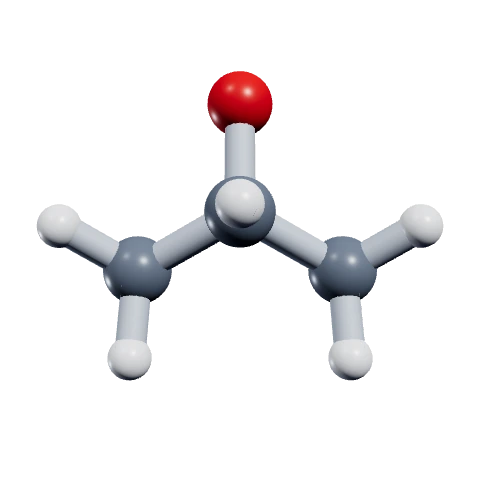


Every buyer of isopropyl alcohol eventually asks the same question: why does it come in 70, 91 and 99 percent, and not in round numbers? The answer is not a marketing department. It is a hard thermodynamic boundary that sits at almost exactly 91% by volume, and no amount of additional distillation will cross it. This is the story of that wall — where it comes from, what it takes to break through, and why the number printed on a drum is really a record of how much energy went into making it.

The wall: why distillation stops at 91%
Distillation works on a simple asymmetry. Heat a mixture of two liquids and the more volatile one is over-represented in the vapour. Condense that vapour and you have a liquid richer in the volatile component than the one you started with. Repeat the trick up a column of trays and you climb, step by step, toward purity.
Isopropyl alcohol boils at 82.4 °C — the NIST Chemistry WebBook gives 355.5 ± 0.4 K, an average of 102 reported values. Water boils at 100 °C. A 17.6-degree gap looks like a comfortable margin, and for the first stretch of the climb it is. Take a dilute stream of IPA and water and the column will happily concentrate it: 20%, 40%, 70%, 85%.
Then it stops.
At 87.7% isopropyl alcohol by weight — roughly 91% by volume — the mixture boils at 80.37 °C, and the vapour coming off it has exactly the same composition as the liquid it came from.
That is an azeotrope, and it is the end of the road for ordinary distillation. The asymmetry that the whole process depends on has vanished. Condense the vapour and you get back precisely what you boiled. Add a hundred more trays to the column, run it for a week, spend whatever you like on reflux, and you will still come off at 91%. The thermodynamics do not negotiate.
Note the detail that makes it strange: the azeotrope boils at 80.37 °C, which is lower than either pure component. Pure IPA boils at 82.4 °C; water at 100 °C; the mixture of the two boils below both. This is a minimum-boiling azeotrope, and it happens because IPA molecules disrupt water's hydrogen-bonded network more than they bond to it. The mixture is, in a thermodynamic sense, less comfortable with itself than either pure liquid — so it escapes into vapour more readily.
91% isopropyl alcohol is not a product decision. It is where physics stops the still.
So 91% is the honest number
Once you see the azeotrope, the product ladder stops looking arbitrary. Ninety-one percent is not a grade someone chose; it is the natural resting point of the cheapest process that makes IPA. Run a conventional column until it will not climb any further and 91% is what comes out of the top. Every supplier's 91% is standing on the same physical shelf.
That has a practical consequence buyers rarely connect: 91% is the concentration you can buy with the least process behind it, and every percentage point above it costs disproportionately more to produce, because getting there requires abandoning simple distillation entirely and bringing in a second, unrelated separation technology.
It also explains the shape of the market. You will find 70% and 50% everywhere, because those are made by taking the azeotrope and adding purified water — trivially easy, and the water is cheaper than the alcohol. You will find 91% everywhere, because that is the column's natural output. And you will find a step change in price and availability at 99%, because that is where a different factory has to get involved.
Breaking the wall: how 99% is actually made
There are three industrial routes past the azeotrope. All of them work by changing the rules of the separation rather than by trying harder at the same one.
1. Azeotropic distillation with an entrainer
Add a third component — an entrainer — that forms a new, lower-boiling azeotrope with the water and carries it out of the top of the column, leaving dry alcohol behind at the bottom. Historically benzene did this job; it was abandoned as its carcinogenicity became clear. Cyclohexane and diisopropyl ether are the common modern choices.
The method works, but look at what it costs: a third chemical to buy, store and handle, a second column to recover and recycle it, and a new contamination pathway to control. Trace entrainer in the finished alcohol is a real specification concern, which is one reason high-purity grades carry certificates that report far more than just water content.
2. Molecular sieves (pressure-swing adsorption)
The elegant route. A 3 Å zeolite has pores sized so that a water molecule fits and an isopropanol molecule does not. Pass the azeotropic vapour through a bed of it and the water is adsorbed while the alcohol sails through. When the bed saturates, drop the pressure, drive the water back off, and switch to a second bed while the first regenerates.
Nothing is added to the product, which is why this route dominates for high-purity and electronic grades. The cost is capital and energy rather than chemistry — beds, valves, cycles, and the heat to regenerate.
3. Membrane pervaporation
A selective membrane passes water preferentially while rejecting alcohol, driven by a vacuum on the permeate side. Lower energy than distillation, and increasingly used in hybrid schemes where a column does the easy work up to the azeotrope and a membrane finishes the job.
The buying insight hiding in all this: the gap between 91% and 99% is not eight percentage points of the same process. It is the boundary between one technology and another. That is why the two behave like different products in lead time, availability and specification — because industrially, they are.
The molecule that started the petrochemical industry
Isopropyl alcohol has a claim almost no other industrial chemical can make: it was the first commercial petrochemical. In 1920, Standard Oil of New Jersey began producing it from propylene at the Bayway refinery in Linden, New Jersey, using indirect hydration over sulfuric acid based on work by Carleton Ellis.
What made it historic was the feedstock. Propylene was a nuisance — a light gas produced by cracking, flared off or burned for fuel because nobody had a use for it. Turning that waste stream into a saleable chemical established the entire premise of the petrochemical industry: that the by-products of fuel refining are raw materials for chemistry. Everything downstream of that idea, from plastics to solvents to synthetic fibres, follows the path IPA opened.
We have written the full production story separately — see How Isopropyl Alcohol Is Made: From Refinery Gas to IPA.
What the number actually does on a surface
The azeotrope explains where the concentrations come from. It does not explain why anyone should care. That part is about what the remaining water does when the alcohol is put to work.
Marangoni drying, and why semiconductor fabs care about surface tension
Water has a surface tension of roughly 72 mN/m — very high, because of hydrogen bonding. Isopropanol's is roughly a third of that. Bring the two together and you get a surface-tension gradient, and a gradient in surface tension makes liquid flow: the Marangoni effect.
Semiconductor fabs exploit this directly. A wafer is withdrawn from ultrapure water through a zone of IPA vapour. Where the vapour meets the meniscus, surface tension drops locally, and the resulting Marangoni flow drags the water film off the wafer rather than letting it break into droplets. The wafer emerges dry with no drying spots.
This matters because a droplet that evaporates in place leaves behind everything dissolved in it. On a surface with features measured in nanometres, a single dried spot is a defect and the die is scrapped. The alcohol is not cleaning anything here — it is manipulating the physics of the water's departure. There is more on the process in Isopropyl Alcohol in Semiconductor Manufacturing.
Flux, residue and the repair bench
The same principle scales down to an electronics bench. Rosin flux residue dissolves readily in isopropanol; the question is what is left when the solvent leaves. A high-concentration IPA flashes off and leaves little behind. A dilute one leaves the water behind on the board, because water evaporates far more slowly and takes any dissolved ionic contamination with it as it goes — depositing it exactly where it was pooled.
That is the real argument for concentration in electronics work, and it is a physical one, not a purity fetish. Our bench-level walkthrough is in Isopropyl Alcohol for Electronics.
Water is not an inert filler. In every one of these applications the water in a dilute grade is not simply "not alcohol" — it is an active participant with its own surface tension, its own evaporation rate, and its own ability to carry dissolved contamination to the surface and leave it there.
The azeotrope pulls back: why an open drum drifts
Here is the part that costs people money, and it follows directly from everything above.
Isopropyl alcohol is hygroscopic. It pulls water vapour out of the air. And the composition it is drifting toward is not some arbitrary dilution — it is the azeotrope. The same thermodynamic point that stopped the still from climbing is the point the open drum is falling back to.
You paid to break the azeotrope. Leave the drum open and you are handing that back to the atmosphere.
Practically, for anyone running 99%+ material:
- Keep containers closed. Every hour of headspace exposed to humid air is a slow re-dilution. This is not a trivial effect in a Gulf Coast summer.
- Minimise headspace. A drum that is one-third full has twice the air contact of one that is two-thirds full, and it will drift correspondingly faster.
- Do not decant into an open vessel and walk away. The transfer step is where most of the moisture pickup happens.
- Re-test if it has been open and it matters. If your process is genuinely concentration-sensitive, the certificate that came with the drum describes the material as it was filled, not as it is after three months of partial use.
- Dispense from the bottom, not the top, where practical, so the bulk of the liquid is not repeatedly exposed.
This is also the honest answer to a question we get often: "can I just buy 99% and dilute it myself?" Physically, yes — going down the concentration scale is trivial, which is exactly the asymmetry the azeotrope creates. Whether you should depends on your water quality, your quality system and any specification you are working to; the arithmetic is the easy part and the governance is not. We wrote the mechanics up in How to Make 70% Isopropyl Alcohol from 99%. Note that mixing IPA and water produces a small volume contraction, so the finished volume is slightly less than the sum of the parts — size the vessel accordingly.
Ageing, peroxides and the drum at the back of the shelf
Isopropanol is a secondary alcohol, and secondary alcohols can form peroxides on long storage in the presence of air and light — the same class of hazard that makes old ether bottles notorious. The risk is considerably lower than with diisopropyl ether, but it is not zero, and it concentrates in exactly the situation where nobody is looking: a partially used container that has sat for years.
Never distil or evaporate an old container of isopropanol to dryness. Peroxides concentrate in the residue, and the residue is where the energy is. If you have inherited unlabelled or long-stored alcohol of unknown age, treat it as suspect, test it if you have the means, and dispose of it properly rather than boiling it down. Consult the SDS for the specific product and your own EHS procedures.
Practical housekeeping that costs nothing: date containers on receipt, store away from light and heat, rotate stock so the oldest is used first, and keep drums closed — which, conveniently, is the same discipline that stops the azeotrope pulling your concentration back down.
Grade and concentration are different axes
Everything above is about concentration — how much of the liquid is isopropanol. That is independent of grade, which is the standard the material is certified against and the documentation that travels with it.
| Axis | What it describes | Set by | Where it comes from |
|---|---|---|---|
| Concentration | Fraction of the liquid that is isopropanol | Physics and process — the azeotrope and what was done to beat it | Distillation, sieves, membranes, or deliberate dilution |
| Grade | The specification the lot is certified against | A published monograph and the testing behind it | Technical, USP, ACS Reagent |
The two do not imply one another. A high concentration is not automatically a high grade, and a certified grade is not automatically concentrated. Alliance stocks the same concentration in more than one grade precisely because these are separate questions — the liquid strength is identical and what differs is the monograph it was tested against and the paperwork that proves it.
- Technical Grade — meets our internal specification, without certification to a pharmacopeial or ACS monograph.
- USP Grade — certified against the United States Pharmacopeia monograph.
- ACS Reagent Grade — certified against the American Chemical Society reagent specification, the tightest of the three on trace impurities.
If a specification names a grade, that grade is the requirement and no argument about concentration overrides it. A cheaper drum that fails the specification has not saved anything. Where the choice is genuinely open, the concentration question is the physical one this article has been about.
Specifying it: the questions worth asking

By the time you are buying at drum and tote volume, the useful questions have changed. A few that separate a considered purchase from a reactive one:
What does the certificate actually report?
For a high-concentration grade, water content is the number that tells you whether you received what you paid the azeotrope-breaking premium for. Ask whether the certificate of analysis is lot-specific rather than a generic specification sheet — the two are different documents doing different jobs, and only one of them describes the material in your drum.
How long will it sit, and in what state?
A drum consumed in three weeks and a drum consumed over eighteen months are different purchases even if the liquid is identical. If it is the latter and concentration matters, buy a pack size matched to your consumption rather than the one with the best headline economics. The drift is real and it is one-directional.
Is the concentration genuinely open?
If a written procedure, a customer specification or a quality system fixes the concentration, that is the end of the discussion. The physics in this article is useful when the choice is yours and irrelevant when it is not — knowing which situation you are in is the whole of the skill.
What does your storage classification allow?
Isopropyl alcohol is a flammable liquid at every concentration sold, and the requirements tighten as concentration rises. Moving from pails to drums can change your storage classification and what your permit allows. Work that out before the pallet arrives, not when it is on the dock, and consult the SDS for the specific product alongside your own authority having jurisdiction.
Common questions
Why is isopropyl alcohol sold at 91% instead of a round 90%?
Because 91% by volume is approximately where the isopropanol–water azeotrope sits (87.7% by weight, boiling at 80.37 °C). It is the natural output of a conventional distillation column, not a chosen figure.
Can you distil isopropyl alcohol past 91%?
Not with ordinary distillation. At the azeotrope the vapour and liquid have the same composition, so further separation yields nothing regardless of column height or reflux. Reaching 99%+ requires entrainer-assisted azeotropic distillation, 3 Å molecular sieve adsorption, or membrane pervaporation.
Why does 99% isopropyl alcohol cost more than 91%?
Because the last few percent are made by a fundamentally different and more capital-intensive process. The gap between 91% and 99% is a technology boundary, not eight more percentage points of the same operation.
Does isopropyl alcohol absorb water from the air?
Yes — it is hygroscopic, and it drifts toward the azeotropic composition. High-concentration material stored in a partly empty, frequently opened container will lose concentration over time. Keep containers closed, minimise headspace, and re-test if your process is concentration-sensitive.
What is the boiling point of isopropyl alcohol?
82.4 °C for the pure compound (NIST gives 355.5 ± 0.4 K, an average of 102 reported values). The azeotrope with water boils lower, at 80.37 °C.
Is grade the same as concentration?
No. Concentration is how much of the liquid is isopropanol; grade is the standard the lot is certified against — Technical, USP or ACS Reagent. The same concentration is available in more than one grade, and a specification naming a grade must be met regardless of concentration arithmetic.
Can old isopropyl alcohol form peroxides?
As a secondary alcohol it can, on long storage with air and light exposure — much less readily than ethers, but not never. Never evaporate or distil an old container to dryness, since peroxides concentrate in the residue. Date containers on receipt and rotate stock.
References & Authoritative Sources
Chemical identity and thermophysical data below are drawn from the U.S. National Institute of Standards and Technology and the National Institutes of Health's PubChem database.
- PubChem CID 3776: Isopropyl Alcohol (propan-2-ol) — National Center for Biotechnology Information, U.S. National Library of Medicine. CAS 67-63-0, molecular formula C3H8O, molecular weight 60.10 g/mol.
- NIST Chemistry WebBook: 2-Propanol — normal boiling point 355.5 ± 0.4 K (average of 102 of 118 reported values).
- Isopropanol–water minimum-boiling azeotrope: 87.7% isopropanol by weight (≈91% by volume), boiling point 80.37 °C at atmospheric pressure — a value reported consistently across vapour–liquid equilibrium literature and industrial separation practice.
- Engineering and Technology History Wiki: Isopropyl Alcohol — first commercial petrochemical, produced by Standard Oil of New Jersey from propylene at the Bayway refinery, 1920.
- Isopropanol — thermophysical data — NIST Chemistry WebBook, SRD 69, National Institute of Standards and Technology. Accessed 2026-09-04.
Need a specific concentration and grade?
Every concentration and grade we stock, with live pricing from pails through drums and IBC totes, is on our bulk supplier page. If you are not sure which concentration your process actually needs, call and describe the application — we would rather scope it correctly than ship the wrong material.
See bulk isopropyl alcohol pricingKey numbers and sources
| Fact | Value | Source |
|---|---|---|
| Chemical formula of isopropyl alcohol | C 3 H 8 O | pubchem.ncbi.nlm.nih.gov |
| CAS number of isopropyl alcohol | 67-63-0 | pubchem.ncbi.nlm.nih.gov |
| PubChem CID of isopropyl alcohol | 3776 | pubchem.ncbi.nlm.nih.gov |
| Boiling point of isopropyl alcohol-water azeotrope | 80.37 °C | See article text |
| Azeotrope composition by weight | 87.7% by weight | See article text |
| Azeotrope composition by volume | about 91% by volume | See article text |
Related: What Is Denatured Alcohol? Why the Government Poisons Perfectly Good Ethanol on Purpose — the same azeotrope wall on the ethanol side — why 190 proof is where distillation stops and 200 proof costs more.
Frequently asked questions
How much does a 55 gallon drum of isopropyl alcohol cost?
Current list pricing at Alliance Chemical is $925 to $1,370 per 55 gallon drum, depending on concentration and grade. Isopropyl Alcohol 99% Technical Grade is $925 and Isopropyl Alcohol 99.9% ACS Reagent Grade is $1,370. Prices are for single units and ship from Taylor, Texas.
Which isopropyl alcohol is cheapest per gallon of actual alcohol?
Isopropyl Alcohol 99% Technical Grade, at $16.99 per gallon of isopropanol ($925 for 54.45 gallons of alcohol in a 55 gallon drum). The most expensive on that basis is Isopropyl Alcohol 50% USP Grade at $43.64 per gallon of alcohol - a 2.57x spread across the range.
Is a 50% drum cheaper than a 99% drum?
On the invoice it can be, but not per gallon of alcohol. Isopropyl Alcohol 50% Technical Grade costs $999 per drum against $925 for 99% Technical Grade - $74 more for 26.95 fewer gallons of actual isopropanol, because a 50% drum is half water.
What is the difference between Technical, USP and ACS Reagent grade isopropyl alcohol?
Grade is the standard the material is certified against, and it is independent of concentration. Technical Grade meets our internal specification without pharmacopeial or ACS certification. USP Grade is certified against the United States Pharmacopeia monograph. ACS Reagent Grade is certified against the American Chemical Society reagent specification. Alliance stocks 50% in both Technical ($999) and USP ($1,200) - the same concentration at a $201 difference, which is the certification, not the strength.
What does a 55 gallon drum of isopropyl alcohol weigh?
Net weight ranges from 363 to 418 lb across our range. Because isopropanol is lighter than water, more dilute blends are heavier: 91% USP is 363 lb while 50% grades are 418 lb. Drums ship LTL freight on a pallet.
Do you charge hazmat fees on isopropyl alcohol drums?
No. Alliance Chemical does not charge hazmat fees or hidden surcharges. The freight quote you receive is the freight cost. Orders placed before noon Central typically ship the same or next business day from Taylor, Texas.
Can I get an SDS and a certificate of analysis?
Yes. An SDS ships with every order, and a lot-specific certificate of analysis is available on request.
Related Chemical Collections
About the author
Andre Taki
This article is for informational purposes only.


