



Every year, this warehouse ships thousands of gallons of a chemical that is, at the molecular level, the same stuff that is in a bottle of vodka — and every gallon of it has been deliberately spiked with a poison, because federal law says so. The poison is not an accident, a contaminant, or a cost-cutting shortcut. It is the product. It has a recipe number. Someone in Washington maintains the recipe.
This is denatured alcohol. It is one of the most useful solvents in industry, the reason a gallon of 200-proof ethanol costs what a gallon of solvent should cost rather than what a gallon of whiskey costs, and the subject of the single strangest public-health decision the United States government ever made on purpose. Here is what it is, why it exists, what happened in 1926, and what is actually in the drum.
Short version, before the long one: you cannot drink it. Not the methanol kind, not the isopropyl kind, not the 190 proof, not the 200 proof. We will come back to this, because people ask.
What is denatured alcohol?
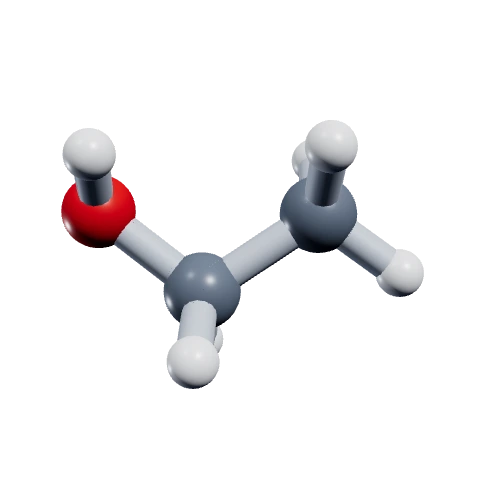
Denatured alcohol is ordinary ethanol — ethyl alcohol, C₂H₆O, CAS 64-17-5, the same molecule that ferments out of grapes and grain — blended with a small amount of an additive that makes it poisonous, foul, or both, following a formula published by the federal government, so that it can be sold for industrial use without being taxed as a beverage.
The word is precise, if a little theatrical. To denature something is to strip it of its nature. Ethanol’s nature, from the point of view of the U.S. Treasury, is that people will drink it. Add the right five percent of something nasty and that nature is gone: the liquid still dissolves shellac, still cleans a printing plate, still thins a coating, still burns clean in a stove. It just no longer qualifies as a drink, and so it no longer qualifies for the drink tax.
Which is a very long way of saying that denatured alcohol is a chemical with a criminal record it did not earn. Nothing is wrong with it. It was simply made ineligible.
Nothing about the ethanol changes. The molecule is untouched. The additive is simply along for the ride, at a concentration high enough that you cannot practically get it back out, and that is the whole point of choosing it.
Identity: Ethanol, CAS 64-17-5, PubChem CID 702. Denatured alcohol is not a different chemical; it is ethanol plus a regulated denaturant. Our 3A and 3C grades both carry CAS 64-17-5 and ship as DOT UN1987 Alcohols, n.o.s., Class 3, Packing Group II.

Why is alcohol denatured at all?
Alcohol is denatured because of a tax. Drinkable spirits carry a federal excise tax of $13.50 per proof gallon under 26 U.S.C. §5001, and a proof gallon is one gallon at 100 proof, so a gallon of 200-proof ethanol owes $27.00 in federal tax alone before any state gets involved. Denaturing is the legal mechanism that removes that tax from ethanol nobody is going to drink.
Put yourself in the position of a chemist in 1905. You need ethanol to make varnish, or celluloid film, or smokeless powder, or to run a lamp. The chemistry does not care whether the ethanol came from a distillery. The Treasury, however, cannot tell your varnish ethanol from a saloon’s ethanol, and a saloon’s ethanol was one of the largest sources of federal revenue in the country. So the tax applied to all of it, and American industry imported its solvent or did without.
Germany and France had already solved this. Their answer was elegant in the way that only a tax solution can be: let industry have the alcohol tax-free, on the condition that it is first made undrinkable. Congress adopted the idea in the Act of June 7, 1906 — whose official title is, no kidding, “An Act For the withdrawal from bond, tax free, of domestic alcohol when rendered unfit for beverage or liquid medicinal uses by mixture with suitable denaturing materials.” The operative sentence reads:
“…from and after January first, nineteen hundred and seven, domestic alcohol… may be withdrawn from bond without the payment of internal-revenue tax, for use in the arts and industries, and for fuel, light, and power, provided said alcohol shall have been mixed in the presence and under the direction of an authorized Government officer… with methyl alcohol or other denaturing material or materials… but which destroys its character as a beverage and renders it unfit for liquid medicinal purposes…” — Act of June 7, 1906, 34 Stat. 217
Read that middle clause again: in the presence and under the direction of an authorized Government officer. For the first years of this system, a federal employee had to physically stand in the warehouse and watch you ruin the alcohol. That is how seriously the Treasury took the possibility that you might not ruin it properly.
That single sentence is the reason every gallon in our alcohol aisle has a formula number on it. The tax is the reason the poison exists. The poison is the reason the tax does not apply. It is a perfectly circular piece of law, and it has worked, more or less, for a hundred and twenty years.
So: why denatured anything? Because the alternative was a country where varnish cost as much as bourbon. Denaturing is not a safety measure and never was. It is a tax fence with a chemical for a gate.
The math the law is protecting: a proof gallon is one gallon at 100 proof, so one gallon of 200-proof ethanol counts as two proof gallons — $13.50 × 2 = $27.00 of federal excise tax on a single gallon, before freight, before the drum, before anyone has made anything. On a 55-gallon drum that is roughly $1,485 of tax. Five gallons of denaturant per hundred makes it zero. That is the entire commercial reason this product category exists.
What did the government put in it in 1926, and what happened?
In 1926 the Treasury Department, under President Calvin Coolidge, ordered the denaturing formulas for industrial alcohol made substantially more toxic, because bootleggers were stealing industrial alcohol, re-distilling it, and selling it as liquor — and by the time Prohibition was repealed in December 1933 the program had killed an estimated 10,000 Americans.
The logic ran like this. Prohibition took effect in 1920. Legal beverage alcohol vanished, but industrial alcohol did not; the 1906 law was still on the books, and the country still needed solvents. Bootleggers hired chemists to “renature” the stolen stock — boil off or mask the denaturant — and by the mid-1920s an enormous share of what Americans were drinking had started life as varnish thinner. The government’s response was to make the varnish thinner harder to clean up. If the bootleggers’ chemists could remove the denaturant, the Treasury would add denaturants they could not remove, or could not remove in time.
By mid-1927 the revised formulas were in force. Methyl alcohol — methanol, the one that blinds you — went up to as much as 10 percent. Depending on the formula, the list of approved additives also included kerosene, brucine (a strychnine relative), gasoline, benzene, cadmium, iodine, zinc, mercury salts, nicotine, ether, formaldehyde, chloroform, camphor, carbolic acid, quinine and acetone. This was not a secret. It was announced.
The deaths followed the calendar. Over Christmas 1926 in New York City, eight people died and more than sixty were hospitalized from poisoned alcohol in a single stretch of days, and twenty-three more died within the following two days. New York’s chief medical examiner, Charles Norris, counted about 400 deaths from poisoned alcohol in the city in 1926 and about 700 in 1927 — and Norris, who ran the first modern forensic toxicology lab in the country, was in a position to count. He was also the loudest voice against the policy. His line, which deserves to be quoted in full because it is still correct:
“The government knows it is not stopping drinking by putting poison in alcohol.” — Charles Norris, Chief Medical Examiner, New York City
Here is the part that is hard to sit with. Norris published his counts. The newspapers ran them. The deaths were public, documented and attributed — and the policy did not change. The strengthened formulas stayed in force until Prohibition itself was repealed in December 1933, seven years after that first Christmas. The underlying legal theory — that the label says poison, and what happens after the label is the drinker’s problem — is still the theory that governs denatured alcohol today. What changed is that nobody is designing the recipe to kill you any more.
This is the part where we say it plainly: denatured alcohol is not, and has never been, a drink with a warning on it. It is a solvent. Methanol is metabolized in the body to formaldehyde and then formic acid, which attacks the optic nerve; the classic outcome of drinking methanol-denatured alcohol is permanent blindness, and the next outcome is death. Isopropyl alcohol is also toxic when swallowed. There is no denatured formula that is safe to consume, and no home method that reliably removes the denaturant. If you want ethanol to drink, buy the taxed kind.
What is actually in denatured alcohol today?
Today’s denaturing formulas are published by the Alcohol and Tobacco Tax and Trade Bureau (TTB) in 27 CFR Part 21, and the two most common industrial grades — the two we stock — use exactly one additive each, at five gallons per hundred: SDA Formula 3-A adds methyl alcohol (or cyclohexane), and SDA Formula 3-C adds isopropyl alcohol.
The regulation is refreshingly literal. Here it is, verbatim:
| Formula | 27 CFR | “To every 100 gallons of alcohol add:” | What is in our drum |
|---|---|---|---|
| SDA 3-A | §21.35 | Five gallons of cyclohexane or methyl alcohol. | Methyl alcohol. Our 3A ships under the DOT description “Alcohols, n.o.s. (Ethyl alcohol, methanol).” |
| SDA 3-C | §21.37 | Five gallons of isopropyl alcohol. | Isopropyl alcohol. Our 3C ships as “Alcohols, n.o.s. (Ethyl alcohol, isopropyl alcohol).” |
Five gallons into a hundred works out to about 4.8 percent of the finished volume. That is the whole difference between a drum of industrial solvent and a drum of contraband. The remaining 95-plus percent is ethanol of whatever proof the grade specifies, and the ethanol does the work.

Why two formulas? Because the denaturant has to be something the customer can live with. Methanol is cheap, boils close to ethanol, and is nearly impossible to separate from it by ordinary distillation, which makes 3-A the workhorse for coatings, inks, stains, adhesives and general solvent use where nobody cares what the other five percent is. Isopropyl alcohol is a gentler, more predictable co-solvent — itself an excellent solvent — so 3-C is the choice for extraction, cleanroom and process work where methanol’s vapor, toxicity or reactivity would be a nuisance. TTB lists the authorized uses for each formula by code number: cellulose coatings, photographic film, soldering flux, inks, wood stains, shampoos, dehydration products, processing of pectin, crude drugs, antibiotics and vaccines.
Notice what is not in these two formulas: no brucine, no kerosene, no mercury. The 1927 recipes did not survive Prohibition. What survived is the principle — five percent of something you do not want to drink — applied with the minimum that still does the job. The modern formula is not trying to punish anyone. It is trying to satisfy an accountant.
“Specially” denatured is a legal term, not a marketing one. The SDA in SDA 3-A stands for specially denatured alcohol, a class administered under 27 CFR Part 20 with its own permit and record-keeping framework, as distinct from completely denatured alcohol (CDA), which is made so unpleasant it can be sold with fewer controls. Which permits apply depends on your formula and end use; our 3A-vs-3C buyer’s guide walks through it, and TTB is the authority. If you are not sure, ask before you order rather than after.
Can you drink denatured alcohol?
No.
That is the entire answer, but because this is the question people actually type into a search engine, here is the reasoning behind it, in the order it matters. First, the additive is chosen precisely because it is harmful and hard to remove: methanol in 3-A causes blindness and death; isopropyl alcohol in 3-C is toxic when swallowed and is metabolized to acetone. Second, the ethanol itself in a 200-proof product is anhydrous and far stronger than any beverage — even without the denaturant it would be a hazard. Third, and this is the one people forget, it is illegal: the product is untaxed on the explicit legal condition that it not be used as a beverage, and re-purposing it that way is the exact offense the 1906 law and the 1926 formulas were written to punish. There is no grade, proof or formula of denatured alcohol that changes any of this.
The people who died in 1926 and 1927 mostly did not know what they were drinking. You do. Buy the taxed bottle.
What is denatured alcohol used for?
Denatured alcohol is used wherever a process needs ethanol’s solvent behavior — it dissolves resins, oils, dyes and many salts, it is miscible with water, it evaporates fast and leaves nothing behind — without the beverage tax, which in practice means coatings, wood finishing, printing, extraction, laboratory work, fuel and cleaning.
- Shellac and wood finishing. Shellac dissolves in ethanol and in essentially nothing else convenient; 200-proof denatured alcohol is the standard shellac solvent because the absence of water gives a clear, fast-drying, blush-free film. Our shellac guide covers cuts and ratios.
- Coatings, inks and stains. Cellulose and synthetic resin coatings, printing inks (including meat-branding inks) and wood stains are all on TTB’s authorized-use list for 3-A and 3-C. The ethanol carries the pigment or resin and leaves when the job is done.
- Botanical extraction and processing. 190-proof SDA is a classic extraction solvent; TTB authorizes both formulas for processing pectin, crude drugs, glandular products, antibiotics and vaccines. Note the authorization is for processing — the alcohol is removed, not consumed.
- Laboratory and cleaning solvent. Glassware, optics, electronics and adhesive residue. 3-C is the usual pick when methanol vapor is unwelcome in the room.
- Fuel. The 1906 Act named “fuel, light and power” explicitly. Alcohol stoves, marine stoves and chafing fuel still run on it.
- Dehydration and chemical processing. Drying cellulose compounds, sodium hydrosulfite and other intermediates; a general reaction and dilution solvent where anhydrous ethanol is specified and the product is not for human consumption.
You may have noticed something odd in that authorized-use list: shampoos and soap are on it. That is not a contradiction, but it is worth being precise about, because it is the single most misread thing in Part 21. TTB authorizes SDA as a manufacturing input for those articles, under a permit, in a formulation where the alcohol is processed into a finished product that is no longer denatured alcohol. It does not authorize anyone to pour the drum onto a person. Same for the “processing antibiotics and vaccines” entry — the alcohol is a process solvent and is removed.
So what our drum is not for: it is not a consumer product and it is not an ingredient you can put in or on someone on your own authority. Nothing ingested, no tinctures, no flavoring, nothing sold as a beverage. If your finished article is meant for people, you are in permit territory — talk to TTB and talk to us, in that order.
190 proof vs 200 proof: what does proof mean here?
Proof is twice the alcohol percentage by volume, so 190 proof is about 95 percent ethanol (with water making up most of the rest) and 200 proof is anhydrous — nominally 100 percent, water-free ethanol. The denaturant is added on top of that base.
Why does anyone bother making 190? Because 95.6 percent is where ordinary distillation stops. Ethanol and water form an azeotrope — a mixture that boils as if it were a single substance — and no amount of re-distilling gets past it. Reaching 200 proof takes a second, separate step (molecular sieves or an entrainer), and that step costs money, which is why 200 proof carries a premium. The same wall exists for isopropyl alcohol at 91 percent; we wrote up why distillation physically stops there.
The practical rule: if water is harmless to your process, 190 proof is the cheaper solvent and it works. If water is the enemy — shellac, moisture-sensitive reactions, anything that blushes or hydrolyzes — pay for 200. And remember that 200 proof does not stay 200 proof in an open drum; anhydrous ethanol pulls moisture out of the air. Keep it closed.

How do you choose a denatured alcohol grade?
Choose the proof by whether water can be in the drum, and choose the formula by whether methanol can be in the room.
| If your job is… | Proof | Formula | Product |
|---|---|---|---|
| General solvent, coatings, inks, cleaning, fuel — water tolerable | 190 | 3A | Denatured Alcohol 190 Proof 3A |
| Same, but methanol vapor or toxicity is a problem in your space | 190 | 3C | Denatured Alcohol 190 Proof 3C |
| Shellac, moisture-sensitive work, anhydrous spec — cost-sensitive | 200 | 3A | Denatured Alcohol 200 Proof 3A |
| Anhydrous spec plus a co-solvent you can live with (extraction, process, cleanroom) | 200 | 3C | Denatured Alcohol 200 Proof 3C |
All four are Technical Grade, CAS 64-17-5, flash point 55 °F (13 °C), DOT Class 3 flammable liquid, Packing Group II. They ship in the same ladder from a single quart to a 330-gallon IBC tote, so a bench trial and a production order are the same product. If the application is one where the denaturant genuinely matters — and you are not sure which way — tell us what you are making and we will spec the formula, because the wrong five percent is the kind of mistake that only shows up in the finished product.
Key numbers and sources
| Fact | Figure | Source |
|---|---|---|
| Federal excise tax on distilled spirits | $13.50 per proof gallon | 26 U.S.C. §5001 |
| Tax-free industrial alcohol authorized | Act of June 7, 1906; effective January 1, 1907 | 34 Stat. 217 |
| SDA Formula 3-A | 5 gal cyclohexane or methyl alcohol per 100 gal | 27 CFR §21.35 |
| SDA Formula 3-C | 5 gal isopropyl alcohol per 100 gal | 27 CFR §21.37 |
| Treasury order strengthening denaturants | 1926; methanol to 10% by mid-1927 | Blum, Slate, 2010 |
| New York City deaths from poisoned alcohol | ~400 in 1926; ~700 in 1927 | Blum, Slate, 2010 (Norris’s office) |
| National death estimate, 1926–1933 | At least 10,000 | Blum, Slate, 2010 |
| Ethanol identity | C₂H₆O, CAS 64-17-5 | PubChem CID 702 |
| Methanol identity | CH₄O, CAS 67-56-1 | PubChem CID 887 |
| Ethanol–water azeotrope (why 190 proof is the distillation limit) | ~95.6 wt% ethanol, boils ~78.2 °C — below either pure component | Chemistry LibreTexts |
| Ethanol thermophysical data | Reference property data for C₂H₆O | NIST WebBook, SRD 69 |
References & Authoritative Sources
Denaturing formulas are quoted verbatim from the Code of Federal Regulations; the tax rate from the United States Code; the 1906 statute from the Statutes at Large; Prohibition-era figures from Deborah Blum’s reporting, which draws on the records of the New York City Office of the Chief Medical Examiner; chemical identities from the NIH PubChem database.
- 27 CFR §21.35, Formula No. 3-A. eCFR
- 27 CFR §21.37, Formula No. 3-C. eCFR
- 27 CFR Part 20, Distribution and Use of Denatured Alcohol and Rum. eCFR
- 26 U.S.C. §5001, Imposition, rate, and attachment of tax. Cornell LII
- An Act for the withdrawal from bond, tax free, of domestic alcohol when rendered unfit for beverage or liquid medicinal uses by mixture with suitable denaturing materials. June 7, 1906, 34 Stat. 217. govinfo.gov
- “Denatured Alcohol.” Popular Science Monthly, March 1907 — contemporary account of the 1906 Act taking effect. Wikisource
- Blum, Deborah. “The Chemist’s War: The little-told story of how the U.S. government poisoned alcohol during Prohibition.” Slate, February 19, 2010. slate.com
- Blum, Deborah. The Poisoner’s Handbook: Murder and the Birth of Forensic Medicine in Jazz Age New York. Penguin, 2010.
- Ethanol, CAS 64-17-5. PubChem CID 702
- Methanol, CAS 67-56-1. PubChem CID 887
- Ethanol, NIST Chemistry WebBook, SRD 69. webbook.nist.gov
- “Fractional Distillation of Non-ideal Mixtures (Azeotropes).” Chemistry LibreTexts — the ethanol–water azeotrope at ~95.6 wt%. chem.libretexts.org
Denatured alcohol from Alliance Chemical
Four grades, one molecule, the legally required five percent already in it. Technical Grade, CAS 64-17-5, from a single quart to a 330-gallon tote. Tell us the application and we will spec the proof and the formula. Certificate of Analysis on request, no charge.
Related reading
- Denatured alcohol vs isopropyl alcohol: SDA 3A vs 3C — the side-by-side comparison, substitution rules and permit notes.
- 200 proof denatured alcohol for shellac — cuts, ratios and why water ruins the film.
- Why isopropyl alcohol stops at 91% — the azeotrope wall, the same physics that makes 200 proof cost more than 190.
- How isopropyl alcohol is made — the first petrochemical, and the denaturant in SDA 3-C.
- Elixir Sulfanilamide, 1937 — the other poisoning that changed federal law, four years after Prohibition ended.
- Who discovered phosphorus? — Hennig Brand, 1669, and chemistry’s strangest discovery story.
- The Alkali Act of 1863 — the first time a government regulated a chemical because of what it did to the neighbors.
Related: What Fuel Launched Freedom 7? The Alcohol, Water and Hydrogen Peroxide Behind America’s First Astronaut — the same molecule in a very different job: the ethyl alcohol, cut with water, that put the first American in space.
Frequently asked questions
What is denatured alcohol?
Denatured alcohol is ethanol (ethyl alcohol, CAS 64-17-5) blended with a small amount of a toxic or foul-tasting additive, following a formula published by the U.S. Alcohol and Tobacco Tax and Trade Bureau in 27 CFR Part 21, so that it cannot be used as a beverage and is therefore exempt from the federal excise tax on spirits. The ethanol itself is unchanged; the additive is what makes it legally industrial.
Why is alcohol denatured?
Because of tax. Drinkable spirits are taxed at $13.50 per proof gallon under 26 U.S.C. 5001, which is $27 on a gallon of 200-proof ethanol. The Act of June 7, 1906 allowed industry to withdraw ethanol tax-free from January 1, 1907, on the condition that it first be made unfit to drink. Denaturing is that condition.
Can you drink denatured alcohol?
No. The denaturant is chosen because it is harmful and hard to remove. SDA 3-A contains methanol, which is metabolized to formic acid and causes blindness and death; SDA 3-C contains isopropyl alcohol, which is also toxic when swallowed. There is no denatured formula that is safe to consume, no reliable home method to remove the denaturant, and using it as a beverage is illegal.
What is in denatured alcohol?
For the two most common industrial grades: SDA Formula 3-A (27 CFR 21.35) is 100 gallons of ethanol plus five gallons of methyl alcohol or cyclohexane; SDA Formula 3-C (27 CFR 21.37) is 100 gallons of ethanol plus five gallons of isopropyl alcohol. That is roughly 4.8% denaturant by volume. Alliance Chemical's 3A uses methanol; its 3C uses isopropyl alcohol.
Did the U.S. government really poison alcohol during Prohibition?
Yes. In 1926 the Treasury Department ordered the denaturing formulas for industrial alcohol made more toxic to stop bootleggers from re-distilling it, raising methanol to as much as 10% and authorizing additives such as kerosene, brucine, benzene and mercury salts. New York City's chief medical examiner Charles Norris counted about 400 deaths from poisoned alcohol in 1926 and 700 in 1927; the national toll by repeal in 1933 is estimated at 10,000 or more.
What is the difference between SDA 3A and SDA 3C?
The denaturant. 3-A adds five gallons of methyl alcohol (or cyclohexane) per 100 gallons of ethanol and is the general-purpose choice for coatings, inks, stains and cleaning. 3-C adds five gallons of isopropyl alcohol instead and is preferred where methanol's vapor or toxicity is unwelcome, such as extraction, process and cleanroom work. Neither is safe to drink.
What is denatured alcohol used for?
Shellac and wood finishing, cellulose and resin coatings, printing inks and wood stains, botanical extraction and pharmaceutical processing, laboratory and electronics cleaning, alcohol-stove fuel, and dehydration or reaction solvent work where anhydrous ethanol is specified and the product is not for human consumption.
What is the difference between 190 proof and 200 proof denatured alcohol?
Proof is twice the alcohol percentage by volume. 190 proof is about 95% ethanol, the limit of ordinary distillation because ethanol and water form an azeotrope at about 95.6% by weight. 200 proof is anhydrous ethanol produced by an additional dehydration step and costs more. Use 190 when water is harmless to the process and 200 when it is not, such as shellac or moisture-sensitive chemistry.
Related Chemical Collections
About the author
Andre Taki
This article is for informational purposes only.


