

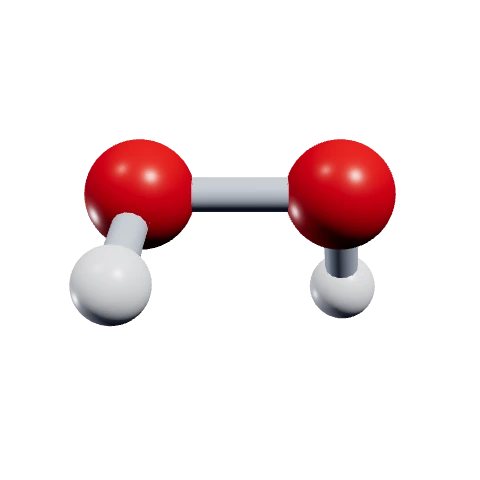


At 9:34 in the morning on May 5, 1961, a 37-year-old Navy test pilot named Alan Shepard was sitting on top of a rocket whose fuel tank held, give or take, three parts alcohol to one part water. Not a hydrazine blend. Not kerosene. The same molecule, C₂H₅OH, that goes into a laboratory wash bottle, a shellac thinner and a bottle of vodka, cut with water, pumped through the walls of the engine and burned with liquid oxygen.
Fifteen minutes and twenty-eight seconds later he was bobbing in the Atlantic as the first American in space. He was not, however, the first human in space. That honor had gone to Yuri Gagarin three weeks earlier, and one of the reasons it did is buried in a NASA history most people never open: a small valve that would not properly meter hydrogen peroxide.
This is the chemistry of Freedom 7: what was in the tanks, why NASA chose the weaker fuel on purpose, why a rocket engine needed water, and how a peroxide valve changed the order of the space race. We sell the molecule at the center of it, and we have never sold a drop of it as rocket fuel. We will come back to that.

What fuel did the Redstone rocket that launched Freedom 7 use?
The Mercury-Redstone that launched Freedom 7 burned ethyl alcohol diluted with water, about 75% alcohol to 25% water, with liquid oxygen as the oxidizer. NASA’s official history of Project Mercury, This New Ocean (NASA SP-4201), describes the Redstone’s engine as one that “burned alcohol and liquid oxygen,” and a NASA history of the first Redstone launch specifies “a mixture of 75 percent ethyl alcohol and 25 percent water as fuel and liquid oxygen as oxidizer.” The proportions appear in the NASA account.
Two tanks, two liquids. The alcohol-water blend was the fuel, the thing being burned. Liquid oxygen, kept at around −183 °C (−297 °F), was the oxidizer, the thing doing the burning. The engine was the Rocketdyne A-7, rated at roughly 78,000 pounds of thrust, and on the Mercury version it burned for about two and a half minutes before shutting down and letting the capsule coast to the top of its arc.
There was a third working fluid aboard that people forget, and it did two jobs. The pumps that shoved alcohol and oxygen into the engine were spun by a turbine, and the turbine was driven by steam made by decomposing hydrogen peroxide in a steam generator. NASA’s history notes the Mercury-Redstone needed “an auxiliary hydrogen peroxide fuel tank to power the engine turbopump.” Up in the capsule, a separate peroxide supply fed the small thrusters that turned Freedom 7 in space. Alcohol lifted the rocket; peroxide ran almost everything that moved it.
Ethanol identity: ethyl alcohol, C₂H₅OH (C₂H₆O), CAS 64-17-5, the same compound whether it is in a rocket tank, a laboratory bottle or a drum of denatured alcohol. PubChem CID 702.
Why did NASA choose alcohol over a more powerful rocket fuel?
NASA chose alcohol because the more powerful alternative, hydyne, was more toxic, and a pad accident with a man aboard made toxicity a life-or-death variable. The Redstone family already had a hotter fuel available. Its souped-up cousin, the Jupiter-C, which launched America’s first satellite in 1958, ran on hydyne, a hydrazine-based blend that squeezed more performance out of the same engine.
When the Army and NASA engineers set about “man-rating” the rocket for Project Mercury, they went backwards on purpose. In the words of This New Ocean (NASA SP-4201), they “decided to revert to alcohol for fuel rather than use the more powerful but more toxic hydyne that fueled the Jupiter-C.” To make up the lost performance, they kept the Jupiter-C’s stretched fuel tanks, which the history says bought “20 extra seconds of engine burning time.”
This is a decision procurement people will recognize. Given a choice between the higher-spec material and the one you understand completely, they bought the one they understood. Alcohol and liquid oxygen had been flown for well over a decade, its behavior in the engine was known, and if something went wrong on the pad, the astronaut and the ground crew would be dealing with a spill of alcohol rather than a hydrazine compound. The Mercury planners made hundreds of choices like this, and the history sums up the philosophy plainly: redundancy and simplicity were how you bought reliability.
The trade in one line: hydyne meant more performance and more toxicity; alcohol meant less performance, more known behavior and a spill you could survive. For the first crewed flight, NASA took the second deal and made up the difference with bigger tanks.
Why was there water in the Redstone’s rocket fuel?
The water was there to keep the engine from melting: it lowered the flame temperature, and the fuel itself was used to cool the combustion chamber. Pure ethanol burned with liquid oxygen runs extremely hot. Cutting it to about 75% alcohol pulls the combustion temperature down to something the chamber walls can survive, at the price of some energy.
The cooling trick is older than the Redstone. The Smithsonian’s record of the German V-2 explains that its 75% alcohol-water fuel was used because “the water additive helped cool the motor, which developed maximum operating temperatures of about 4,900 F.” Before it was burned, the alcohol blend was routed through the double walls of the combustion chamber, soaking up heat and carrying it back into the fire. Engineers call this regenerative cooling: the fuel is the coolant on its way to becoming the fuel.
That arrangement explains why alcohol was such a good early rocket fuel. It mixes with water in any proportion, so the blend is uniform in the tank with nothing to settle out. It stays liquid across a wide temperature range. It was cheap and plentiful. And it burns cleanly, which is why photographs of Redstone launches show that pale, almost invisible plume instead of the black-edged orange of a kerosene engine.
How strong was it? A fuel that is three parts alcohol to one part water sits in the neighborhood of 150 proof if the 75% is read by volume (proof is twice the alcohol percentage by volume). The historical sources give the ratio without always saying whether it is by weight or by volume, so treat “roughly 150 proof” as an approximation rather than a spec.
Where did the Redstone’s alcohol-and-oxygen recipe come from?
The recipe came from the German V-2, of which the Redstone was, in NASA’s words, “a direct descendant.” The Redstone was designed by Wernher von Braun’s team for the U.S. Army at Redstone Arsenal in Huntsville, Alabama, and the V-2 that many of those engineers had built during the Second World War burned the same pair of propellants: alcohol and water as the fuel, liquid oxygen as the oxidizer.
That lineage deserves a sentence of plain honesty rather than a footnote. The V-2 was a weapon fired at London and Antwerp, and it was manufactured largely by prisoners. The Smithsonian’s own record states that “at least 10,000 concentration camp workers died in the process of manufacturing it,” and it notes that von Braun was aware of the use of camp labor. The Redstone inherited the V-2’s chemistry along with its engineers; the chemistry is not what makes that history comfortable.
Alcohol and liquid oxygen also powered a very different American milestone first. This New Ocean (NASA SP-4201) records that the Bell X-1, the rocket plane Chuck Yeager flew faster than sound on October 14, 1947, was powered by a rocket “burning liquid oxygen and a mixture of alcohol and distilled water.” So the same humble fuel carried the United States through the sound barrier and, fourteen years later, into space.
Did Freedom 7 burn hydyne or RP-1 kerosene?
No. Freedom 7’s Mercury-Redstone burned alcohol and liquid oxygen; hydyne fueled the earlier Jupiter-C, and RP-1 kerosene fueled later rockets such as the Atlas that carried John Glenn into orbit. This is worth stating outright because published sources disagree. We found reputable museum and agency web pages that list hydyne, or “LOX/RP-1,” as the propellant for Shepard’s rocket.
The confusion is understandable. The Mercury-Redstone was built from the Jupiter-C airframe, and the Jupiter-C did burn hydyne, so a record describing the airframe’s history can carry the wrong fuel forward. The deciding source is NASA’s official program history, written from Project Mercury’s own records, which says the designers reverted to alcohol specifically to avoid hydyne’s toxicity. When sources conflict on a fact like this, go to the document written from the program files.
What did hydrogen peroxide do on Freedom 7?
Hydrogen peroxide did two jobs: it made the steam that drove the Redstone’s fuel pumps, and it fed the thrusters that turned the Freedom 7 capsule in space. Concentrated hydrogen peroxide, H₂O₂, breaks down into steam and oxygen when it meets a catalyst, releasing heat. No flame and no second chemical to ignite it, just a controlled decomposition, which made it attractive for anything that had to start reliably.
In the booster, that hot steam spun the turbine that ran the alcohol and liquid-oxygen pumps. In the capsule, small peroxide jets made up the Reaction Control System. At the top of the flight, NASA’s history describes Shepard switching to “fly-by-wire,” using his hand controller to position the capsule with “the hydrogen peroxide jets.” On the way down, falling toward the water, he “pushed the switch to dump the remaining hydrogen peroxide fuel” before splashdown.
Not the same peroxide: the peroxide that ran spacecraft thrusters was propulsion-grade, far more concentrated than anything sold for cleaning, labs or water treatment. Alliance Chemical’s hydrogen peroxide tops out at 30%, is not a propellant, and is not sold for propulsion. If you want to know what the different strengths are actually for, see our hydrogen peroxide concentration guide.
Why wasn’t Alan Shepard the first human in space?
Shepard lost the race to Gagarin partly because NASA inserted one extra uncrewed Redstone test in March 1961, largely to fix a hydrogen peroxide control problem that had made earlier Redstones over-accelerate. The Redstone’s path to carrying a person was not smooth, and This New Ocean (NASA SP-4201) tells it in painful detail.
MR-1: the four-inch flight (November 21, 1960)
The first Mercury-Redstone ignited on schedule, rose a few inches, and shut down. The escape tower fired and flew away on its own, leaving the capsule and rocket sitting on the pad. NASA’s history calls it “the absolute nadir of morale” for Project Mercury. The countdown had already been held that morning to fix a leak in the capsule’s hydrogen peroxide system.
MR-2: Ham’s fast ride (January 31, 1961)
The next flight carried a chimpanzee named Ham. The rocket flew too steep and too fast. According to the history, “137 seconds into the flight, the liquid oxygen supply became depleted,” the abort system fired early, and the capsule reached about 7,540 feet per second against a planned 6,465. Ham came back alive and, by NASA’s account, performing his tasks; the rocket had not behaved.

The valve
The cause is the part of the story that belongs to chemistry. NASA’s history identifies “the foremost cause of previous Redstone booster overaccelerations” as “a small servo control valve that had failed to regulate properly the flow of hydrogen peroxide to the steam generator, which in turn powered, and in the case of MR-1A and MR-2 overpowered, the fuel pumps.” Too much peroxide meant too much steam, too much steam meant the pumps pushed too much alcohol and oxygen, and too much propellant meant a rocket running harder than it should.
MR-BD: the flight that flew empty (March 24, 1961)
Von Braun’s team at the Marshall Space Flight Center wanted one more test before risking a person, with seven modifications to the booster, including the thrust regulator. NASA agreed, postponed the first crewed flight, and inserted an extra mission called MR-BD, for Mercury-Redstone Booster Development. It flew on March 24, 1961, carrying a boilerplate capsule and no one, and it worked.
Nineteen days later, on April 12, 1961, Yuri Gagarin orbited the Earth. Historians have argued ever since about whether Shepard could have flown on March 24 instead. Two honest qualifications belong next to that argument: Gagarin’s flight was a full orbit while Shepard’s was a 15-minute suborbital hop, and the engineers who asked for the extra flight were doing exactly what a reliability program is supposed to do. It is still a remarkable fact that a peroxide metering valve sits in the causal chain of who went first.
What happened on the Freedom 7 flight?
Freedom 7 lifted off at 9:34 a.m. EST on May 5, 1961, reached 116.5 statute miles, traveled 303 miles downrange and splashed down in the Atlantic 15 minutes and 28 seconds later. Those figures are from NASA’s mission record, which also lists a top speed of 5,134 miles per hour.
Shepard rode the alcohol-and-oxygen engine for the powered part of the climb, then coasted over the top in near weightlessness, looking out at the Florida coast and the Bahamas through his periscope, and flew the capsule by hand with its peroxide jets as it approached the retrofire attitude. The retrorockets fired, the parachutes opened, he dumped his remaining peroxide, and a helicopter carried him to the aircraft carrier Lake Champlain. The Mercury-Redstone went on to launch Gus Grissom on Liberty Bell 7 in July 1961 on the same alcohol and liquid oxygen, and then the program moved on to the kerosene-fueled Atlas for orbital flights.

Why don’t large rockets burn alcohol anymore?
Large rockets moved away from alcohol because it carries less energy per kilogram than kerosene, hydrogen or methane, and a quarter of the Redstone’s fuel was water that contributed no energy at all. Ethanol releases about 1,367 kilojoules per mole when it burns completely, roughly 29.7 megajoules per kilogram (NIST). Hydrocarbon fuels such as kerosene release considerably more per kilogram, because they carry no oxygen atom of their own. Every kilogram of water in the tank is mass the rocket has to lift and cannot burn.
For a short suborbital hop, that penalty was acceptable in exchange for a fuel the engineers trusted. For orbit, it was not. That is why the Mercury program switched boosters for orbital flights, and why nearly every orbital rocket since has used denser, more energetic fuels. Alcohol’s place in the story is as the reliable fuel that got the first flights up, not the one that scaled.
| Rocket | Year | Fuel | Oxidizer | Why it matters here |
|---|---|---|---|---|
| V-2 (A-4) | 1944 | ~75% alcohol, 25% water | Liquid oxygen | The recipe the Redstone inherited; built with forced labor |
| Bell X-1 | 1947 | Alcohol and distilled water | Liquid oxygen | First aircraft through the sound barrier |
| Jupiter-C | 1958 | Hydyne (hydrazine-based) | Liquid oxygen | More power, more toxic; launched Explorer 1 |
| Mercury-Redstone | 1961 | ~75% ethyl alcohol, 25% water | Liquid oxygen | Launched Shepard and Grissom; peroxide-driven turbopump |
| Mercury-Atlas | 1962 | RP-1 kerosene | Liquid oxygen | Carried Mercury into orbit |
Is rocket ethanol the same ethanol you can buy today?
Yes, at the molecular level: ethyl alcohol is C₂H₅OH, CAS 64-17-5, whether it flew on a Redstone or ships in a drum today. What differs is the grade, the proof and, for most industrial alcohol, the denaturant. A laboratory or pharmaceutical buyer wants USP-grade ethyl alcohol with a documented specification. A shop or process buyer usually wants denatured alcohol, ethanol with a federally specified additive that keeps it out of the beverage tax system, in 190 proof (about 95% ethanol, the distillation limit) or 200 proof (anhydrous).
What ethanol does in industry today is the quiet version of what it did in the Redstone: it dissolves things, it mixes with water in any ratio, it evaporates cleanly, and its behavior is completely understood. It thins shellac, cleans precision parts, extracts botanicals, carries fragrances and serves as a laboratory solvent. If you want the full story on why most industrial ethanol is deliberately made undrinkable, read what denatured alcohol is and why ethanol is poisoned on purpose.
What we do not do: Alliance Chemical does not sell rocket propellant, and nothing we sell is intended or labeled for propulsion. Ethanol is a DOT Class 3 flammable liquid with a flash point around 55 °F (13 °C); store it away from ignition sources and oxidizers, and follow the safety data sheet on every product page.
| If you need | Grade | Product |
|---|---|---|
| Undenatured ethanol to a pharmacopeia specification (lab, pharma) | USP Grade | Ethyl Alcohol (U.S.P. Grade), NSN 6810-00-823-8003 |
| General solvent and cleaning where a little water is fine | Technical Grade, 190 proof | Denatured Alcohol 190 Proof 3A or 3C |
| Water-sensitive work (shellac, some extractions, fast drying) | Technical Grade, 200 proof | Denatured Alcohol 200 Proof 3A or 3C |
Key numbers and sources
| Fact | Figure | Source |
|---|---|---|
| Freedom 7 launch | May 5, 1961, 9:34 a.m. EST | NASA MR-3 mission page |
| Flight duration | 15 minutes, 28 seconds | NASA MR-3 mission page |
| Peak altitude / downrange | 116.5 / 303 statute miles | NASA MR-3 mission page |
| Maximum speed | 5,134 mph | NASA MR-3 mission page |
| Mercury-Redstone fuel choice | Reverted to alcohol; hydyne rejected as more toxic | This New Ocean (NASA SP-4201), “Man-Rating the Machines” |
| Redstone fuel blend | ~75% ethyl alcohol, 25% water, with liquid oxygen | NASA, “70 Years Ago: First Redstone Launch” |
| Turbopump drive | Steam from hydrogen peroxide | NASA SP-4201, “Man-Rating the Machines” |
| Cause of MR-1A / MR-2 over-acceleration | Servo valve mis-regulating peroxide to the steam generator | NASA SP-4201, “Tests Versus Time in the Race for Space” |
| MR-BD extra test flight | March 24, 1961 | NASA SP-4201, “Tests Versus Time in the Race for Space” |
| V-2 fuel and cooling | 75% alcohol-water; water helped cool the motor | Smithsonian NASM, V-2 record |
| Ethanol identity | C₂H₆O, CAS 64-17-5 | PubChem CID 702 |
| Ethanol heat of combustion | ~1,367 kJ/mol (~29.7 MJ/kg) | NIST Chemistry WebBook |
References & Authoritative Sources
Flight events and engineering decisions are quoted from NASA’s official history of Project Mercury; flight figures from NASA’s mission record; V-2 details from the Smithsonian National Air and Space Museum; chemical data from PubChem and the NIST Chemistry WebBook. Where sources disagree on Freedom 7’s fuel, we follow NASA SP-4201.
- Swenson, Loyd S., Jr., James M. Grimwood and Charles C. Alexander. This New Ocean: A History of Project Mercury. NASA SP-4201, 1966. nasa.gov (PDF)
- “Mercury-Redstone 3: Freedom 7.” NASA. nasa.gov
- “V-2 Missile.” Smithsonian National Air and Space Museum, object A19600342000. airandspace.si.edu
- “70 Years Ago: First Redstone Launch From Cape Canaveral.” NASA History. nasa.gov
- Ethanol, CAS 64-17-5. PubChem CID 702
- Ethanol, NIST Chemistry WebBook, SRD 69 (condensed-phase thermochemistry). webbook.nist.gov
- Photographs: NASA Image and Video Library, images 6100884 (MR-3 liftoff), G61-00337 (Ham, preflight) and 6417078 (Shepard with Freedom 7). images.nasa.gov
Ethyl alcohol from Alliance Chemical
The molecule that launched Freedom 7, for the jobs it does on the ground: USP Grade ethyl alcohol for labs, and Technical Grade denatured alcohol in 190 and 200 proof, SDA 3A and 3C, from a single quart to a 330-gallon tote. Tell us the application and we will spec the grade. Certificate of Analysis on request, no charge.
Related reading
- What is denatured alcohol? — why the government poisons perfectly good ethanol, and what is in SDA 3A vs 3C.
- Nitric acid fed half the world, powered Apollo, and cracked dynamite wide open — the hypergolic chemistry that took over after alcohol.
- Hydrogen peroxide concentrations explained — what 3% through 30% are actually for.
- From lab to launch pad — the ground-side chemistry of rocketry.
- Glycols in space exploration — the coolant chemistry of spacecraft.
- Who discovered phosphorus? — Hennig Brand, 1669, and chemistry’s strangest discovery story.
Related: The Army Made a Man Fly on Hydrogen Peroxide, Then Walked Away: The Bell Rocket Belt, the X-15 and the Machine That Trained Neil Armstrong — the other peroxide story of 1961: while the Redstone used it to drive a pump, the Army was using it to fly a man.
Frequently asked questions
What fuel did Freedom 7 use?
The Mercury-Redstone rocket that launched Freedom 7 on May 5, 1961 burned ethyl alcohol diluted with about 25% water, with liquid oxygen as the oxidizer. Its turbopump was driven by steam from decomposed hydrogen peroxide.
Did the Mercury-Redstone use hydyne?
No. NASA’s official history, This New Ocean (SP-4201), says the Mercury-Redstone designers reverted to alcohol rather than use the more powerful but more toxic hydyne that fueled the Jupiter-C.
Why was water mixed into the Redstone’s alcohol fuel?
Water lowered the flame temperature, and the alcohol-water blend flowed through the double walls of the combustion chamber to cool it before being burned, a technique called regenerative cooling inherited from the V-2.
What was hydrogen peroxide used for on Freedom 7?
Hydrogen peroxide made the steam that drove the Redstone’s fuel pumps, and it fed the small thrusters that Alan Shepard used to position the Freedom 7 capsule in space. That propulsion-grade peroxide was far more concentrated than commercial grades.
Why was Alan Shepard not the first person in space?
NASA inserted an extra uncrewed Redstone test, MR-BD, on March 24, 1961, largely to fix a valve that mis-regulated hydrogen peroxide to the steam generator and caused earlier Redstones to over-accelerate. Yuri Gagarin orbited the Earth on April 12, 1961; Shepard flew on May 5.
Was the Redstone rocket based on the V-2?
Yes. NASA’s history calls the Redstone a direct descendant of the V-2, which burned the same alcohol-water fuel with liquid oxygen. The V-2 was built largely by concentration camp prisoners, at least 10,000 of whom died, according to the Smithsonian.
Is the ethanol in a rocket the same as industrial ethanol?
The molecule is the same, ethyl alcohol, C2H5OH, CAS 64-17-5. Industrial and laboratory ethanol differ in grade, proof and, for denatured alcohol, a federally specified additive. Alliance Chemical does not sell ethanol as a rocket propellant.
Why don’t modern rockets burn alcohol?
Ethanol carries less energy per kilogram than kerosene, hydrogen or methane, and diluting it with water lowers that further. It suited short suborbital flights but not orbital launches, which is why Mercury switched to the kerosene-fueled Atlas for orbit.
Related Chemical Collections
About the author
Andre Taki
This article is for informational purposes only.


