



In the second week of June 1961 an Army cameraman set up on the lawn outside the Pentagon and filmed a man take off. There was no propeller, no jet, no flame. Harold Graham, a 27-year-old engineer from Bell Aerosystems in Buffalo, New York, stood in a harness with two steel tanks on his back, squeezed a throttle on his right hand, and rose over the grass on a roaring cloud of steam. A few seconds later he came down in front of a row of generals and a crowd that, by the film’s own evidence, had never seen anything like it.
The tanks held hydrogen peroxide. Not the 3% in a brown bottle, but 90%, forced through a bed of silver catalyst that tore it apart into oxygen and superheated steam. The steam did the lifting. That was the whole engine.
The Army had paid for the belt, and after the demonstration it walked away: about twenty-one seconds of flight is not a weapon. But the peroxide rocket did not go away with it. The same chemistry was already steering the X-15 above the atmosphere, and three years later it flew the ungainly machine on which Neil Armstrong learned to land on the Moon. This is the story of a chemical that failed as a stunt and succeeded as an instrument, told from the Army’s own film and NASA’s own records. We sell the molecule, at 3% to 30%, and we have never sold a drop of it for propulsion. We will come back to that.

What was the Bell Rocket Belt, and who flew it first?
The Bell Rocket Belt was a one-man hydrogen peroxide rocket pack designed by Bell Aerosystems engineer Wendell F. Moore, first flown free of a tether by his colleague Harold Graham on April 20, 1961, at Niagara Falls, New York. Moore, who had worked on Bell’s X-2 rocket plane, began sketching a personal rocket at Edwards Air Force Base in 1953. He made the first tethered flight himself in December 1958, hanging from a safety line in a hangar while the pack’s steam blast lifted him a few feet off the floor.
The Army bought in. Bell won an Army contract to develop the belt in August 1960, under a program that called it, with no romance at all, the Small Rocket Lift Device. When Moore broke a knee in a tethered test early in 1961, Graham, a 27-year-old engineer, stepped in as pilot. On April 20, 1961, he made the first untethered flight in history: about 13 seconds, 113 feet across a field, a peak speed of roughly 10 miles per hour, and a height of about 18 inches. The account in Invention & Technology calls him “the first human rocket in history,” and it is hard to argue.
The date matters. Graham’s first free flight came eight days after Yuri Gagarin orbited the Earth and fifteen days before Alan Shepard flew Freedom 7. In the spring of 1961 a man rising eighteen inches on a cloud of steam in upstate New York was, briefly, the third-strangest thing in the sky.
How did hydrogen peroxide make a man fly without burning anything?
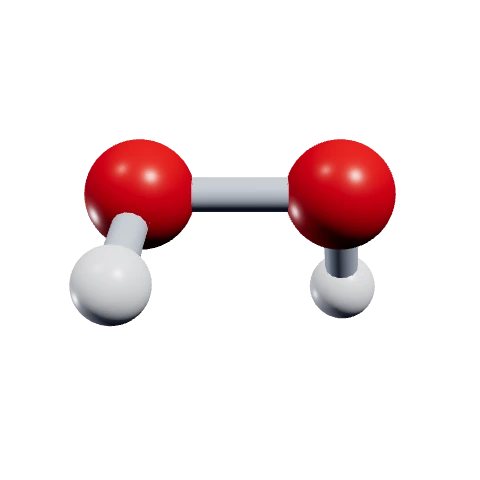
The belt was a monopropellant rocket: concentrated hydrogen peroxide met a silver catalyst, decomposed instantly into steam and oxygen, and the hot gas blasting out of two nozzles produced the thrust. Nothing burned. Hydrogen peroxide, H₂O₂, is water with one extra oxygen atom bolted on, and that extra atom wants out. Left alone in a clean bottle it leaves slowly. Pushed through a bed of silver-plated screens, the reaction runs to completion in a fraction of a second:
2 H₂O₂ (liquid) → 2 H₂O (steam) + O₂ (gas) + heat. The decomposition is strongly exothermic, and at 90% concentration there is so little water to soak up that heat that the products leave the catalyst bed as a gas at several hundred degrees Celsius. Published silver-catalyst thruster studies report bed temperatures in the region of 600–700 °C, close to the melting point of silver itself, which is why the concentration a silver bed can handle has a ceiling (Catalytic effect of platinum and silver in a hydrogen peroxide monopropellant thruster).
Inside the belt, the layout was simple enough to describe in a sentence. Two tanks of 90% peroxide sat either side of a central tank of nitrogen gas at high pressure. Opening the throttle let nitrogen push peroxide into the catalyst chamber; the chamber fed two insulated tubes that curved over the pilot’s shoulders and ended in nozzles pointing down and slightly out. Twist the hand grips and the nozzles tilted, steering the blast. There was no ignition system to fail, no fuel and oxidizer to mix, and no flame. A rocket with one moving fluid.

The price of that simplicity was fuel. Hydrogen peroxide is a poor propellant by rocket standards, because its exhaust is mostly water vapor, a heavy molecule that leaves the nozzle slowly. The belt carried only as much peroxide as a man could stand up under, and at full throttle it drank the lot in about twenty-one seconds. Every flight in the Army film is a short one for the same reason: the pilot had to be back on the ground before the tanks ran dry, with a margin. The other cost was noise. A steam rocket a foot behind each ear is loud enough that Graham flew in a helmet and the crew wore ear protection, and the Army film, which is silent, spares you that part.
What happened at Fort Eustis and the Pentagon in June 1961?
The Army filmed formal demonstrations of the belt at Fort Eustis, Virginia, and on the lawn of the Pentagon between June 7 and June 15, 1961, and that film survives in the National Archives. The catalog record for reel 111-LC-45135, shot by the Army Signal Corps, titles it plainly: “Demonstration of the flying rocket belt, Fort Eustis, Virginia and the Pentagon.” The slate boards inside the film carry the date 7/6/61.
The Fort Eustis footage is the more technical half. Graham is strapped into the pack on a rolling stand by a crew in white T-shirts, checked over, and walked out onto the grass beside a line of transport aircraft. He lifts off, crosses the field, clears a parked Army truck with a crowd watching from behind it, and settles back onto the turf. The second half moves to Washington. Graham, now in a white helmet and dark flight suit, is fitted out beside a fife-and-drum unit in colonial uniform, walks out past the Pentagon’s facade, and flies a short arc over the lawn, clearing a staff car and landing in front of a reviewing stand of officers and civilians.

Watch the film closely and the twenty-one-second limit is visible in every shot. No flight lasts long enough to be dull. Graham rises, crosses something, and comes down; the crew is waiting with the stand before he lands. The belt could carry a man over an obstacle, and it could astonish a crowd. What it could not do was go anywhere.
Why did the Army walk away from the rocket belt?
The Army dropped the belt because of its flight time: twenty-one seconds of peroxide, and no practical way to carry more. Invention & Technology puts it in one sentence: the Army “eventually lost interest in the rocket belt because of its limited flight time: only twenty-one seconds.” A soldier who can fly for twenty-one seconds can cross a river or a wall. He cannot carry a load, cannot loiter, cannot go back, and arrives at the far side with an empty pack that weighs as much as a full one.
The physics behind that number is the physics of the propellant, not of the design. Thrust from a peroxide rocket comes from throwing steam and oxygen out of a nozzle; the energy available per pound of peroxide is fixed by the chemistry, and it is modest. Making the belt fly longer meant carrying more peroxide, and every extra pound of peroxide had to be lifted by peroxide. Bell ran the arithmetic and so did the Army, and the answer was the same for both.
The belt lived on as a spectacle. Graham flew it for President Kennedy at Fort Bragg in 1962, and Bell pilots flew later versions at fairs, football games and a world’s fair. As a weapon it was over by the time the Pentagon film was developed.
A note on the man in the film. Harold Graham was a test engineer, not a stuntman, and the flights in the Army reel were engineering demonstrations with a crew, a stand and a plan. Nothing about a 90% peroxide rocket strapped to a human being is safe to imitate, and the concentrations sold for industrial and laboratory use will not do it in any case. See below.
Where did the peroxide rocket go next? The X-15
While the Army was losing interest, the same monopropellant peroxide rocket was flying the X-15, the rocket plane that set the world altitude record of 354,200 feet in 1963. Above roughly 100,000 feet the air is too thin for a rudder or an aileron to bite, so the X-15 carried a reaction control system. NASA’s own fact sheet on the aircraft describes it: “For flight in the thin air outside the Earth’s atmosphere, the X-15 used a reaction control system. Hydrogen peroxide thrust rockets on the nose of the aircraft provided pitch and yaw control. Those on the wings furnished roll control” (NASA fact sheet FS-052).
Those thrusters were the belt’s cousins: peroxide, catalyst, steam, nozzle. The X-15 also used peroxide to run its two auxiliary power units, the small turbines that drove the hydraulic pumps and generators, so a plane flying at the edge of space had steam from decomposed peroxide both steering it and keeping its controls powered. NASA credits the X-15 program with the “first use of reaction controls for attitude control in space,” and with the successful transition from aerodynamic controls to reaction controls and back again, the maneuver every returning spacecraft since has depended on.
On August 22, 1963, NASA pilot Joseph Walker took X-15 number three to 354,200 feet, a record for a winged aircraft that stood for over forty years. For the minutes he spent above the atmosphere, the only thing holding the aircraft’s nose where he wanted it was hydrogen peroxide.
How did hydrogen peroxide help Neil Armstrong learn to land on the Moon?
Bell built NASA a free-flying lunar landing simulator, the Lunar Landing Research Vehicle, whose lift and attitude rockets ran on hydrogen peroxide, and Armstrong flew its training version more than thirty times before Apollo 11. The problem NASA faced in 1961 was that no simulator on the ground could teach a pilot what it felt like to fly a lunar module in one-sixth gravity with no air. Bell, with its rocket-belt experience and its vertical-takeoff work, proposed a machine that could fake the Moon over the Mojave Desert.
The LLRV was an open aluminum truss on four legs, nicknamed the flying bedstead. A jet engine mounted vertically in a gimbal lifted it to altitude and was then throttled back to carry exactly five-sixths of the vehicle’s weight, cancelling out the difference between Earth and lunar gravity. Everything else was peroxide. NASA’s fact sheet is specific: “Two hydrogen peroxide lift rockets with thrust that could be varied from 100 to 500 pounds handled the LLRV’s rate of descent and horizontal movement. Sixteen smaller hydrogen peroxide rockets, mounted in pairs, gave the pilot control in pitch, yaw and roll,” with six more 500-pound peroxide rockets as a backup if the jet failed (NASA fact sheet FS-026). NASA gave Bell a $50,000 study contract in December 1961 and a $3.6 million production contract on February 1, 1963. Joe Walker, the same pilot who had taken the X-15 to its altitude record, made the first LLRV flight on October 30, 1964: three hops, just under sixty seconds in all, to a height of ten feet.

The machine was dangerous, and peroxide was in the middle of its worst day. On May 6, 1968, Armstrong was flying LLRV No. 1 at Ellington Air Force Base near Houston when, after about five minutes, the vehicle began to roll and pitch out of control. About 200 feet up he ejected; the LLRV hit the ground and burned, and he parachuted down unhurt. NASA’s history office records the investigation board’s finding: “a loss of helium pressure caused depletion of the hydrogen peroxide used for the reserve attitude thrusters” (NASA History, “55 Years Ago: Astronaut Armstrong Survives LLRV Crash”). The helium was the pressurant that pushed the peroxide to the rockets, the same job nitrogen had done in the belt. When it leaked away, the thrusters starved.
Armstrong kept flying the trainer. Fourteen months later he landed Eagle on the Moon by hand, and afterward he said the lunar module “flew very much like the Lunar Landing Training Vehicle which I had flown more than 30 times.” His summary of the peroxide-rocket bedstead was as dry as the man: “It was a contrary machine, and a risky machine, but a very useful one” (NASA History, “50 Years Ago: The Lunar Landing Training Vehicle”). Apollo 8’s Bill Anders called the trainer “a much unsung hero of the Apollo Program.”
The through-line: the rocket belt (1961), the X-15 reaction controls (1959–68) and the LLRV (1964–68) were three applications of one idea, hydrogen peroxide decomposed over a catalyst to make controllable thrust with no combustion. The belt failed because that idea cannot carry much energy. The X-15 and the LLRV succeeded because they did not need much; they needed thrust that was instant, throttleable and reliable, and a monopropellant delivers exactly that.
Is the hydrogen peroxide Alliance Chemical sells a propellant? No
No. The peroxide in this story was 90% rocket-grade; the hydrogen peroxide Alliance Chemical sells runs from 3% to 30%, is stabilized for storage, is not a propellant, and is not sold for propulsion. The difference is not a marketing distinction. It is the chemistry of the same equation at a different concentration. In 90% peroxide there is barely any water, so nearly all the heat of decomposition goes into making the products hot, and they leave as high-pressure gas. In 30% peroxide, seven parts in ten of the liquid are already water, and that water absorbs the heat. Decompose it over a catalyst and you get warm, oxygenated water and a fizz, not a jet. At 3% you get a fizz you can barely see.
Regulators draw the same lines. Under the U.S. hazardous materials table, aqueous hydrogen peroxide of 8% to under 20% ships as UN 2984, a Class 5.1 oxidizer, Packing Group III; 20% to 60% ships as UN 2014, Class 5.1 with a corrosive subsidiary hazard, Packing Group II; and solutions over 60%, the rocket-grade range, are UN 2015, Packing Group I, the most restrictive category, with their own stabilization and packaging requirements (49 CFR 172.101). Below 8% it is not regulated as a hazardous material for transport at all. Every one of our grades sits in the first three bands.
Not the same peroxide: Alliance Chemical’s hydrogen peroxide tops out at 30%, is not a propellant, and is not sold for propulsion. Concentrations of 20% and above will still bleach skin white on contact, damage eyes and accelerate combustion of anything flammable they soak into, which is why they ship as oxidizers and why the safety data sheet on every product page tells you to keep them away from metals, heat and organics. Respect them. Do not try to make them fly.
Identity: hydrogen peroxide, H₂O₂, CAS 7722-84-1, the same compound at 3%, 30% or 90%. PubChem CID 784.
What are 3% to 30% hydrogen peroxide actually used for?
Commercial hydrogen peroxide is bought for what the extra oxygen atom does when it leaves gently: it oxidizes, it bleaches, and it breaks down into nothing but water and oxygen. That last property is the reason it has displaced chlorine chemistry in so many places. Nothing is left behind.
| Concentration | Typical jobs | Notes |
|---|---|---|
| 3%–6% | General-purpose oxidizer, surface cleaning, hydroponic and horticultural oxygenation, light bleaching | Below the 8% transport threshold; the strength most people recognize |
| 10%–15% | Bleaching, stain and residue oxidation, pool and water applications at dilution, textile and pulp work | UN 2984, Class 5.1 PG III; ships as an oxidizer |
| 25%–30% | Laboratory reagent (ACS), process oxidation, etching and metal surface work, bulk dilution stock for everything above | UN 2014, Class 5.1 with corrosive subsidiary, PG II; the most economical way to buy active H₂O₂ |
Two grades cover those jobs. Technical Grade is the workhorse: the right choice for cleaning, bleaching, oxidation and dilution where a documented trace-metal profile is not required. ACS Reagent Grade meets the American Chemical Society reagent specification and is what a laboratory, a QC bench or a sensitive process should buy. If you are not sure which you need, the honest answer is usually Technical unless a method or a specification says otherwise, and you can read our concentration guide for the arithmetic of diluting a stronger grade down.
Key numbers and sources
| Fact | Figure | Source |
|---|---|---|
| First free flight of the Bell Rocket Belt | April 20, 1961; Harold Graham; 13 s, 113 ft, ~18 in altitude | Invention & Technology, “The Rocket Belt” |
| Propellant | 90% hydrogen peroxide, nitrogen pressurant, silver catalyst | Invention & Technology |
| Flight time limit | ~21 seconds | Invention & Technology |
| Army development contract | August 1960 | Invention & Technology |
| Fort Eustis and Pentagon demonstrations | June 7–15, 1961 | National Archives, 111-LC-45135 |
| X-15 reaction controls | Hydrogen peroxide thrust rockets, nose (pitch, yaw) and wings (roll) | NASA fact sheet FS-052 |
| X-15 altitude record | 354,200 ft, August 22, 1963, Joseph Walker | NASA fact sheet FS-052 |
| LLRV peroxide rockets | 2 lift rockets, 100–500 lb thrust; 16 attitude rockets; 6 backup 500-lb rockets | NASA fact sheet FS-026 |
| LLRV contracts and first flight | $50,000 study Dec 1961; $3.6M production Feb 1, 1963; first flight Oct 30, 1964 | NASA fact sheet FS-026 |
| Armstrong LLRV ejection | May 6, 1968, ~200 ft; helium loss depleted attitude-thruster peroxide | NASA History |
| Hydrogen peroxide transport classes | 8–<20% UN 2984 PG III; 20–60% UN 2014 PG II; >60% UN 2015 PG I | 49 CFR 172.101 |
| Identity | H₂O₂, CAS 7722-84-1 | PubChem CID 784 |
References & Authoritative Sources
The 1961 demonstrations are described from the Army Signal Corps film itself and its National Archives catalog record; rocket-belt development dates from Invention & Technology; X-15 and LLRV figures from NASA fact sheets; the Armstrong ejection and quotations from NASA’s history office; transport classes from the Code of Federal Regulations.
- U.S. Army Signal Corps. Demonstration of the flying rocket belt, Fort Eustis, Virginia and the Pentagon, June 7–15, 1961. National Archives Identifier 28527, Local Identifier 111-LC-45135. catalog.archives.gov
- “The Rocket Belt.” Invention & Technology. inventionandtech.com
- “X-15 Hypersonic Research Program.” NASA Dryden Flight Research Center fact sheet FS-052. nasa.gov (PDF)
- “Lunar Landing Research Vehicle.” NASA Dryden Flight Research Center fact sheet FS-026. nasa.gov (PDF)
- “55 Years Ago: Astronaut Armstrong Survives LLRV Crash.” NASA History. nasa.gov
- “50 Years Ago: The Lunar Landing Training Vehicle.” NASA History. nasa.gov
- 49 CFR § 172.101, Hazardous Materials Table (hydrogen peroxide, aqueous solutions: UN 2984, UN 2014, UN 2015). ecfr.gov
- Hydrogen peroxide, CAS 7722-84-1. PubChem CID 784
- Photographs and frames: NASA Image and Video Library, ECN-535 (LLRV No. 1 in flight, December 1964); National Archives film 111-LC-45135 via the NARA YouTube channel. U.S. government works, public domain; no endorsement implied.
Hydrogen peroxide from Alliance Chemical
The molecule that lifted a man in 1961, at the strengths it is actually sold for: Technical Grade for cleaning, bleaching, oxidation and dilution stock, and ACS Reagent Grade for the lab and the spec-driven process. From a quart to a 330-gallon tote. Tell us the application and we will spec the grade and the concentration. Certificate of Analysis on request, no charge.
Technical Grade
ACS Reagent Grade
Related reading
- The complete hydrogen peroxide concentration guide, 3% to 30% — what each strength is for and how to dilute down.
- What fuel launched Freedom 7? — the alcohol rocket of May 1961, and the peroxide valve that helped Gagarin fly first.
- Does hydrogen peroxide expire? — the slow version of the same decomposition, and how to slow it further.
- H₂O₂ cleaning recipes by concentration — the working strengths for the jobs that do not involve flying.
- From lab to launch pad — the ground-side chemistry of rocketry.
- Nitric acid fed half the world and powered Apollo — the hypergolic chemistry that flew the lunar module itself.
Frequently asked questions
What fuel did the Bell Rocket Belt use?
The Bell Rocket Belt ran on 90% hydrogen peroxide pushed by pressurized nitrogen through a silver catalyst, which decomposed it into superheated steam and oxygen. The steam blasting from two nozzles provided the thrust; nothing was burned.
Who made the first rocket belt flight, and when?
Bell Aerosystems engineer Harold Graham made the first untethered rocket belt flight on April 20, 1961, near Niagara Falls, New York: about 13 seconds, 113 feet, at a height of roughly 18 inches. The belt was designed by Bell engineer Wendell F. Moore, who made the first tethered flight in December 1958.
How long could the rocket belt fly?
About 21 seconds on a full load of peroxide. That limit, set by how little energy hydrogen peroxide carries per pound, is the reason the U.S. Army lost interest in the belt after the 1961 demonstrations.
Did the Army really demonstrate the rocket belt at the Pentagon?
Yes. The U.S. Army Signal Corps filmed demonstrations at Fort Eustis, Virginia, and on the Pentagon lawn between June 7 and 15, 1961. The film is held by the National Archives as item 111-LC-45135 and is in the public domain.
How did the X-15 use hydrogen peroxide?
The X-15 used hydrogen peroxide thrust rockets on its nose for pitch and yaw control and on its wings for roll control when flying above the atmosphere, and peroxide-driven auxiliary power units for hydraulics and electricity. It set an altitude record of 354,200 feet on August 22, 1963.
What was the Lunar Landing Research Vehicle and what did peroxide do on it?
The LLRV was a Bell-built free-flying simulator NASA used to train Apollo pilots. A vertical jet engine carried five-sixths of its weight to mimic lunar gravity; two hydrogen peroxide lift rockets of 100 to 500 pounds thrust and sixteen smaller peroxide attitude rockets did the flying. Neil Armstrong flew the training version more than 30 times before Apollo 11.
Why did Neil Armstrong eject from the LLRV in 1968?
On May 6, 1968, a loss of helium pressure depleted the hydrogen peroxide feeding the LLRV’s reserve attitude thrusters, and the vehicle went out of control. Armstrong ejected at about 200 feet and landed by parachute unhurt; the vehicle was destroyed.
Is the hydrogen peroxide Alliance Chemical sells a propellant?
No. Alliance Chemical sells hydrogen peroxide at 3% to 30% in Technical Grade and ACS Reagent Grade. These stabilized commercial concentrations are not propellants and are not sold for propulsion; the rocket belt, X-15 and LLRV used 90% peroxide, a different regulatory and safety category.
Related Chemical Collections
About the author
Andre Taki
This article is for informational purposes only.


