

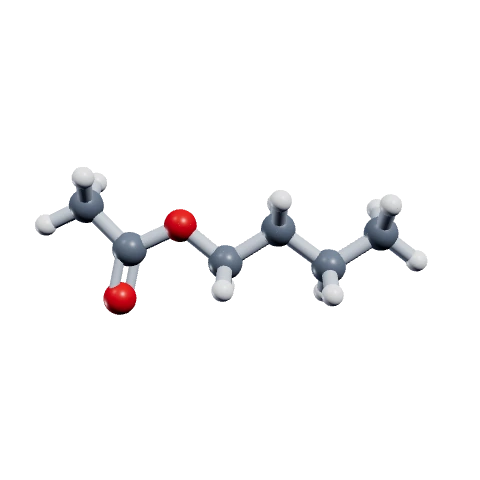


What is n-butyl acetate?
n-Butyl acetate is the ester of n-butanol and acetic acid — a clear, colorless, flammable liquid with a fruity odor, used primarily as a solvent in coatings, lacquers, inks and adhesives. That is the short answer, and it is the answer almost every page on the internet gives you.
Here is the part those pages leave out. Somewhere on the technical datasheet of nearly every industrial solvent you have ever bought, there is a line that reads evaporation rate followed by a bare number. That number is not measured in grams per minute, or millimeters per hour, or any unit at all. It is a ratio. And the thing it is a ratio to — the liquid sitting at the zero point of the whole system, the one defined as exactly 1.0 — is n-butyl acetate.
Acetone does not evaporate at "6.3." Acetone evaporates 6.3 times faster than n-butyl acetate. The number is meaningless without the molecule in this article.
Physical identity (NIOSH Pocket Guide): CAS 123-86-4 · formula CH3COO[CH2]3CH3 · molecular weight 116.2 · boiling point 258 °F (126 °C) · freezing point −107 °F · flash point 72 °F · vapor pressure 10 mmHg · specific gravity 0.88 · lower explosive limit 1.7%.
Why is n-butyl acetate the reference standard for evaporation rate?
Because a ratio scale needs a reference, and a good reference has to be boring.
A reference liquid has to sit in the middle of the range you care about — fast enough that slow solvents produce workable numbers, slow enough that fast solvents do not produce absurd ones. It has to be chemically stable, available at consistent purity, and not so volatile that the measurement drifts with the weather. n-Butyl acetate fits: it boils at 126 °C, it is stable, and it has been produced at industrial scale and consistent quality for a century.
It also came from the right industry. The evaporation-rate scale is a coatings instrument — it exists because the speed at which solvent leaves a wet film controls how that film flows, levels and hardens. n-Butyl acetate was already the workhorse solvent of nitrocellulose lacquer. Calling the workhorse 1.0 meant most formulators’ numbers landed near 1, which is exactly what you want from a scale.
We have not found an authoritative published account of the specific committee decision that fixed n-butyl acetate as the reference, and we are not going to invent one. What is documented is the convention itself, and that it is still in force on datasheets today.
How does the evaporation rate scale actually work?
The classical method is almost aggressively simple. A measured quantity of solvent is placed on filter paper in a controlled-airflow chamber, and the time taken to evaporate is compared against the time taken by n-butyl acetate under identical conditions. Rate is expressed as a ratio. Higher means faster.
The conditions are tightly specified, and the specifics explain a great deal about why published charts disagree: 0.70 mL of solvent on a 90 mm filter paper disk, a cabinet held at 25 °C (77 °F), dry air or nitrogen at 21 litres per minute, and — critically — a relative humidity of 0 to 5%. The endpoint is not dryness but 90% weight loss.
The reference is a stopwatch reading. Under those conditions, n-butyl acetate at 99% ester purity is calibrated to reach 90% evaporation in 470 ± 10 seconds. Every relative rate in the classical table is just 470 divided by the test solvent’s own 90% time. Acetone takes about 82 seconds: 470 ÷ 82 = 5.7.
The test method most often cited for this is ASTM D3539, Standard Test Methods for Evaporation Rates of Volatile Liquids by Shell Thin-Film Evaporometer. And here is a fact worth knowing before you cite it in a specification:
ASTM D3539 was withdrawn in 2015. The standard everybody still gestures at has not been an active ASTM standard for a decade — yet the n-butyl acetate = 1.0 convention it carried is printed on solvent datasheets published this year. The convention long outlived its test method. If you are writing a purchase specification, cite the number and the basis, not a withdrawn standard.
Conventional practice sorts the results into three bands, on the n-butyl acetate = 1.0 basis:
n-Butyl acetate, at exactly 1.0, sits in the middle band. It is the definition of a medium evaporating solvent, in the most literal sense available.
Solvent evaporation rate chart
The table below is taken from the Eastman Solvent Selector Chart, which publishes both reference bases side by side — a useful thing, because it shows you at a glance that the two scales disagree about which direction "bigger" points. Every solvent in this first table is one we stock.
| Solvent | CAS | Rate (n-BuAc = 1) | Rate (ether = 1) | Band |
|---|---|---|---|---|
| Acetone | 67-64-1 | 6.3 | 1.9 | Fast |
| Ethyl acetate | 141-78-6 | 4.1 | 2.9 | Fast |
| Methyl ethyl ketone (MEK) | 78-93-3 | 3.8 | 3.1 | Fast |
| Isopropyl acetate | 108-21-4 | 3.0 | 3.9 | Medium |
| tert-Butyl acetate (TBAc) | 540-88-5 | 2.8 | 4.2 | Medium |
| Methyl n-propyl ketone (MPK) | 107-87-9 | 2.3 | 5.1 | Medium |
| Isopropyl alcohol (IPA) | 67-63-0 | 1.7 | 6.9 | Medium |
| Methyl isobutyl ketone (MIBK) | 108-10-1 | 1.6 | 7.4 | Medium |
| n-Butyl acetate | 123-86-4 | 1.00 | 11.8 | Medium |
| Methyl n-amyl ketone (MAK / MNAK) | 110-43-0 | 0.4 | 29.5 | Slow |
| Cyclohexanone | 108-94-1 | 0.3 | 39.3 | Slow |
The hydrocarbon solvents and water, on the same n-butyl acetate = 1.0 basis. These are shown as ranges on purpose: most of them are distillation cuts rather than single compounds, so the honest answer genuinely is a band, not a figure.
| Solvent | Rate (n-BuAc = 1) | Band |
|---|---|---|
| Hexane (commercial, ~50% n-hexane) | 7.2 – 8.3 | Fast |
| Toluene | 1.9 – 2.0 | Medium |
| Naphtha (VM&P) | 1.4 | Medium |
| Xylene | 0.70 – 0.77 | Slow |
| n-Butyl alcohol (n-butanol) | 0.44 – 0.5 | Slow |
| Water | 0.36 | Slow |
| Mineral spirits (varies by cut) | 0.01 – 0.33 | Slow |
Published values disagree, and now you know exactly why. Acetone is listed at 6.3 by Eastman, 5.6 by Shell, and 5.7 in the classical method’s own table. Three causes, all real: (1) humidity — at least one widely-circulated chart was measured at 20% RH when the method calls for 0–5%, which flatters water-sensitive solvents; (2) the reference itself — the manual and automatic versions of the test normalise against different butyl acetate purities (roughly 450 versus 470 seconds), baking a ~4% offset into every number downstream; (3) cuts, not compounds — "hexane," "naphtha" and "mineral spirits" are boiling ranges whose composition varies by supplier. Treat these as a ranking to plan a blend around, not as physical constants.

The two-scale trap: why an evaporation rate of 11.8 means two opposite things
Look again at the row for n-butyl acetate in the table above. It reads 1.00 in one column and 11.8 in the next. Same liquid, same chart, same day.
The first column uses n-butyl acetate as the reference, where a higher number means a faster solvent. The second uses diethyl ether as the reference — a convention more common in European documentation — where the value expresses how much longer the solvent takes to evaporate than ether does. On that basis a higher number means a slower solvent. The two scales run in opposite directions.
The practical failure. A datasheet that says only "evaporation rate: 11.8" is ambiguous. On the n-butyl acetate basis that would be a solvent nearly twice as fast as acetone. On the ether basis it is n-butyl acetate itself — a medium solvent. If you specified a blend from the first reading and received the second, your film would behave nothing like your lab sample. Always read the basis, not just the number.
The two scales are genuinely reciprocal, and you can see it in the numbers: on the n-butyl acetate basis, diethyl ether is 11.8 — it evaporates 11.8 times faster than the reference. Flip the reference to ether and n-butyl acetate becomes 11.8, because it takes 11.8 times longer. Same ratio, same digits, mirrored meaning. That is exactly why the digits alone cannot tell you which scale you are reading.
This is the single most common way an evaporation-rate figure gets misused in purchasing, and it costs real money, because the failure does not show up until the coating is already on the part.
How formulators actually use the evaporation rate chart
A working solvent system is almost never one solvent. It is usually a blend drawn from all three bands, because the wet film has to do different jobs at different moments, and no single evaporation rate is right for all of them.
Think of it as three shifts:
- The fast fraction (> 3.0) — acetone, ethyl acetate, MEK. Carries the material through the gun or the roller and takes the bulk of the volume out of the film quickly, so the coating stops running.
- The medium fraction (0.8–3.0) — n-butyl acetate, IPA, MIBK, TBAc. The body of the blend. This is the window in which the film levels: brush marks and spray texture flow out while the surface is still mobile.
- The slow tail (< 0.8) — cyclohexanone, MAK, xylene, mineral spirits. A small fraction that stays in the film to the end, keeping the surface open just long enough to finish levelling and release trapped air.
Get the balance wrong in either direction and the film tells on you:
Too fast and the film skins before it levels — you keep the spray texture, and on a humid day the rapid cooling at the surface can pull moisture out of the air and leave a cloudy blush. Too slow and the film stays mobile too long — it sags on vertical surfaces, stays soft, and solvent still trapped under a skinned surface can burst through as it leaves, leaving pinholes (solvent pop).
This is the practical reason the reference solvent matters commercially. When a formulator reaches for "a medium solvent," n-butyl acetate is not one option among several — it is the definition of the category, the 1.0 that the fast and slow fractions are balanced around.
Is butyl acetate the same as acetone?
No. They are different chemicals with different speeds, and the evaporation scale is the cleanest way to see the difference: acetone evaporates roughly six times faster than n-butyl acetate (6.3 versus 1.0 on the Eastman chart).
That single ratio explains most of why formulators reach for one over the other. Acetone flashes off almost immediately, which is what you want for fast cleanup and quick-drying work, and exactly what you do not want in a sprayed finish that needs time to flow out level. n-Butyl acetate leaves slowly enough that the wet film has time to level before it sets — which is the whole reason it became the lacquer industry’s default.
They also differ in chemistry: acetone is a ketone, n-butyl acetate is an ester. Acetone is miscible with water in all proportions; n-butyl acetate is only slightly soluble in water.
Are n-butyl acetate and butyl acetate the same thing?
In everyday trade usage, "butyl acetate" almost always means n-butyl acetate (the normal, straight-chain isomer, CAS 123-86-4). But "butyl" describes a four-carbon group that can be arranged four different ways, and all four acetates exist as real, separately traded products:
| Name | CAS | Rate (n-BuAc = 1) | Note |
|---|---|---|---|
| n-Butyl acetate | 123-86-4 | 1.00 | The reference standard. What "butyl acetate" normally means. |
| Isobutyl acetate | 110-19-0 | 1.4 | Branched; slightly faster. |
| tert-Butyl acetate (TBAc) | 540-88-5 | 2.8 | Nearly three times faster; VOC-exempt in the US. |
| sec-Butyl acetate | 105-46-4 | — | Less common in general industrial supply. |
This is a live ordering error, not a chemistry-class footnote. tert-Butyl acetate evaporates about 2.8 times faster than n-butyl acetate. If a formulation was built around the reference solvent and someone substitutes TBAc because the name looked close enough on a purchase order, the film is now drying nearly three times too quickly. Check the CAS number, not the name.
We stock both the reference solvent and TBAc, so if you are not certain which one your process actually calls for, tell us the application and we will help you match it.

What is n-butyl acetate used for?
Almost everything it does follows from that medium evaporation rate: it leaves fast enough to be productive and slowly enough to let a film level out.
- Coatings and lacquers. The classic application. A strong solvent for nitrocellulose, cellulose esters, acrylics and many polyurethane systems, with the flow-out window the finish needs.
- Automotive refinish. Widely used in clearcoats and basecoat reducers, where drying speed directly controls gloss, orange peel and solvent pop.
- Printing inks. Controls tack and set speed on press.
- Adhesives. Dissolves and carries polymer systems that need a controlled open time.
- Industrial cleaning and surface prep. Effective on resins, oils and uncured coatings.
- Chemical processing. An extraction and reaction solvent where a water-immiscible ester is wanted.
n-Butyl acetate also occurs naturally in apples and other fruit, which is the source of its characteristic odor, and it is used industrially as a flavor and fragrance component. That application requires material sold against the appropriate food or flavor specification. The product described on this page is Technical Grade. If your application has a specification attached to it, tell us what it is before you order and we will confirm what we can supply against it.
Is butyl acetate toxic to humans?
n-Butyl acetate is a recognized industrial solvent with established occupational exposure limits, and the primary hazards in normal handling are flammability and vapor exposure rather than acute toxicity. The NIOSH Pocket Guide lists the following:
| Limit | Value |
|---|---|
| OSHA PEL | TWA 150 ppm (710 mg/m3) |
| NIOSH REL | TWA 150 ppm (710 mg/m3); ST 200 ppm (950 mg/m3) |
| IDLH | 1,700 ppm (10% LEL) |
| Flash point | 72 °F |
| Lower explosive limit | 1.7% |
Reported effects of overexposure are irritation of the eyes, skin and upper respiratory tract, along with headache, drowsiness and narcosis at higher concentrations. Incompatible materials are nitrates, strong oxidizers, strong alkalis and strong acids.
Flash point 72 °F is below ordinary summer room temperature. This is a flammable liquid in practical terms, not a theoretical one. Bond and ground when transferring, keep ignition sources away, and ventilate. Always work from the current SDS for the material you actually received.
What does n-butyl acetate cost, and how do you buy it?
We supply n-butyl acetate in Technical Grade, CAS 123-86-4, from a single quart up to a 330-gallon IBC tote. Indicative pricing from the live product page:
| Pack | Price |
|---|---|
| 1 quart | $25.00 |
| 1 gallon | $49.00 |
| 5 gallon pail | $220.00 |
| 15 gallon drum | $693.75 |
| 55 gallon drum | $2,000.00 |
| 275 gallon IBC tote | $9,800.00 |
| 330 gallon IBC tote | $11,500.00 |
Prices move with the market — check the product page for current figures. Larger and recurring volumes are quoted directly.
What we can do for you beyond shipping a drum: tell us the application and we will help you match the grade, so you are not paying for purity you will never use or under-specifying a step that matters. Need the certificate of analysis? Just ask — no charge. We supply from quarts to totes on recurring schedules, and quotes come back fast.
- Identity, physical constants and exposure limits (CAS 123-86-4; MW 116.2; BP 258 °F; flash point 72 °F; vapor pressure 10 mmHg; specific gravity 0.88; LEL 1.7%; OSHA PEL TWA 150 ppm; NIOSH REL TWA 150 ppm / ST 200 ppm; IDLH 1,700 ppm) — NIOSH Pocket Guide to Chemical Hazards, n-Butyl acetate.
- Relative evaporation rates on both the n-BuOAc = 1 and ethyl ether = 1 bases, and CAS numbers for the ester and ketone solvents listed — Eastman Solvent Selector Chart.
- Reference basis, scale direction, and the fast / medium / slow band cutoffs (>3.0, 0.8–3.0, <0.8) — ILPI MSDS HyperGlossary: Evaporation Rate.
- Designation, title, plural test methods (manual and automatic), the n-butyl acetate = 1.0 reporting basis, the 470 ± 10 second calibration, the 0–5% RH test conditions, and the withdrawn status — ASTM D3539-11, Standard Test Methods for Evaporation Rates of Volatile Liquids by Shell Thin-Film Evaporometer (Withdrawn 2015). ASTM publishes no rationale for the withdrawal and identifies no superseding standard; we make no claim as to why it was withdrawn.
- Hydrocarbon and water values, and the acetone / MEK / IPA / toluene / xylene cross-checks — manufacturer technical datasheets published by Shell Chemicals for the corresponding solvent grades.
- Compound identity cross-check — PubChem CID 31272.
Frequently asked questions
What is the evaporation rate of n-butyl acetate?
Exactly 1.0 — by definition. n-Butyl acetate is the reference liquid for the standard coatings evaporation-rate scale, so every other solvent’s rate is expressed as a multiple of it. On the alternative diethyl ether = 1 basis, n-butyl acetate is 11.8.
Is butyl acetate the same as acetone?
No. Acetone is a ketone and evaporates about 6.3 times faster than n-butyl acetate, which is an ester. Acetone is also fully miscible with water, while n-butyl acetate is only slightly water-soluble. The speed difference is why lacquers use n-butyl acetate for flow-out and acetone for fast cleanup.
Are n-butyl acetate and butyl acetate the same?
In normal trade usage, yes — "butyl acetate" means n-butyl acetate, CAS 123-86-4. But isobutyl acetate (110-19-0), tert-butyl acetate (540-88-5) and sec-butyl acetate (105-46-4) are separate products. tert-Butyl acetate evaporates about 2.8 times faster, so always confirm the CAS number rather than the name.
What is the boiling point of n-butyl acetate?
258 °F (126 °C), per the NIOSH Pocket Guide. Its flash point is 72 °F and its vapor pressure is 10 mmHg at room temperature.
Is butyl acetate toxic to humans?
It is a standard industrial solvent with an OSHA PEL of 150 ppm (TWA) and a NIOSH REL of 150 ppm TWA / 200 ppm short-term; the IDLH is 1,700 ppm. Overexposure causes eye, skin and respiratory irritation, headache and drowsiness. The more immediate practical hazard is flammability — the flash point is 72 °F.
What does an evaporation rate number on a datasheet actually mean?
It is a ratio, not a unit. Two bases are in use and they run in opposite directions: on the n-butyl acetate = 1.0 basis a higher number means a faster solvent, while on the diethyl ether = 1 basis a higher number means a slower one. Always read which basis the datasheet is using.
What grade of n-butyl acetate does Alliance Chemical supply?
Technical Grade, CAS 123-86-4, in pack sizes from 1 quart through 5-gallon pails, 15- and 55-gallon drums, and 275- and 330-gallon IBC totes. A certificate of analysis is available on request at no charge.
Is ASTM D3539 still an active standard?
No. ASTM D3539, the Shell Thin-Film Evaporometer method most often cited for relative evaporation rate, was withdrawn in 2015. The n-butyl acetate = 1.0 convention it carried remains in everyday use on solvent datasheets, so cite the value and its basis rather than the withdrawn method.
Sources
- NIOSH Pocket Guide to Chemical Hazards, n-Butyl acetate · CDC
- ASTM D3539-11, Standard Test Methods for Evaporation Rates of Volatile Liquids by Shell Thin-Film Evaporometer (Withdrawn 2015) · ASTM International
- PubChem CID 31272 · PubChem (NIH National Library of Medicine)
Related Chemical Collections
About the author
Andre Taki
This article is for informational purposes only.

