

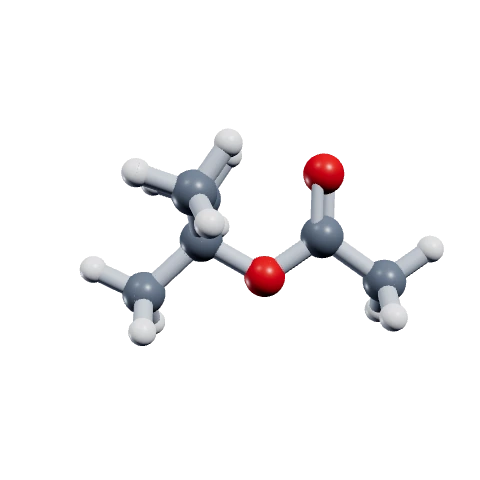


Most solvents are judged by how well they dissolve things. Tert-butyl acetate is bought for something stranger: a line in the Federal Register. In 2004 the EPA decided this particular ester barely contributes to smog and struck it from the legal definition of a VOC — and overnight a competent-but-unremarkable coatings solvent became one of the few tools a formulator can add to a can without raising its reportable VOC content. This is the guide to what TBAc actually is, why the exemption exists (and where it does not apply), how it compares to the other “butyl acetates” people confuse it with, and how to buy it for real work.
What is tert-butyl acetate (TBAc)?
Tert-butyl acetate is an organic ester — the reaction product of acetic acid and tert-butyl alcohol — sold as a clear, colorless, flammable liquid solvent with a faint camphor- or blueberry-like smell. Its chemical formula is C6H12O2, its CAS number is 540-88-5, and it goes by several names on labels and safety data sheets: TBAc, t-butyl acetate, tertiary butyl acetate, and acetic acid tert-butyl ester. In the coatings and ink trade it is simply “the exempt acetate.”
Structurally it is the branched cousin of the more common n-butyl acetate. Both share the same formula, C6H12O2, but where n-butyl acetate has a straight four-carbon chain hanging off the ester oxygen, TBAc has that same four carbons folded into a compact, ball-shaped tert-butyl group. That branching is not cosmetic: it is why TBAc evaporates at a different rate, why it resists breaking down in the atmosphere, and — ultimately — why the EPA treats it so differently from every other solvent in the ester family.
As a solvent, TBAc is a solid all-rounder: a medium evaporation rate (faster than n-butyl acetate, slower than acetone), good solvency for resins, oils, cellulose derivatives, and polymers, low water solubility, and low toxicity relative to many of the aromatics it replaces. On performance alone it would be a perfectly ordinary acetate ester. What lifts it out of the ordinary is the regulatory status covered next.
Is tert-butyl acetate a VOC? The EPA-exempt story
Under federal Clean Air Act rules, tert-butyl acetate is exempt from the definition of a volatile organic compound — even though it is, in the plain-English sense, a volatile organic liquid that readily evaporates. The EPA added TBAc to its list of exempted compounds in 40 CFR 51.100(s) through a final rule published on November 29, 2004 (69 FR 69298). Understanding that apparent contradiction is the whole reason this solvent commands a premium.
The word “VOC” in air-quality law does not mean “anything that evaporates.” It means, specifically, a carbon compound that participates in atmospheric photochemical reactions — the sunlight-driven chemistry that turns solvent vapors and nitrogen oxides into ground-level ozone (smog). The EPA maintains a list of compounds that evaporate but react so slowly in the atmosphere that they make a negligible contribution to ozone formation. Those compounds are declared “negligibly reactive” and are excluded from the regulatory definition of VOC. Acetone was the famous early example; tert-butyl acetate joined the list in 2004.
For a coatings, ink, or adhesive manufacturer, the consequence is direct and valuable: because exempt solvents are not counted toward a product's regulated VOC content, TBAc lets a formulator add solvent power to a formula without adding to its reportable VOC number. A paint that must meet a grams-per-liter VOC limit can use TBAc to adjust viscosity, flow, and dry time while staying under the line. That is why it displaces higher-reactivity workhorses like MEK, toluene, xylene, and MIBK in reformulation projects.
The two caveats nobody should skip
The exemption is powerful but narrow, and getting it wrong is a compliance problem, not a rounding error.
One more point of honesty: TBAc is not a federal hazardous air pollutant (HAP), which is part of its appeal as a replacement for HAP-listed aromatics like toluene and xylene. But “not a HAP” and “VOC-exempt” are two separate regulatory facts — a compound can be one, both, or neither, and TBAc happens to be both.

TBAc vs. n-butyl acetate vs. ethyl acetate vs. acetone
Tert-butyl acetate is one of four common “fast” oxygenated solvents that get lumped together and swapped by mistake, and the differences matter for both performance and paperwork. They are not interchangeable: they differ in evaporation speed, solvency, odor, and — critically — in whether they count as a VOC.
| Solvent | Formula | Evaporation | VOC status (federal) | Typical role |
|---|---|---|---|---|
| Tert-butyl acetate (TBAc) | C6H12O2 | Medium | Exempt | Low-VOC coatings, inks, adhesives, cleaners |
| n-Butyl acetate | C6H12O2 | Medium (slower) | VOC | Coatings gold standard for flow & gloss |
| Ethyl acetate | C4H8O2 | Fast | VOC | Fast-dry lacquers, inks, extraction |
| Acetone | C3H6O | Very fast | Exempt | Cleanup, thinning, very fast flash-off |
Is tert-butyl acetate the same as acetone? No. Acetone is a ketone (C3H6O) that flashes off very fast and can be too aggressive or too quick for a quality finish; TBAc is an ester that evaporates at a controllable medium rate and leaves more working time. They share one important trait — both are VOC-exempt — which is exactly why formulators reach for one or the other when they need solvency that will not raise the VOC number. TBAc is the choice when acetone flashes off too fast to level properly.
Against n-butyl acetate, its straight-chain twin, the trade is cleaner still: nearly the same solvency and a similar evaporation window, but n-butyl acetate is a counted VOC and TBAc is not. That single difference is why a reformulation project will often swap in TBAc for part of the n-butyl acetate load — you keep the coating's feel and hold the line on VOC content. See our companion guides on n-butyl acetate and ethyl acetate for the full comparison.
Isn’t tert-butyl acetate the same as tert-butanol? (An ester is not an alcohol)
No — and this is the single most common mix-up around this chemical, made worse by the fact that both get abbreviated “TBA.” Tert-butyl acetate is an ester (C6H12O2, CAS 540-88-5); tert-butanol, also called tert-butyl alcohol, is an alcohol (C4H10O, CAS 75-65-0). They are different compounds with different formulas, different CAS numbers, different properties, and different uses.
The relationship between them is a chemical reaction: tert-butyl acetate is what you get when tert-butyl alcohol reacts with acetic acid (an esterification). The alcohol is a reactant; the acetate is the product. In practical terms, the alcohol (tert-butanol) is water-miscible, is used as a gasoline oxygenate and a solubilizer, and can freeze into a waxy solid near room temperature; the acetate (TBAc) is a water-insoluble coatings solvent that stays liquid and carries the VOC-exempt status. If a supplier or a safety data sheet lists “TBA,” check the CAS number — 540-88-5 is the solvent you want for coatings; 75-65-0 is the alcohol.
What is tert-butyl acetate used for?
Tert-butyl acetate is used mainly as an industrial solvent in coatings, inks, adhesives, and cleaners — the same jobs as the other acetate esters, but chosen when low reactivity or exempt VOC status is the deciding factor. Its combination of good solvency, a controllable medium evaporation rate, and regulatory advantage puts it into a handful of major arenas.
Paints, coatings, lacquers & enamels
This is the heartland. TBAc dissolves the resins and cellulose derivatives that make up lacquers, enamels, and industrial finishes, and it does so while keeping the coating’s reportable VOC content down. Automotive refinish, wood coatings, and industrial maintenance paints all use it as a low-VOC letdown and viscosity solvent, frequently as a partial replacement for toluene, xylene, or n-butyl acetate.
Printing inks
Flexographic and gravure inks rely on solvents that dissolve the resin, carry pigment, and flash off at a controlled rate on press. TBAc’s medium evaporation and exempt status make it a natural fit for low-VOC ink formulations, where every gram of exempt solvent is a gram that does not count against the limit.
Adhesives & sealants
In solvent-borne adhesives, TBAc thins the polymer to a workable viscosity and controls open time, then evaporates cleanly. It shows up in pressure-sensitive, contact, and assembly adhesives that are being reformulated to lower VOC content without switching chemistries.
Industrial & equipment cleaning
As a fast, low-residue solvent, TBAc is used to clean equipment, tools, and surfaces — degreasing, flushing coating lines, and wiping down substrates before finishing. Its low residue and controllable flash-off make it a cleaner alternative to some aromatic and ketone solvents in the same role.
Chemical synthesis & other niches
Beyond formulation, TBAc serves as a reaction medium and reagent in organic synthesis (tert-butyl esters are useful protecting groups and intermediates), and it has been used as an octane-boosting gasoline additive. These are smaller volumes than coatings, but they round out why the molecule is worth making at scale.

Why coatings and ink formulators are switching to TBAc
Formulators switch to tert-butyl acetate to hit tightening VOC limits without giving up performance — it is a compliance tool first and a solvent second. As federal and state rules push the allowable VOC content of coatings and inks steadily downward, a manufacturer has only a few levers: reformulate to waterborne (expensive and slow), cut solids (hurts the coating), or replace counted solvents with exempt ones. TBAc is the low-disruption lever.
The math is simple. Suppose a solvent-borne coating is over its VOC limit by a modest margin. Replacing part of the toluene or n-butyl acetate load with TBAc removes that mass from the VOC calculation entirely, because exempt solvent does not count — while the coating keeps roughly the same solids, viscosity, and dry behavior. The formulator buys compliance without re-engineering the whole product.
The realistic version keeps the two caveats front of mind: the win is a federal VOC-content win (not California, where TBAc still counts), and the facility still tracks TBAc for its emissions inventory and permits. Used inside those lines, though, TBAc is one of the cleanest ways to move an existing solvent-borne formula under a lower VOC ceiling. For the bigger picture of choosing solvents for a job, see our guide to choosing the right industrial solvent.
Tert-butyl acetate safety, handling & storage
Tert-butyl acetate is a flammable liquid of moderate toxicity, and the main hazard to plan around is fire, not health. It is classified as an OSHA/NFPA Class IB flammable liquid because its flash point — 72 °F (22 °C) — is below room temperature on a warm day, meaning its vapors can form an ignitable mixture at ordinary temperatures. Treat it with the same respect as any low-flash solvent.
Fire. Keep TBAc away from heat, sparks, open flame, and static discharge; its vapors are heavier than air and can travel to an ignition source. Store and use with adequate ventilation, bond and ground containers when transferring, and keep it away from strong oxidizers. Exposure. The vapor is a mild irritant to the eyes, nose, and throat, and high concentrations can cause headache or drowsiness; the exposure limit is 200 ppm as an 8-hour time-weighted average across OSHA, NIOSH, and ACGIH. Use in a well-ventilated area or with local exhaust, and wear chemical-resistant gloves and eye protection. Storage. Keep containers tightly closed in a cool, well-ventilated flammables area away from ignition sources and oxidizers, and follow NFPA 30 for flammable-liquid storage. Always read the product SDS before handling.
How to buy tert-butyl acetate smart
Buying TBAc well comes down to three checks: confirm the CAS number, match the grade to the job, and pick the pack size that fits your volume. Because “TBA” is ambiguous, the CAS number is your first safeguard — 540-88-5 is the acetate solvent; 75-65-0 is the alcohol. Insist on seeing it on the label and the certificate of analysis.
On grade: for coatings, inks, adhesives, cleaning, and general industrial use, technical-grade tert-butyl acetate is the correct and economical choice — it is high-purity solvent-grade material with the performance and the exempt status that formulators need, without paying for reagent-grade certification a production line will never use. Alliance Chemical supplies TBAc as a single technical grade, so the decision is really about pack size, not purity tier.
On pack size: we stock TBAc from 1-quart bottles up through 1-gallon, 5-gallon pails, and 55-gallon drums (and multi-drum pallets for production volume), with a certificate of analysis available on request at no charge. Larger packs lower your cost per gallon, so once a formulation or cleaning process is dialed in, stepping up a size is usually the cheaper long-run move — and it reduces how often you handle and decant a flammable liquid. If you are reformulating to lower VOC content and are not sure how much of your current solvent load TBAc can replace, tell us the application and we will help you spec it.
Key numbers & sources for tert-butyl acetate
The atomic facts on tert-butyl acetate, each linked to a primary source.
| Property | Value | Source |
|---|---|---|
| CAS number | 540-88-5 | PubChem CID 10908 |
| Formula / molar mass | C6H12O2 / 116.16 g/mol | PubChem |
| Boiling point | 97–98 °C (206–208 °F) | OSHA Chemical Data |
| Flash point | 72 °F (22 °C) — Class IB flammable | OSHA Chemical Data |
| Exposure limit (PEL / REL / TLV) | 200 ppm, 8-hr TWA | NIOSH Pocket Guide |
| VOC-exempt status | Exempt from the VOC definition | 40 CFR 51.100(s) |
| Exemption final rule | 69 FR 69298 (Nov 29, 2004) | Federal Register |
| Hazardous air pollutant (HAP)? | No — not a listed HAP | EPA HAP list |
The 30-second tert-butyl acetate decision
If you remember only a few things about TBAc, remember these:
- It is VOC-exempt (federal), not VOC-free. EPA exempts it from VOC content limits under 40 CFR 51.100(s); you still track it for emissions and permits.
- California does not exempt it. Confirm the rule in the state where the product ships and is used.
- It replaces MEK, toluene, xylene & part of the n-butyl acetate load in coatings, inks, adhesives, and cleaners — solvency without a higher VOC number.
- “TBA” is ambiguous — the acetate solvent is CAS 540-88-5; the alcohol is 75-65-0.
- Treat it as a Class IB flammable (flash 72 °F) and hold exposure under 200 ppm.
Everything else — the medium evaporation rate, the good resin solvency, the low residue — is why formulators are comfortable making the swap. The exemption is why they bother.
Buy Tert-Butyl Acetate (TBAc) — Technical Grade
CAS 540-88-5, VOC-exempt under 40 CFR 51.100(s). In stock from 1-quart bottles to 55-gallon drums, with the certificate of analysis on request at no charge. Reformulating to lower VOC content? Tell us your current solvent load and we will help you spec the swap.
Frequently asked questions
Is tert-butyl acetate a VOC?
Under federal Clean Air Act rules, tert-butyl acetate is exempt from the definition of a volatile organic compound. The EPA added it to the exempt list in 40 CFR 51.100(s) via a final rule on November 29, 2004 (69 FR 69298) because its low maximum incremental reactivity means it makes a negligible contribution to ground-level ozone. In everyday terms it is a volatile liquid that evaporates, but in air-quality law it does not count as a VOC. Two caveats: facilities generally must still track it as a VOC for emissions inventories and permits, and California (CARB) does not exempt it.
What is tert-butyl acetate used for?
Tert-butyl acetate is used mainly as an industrial solvent in paints, coatings, lacquers, enamels, printing inks, adhesives, sealants, and industrial cleaners, where its VOC-exempt status lets formulators add solvency without raising a product's reportable VOC content. It is also used as a reaction medium and reagent in organic synthesis and has been used as an octane-boosting gasoline additive. It typically replaces higher-reactivity solvents such as MEK, toluene, xylene, and MIBK.
Is tert-butyl acetate the same as acetone?
No. Acetone is a ketone (C3H6O) that evaporates very fast, while tert-butyl acetate is an ester (C6H12O2, CAS 540-88-5) that evaporates at a controllable medium rate and gives more working time for leveling and flow. They share one key trait: both are VOC-exempt under federal rules, which is why formulators choose one or the other when they need solvency that will not raise the VOC number. TBAc is the pick when acetone flashes off too quickly for a quality finish.
What is the difference between tert-butyl acetate and n-butyl acetate?
They share the same formula, C6H12O2, but different structures: n-butyl acetate has a straight four-carbon chain, while tert-butyl acetate has a branched tert-butyl group. The practical difference that matters most is regulatory: n-butyl acetate is a counted VOC, while tert-butyl acetate is VOC-exempt under federal rules. Their solvency and evaporation rates are broadly similar, so formulators often swap TBAc for part of the n-butyl acetate load to lower reportable VOC content while keeping performance.
Is tert-butyl acetate the same as tert-butanol (TBA alcohol)?
No, and this is a common mix-up because both get abbreviated 'TBA.' Tert-butyl acetate is an ester (C6H12O2, CAS 540-88-5), a water-insoluble coatings solvent that is VOC-exempt. Tert-butanol, or tert-butyl alcohol, is an alcohol (C4H10O, CAS 75-65-0), a water-miscible fuel oxygenate and solubilizer that can freeze into a waxy solid near room temperature. The acetate is made by reacting the alcohol with acetic acid. Always check the CAS number: 540-88-5 is the solvent; 75-65-0 is the alcohol.
Is tert-butyl acetate flammable?
Yes. Tert-butyl acetate is a Class IB flammable liquid with a flash point of about 72 F (22 C), so its vapors can form an ignitable mixture at ordinary temperatures. Keep it away from heat, sparks, open flame, and static; bond and ground containers when transferring; use adequate ventilation; and store it in a flammables area per NFPA 30. It ships as a DOT hazard class 3 flammable liquid. Always follow the product SDS.
Does California exempt tert-butyl acetate as a VOC?
No. The California Air Resources Board (CARB) and California air districts such as the South Coast AQMD do not exempt tert-butyl acetate as a VOC, even though the U.S. EPA does at the federal level. A coating or ink that is compliant elsewhere on the strength of the TBAc exemption can be non-compliant in California, where TBAc still counts against the VOC limit. Always confirm the rule in the jurisdiction where the product is sold and used.
What grade of tert-butyl acetate should I buy?
For coatings, inks, adhesives, cleaning, and general industrial use, technical-grade tert-butyl acetate is the correct and economical choice: it is high-purity solvent-grade material with the performance and the VOC-exempt status formulators need, without paying for reagent-grade certification a production line will not use. Confirm CAS 540-88-5 on the label and certificate of analysis, then choose the pack size that fits your volume, since larger packs lower the cost per gallon.
Sources
- PubChem CID 10908 · PubChem (NIH National Library of Medicine)
- OSHA Chemical Data · OSHA
- NIOSH Pocket Guide · CDC
- 40 CFR 51.100(s) · Legal Information Institute (Cornell Law)
- Federal Register · Federal Register
- EPA HAP list · U.S. EPA
Related Chemical Collections
About the author
Andre Taki
This article is for informational purposes only.