

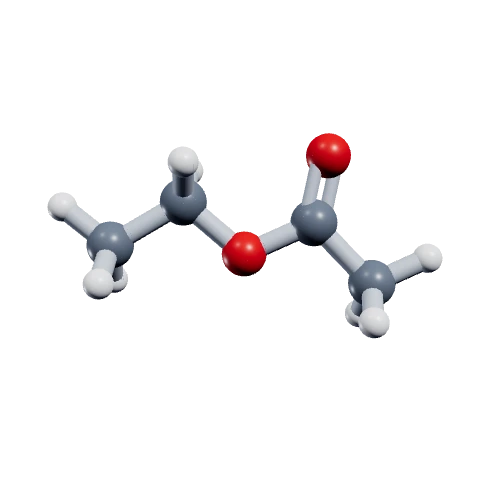


Ethyl acetate (CH₃COOC₂H₅) is one of the most widely used organic solvents in the world. With a fruity, sweet odor and rapid evaporation rate, it serves industries from pharmaceutical manufacturing to nail salons, print shops and coating lines. If you work with solvents, you have almost certainly encountered ethyl acetate — even if you did not know it by name.
This guide covers everything from its fundamental chemical properties to its uses in coatings, inks, extraction and decaffeination, plus practical guidance on selecting the right grade for your needs.

Ethyl acetate formula, boiling point, density and CAS at a glance
Ethyl acetate is C₄H₈O₂ (CH₃COOC₂H₅), CAS 141-78-6. It boils at 77.1 °C (170.8 °F) and has a density of 0.902 g/mL at 20 °C, so it floats on water.
| Property | Value | Source |
|---|---|---|
| Molecular formula | C₄H₈O₂ (CH₃COOC₂H₅) | PubChem |
| Molar mass (molecular weight) | 88.11 g/mol | PubChem |
| CAS number | 141-78-6 | NIST |
| Boiling point | 77.1 °C (170.8 °F); NIST 350.2 K (77.05 °C) | HSDB, NIST |
| Melting point | -83.6 °C (-118.5 °F); HSDB -83.8 °C | CAMEO |
| Density, 20 °C | 0.902 g/mL; HSDB 0.9003 g/cm³ | CAMEO, HSDB |
| Flash point (closed cup) | -4 °C (24 °F) | ICSC, NIOSH |
| Refractive index, 20 °C | 1.3723 | HSDB |
| Vapor pressure, 20 °C | 73 mmHg | NIOSH |
| Water solubility, 20 °C | 8.7 g/100 mL | ICSC |
Published density values differ slightly for the same quantity: CAMEO gives 0.902 at 20 °C, and HSDB lists both 0.902 (as specific gravity 20/4 °C) and 0.9003 g/cm³. Use 0.90 g/mL for conversions.
What is the structure of ethyl acetate?
Ethyl acetate is an ester: an acetyl group (CH₃C=O) bonded through an oxygen atom to an ethyl group. Its structural formula is CH₃-C(=O)-O-CH₂-CH₃ (SMILES CCOC(=O)C).
It accepts hydrogen bonds but has no O-H to donate one (PubChem: 0 donors, 2 acceptors), so it mixes with alcohols but only partly with water. HSDB notes it is slowly decomposed by moisture and turns acidic, which is why acidity is on both our grade specs. Other names: ethyl ethanoate, acetic ether, vinegar naphtha; abbreviated EtOAc or EA.
Chemical and Physical Properties
Understanding ethyl acetate starts with its physical profile. These numbers show up constantly in safety data sheets, process engineering calculations, and regulatory filings — and they are among the most searched properties for this solvent.
| Property | Value | Significance |
|---|---|---|
| Melting Point | -83.6 °C (-118.5 °F) | Remains liquid in virtually all working conditions |
| Solubility in Water | 8.7 g/100 mL (20 °C) | Slightly miscible — useful for liquid-liquid extraction |
| Autoignition Temperature | 427 °C (800 °F) | Standard precautions for flammable solvents apply |
| Refractive Index | 1.3723 (20 °C) | Used for purity verification in QC labs |
| NFPA 704 Rating | Health: 1 / Flammability: 3 / Reactivity: 0 | Fire hazard dominates: ventilate and remove ignition sources |
Why Boiling Point Matters
At 77.1 °C, ethyl acetate boils well above diethyl ether (34.6 °C) and well below toluene (110.6 °C). This makes it ideal for processes that need a fast-evaporating solvent that is still easy to handle — coatings dry quickly, extractions concentrate efficiently, and residual solvent is easy to remove from finished products.
Does ethyl acetate evaporate at room temperature?
Yes, ethyl acetate evaporates at room temperature: its vapor pressure is 73 mmHg at 20 °C, so it evaporates steadily from an open container far below its 77.1 °C boiling point, and there is no single "evaporation temperature." The NIOSH Pocket Guide puts acetone at 180 mmHg and n-butyl acetate at 10 mmHg, so ethyl acetate is slower than acetone and much faster than butyl acetate.
How Ethyl Acetate Is Made
Ethyl acetate is produced by the Fischer esterification of ethanol and acetic acid in the presence of an acid catalyst (typically sulfuric acid). The reaction is straightforward:
It is an equilibrium, driven forward by distilling off the ester and water. HSDB also lists Tishchenko condensation of acetaldehyde, and recovery as a co-product of butane oxidation to acetic acid and of polyvinyl alcohol manufacture.
Both feedstocks, ethanol and acetic acid, can be made from biomass, so ethyl acetate is bio-based only when both come from bio-derived sources.
Why wet ethyl acetate distills at 70.4 °C: the water azeotrope
Ethyl acetate and water form an azeotrope that boils at 70.4 °C and holds 6.1% water by weight, per the Hazardous Substances Data Bank (PubChem). With ethanol present, a three-part azeotrope boils at 70.3 °C. Both boil well below dry ethyl acetate at 77.1 °C.

- A head temperature near 70 °C means water is coming over.
- Distillation dries it. Ethyl acetate holds at most 3.3% water (HSDB), less than the azeotrope carries, so the water leaves in the early cut and the fraction taken near 77 °C is drier than the feed.
- Check acidity on recovered solvent. Wet ethyl acetate slowly hydrolyzes to acetic acid and ethanol.
Traditional Industrial Applications

Fast evaporation and strong solvency for nitrocellulose and many resins keep ethyl acetate in coatings, inks and adhesives.
Coatings & Lacquers
The largest use in HSDB's late-1990s U.S. demand profile, about 60%. It dissolves nitrocellulose, cellulose acetate butyrate (CAB), and many acrylic resins. Its fast evaporation rate produces smooth, defect-free films. Automotive clear coats, wood finishes, and industrial primers all rely on it.
Adhesives
Contact cements, laminating adhesives, and pressure-sensitive tape formulations use ethyl acetate as the primary carrier solvent. It flashes off quickly, building tack fast without leaving residual odor.
Printing Inks
Flexographic and rotogravure packaging inks use ethyl acetate because it evaporates fast and leaves little retained solvent.
Nail Polish & Cosmetics
Ethyl acetate is a solvent in nail polish and in non-acetone nail polish removers; HSDB gives about 40 wt% as a typical level in removers. It dissolves the nitrocellulose film-forming agent and evaporates fast enough to produce a smooth, hard finish.
Food & Flavor Industry
Used as a solvent for decaffeinating coffee and tea and as a flavoring. Ethyl acetate occurs naturally in wine, brandy, pineapples and bananas. FDA lists it as a GRAS synthetic flavoring (21 CFR 182.60) and permits it for decaffeination under 21 CFR 173.228. Our Technical and ACS grades are not sold for food use.
Pharmaceutical Manufacturing
Used for crystallization, purification and extraction of active pharmaceutical ingredients (APIs). ICH Q3C puts it in Class 3, which allows up to 5,000 ppm (50 mg/day) residual solvent in a drug product without justification.
Is ethyl acetate used to decaffeinate coffee and tea?
Yes. 21 CFR 173.228 permits ethyl acetate "as a solvent in the decaffeination of coffee and tea" if it meets the Food Chemicals Codex specification and is used under good manufacturing practice. The section sets no numeric residue limit, and Alliance's Technical and ACS grades are not made or sold for food use.

- It is already in food. HSDB lists it in wine, brandy, pineapples and bananas, and at 25 to 50 ppm in US lager beer.
- Two FDA listings. GRAS as a flavoring (21 CFR 182.60); a secondary direct food additive for decaffeination (Part 173).
- Not our grades. Decaffeinators buy material made to the Food Chemicals Codex. Alliance sells Technical and ACS grades for solvent, coatings, adhesive and lab use, not food processing.
Modern and Advanced Applications
Beyond coatings, inks and adhesives, ethyl acetate turns up in a few newer applications.
Cannabis & Botanical Extraction
Some botanical and cannabis extractors use ethyl acetate, an ICH Q3C Class 3 solvent, because it is moderately polar and boils at 77.1 °C. Which extraction solvents are allowed, and how much residue a finished product may carry, is set state by state, so check your state's rules first. Our Technical and ACS grades are sold for industrial and lab use, not for products people ingest or inhale. See our cannabis extraction solvent guide.
Green Chemistry & Bio-Based Manufacturing
Ethyl acetate made from bio-derived ethanol and bio-derived acetic acid is a bio-based solvent; one made from fossil feedstocks is not, so ask the producer which route a lot came from.
Ethylene acetate, "ethyl acetone," acetone and rubbing alcohol are not ethyl acetate
"Ethylene acetate," "ethyl acetone," acetone and rubbing alcohol are all different compounds from ethyl acetate. "Ethylene acetate" is a PubChem synonym of ethylene glycol diacetate (CID 8121), a high-boiling solvent; "ethyl acetone" is a synonym of 2-pentanone (CID 7895), a ketone. If you wanted a fast, fruity-smelling solvent, you meant ethyl acetate.
| Name searched | What it is | Formula | CAS | Boiling point | Water solubility, 20 °C |
|---|---|---|---|---|---|
| Ethyl acetate | Ester | C₄H₈O₂ | 141-78-6 | 77.1 °C | 8.7 g/100 mL |
| "Ethylene acetate" | Ethylene glycol diacetate | C₆H₁₀O₄ | 111-55-7 | 190 to 191 °C | 16.4 wt% |
| "Ethyl acetone" | 2-Pentanone (ketone) | C₅H₁₀O | 107-87-9 | 102 °C | 4 g/100 mL |
| Acetone | Ketone | C₃H₆O | 67-64-1 | 56 °C | Miscible |
| "Rubbing alcohol" | Isopropanol (alcohol) | C₃H₈O | 67-63-0 | 82.3 °C (pure isopropanol) | Miscible |
Ethyl acetate vs acetone
Ethyl acetate is not acetone. Ethyl acetate (C₄H₈O₂) is an ester that boils at 77.1 °C, and only 8.7 g of it dissolves in 100 mL of water; acetone (C₃H₆O) is a ketone that boils at 56 °C and mixes with water completely.
| Property | Ethyl acetate | Acetone |
|---|---|---|
| Formula | C₄H₈O₂ (CH₃COOC₂H₅) | C₃H₆O (CH₃COCH₃) |
| Boiling point | 77.1 °C | 56 °C |
| Flash point (closed cup) | -4 °C | -18 °C |
| Vapor pressure at 20 °C | 73 mmHg | 180 mmHg |
| Solubility in water | 8.7 g/100 mL at 20 °C | Miscible |
| OSHA PEL / NIOSH REL | 400 / 400 ppm | 1,000 / 250 ppm |
| GHS hazard statements | H225, H319, H336 | H225, H319, H336 |
| Dissolves (HSDB, Haz-Map) | Nitrocellulose, shellac, vinyl resins, varnishes | Resins, fats, oils, dyes, cellulosics, plastics |
Is ethyl acetate safer than acetone? Neither clearly is: same GHS hazard statements, acetone has the lower flash point, OSHA allows more acetone, NIOSH recommends less. Sources: NIOSH, NIOSH acetone, ICSC, PubChem acetone.
Is ethyl acetate the same as rubbing alcohol?
No. Rubbing alcohol is isopropanol diluted with water (PubChem lists 50%, 70% and 91% products under isopropanol, CID 3776); isopropanol is an alcohol that mixes with water completely, and pure isopropanol boils at 82.3 °C. Ethyl acetate is an ester. See rubbing alcohol vs isopropyl alcohol.
Ethyl Acetate vs. Other Solvents
Choosing the right solvent often comes down to comparing evaporation rates, solvency power, safety profiles, and cost. Here is how ethyl acetate stacks up against the solvents it most commonly competes with.
| Property | Ethyl Acetate | MEK | Toluene | n-Butyl Acetate |
|---|---|---|---|---|
| Boiling Point | 77.1 °C | 79.6 °C | 110.6 °C | 126.1 °C |
| Vapor pressure, 20 °C (NIOSH) | 73 mmHg | 78 mmHg | 21 mmHg | 10 mmHg |
| Flash Point | -4 °C | -9 °C | 4 °C | 22 °C |
| OSHA PEL, TWA (ppm) | 400 | 200 | 200 | 150 |
| NIOSH REL, TWA (ppm) | 400 | 200 | 100 | 150 |
| Nitrocellulose Solvency | Excellent (true solvent) | Excellent | Diluent only (does not dissolve it alone) | Good (true solvent) |
| Odor | Sweet, fruity | Sharp, acetone-like | Sweet, pungent | Fruity, mild |
| ICH Q3C solvent class | Class 3 | Class 3 | Class 2 | Class 3 |
How to Read This Table
Vapor pressure drives drying speed: ethyl acetate (73 mmHg) and MEK (78 mmHg) dry at a similar rate, far faster than n-butyl acetate (10 mmHg) or toluene (21 mmHg).
OSHA PEL is the enforceable U.S. 8-hour limit and NIOSH REL is NIOSH's recommendation. Ethyl acetate’s 400 ppm is the highest of these four solvents on both, double MEK’s 200 ppm. The ICH Q3C class comes from FDA's Q3C solvent tables.
When to Choose Ethyl Acetate Over MEK
Both evaporate fast and dissolve nitrocellulose well. Ethyl acetate has the higher exposure limit (OSHA PEL 400 ppm vs 200 ppm for MEK) and a milder odor; both are highly flammable. Choose MEK when you need more aggressive dissolving (stripping thick coatings, cleaning stubborn residues).
When to Choose Ethyl Acetate Over Toluene
Toluene’s exposure limits are much tighter: NIOSH recommends 100 ppm against 400 ppm for ethyl acetate, and the ACGIH TLV for toluene is 20 ppm (HSDB). FDA’s Q3C guidance puts toluene in Class 2 and ethyl acetate in Class 3. In a nitrocellulose lacquer, toluene is only a diluent, so the true solvent in the blend is usually an ester such as ethyl acetate or butyl acetate.
Understanding Grades: Technical vs. ACS
Alliance Chemical offers ethyl acetate in two grades, each suited to different applications.
| Specification | Technical Grade | ACS Reagent Grade |
|---|---|---|
| Purity (assay by GC) | ≥ 99.7 wt% | ≥ 99.5% |
| Water Content | ≤ 0.3% | ≤ 0.2% (Karl Fischer) |
| Residue After Evaporation | ≤ 5 mg/100 mL nonvolatile matter | ≤ 0.003% |
| Acidity | ≤ 50 ppm as acetic acid | ≤ 0.0009 meq/g titrable acid |
| Other named limits | Ethanol ≤ 0.05 wt%; color ≤ 10 Pt-Co; distills 75.5 to 78.0 °C | Ethanol ≤ 0.1%; methanol and methyl acetate ≤ 0.02% each; acetone and acetaldehyde ≤ 0.005% each; color ≤ 10 APHA |
| Best For | Coatings, adhesives, cleaning, general industrial use | Lab analysis, QC and research where named impurity limits must be documented |
| COA | On request, no charge | On request, no charge |
Limits from our Technical and ACS data sheets. Technical grade has the higher minimum assay; ACS sets limits on more named impurities and a tighter water limit.
Which Grade Do You Need?
Technical grade is the right call for coatings, adhesives, cleaning and general-purpose dissolving. At 99.7 wt% minimum assay it is a high-purity ethyl acetate.
ACS grade fits work where named impurity limits must be documented: analytical labs, QC and research. It is a reagent specification, not a pharmacopeia or Food Chemicals Codex grade, so check what your regulator requires before using either of our grades in a drug, food or other consumer product. Need the Certificate of Analysis? Just ask, we send it at no charge.
Safety, Handling, and Storage
Ethyl acetate is a volatile, flammable liquid that demands proper handling.
Is ethyl acetate toxic? Why is it hazardous?
Ethyl acetate is an ICH Q3C Class 3 solvent, the class FDA's ICH Q3C guidance describes as "of lower risk to human health," so its toxicity to humans is low but not zero. OSHA's PEL and NIOSH's REL are both 400 ppm, and high vapor concentrations irritate the eyes and can cause drowsiness or dizziness. Its main hazard is fire: GHS classes it as a Category 2 flammable liquid (H225) that also causes serious eye irritation (H319) and may cause drowsiness or dizziness (H336), and the EU label adds EUH066, repeated exposure may cause skin dryness or cracking.
NIOSH set the IDLH at 2,000 ppm, 10% of the lower explosive limit. The NIOSH Pocket Guide lists eyes, skin and respiratory system as target organs. It ships as UN1173, Class 3, Packing Group II. For handling and exposure procedures use the ethyl acetate SDS; this is not medical guidance.
Key Safety Facts
- Flammability: NFPA 3 (highly flammable). Flash point of -4 °C means vapors can ignite at temperatures below freezing. Eliminate ignition sources and ground all transfer equipment.
- Exposure limits: OSHA PEL, NIOSH REL and ACGIH TLV-TWA are all 400 ppm (time-weighted average). None of the three sets a short-term exposure limit (STEL); the NIOSH IDLH is 2,000 ppm.
- PPE: Chemical splash goggles, butyl rubber or laminated film gloves (disposable nitrile is splash protection only against ethyl acetate and should be changed as soon as it is wetted), lab coat. Use in a fume hood or with local exhaust ventilation.
- First aid: follow Section 4 of the ethyl acetate SDS.
Storage Requirements
- Store in a cool, well-ventilated area away from heat, sparks, and open flame
- Keep containers tightly closed when not in use — ethyl acetate evaporates rapidly and absorbs moisture from air
- Use containers rated for flammable liquids, and bond and ground metal containers during transfer
- Separate from oxidizers, nitrates, strong acids, and strong bases
Ventilation Is Non-Negotiable
Ethyl acetate vapors are heavier than air (vapor density = 3.04) and accumulate in low-lying areas. In enclosed spaces without adequate ventilation, vapor concentrations can reach flammable levels quickly. Always verify your workspace meets OSHA ventilation requirements before use. Refer to the Safety Data Sheet for your specific grade.
Common Questions About Ethyl Acetate
Is ethyl acetate the same as acetone?
No. Both are fast-evaporating solvents, but they are chemically different. Acetone (CH₃COCH₃) is a ketone; ethyl acetate (CH₃COOC₂H₅) is an ester. Ethyl acetate has a milder odor and is less aggressive on plastics. Acetone is a stronger universal solvent and is fully miscible with water, while ethyl acetate is only slightly water-soluble.
Can ethyl acetate dissolve nitrocellulose?
Yes — ethyl acetate is classified as a true solvent for nitrocellulose, meaning it dissolves it directly without needing a co-solvent. This is why it is widely used in lacquer and nail polish formulations. Toluene, by contrast, does not dissolve nitrocellulose on its own; lacquer formulas use it as a diluent blended with a true solvent like ethyl acetate or butyl acetate.
Is ethyl acetate safe for food contact?
FDA lists ethyl acetate as a GRAS synthetic flavoring substance (21 CFR 182.60) and permits it as a decaffeination solvent for coffee and tea when it meets the Food Chemicals Codex specification (21 CFR 173.228). Those rules cover material made to the Food Chemicals Codex; our Technical and ACS grades are for industrial and lab use, not food. See decaffeination.
What is the difference between ethyl acetate and methyl ethyl ketone?
See the solvent comparison table above. The short version: the two evaporate at a similar rate (vapor pressure 73 vs 78 mmHg at 20 °C), ethyl acetate has the higher OSHA limit (400 vs 200 ppm), and it smells milder. MEK has stronger dissolving power and works better on thick, stubborn coatings.
Get Ethyl Acetate Shipped Direct
Available in Technical and ACS reagent grades. Find the SDS in our document library, or ask us for it. Need the Certificate of Analysis? Just ask, we send it at no charge.
Technical Grade ACS Reagent GradeRelated Guides
- What Is MEK (Methyl Ethyl Ketone)? The Complete Guide
- Acetone Essentials: Industry, Nail Care, and Home Cleaning
- Mineral Spirits vs. Paint Thinner: Key Differences
- The Ultimate Guide to Industrial Solvents
- Choosing the Right Solvent for Cannabis Extraction
- Leather Glazing 101: The Role of Ethyl Acetate
- Understanding Chemical Grades: ACS, Technical, USP, and More
- Isopropyl Acetate vs Ethyl Acetate: Boiling Point, Water Solubility & ICH Class
Ethyl acetate is a polar ester solvent, which makes it ideal for medium-polarity extractions and coatings. For workflows that instead demand a low-polarity, fast-evaporating hydrocarbon cut, see our complete guide to petroleum ether — covering the 40-60°C and 60-80°C boiling-range grades and their pharmaceutical applications under USP <467>.
References & Authoritative Sources
Chemical identity, properties, and safety data sourced from the U.S. National Library of Medicine's PubChem database — the authoritative open-chemistry data resource maintained by the National Institutes of Health.
- PubChem CID 180: Acetone Technical Grade — National Center for Biotechnology Information, U.S. National Library of Medicine. CAS 67-64-1.
- PubChem CID 1140: Toluene — National Center for Biotechnology Information, U.S. National Library of Medicine. CAS 108-88-3.
- PubChem CID 6569: Methyl Ethyl Ketone (MEK) — National Center for Biotechnology Information, U.S. National Library of Medicine. CAS 78-93-3.
- PubChem CID 8857: Ethyl Acetate — National Center for Biotechnology Information, U.S. National Library of Medicine. CAS 141-78-6.
- NIST Chemistry WebBook: Ethyl Acetate, NIST. Accessed 2026-09-30.
- NIOSH Pocket Guide: Ethyl acetate, CDC. Accessed 2026-09-30.
- NIOSH Pocket Guide: Acetone, CDC. Accessed 2026-09-30.
- CAMEO Chemicals: Ethyl Acetate, NOAA. Accessed 2026-09-30.
- ICSC 0367: Ethyl Acetate, ILO/WHO. Accessed 2026-09-30.
- 21 CFR 173.228: Ethyl acetate, eCFR. Accessed 2026-09-30.
- 21 CFR 182.60: Synthetic flavoring substances, eCFR. Accessed 2026-09-30.
- Q3C Tables and List: Guidance for Industry, U.S. Food and Drug Administration. Accessed 2026-09-30.
Related from Alliance Chemical
Toluene 99.5%: The Complete Guide to Race-Gas Octane, Nitrocellulose Lacquer & Synthesis Solvent
The aromatic hydrocarbon at the intersection of race-fuel octane chemistry, nitrocellulose lacquer formulation, and organic-synthesis Grignard work.
Related: Ethyl Acetate as a Green Solvent: The NMP Replacement
Related: Tert-Butyl Acetate (TBAc): The VOC-Exempt Solvent Guide — how ethyl acetate compares to the VOC-exempt acetate.
Key numbers and sources
| Fact | Value | Source |
|---|---|---|
| Chemical formula of ethyl acetate | CH₃COOC₂H₅ | pubchem.ncbi.nlm.nih.gov |
| CAS number of ethyl acetate | 141-78-6 | webbook.nist.gov |
| Boiling point of ethyl acetate | 77.1 °C | pubchem.ncbi.nlm.nih.gov |
| Density of ethyl acetate at 20 °C | 0.902 g/mL | cameochemicals.noaa.gov |
| Flash point of ethyl acetate | -4 °C | chemicalsafety.ilo.org |
| ACGIH TLV-TWA (8-hour workplace exposure limit) for ethyl acetate | 400 ppm | pubchem.ncbi.nlm.nih.gov |
| Molecular weight of ethyl acetate | 88.11 g/mol | pubchem.ncbi.nlm.nih.gov |
| OSHA PEL / NIOSH REL / IDLH for ethyl acetate | 400 ppm / 400 ppm / 2,000 ppm | cdc.gov/niosh |
Related: Same Owner, Same Catalyst, Twelve Times the Gas: Why Europe's Last Acetic Acid Plants Went Dark — the September 2026 Hull shutdown and why ethyl acetate made from ethylene is a gas product.
Frequently asked questions
What is the chemical formula of ethyl acetate?
Ethyl acetate's molecular formula is C4H8O2, and its condensed structural formula is CH3COOC2H5 (CH3-C(=O)-O-CH2-CH3): an acetyl group bonded through an oxygen atom to an ethyl group, which makes it an ester. Its molecular weight (molar mass) is 88.11 g/mol and its CAS number is 141-78-6. The systematic name is ethyl ethanoate and the usual abbreviation is EtOAc.
What is the boiling point of ethyl acetate?
Ethyl acetate boils at 77.1 °C (170.8 °F) at 760 mmHg; NIST's average of reported values is 350.2 K, or 77.05 °C. It melts at -83.6 °C (-118.5 °F). Wet ethyl acetate distills lower: its azeotrope with water, 6.1% water by weight per HSDB, boils at 70.4 °C, so a still head reading near 70 °C means water is coming over.
What is the density of ethyl acetate?
Ethyl acetate has a density of about 0.90 g/mL at 20 °C. Published values differ slightly for the same quantity: CAMEO gives 0.902, and HSDB lists both 0.902 (as specific gravity 20/4 °C) and 0.9003 g/cm3. It is lighter than water and floats, while its vapor is 3.04 times heavier than air and collects in low areas.
Does ethyl acetate evaporate at room temperature?
Yes, ethyl acetate evaporates at room temperature. Its vapor pressure is 73 mmHg at 20 °C, so it evaporates steadily from an open container well below its 77.1 °C boiling point. NIOSH lists acetone at 180 mmHg and n-butyl acetate at 10 mmHg at the same temperature, so ethyl acetate evaporates slower than acetone and much faster than butyl acetate.
Is ethyl acetate the same as acetone or rubbing alcohol?
No. Ethyl acetate (C4H8O2) is an ester that boils at 77.1 °C, and only 8.7 g of it dissolves in 100 mL of water. Acetone (C3H6O) is a ketone that boils at 56 °C and mixes with water completely. Rubbing alcohol is isopropanol (C3H8O), an alcohol, diluted with water; pure isopropanol boils at 82.3 °C. All three are flammable solvents, but they are different compounds.
Is ethylene acetate the same as ethyl acetate?
No. PubChem files the name ethylene acetate under ethylene glycol diacetate (C6H10O4, CAS 111-55-7), which boils at 190 to 191 °C. Ethyl acetate is C4H8O2, CAS 141-78-6, and boils at 77.1 °C. Likewise, ethyl acetone is a synonym of 2-pentanone, a ketone. Someone looking for a fast, fruity-smelling solvent almost always means ethyl acetate.
Is ethyl acetate toxic to humans?
Ethyl acetate is an ICH Q3C Class 3 solvent, the class FDA describes as of lower risk to human health, so its toxicity is low but not zero. OSHA's PEL and NIOSH's REL are both 400 ppm, the NIOSH IDLH is 2,000 ppm, and high vapor levels irritate the eyes and cause drowsiness or dizziness. Its main hazard is fire: it is a GHS Category 2 flammable liquid (H225). Follow the SDS for handling.
Is ethyl acetate used in food and decaf coffee?
Yes. FDA lists ethyl acetate as a GRAS synthetic flavoring (21 CFR 182.60) and permits it as a solvent for decaffeinating coffee and tea when it meets the Food Chemicals Codex specification and is used under good manufacturing practice (21 CFR 173.228). It also occurs naturally in wine, brandy, pineapples and bananas. Alliance's Technical and ACS grades are sold for industrial and lab use, not food.
What is ethyl acetate used for?
Mostly as a solvent. A late-1990s U.S. demand profile cited by HSDB put coatings at 60%, pharmaceutical and synthesis process solvent at 15%, inks at 15%, and adhesives, cosmetics and other uses at 10%. It is also a chromatography solvent and is used in nail polish and non-acetone nail polish removers (HSDB: typically 40 wt% in removers). Alliance's Technical and ACS grades are sold for industrial and lab use.
Can ethyl acetate dissolve nitrocellulose?
Yes. Ethyl acetate is a true solvent for nitrocellulose, meaning it dissolves it directly without a co-solvent, which is why it is used in lacquers and nail polish. Toluene, by contrast, does not dissolve nitrocellulose on its own; lacquer formulas use it as a diluent blended with a true solvent such as ethyl acetate or butyl acetate.
What is the difference between ethyl acetate and MEK?
Ethyl acetate is an ester (C4H8O2) and MEK is a ketone (C4H8O). They boil close together, 77.1 °C versus 79.6 °C, and evaporate at a similar rate (vapor pressure 73 vs 78 mmHg at 20 °C). MEK has the lower flash point (-9 °C vs -4 °C) and is far more soluble in water (29 vs 8.7 g/100 mL at 20 °C). Ethyl acetate has the higher OSHA exposure limit, 400 ppm versus 200 ppm, and a milder odor.
What is the difference between Technical and ACS grade ethyl acetate?
Per Alliance's technical data sheets, Technical grade is at least 99.7 wt% ethyl acetate with water at or below 0.3% and acidity at or below 50 ppm as acetic acid. ACS grade is at least 99.5% with water at or below 0.2% and limits on more named impurities. ACS is a reagent specification for lab, QC and research work, not a pharmacopeia or Food Chemicals Codex grade.
Related Chemical Collections
About the author
Andre Taki
This article is for informational purposes only.


