

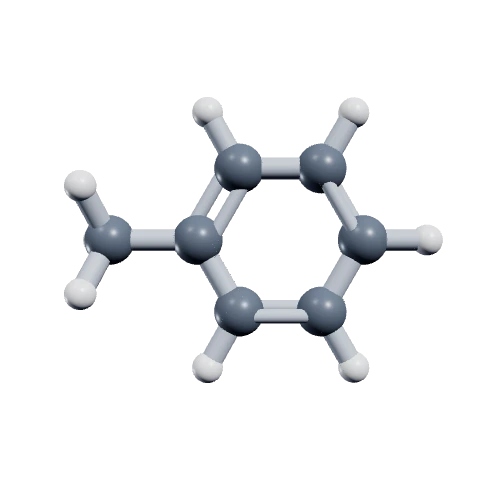


There is a solvent that won Formula One qualifying laps in the mid-1980s, that gives a 1958 Gibson Les Paul its lacquer-deep finish, that dissolves your scale-model figurine paints, and that quietly anchors organic-chemistry benches as the standard anhydrous medium for Grignard reactions. It is the same chemical in all four jobs: toluene, methylbenzene, C₇H₈. The 5-gallon pail on the Alliance loading dock is the same molecule that powered Nelson Piquet to a 1983 championship, just bottled differently.
If you have ever stood next to a hot late-summer dragstrip and watched a turbo-four make 9-second passes on pump gas blended with a heavy aromatic, you have watched toluene at work. If you own a sunburst 1958 Les Paul, you own a guitar whose mirror-deep finish was cut and applied in a solvent system that is mostly toluene. If you have ever passivated a stainless weld, dried a Grignard reagent under inert atmosphere, or thinned a nitrocellulose model paint thin enough to airbrush a cockpit interior, you have used toluene. It is one of the most versatile aromatic hydrocarbons in the chemical industry, and one of the most misunderstood: too often categorized as just "the other paint thinner" when in reality it sits at the intersection of motorsport chemistry, lacquer formulation, organic synthesis, and industrial degreasing.
We field procurement questions about toluene almost every week — from race-fuel mixers, custom-finish luthiers, scale-model paint formulators, university chemistry stockrooms, and adhesive manufacturers. This guide answers them in one place. What toluene actually is. How it compares to xylene, acetone, MEK, and ethyl acetate. Why nitrocellulose lacquer needs it. The race-gas octane math. The synthesis-lab anhydrous-solvent role. The 99.5% purity question. And the practical buying signals — pack size, freight class, container — that separate a smooth procurement from a freight-claim mess.
What is toluene? The chemistry behind methylbenzene and 99.5% purity
Toluene is a clear, colorless, aromatic hydrocarbon with the molecular formula C₇H₈ — a benzene ring with one methyl group (-CH₃) substituted onto it. Its IUPAC name is methylbenzene; the older industrial name toluol persists in technical literature and on European supplier paperwork. CAS 108-88-3 identifies it across every grade, supplier, and pack size in the world.
C₆H₅-CH₃ · methylbenzene · MW 92.14 g/mol
The methyl group is the single substituent that separates toluene from benzene chemically — and the separation matters enormously. Adding the methyl group lowers the molecule's vapor pressure relative to benzene, raises its boiling point from 80°C to 110°C, and — critically — converts the molecule from an IARC Group 1 human carcinogen (benzene) to an IARC Group 3 "not classifiable as carcinogenic to humans" compound (toluene). That single regulatory delta is the reason almost every industrial application that historically ran on benzene migrated to toluene over the 1970s and 1980s.
Key physical and chemical properties (toluene at 25°C)
| Property | Value | Notes |
|---|---|---|
| Molecular formula | C₇H₈ | Methylbenzene; aromatic hydrocarbon |
| Molecular weight | 92.14 g/mol | Light aromatic relative to xylene (106.16) |
| CAS Number | 108-88-3 | Same across all grades and pack sizes |
| Appearance | Clear colorless liquid | Sweet aromatic odor; gasoline-adjacent |
| Density (specific gravity) | 0.867 g/mL | Less dense than water; floats on aqueous phases |
| Boiling point | 110°C (230°F) | Mid-range volatility for industrial solvents |
| Melting point | -95°C (-139°F) | Liquid across virtually every shop-temperature range |
| Flash point | 4°C (39.2°F) | Class IB flammable liquid (NFPA 30); refrigerated storage NOT permitted |
| Vapor pressure | 3.8 kPa (28.4 mmHg) at 25°C | Volatile; releases vapor at room temperature |
| Water solubility | 0.52 g/L at 25°C | Essentially insoluble; nonpolar |
| Kauri-Butanol value | 105 | Solvency strength benchmark; higher = more aggressive |
| Evaporation rate (n-BuAc=1) | 2.0 | Moderate; slower than acetone (5.6), faster than xylene (0.76) |
| UN shipping | UN 1294, Class 3, PG II | Flammable liquid, signal word DANGER |
| NFPA 704 rating | Health 2 · Flammability 3 · Reactivity 0 | Moderate health hazard; serious fire hazard |
What does 99.5% purity actually mean? Our toluene ships at 99.5% minimum assay, with controlled limits on residual water, sulfur compounds, and chlorinated hydrocarbon impurities. That is above the typical commodity-industrial spec (which can run 98.5–99.0% with looser impurity limits) and meets the purity threshold for race-fuel blending, lacquer formulation, paint thinning, preparative organic synthesis, and most laboratory protocols outside HPLC mobile-phase or NMR-grade work. We ship a single specification — there is no Tech / ACS / HPLC tiering to choose from on our SKU.
Toluene vs xylene vs acetone vs MEK: when each solvent wins
The single most asked question in our GSC-tracked toluene queries is some variant of "toluene vs xylene" or "toluene vs acetone." The answer is not "use the strongest one" — it is "match the solvent to the resin and the substrate." Four aromatic and aliphatic solvents dominate North American shop benches, and each has a specific lane.
| Property | Toluene | Xylene | Acetone | MEK |
|---|---|---|---|---|
| Family | Aromatic hydrocarbon | Aromatic hydrocarbon | Polar aprotic ketone | Polar aprotic ketone |
| Boiling point | 110°C | 137–144°C | 56°C | 80°C |
| Evaporation rate (n-BuAc=1) | 2.0 | 0.76 | 5.6 | 3.8 |
| Kauri-Butanol value | 105 | 98 | ~ (off-scale) | ~ (off-scale) |
| Dissolves nitrocellulose? | Yes (with co-solvent) | Partially | Yes (excellent) | Yes (excellent) |
| Dissolves polystyrene? | Yes | Yes | Yes | Yes |
| Dissolves PVC? | No | No | No | Yes (welds PVC) |
| Water miscible? | No | No | Yes (fully) | Slightly (~24%) |
| HAP listed? | Yes | Yes | No | No (delisted 2005) |
| OSHA PEL (TWA) | 200 ppm | 100 ppm | 1000 ppm | 200 ppm |
| Best lane | Lacquer, race gas, anhydrous synthesis | Slower flash for brushable coatings | Fast cleanup, nail/3D-print, lab | Fiberglass, PVC welding, fast lacquer |
The Kauri-Butanol value, decoded
The Kauri-Butanol (KB) number — toluene's is 105 — is a solvency-strength index measured under ASTM D1133. A test sample of a copal-like Kauri gum is dissolved in n-butanol; the solvent under test is titrated in until the solution turns cloudy. The volume of solvent required, scaled, is the KB number. Higher numbers mean more aggressive solvency, which translates to faster dissolution of resin systems and harsher attack on plastics and elastomers. Toluene at 105 sits above xylene (98), well above mineral spirits (38), and is comfortably in the "aggressive aromatic" tier where lacquers, urethanes, and high-resin coatings dissolve cleanly.
The evaporation rate, decoded
Evaporation rate is reported relative to n-butyl acetate (set to 1.0). Toluene's 2.0 means it evaporates twice as fast as n-butyl acetate, which is roughly the speed range you want for a sprayable lacquer that needs to flash off in 10–30 seconds on a vertical surface — fast enough to stop runs, slow enough to flow level. Xylene's 0.76 is the slow-aromatic choice for brush coatings that need open time. Acetone at 5.6 is too fast for most lacquer work — it flashes before the coating has time to level — but ideal for solvent cleanup and the 3D-printer ABS vapor smoothing chamber that maker-movement print shops now standardize on.
Quick procurement rule. If your formula calls for a "high-strength aromatic that flashes fast enough for spray lacquer," it almost certainly means toluene. If it calls for "an aromatic that gives more open time on brushed coatings," it means xylene. If it calls for "a fast-drying polar cleanup solvent," it means acetone. If it calls for "the one that bonds PVC," it means MEK. The legacy "lacquer thinner" blends on hardware-store shelves are typically toluene + xylene + acetone + a small fraction of butyl acetate — the same four solvents in different ratios.
Why nitrocellulose lacquer needs toluene: from guitars to scale models
Nitrocellulose lacquer — the finishing system used on virtually every pre-1970 American electric guitar, on high-end furniture restoration, on traditional aniline-stained leather goods, and on the entire enthusiast tier of scale-model paints — depends on toluene as its primary aromatic carrier. The reason is solubility chemistry. Nitrocellulose is a partially nitrated cellulose ester that dissolves cleanly in a narrow window of polar-aprotic and aromatic solvents but precipitates out of pure aliphatic hydrocarbons. Toluene, blended with a faster active solvent (typically acetone, MEK, or butyl acetate) and a slower retarder (xylene or butyl glycol ether), gives the lacquer its characteristic flow, levelling, and mirror-deep build.
The luthier-shop blend
A custom-finish guitar lacquer typically runs 35–45% toluene as the aromatic carrier, 15–25% butyl acetate as the active solvent, 10–15% acetone as the fast solvent, and 5–10% xylene as the retarder, with the balance being plasticizer (often a phthalate), resin, and stabilizer. The toluene fraction is what gives the dried lacquer its depth and clarity — the aromatic ring system creates a slight refractive index difference between the resin and the air interface that the eye reads as "wet" even after the film fully cures. That deep, mirror-like clarity is the entire reason luthiers have resisted moving to acrylic, urethane, and waterborne finishes — the optical character is genuinely different.
Scale models, plastic kit paints, and the airbrush window
The scale-model paint world — Tamiya, Mr. Color (Gunze), Vallejo Air, AK Interactive, Mig — splits along an aromatic axis. The "lacquer" enamel lines (Tamiya LP, Mr. Color, AK Real Color, Mig AMMO True Metal) are toluene-carrier nitrocellulose systems. The "enamel" lines (Humbrol, Testors) are alkyd-resin systems thinned with mineral spirits or naphtha. The "acrylic" lines are water-or-alcohol carriers. For thin-skin scale-model paint work — gradient camouflage on a 1/48 fighter wing, marble effects on a 28mm miniature face, fine pre-shading lines — only the toluene-carrier lacquer systems give the atomization, flow, and self-levelling that hobbyists need. The toluene in the bottle is the same toluene we ship by the quart from the same drum that fills luthier orders.
The GSC tell. Search queries like "nitrocellulose lacquer toluene solvent" and "nitrocellulose soluble in toluene" are some of the highest-volume queries in our toluene cluster — a signal that the maker community continues to ask the basic chemistry question that determines whether a formula will work. The answer is: nitrocellulose is soluble in toluene with a co-solvent (acetone, MEK, ester) and insoluble in toluene alone. The aromatic ring provides the bulk solvency; the polar co-solvent breaks the cellulose hydrogen-bond network.
The race-gas octane-booster legend: F1, drag strips, and the math
Between the 1983 and 1985 Formula One seasons, the turbocharged BMW M12/13 inline-four engine that powered the Brabham team and the turbocharged Renault EF15 V6 ran on race fuels that were, by published team interviews and post-season technical reviews, predominantly toluene. The 84-octane (RON) gasoline base was blended with 70–84% toluene by volume, raising the effective RON of the qualifying fuel into the 130s and allowing boost pressures north of 5 bar. Nelson Piquet won the 1983 championship on this fuel; the FIA banned toluene-heavy mixtures in 1986 by capping race-fuel RON at 102 and ultimately at 95.
Why toluene boosts octane
Octane number measures a fuel's resistance to autoignition under compression. Two scales are used: Research Octane Number (RON), measured at low engine speed and load, and Motor Octane Number (MON), measured at high engine speed and load. Pump gasoline in the US is sold by Anti-Knock Index (AKI), the average of RON and MON. Toluene's pure RON is 121; its MON is 109. That gap — the so-called sensitivity, RON minus MON — is wide for aromatic hydrocarbons, which means toluene resists knock most effectively at lower RPMs and lower temperatures. That matches the load profile of a heavily turbocharged engine during qualifying laps, where the boost is maximum but engine speed is held relatively low for thermal management.
AKI = (RON + MON) / 2 · Pure toluene AKI = (121 + 109) / 2 = 115
The dragstrip and street-tuner blend math
In sanctioned-class drag racing where the rulebook permits unrestricted blends, the dominant pattern is a base of 93-octane pump premium with 10–30% toluene added by volume. Linear blending is reasonable for octane numbers — a 90/10 blend of 93 AKI gasoline and 115 AKI toluene yields approximately 95 AKI (90% × 93 + 10% × 115). A 70/30 blend yields approximately 100 AKI — knock margin equivalent to factory race-class fuels like Sunoco Standard or VP MS109.
| Base fuel | Toluene fraction | Resulting AKI (calculated) | Typical use |
|---|---|---|---|
| 91 AKI premium | 0% | 91 | Stock or mild tune |
| 93 AKI premium | 10% | ~95 | Boosted street car, 8–14 psi |
| 93 AKI premium | 20% | ~97 | Track-day street car, 15–18 psi |
| 93 AKI premium | 30% | ~100 | Bracket drag racing |
| 93 AKI premium | 50% | ~104 | Heavy-boost dyno tune, race-class |
| 87 AKI base | 50% | ~101 | Budget high-octane blend |
Important caveats. (1) Linear blending is a useful approximation, not an absolute rule — real fuel chemistry has nonlinearity, particularly at high aromatic loading. An on-vehicle dyno pull with a knock-detection load cell is the only definitive test. (2) Toluene-rich fuel runs lean of stoichiometric on a stock gasoline calibration — the AFR target needs to shift roughly 0.5 points richer per 10% toluene to maintain combustion. (3) Heavy aromatic loading degrades fuel-system elastomers (Viton, FKM) over time — short-cycle race use is fine; daily-driver street use is not the design case. (4) Almost every sanctioning body other than unlimited drag classes regulates aromatic fraction. Check your rulebook.
Legal use only. Toluene-blended fuel is not road-legal on EPA-certified emissions vehicles in the United States. EPA Title 40 CFR Part 80 requires gasoline used on-highway to meet Tier 3 specifications including a 35 ppm sulfur cap, 9.0 psi RVP, and specific aromatic limits. Custom blends used on street-driven vehicles in EPA-jurisdiction states violate the federal anti-tampering provisions of the Clean Air Act. Toluene blending in this guide is for sanctioned competition use only.
Toluene in organic synthesis: anhydrous solvent for Grignards and recrystallization
Toluene is the workhorse aromatic solvent of the organic-chemistry research bench. It is the standard medium for Grignard formation when diethyl ether or THF is incompatible with the substrate. It is the dominant azeotrope-former for water removal via Dean-Stark trap. It is the preferred recrystallization solvent for nonpolar aromatic intermediates. It is the universal Friedel-Crafts solvent. And — most importantly for procurement — it can be dried, deoxygenated, and reused at minimal cost, which makes it the lowest-effective-cost solvent on most preparative-scale reactions.
Anhydrous toluene: what it actually means in a lab
The GSC query "anhydrous toluene" generates real volume because lab managers regularly need to specify residual-water levels for moisture-sensitive chemistry. Our 99.5% ships with typical residual water under 200 ppm (0.02%) as-sold — sufficient for most preparative work but not for Grignards, lithium chemistry, or acid-catalyzed dehydrations that require sub-50 ppm water. For those applications, the standard preparation is to dry over activated 4Å molecular sieves overnight (drops residual water below 20 ppm), or run through an alumina-column solvent purification system (sub-10 ppm). Either treatment converts our as-shipped material to "synthesis grade" without changing the chemistry.
The Dean-Stark workhorse
Toluene forms an azeotrope with water at 84.1°C, boiling at a fixed ratio of 80% toluene / 20% water by volume. Setting this azeotrope up in a Dean-Stark trap allows continuous removal of water from a reflux reaction — driving condensations, esterifications, and dehydrations forward at high yield. Acid-catalyzed Fischer esterification, ketone enolization, and dehydration of alcohols to alkenes all run cleanly in toluene with a Dean-Stark trap and a catalytic acid. The same reactions in xylene run slightly higher temperature; in benzene they run slightly faster but with the carcinogenicity penalty.
The grade question for synthesis. For nonpolar aromatic chemistry — Friedel-Crafts, recrystallization, Dean-Stark dehydration — our 99.5% is fully adequate as-shipped. For Grignard formation, lithium chemistry, and tightly water-sensitive coupling chemistry, the as-shipped grade still requires drying over 4Å sieves or alumina-column purification. For HPLC mobile-phase or trace-analytical work, a dedicated HPLC-grade solvent is the correct specification — not our material.
Hazards, exposure limits, and the OSHA / NIOSH / ACGIH numbers that matter
Toluene is a real hazard worth respecting — but the hazard profile is well-characterized, regulated by primary-source agencies, and manageable with standard chemistry-shop PPE and ventilation. It is not a candidate for "extreme handling" PPE protocols; it is a candidate for honest, audit-ready compliance with the published exposure limits.
Published exposure limits
| Authority | Limit | Value | Citation |
|---|---|---|---|
| OSHA | PEL TWA (8 h) | 200 ppm | 29 CFR 1910.1000 Table Z-2 |
| OSHA | STEL | 300 ppm | 29 CFR 1910.1000 Table Z-2 |
| OSHA | Ceiling | 500 ppm | 29 CFR 1910.1000 Table Z-2 |
| NIOSH | REL TWA (10 h) | 100 ppm | NIOSH Pocket Guide |
| NIOSH | STEL (15 min) | 150 ppm | NIOSH Pocket Guide |
| NIOSH | IDLH | 500 ppm | NIOSH IDLH revision 1994 |
| ACGIH | TLV TWA (8 h) | 20 ppm | ACGIH TLV 2023 documentation |
| IARC | Carcinogenicity | Group 3 | Not classifiable as carcinogen to humans |
The ACGIH TLV of 20 ppm — the most protective of the published limits — drives most modern shop ventilation specifications. For routine bench-scale solvent handling under a properly designed fume hood (100 fpm face velocity, sash at working height), airborne concentrations are typically well under 5 ppm even during active pour operations. For unhooded handling at scale (drum decant, bulk transfer, spray application), local exhaust ventilation and respiratory protection are appropriate.
Acute toxicity
Toluene inhalation at concentrations significantly above the OSHA ceiling (above ~500 ppm) produces central nervous system depression — fatigue, headache, dizziness, loss of coordination — and at extreme concentrations (5,000+ ppm, only achievable in confined-space leaks or intentional inhalant abuse) produces unconsciousness and respiratory arrest. The long-term neurological effects associated with toluene are virtually entirely tied to chronic high-concentration exposure scenarios — primarily the documented inhalant-abuse population, not routine industrial use. At workplace-compliant concentrations, the toxicology is conservative.
Fire and storage
Toluene's 4°C flash point places it in NFPA 30 Class IB (flammable liquids with flash point below 73°F and boiling point above 100°F). Storage requires a UL-listed flammable liquid cabinet, grounded and bonded for transfer operations, and isolation from oxidizers. The vapor is heavier than air (vapor density 3.2 relative to air) and can travel along grade to a remote ignition source — a recurring industrial fire scenario that motivates the NFPA 30 separation distances.
Required PPE for routine handling: Viton or laminated film gloves for sustained contact (disposable nitrile is splash protection only, and butyl breaks through quickly on toluene; check the glove maker's permeation chart), safety glasses with side shields (chemical splash goggles for transfer operations), and either a fume hood or NIOSH-approved organic vapor respirator (3M 6001 cartridge or equivalent) for unhooded work above 10 minutes. Bonded grounding strap for any container-to-container transfer above 1 quart. Class B fire extinguisher within 50 feet of any open container.
How to buy toluene smart: pack sizes, freight Class 3, and the purity question
The procurement profile for toluene splits along three axes: pack size, grade specification, and shipping class. Get all three right and the order moves cleanly; get any one wrong and you face freight reclassification, partial-shipment delays, or a grade mismatch when the material hits your bench.
Pack sizes we stock
| Pack size | Container | Typical buyer | Notes |
|---|---|---|---|
| 1 quart | Metal quart can with screw cap | Lab, model painter, single-run synthesis | Single-day-use working quantity; minimizes inventory turn for low-volume users |
| 1 gallon | Metal gallon can | Custom-finish luthier, dragstrip blend prep | Standard workshop pack; 4-can cases for inventory holding |
| 5 gallon | Steel pail with bung | Production paint, anodizing line solvent, mid-scale synthesis | The most cost-effective sub-drum pack; ships LTL freight Class 3 |
| 55 gallon | UN-rated steel drum | Industrial paint manufacturer, scale chemistry plant | Bulk pricing; requires drum pump and grounded transfer setup |
| Pallet (multiple drums) | 4 × 55 gal drums | Contract paint operation, race-fuel blender | FOB Texas; freight to most US points 1–2 business days transit |
Freight class 3 and what it means at receiving
Toluene ships under UN 1294, Hazard Class 3, Packing Group II — a flammable liquid classification that requires placarded transport for shipments above the 1,001-pound exception threshold. For quart and gallon pack sizes shipping ground via UPS, the package travels under the small-quantity exception (49 CFR 173.150) without external placards. For drum and pallet shipments, the carrier requires a hazmat-certified driver and proper UN-rated packaging — both of which we provide on every shipment. The freight invoice will include a hazmat handling fee (typically $35-75 per shipment); we factor this into list pricing so the per-pound cost on a 55-gallon drum remains competitive.
Purity — does 99.5% match your spec?
For roughly 80% of applications — race fuel blending, lacquer formulation, industrial solvent use, paint thinning, scale-model paint thinning, organic synthesis at preparative scale — our 99.5% is the correct specification. It is over-spec relative to commodity industrial toluene (typically 98.5–99.0% with looser impurity limits) and meets the purity expectation for most laboratory protocols. For HPLC, GC, or NMR work that requires UV-cutoff or trace-analytical purity, a dedicated chromatography-grade or NMR-grade solvent is the correct purchase — those are specialized sub-purifications well beyond a single-specification high-purity solvent.
Volume-tier pricing. The per-pound cost of toluene drops nearly 60% between the 1-quart pack and the pallet-of-drums pack. For any application running more than 5 gallons per month, the 55-gallon drum is the procurement breakpoint where the lifetime cost recovers the upfront capital. Speak with our sales team for direct quotes on multi-drum and tanker volumes; we maintain inventory positions at our Texas warehouse for same-week shipment of pallet-and-multi-pallet orders.
Buy Toluene 99.5% — 1 quart through 55-gallon drum
One specification, every pack size. The same material that anchors race-fuel blending, custom-finish lacquer work, and analytical-chemistry benches. UN 1294 Class 3 packaging, hazmat-compliant shipping, and the COA free on request.
Shop Toluene →Related: MEK vs. Acetone: Which Solvent Do You Actually Need? — the ketone-vs-aromatic solvent question, MEK vs toluene included.
Related: Tert-Butyl Acetate (TBAc): The VOC-Exempt Solvent Guide — a counted VOC that TBAc frequently replaces.
References & Authoritative Sources
Primary sources consulted for this article. Regulatory and physical-property figures above are drawn from these references.
- Toluene (CAS 108-88-3) — compound summary — PubChem, National Center for Biotechnology Information. Accessed 2026-09-02.
- Toluene — thermochemical and phase data — NIST Chemistry WebBook, SRD 69. Accessed 2026-09-02.
- 29 CFR 1910.1000 — Air contaminants (Tables Z-1, Z-2 and Z-3 permissible exposure limits) — Electronic Code of Federal Regulations, Occupational Safety and Health Administration. Accessed 2026-09-02.
- 49 CFR 172.101 — Hazardous Materials Table (UN numbers, hazard classes and packing groups) — Electronic Code of Federal Regulations, U.S. Department of Transportation. Accessed 2026-09-02.
- 40 CFR 1090.205 — Gasoline sulfur standards (Tier 3 annual average and per-gallon caps) — Electronic Code of Federal Regulations, U.S. Environmental Protection Agency. Accessed 2026-09-02.
Key numbers and sources
| Fact | Value | Source |
|---|---|---|
| CAS Number | 108-88-3 | pubchem.ncbi.nlm.nih.gov |
| Molecular formula | C₇H₈ | pubchem.ncbi.nlm.nih.gov |
| Molecular weight | 92.14 g/mol | pubchem.ncbi.nlm.nih.gov |
| Boiling point | 110°C (230°F) | webbook.nist.gov |
| Melting point | -95°C (-139°F) | webbook.nist.gov |
| Density (specific gravity) | 0.867 g/mL | webbook.nist.gov |
| OSHA PEL (TWA) | 200 ppm | ecfr.gov |
Related: Who Wins the 2026 Chemistry Nobel? Three Picks, and the One Made on a Bench — toluene as the carrier solvent for silane monolayers, a 2026 Nobel citation-laureate field.
Frequently asked questions
Is toluene the same as toluol?
Yes. Toluol is the older industrial name for the same compound, methylbenzene (C7H8, CAS 108-88-3). The chemistry, grade, and properties are identical; only the paperwork name differs.
Toluene vs xylene: which solvent is stronger?
Toluene is moderately stronger by Kauri-Butanol value (105 vs 98 for xylene) and evaporates noticeably faster (relative evaporation rate 2.0 vs 0.76 with n-butyl acetate = 1). For brush coatings that need open time, xylene wins. For spray lacquer that needs to flash-set on a vertical surface, toluene wins.
Is toluene a polar or nonpolar solvent?
Nonpolar. The methyl-substituted aromatic ring has no permanent dipole. Toluene does not mix with water but mixes cleanly with all common nonpolar hydrocarbon solvents and with most ester, ketone, and ether polar-aprotic solvents.
How much toluene should I add to my race gas?
Common starting points: 10% by volume in 93 AKI pump premium for boosted street use (resulting AKI roughly 95), 30% for bracket drag racing (around 100 AKI), 50% for heavy-boost dyno work (around 104 AKI). Linear blending is a useful approximation; always verify on a chassis dyno with knock detection before sending a calibration to the track. Sanctioned competition use only.
Does toluene attack rubber and plastics?
Yes for many. Toluene dissolves polystyrene, ABS, and most elastomers (natural rubber, SBR, EPDM). It softens nitrile rubber on prolonged contact. It is compatible with PTFE, FFKM (Kalrez), and most fluoroelastomers (Viton/FKM) for short-cycle exposure. Fuel-system material selection matters for race blends.
What grade of toluene do I need?
We ship one specification: 99.5% minimum assay toluene. That spec covers race fuel blending, lacquer formulation, paint thinning, scale-model paint thinning, and preparative organic synthesis — the great majority of working applications. For HPLC, GC, or NMR work that requires UV-cutoff or trace-analytical purity, a dedicated chromatography-grade or NMR-grade solvent is the correct purchase — that is a specialized sub-purification well beyond a single-spec high-purity industrial solvent.
What is the flash point of toluene and what does it mean for storage?
Toluene has a flash point of 4 degrees C (39 F), placing it in NFPA 30 Class IB. Storage requires a UL-listed flammable liquid cabinet, grounded and bonded for transfer operations, isolated from oxidizers. Vapor is 3.2 times heavier than air and can travel along grade to a remote ignition source.
How should I store toluene safely?
UL-listed flammable liquid cabinet, room temperature, away from oxidizers and direct sunlight. Keep in the original metal container with the bung tight. Bonded and grounded for any transfer. Class B fire extinguisher within 50 feet. Sealed shelf life is multi-year.
Related Chemical Collections
About the author
Andre Taki
This article is for informational purposes only.


