



used in mining
What is Methyl Isobutyl Ketone (MIBK)? The chemistry under the label
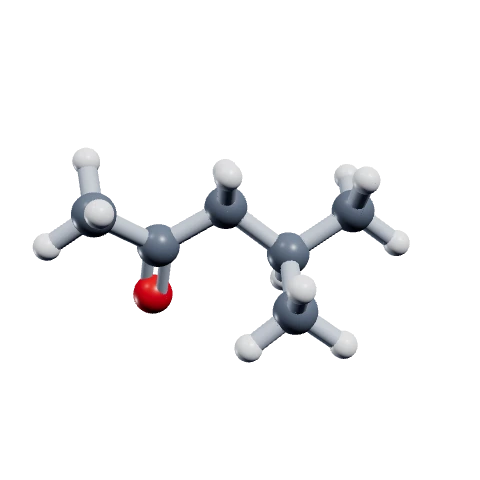
Methyl Isobutyl Ketone is an aliphatic ketone solvent with the molecular formula C6H12O and a molecular weight of 100.16 g/mol. Industry shorthand is MIBK, sometimes 4-methyl-2-pentanone, hexone, or isohexanone. The carbonyl group sits between a methyl and an isobutyl branch — that branched structure is exactly what makes MIBK valuable: it evaporates slower than acetone but faster than higher ketones, dissolves a wider range of resins than MEK, and forms a stable interfacial film in aqueous mining slurries.
CAS: 108-10-1 · Density: 0.802 g/mL at 20°C · Flash point: 14°C (closed cup) · Vapor pressure: 19 mmHg at 20°C · Water solubility: ~19 g/L · Refractive index nD20: 1.3957 · Surface tension: 23.6 mN/m at 20°C
Commercial MIBK is produced primarily by the catalytic condensation of acetone in a three-step process: 2× acetone → diacetone alcohol (DAA) → mesityl oxide → (hydrogenation) MIBK. The first step is base-catalyzed (NaOH or anion exchange resin), the second is acid-catalyzed dehydration, and the final hydrogenation runs over a copper-chromite or palladium catalyst at 80–160°C. The acetone-derived feedstock means MIBK pricing tracks closely with global acetone (and ultimately propylene) cycles — a useful procurement signal when planning bulk buys. Major producers include Eastman, Mitsubishi Chemical, Sasol, and Kumho P&B Chemicals.
Why the “branched” structure matters
The isobutyl branch (rather than a straight propyl group, which would make it di-n-propyl ketone) is the key to MIBK's industrial niche. The branched alpha-carbon gives MIBK three useful properties simultaneously: it lowers water solubility (so the solvent partitions cleanly out of aqueous extraction streams), it raises surface activity (so it stabilizes flotation froths), and it slows the evaporation rate to roughly half that of MEK without dropping into the slow-evap territory of cyclohexanone. The same molecule does not exist in a less-branched isomer with these combined properties — this is why MIBK has resisted substitution by greener alternatives for over five decades.
Peroxide formation on aging — a real procurement issue
Like all aliphatic ketones, MIBK can slowly form organic peroxides on long-term storage (particularly if exposed to air and light). Fresh MIBK contains effectively zero peroxide; material more than 12 months old in opened drums should be tested with KI starch paper or a peroxide test strip before any operation that involves heat or distillation. Peroxide levels above 100 ppm warrant treatment (typically by passing through activated alumina or treatment with a stannous-chloride solution); levels above 1000 ppm warrant disposal as the material can detonate on concentration. Sealed drums under nitrogen blanket and stored below 25°C have a practical shelf life of 24–36 months.
What is MIBK used for? Six industries that run on this ketone
MIBK's industrial footprint is dominated by a single application — mining ore flotation — but five other industries each consume meaningful volumes. Here's how the demand breaks down:
| Industry | Application | Why MIBK |
|---|---|---|
| Mining | Froth flotation frother (Cu, Mo, Au, Pb, Zn) | Stable, drainage-tolerant froth; selective hydrophobic attachment |
| Paint & coatings | Slow-evaporation solvent for lacquers, high-build automotive finishes, nitrocellulose | Mid-range evaporation rate (relative 1.6), strong resin solvency |
| Pharmaceutical | Extraction solvent for penicillin G and other antibiotic APIs | Selective partition coefficient, low water miscibility |
| Rare earths | Liquid-liquid extraction of niobium, tantalum, zirconium | Functional diluent for organophosphate extractants |
| Adhesives | Co-solvent in PVC, polyurethane, and contact adhesives | Flexible solvency; aids resin viscosity control |
| Rubber chemicals | Intermediate in 6PPD antiozonant synthesis | Carbonyl reactivity for amine condensation |
The mining share is so dominant that MIBK consumption is sometimes used as an economic proxy for global base-metal mining activity — when copper futures rally, MIBK lead times stretch.
How does MIBK enable mining ore flotation? The chemistry that separates copper from rock
Froth flotation is the dominant method for concentrating low-grade copper, molybdenum, and gold ores. The chemistry is elegant: hydrophobic mineral particles (rendered so by “collector” chemicals like xanthates) attach to rising air bubbles in an agitated slurry, ride them to the surface, and are skimmed off as a mineral-rich froth. MIBK's role is the frother — the bubble-stabilizing chemistry that lets the system actually work at industrial scale.

Why MIBK specifically? The frother spec sheet
A flotation frother needs three properties that are surprisingly hard to combine:
- Surface-tension activity at low concentration — typically 10–100 ppm in the pulp.
- Stable but drainable froth — bubbles must hold their cargo to the skimmer but release water back to the cell.
- Selective non-stickiness toward gangue — it should not over-froth hydrophilic waste rock.
MIBK hits all three. Its branched ketone structure gives it just enough amphipathic character to lower surface tension without making the froth so stable it floats waste minerals along with the value metals. That selectivity is why MIBK has been the global workhorse frother for over fifty years.
Typical dosing: 30–80 g of MIBK per tonne of ore for copper-moly circuits; 50–120 g/t for refractory gold ores. MIBK is often blended with stronger frothers like pine oil or alcohol-based frothers (MIBC, DF-250) to tune froth carrying capacity for specific ore mineralogies.
Real-world case studies from major copper mines
The scale of MIBK consumption in commercial flotation operations is sobering. At Chile's Chuquicamata mine — the largest open-pit copper mine in the world, processing roughly 180,000 tonnes of ore per day — flotation circuits consume on the order of 10–15 tonnes of frother per day, of which MIBK is a significant fraction blended with MIBC and DF-250 to balance froth stability against drainage. Bingham Canyon (Utah, USA) operates a similar tonnage with comparable frother chemistry. BHP's Escondida and Freeport-McMoRan's Grasberg follow the same playbook with site-specific adjustments for ore mineralogy — sulfide-rich ores need less frother, oxide-blended ores need more.
By-product economics: why molybdenum and gold ride along
A modern porphyry copper deposit typically grades 0.3–0.6% Cu, 0.005–0.04% Mo, and 0.1–0.5 g/t Au. The economics of mining the rock are often marginal on copper alone; the molybdenum and gold by-products fund the operation. Selective flotation — copper recovered first in a bulk float, molybdenum stripped out by selective depression of chalcopyrite, gold recovered from the residual scavenger tails — relies on frother chemistry that doesn't over-stabilize the wrong mineral phase. MIBK's selectivity is the unsung enabler of this entire by-product recovery cascade.
Why MIBK in paint, lacquer, and high-build coatings? The slow-evap solvent
The second-largest MIBK market is industrial paints, lacquers, and coatings — particularly automotive refinish, marine coatings, and nitrocellulose lacquer for furniture. The reason is evaporation control. Painters care about three rate windows: wet-edge flow, surface-leveling, and final cure. MIBK's relative evaporation rate of about 1.6 (with n-butyl acetate = 1.0) puts it neatly in the “medium” band — slow enough to keep a brush or spray-gun pattern flowing, fast enough that films cure within the production-line clock.
MIBK is also strongly solvent-active toward:
- Nitrocellulose — classic furniture lacquer and gun stock finish
- Acrylic resins — automotive refinish topcoats
- Vinyl chloride/vinyl acetate copolymers — coil coatings
- Epoxy resins — high-build industrial maintenance coatings
- Phenolic resins — can/drum interior coatings
For automotive refinish in particular, MIBK is the “mid-temperature retarder” that keeps a high-solids basecoat from blushing in humid weather. Painters typically blend MIBK with faster solvents (MEK, acetone) and slower ones (n-butyl acetate, ethylene glycol monobutyl ether) to hit a specific evaporation profile for shop conditions.
VOC compliance: where MIBK gets tight
Under EPA Method 24 (40 CFR 60, Appendix A-7), MIBK counts as a Volatile Organic Compound. The maximum incremental reactivity (MIR) value for MIBK in the California Air Resources Board (CARB) reactivity-based standard is approximately 4.31 g O3/g VOC — lower than acetone's 0.43 g O3/g but high enough that aggregate use in heavy-rebate paint operations triggers permitting thresholds. The OTC Phase I/II AIM coating rules and SCAQMD Rule 1113 (architectural coatings) tightly cap solvent VOC in topcoats, which has pushed automotive refinish paint formulators toward waterborne basecoats — but MIBK still dominates 2K solvent-borne urethane topcoats where waterborne chemistry can't hit performance specs. Industrial maintenance coatings (bridges, refineries, marine vessels) sit outside the architectural rules and retain heavy MIBK use.
The evaporation triangle — how painters actually blend solvents
Professional refinish painters think of solvents as three points on a triangle: fast-evap (acetone, MEK, ethyl acetate) for instant tack control, mid-evap (MIBK, n-butyl acetate) for flow and leveling, and slow-evap (ethylene glycol monobutyl ether, cyclohexanone) for blush prevention in high-humidity weather. A “summer slow” thinner might run 30% MIBK / 40% n-butyl acetate / 20% EGBE / 10% acetone. A “winter fast” thinner inverts that toward acetone and MEK. MIBK is the pivot in both formulations because of its uniquely balanced evap rate and solvency.
Why MIBK quietly underwrites the EV and grid build-out
The chemistry above is timeless — flotation has worked the same way since the early 1900s. What has changed is the strategic value of what flotation produces. Copper, molybdenum, and the by-product gold and silver streams from porphyry flotation circuits are the raw inputs for three of the largest industrial buildouts in modern history: the EV transition, the electric-grid expansion needed to support it, and the reshoring of critical-mineral supply chains away from China-dominated processing.
The math is direct. A single EV consumes roughly 60–80 kg of copper (vs 20–25 kg in an ICE vehicle); a 1 MW offshore wind turbine uses about 8 tonnes of copper; a kilometer of high-voltage transmission line uses around 4 tonnes. The IEA projects global copper demand growing from roughly 25 Mt/yr today to 35–40 Mt/yr by 2040 under aggressive electrification scenarios. Every additional tonne of copper mined and concentrated runs through a flotation cell stabilized by frother chemistry — and MIBK remains a major component of that frother stack despite decades of effort to replace it.
The procurement implication: mining customers buying MIBK by the drum should plan lead times against the copper-price cycle, not against a generic chemical-distribution cycle. When LME copper rallies above $9,000/t, frother demand stretches lead times by 2–4 weeks. Inventory accordingly.
The Inflation Reduction Act's domestic critical-minerals provisions ($30B+ in tax credits) are driving fresh investment in US copper, lithium, and rare-earth mining projects — many of which will use MIBK-blended frothers in their flotation circuits. Suppliers who can deliver consistent grade and ratable volume into US-domiciled mining operations will see compounding demand through 2030.
MIBK in pharmaceuticals: penicillin G extraction and API recovery
One of MIBK's oldest specialty markets is antibiotic recovery. When penicillin G is fermented by Penicillium chrysogenum, it ends up dissolved in the broth at low concentration (typically 20–50 g/L). The economics of antibiotic manufacture depend on rapid, clean extraction of the API from this aqueous broth into an organic solvent — and MIBK's partition coefficient for penicillin G is excellent.
The classic Whey extraction process uses MIBK at controlled pH (around 2.0–2.5) to extract penicillin G into the organic phase, then back-extracts into a slightly alkaline aqueous buffer for crystallization. Modern continuous-extraction columns still run on the same fundamental MIBK chemistry that came out of WWII-era antibiotic production scale-up.
For pharmaceutical and high-purity laboratory work, ACS Reagent Grade MIBK is the standard — it specifies maximum levels for water (≤0.05%), residue after evaporation, peroxides, and color (APHA ≤15).
Modern API recovery beyond penicillin
The penicillin G process is the textbook example, but MIBK extraction is still widely used in modern API recovery. Cephalosporin antibiotics (cephradine, cefadroxil) use MIBK or MIBK/butyl-acetate blends for crystallization-grade purification. Some beta-lactam intermediates use MIBK as a process solvent in the multi-step synthesis from 6-APA and 7-ACA cores. Modern continuous-process pharmaceutical plants run mixer-settler trains or pulsed extraction columns; the MIBK is recovered by stripping and recycled, typically with 95–99% solvent recovery.
MIBK is also a workhorse extraction solvent for rare-earth metallurgy. Niobium and tantalum are co-extracted from acid leach liquors using MIBK with HF/H2SO4, then selectively stripped at different acid concentrations. This separation is critical for producing the high-purity niobium needed for superalloy and superconductor markets (MRI machines, particle accelerators, jet engine hot sections).
MIBK vs MEK vs Acetone vs Cyclohexanone: which ketone do you actually need?
The aliphatic ketone family has four common members, and they get confused constantly. Here's the practical breakdown:
| Property | Acetone | MEK | MIBK | Cyclohexanone |
|---|---|---|---|---|
| BP (°C) | 56 | 80 | 117 | 156 |
| Evap. rate (BuAc=1) | 5.6 | 3.8 | 1.6 | 0.32 |
| Water solubility | miscible | 275 g/L | 19 g/L | 87 g/L |
| Best for | quick cleaning, lab | thin lacquer, PVC primer | flotation, automotive paint | nylon, PVC pipe cement |
| OSHA PEL (TWA) | 1000 ppm | 200 ppm | 100 ppm | 50 ppm |
The pattern is clear: as you climb the molecular weight ladder (acetone → MEK → MIBK → cyclohexanone), boiling point and solvency for higher resins go up, evaporation rate goes down, and OSHA toxicity limits tighten. Choose the lowest-toxicity ketone that still hits your evaporation and solvency window.
Is MIBK toxic? What OSHA PEL, NIOSH REL, and real handling actually require

MIBK is moderately hazardous — not as benign as acetone, not as dangerous as methylene chloride. The numbers that matter:
| Limit | Value | Source |
|---|---|---|
| OSHA PEL (TWA, 8 hr) | 100 ppm (410 mg/m³) | 29 CFR 1910.1000 |
| NIOSH REL (TWA) | 50 ppm (205 mg/m³) | NIOSH IDLH 500 ppm |
| ACGIH TLV (TWA) | 20 ppm | ACGIH 2024 |
| Flash point | 14°C closed cup | OSHA Class IB flammable |
| Odor threshold | ~0.5 ppm | (odor warns well below limits) |
Health effects: Inhalation at high concentrations causes CNS depression (headache, dizziness, nausea). Liquid contact irritates skin and eyes; repeated skin contact can cause defatting and dermatitis. NOT a confirmed human carcinogen but IARC Group 2B (possibly carcinogenic) based on animal data.
Never store MIBK near strong oxidizers (nitric acid, hydrogen peroxide, hypochlorites). Ketones can form unstable peroxides on long storage; inspect drums >12 months old for crystalline deposits before opening.
Required PPE for routine handling
- Eyes: chemical splash goggles (Z87.1)
- Skin: butyl-rubber or laminated film gloves. Nitrile is rated poor to not recommended for MIBK in manufacturer permeation data, so a nitrile glove that gets splashed comes off immediately. Check the glove maker's chart for your exact glove.
- Respiratory: organic vapor cartridge respirator if not handling under fume hood / general exhaust
- Clothing: chemical-resistant apron for transfer operations
Transport and storage classification
| Classification | Code | Meaning |
|---|---|---|
| UN Number | UN 1245 | Methyl isobutyl ketone |
| DOT Hazard Class | 3 | Flammable liquid |
| Packing Group | II | Medium-danger liquid |
| ERG Guide | 127 | Flammable liquids (polar/water-miscible) |
| NFPA 704 | Health 2 / Fire 3 / Reactivity 0 | Moderate health, serious fire, stable |
| GHS H-codes | H225, H319, H332, H335, H336 | Flammable, eye/respiratory/CNS effects |
Storage best practices: keep MIBK in original UN-rated steel drums or DOT-spec IBC totes, in a flammable-storage cabinet or a Class I Division 2 area with mechanical ventilation. Maintain temperatures below 35°C to slow peroxide accumulation. Bond and ground all transfer operations to dissipate static (MIBK's dielectric constant of 13.1 allows static buildup during pouring). Never pressurize drums for transfer — use a sealed pump system or vacuum transfer.
Where to buy MIBK: ACS Reagent vs Technical Grade and pack sizes

Alliance Chemical stocks MIBK in two grades:
| Grade | Purity | Best for | Spec source |
|---|---|---|---|
| ACS Reagent | ≥99.0% (GC) | Pharmaceutical extraction, analytical chemistry, high-purity coatings | American Chemical Society Committee on Analytical Reagents |
| Technical | ≥99% (GC) | Mining flotation, industrial coatings, adhesives | ASTM D785 / industry spec |
For mining operations, technical grade is the workhorse — mineralogical feed streams are far more variable than any trace impurity in the frother itself. For pharmaceutical extraction or analytical work, ACS grade is non-negotiable due to residue and peroxide specifications.
Pack-size economics: drum vs IBC vs tote
The math on packaging shifts MIBK procurement strategy as volume scales:
- 1-quart can: laboratory and small-shop use. Premium per-unit pricing but no minimum order, ships parcel.
- 1-gallon can: small coatings shops and refinish operations. Sweet spot for occasional users.
- 5-gallon pail: mid-volume formulators. Roughly 31% unit-cost reduction vs gallon cans (verified Alliance pricing). Steel pail with rust-prevention coating.
- 55-gallon drum: plant-scale paint manufacturers and small mining operations. UN-rated 1A1 steel drum. Roughly 70% unit-cost reduction vs gallon cans (verified Alliance pricing).
MIBK pricing tracks the global propylene/acetone cost cycle. Current Alliance Chemical pricing on a 55-gallon technical-grade drum is around $27.50 per gallon (drum total $1,511.39); ACS Reagent grade runs about 26% higher for the tighter spec. The drop from quart-can pricing (~$87/gallon effective) to 55-gallon drum (~$27.50/gallon) is one of the largest savings progressions in our solvent catalog — consolidate volume into drums whenever you can.
Need MIBK delivered in 1-2 business days?
Alliance Chemical stocks MIBK in ACS Reagent and Technical grades, packed quart through 55-gallon drum.
Order Technical Grade MIBKReferences & Authoritative Sources
Chemical identity, properties, and safety data sourced from the U.S. National Library of Medicine's PubChem database — the authoritative open-chemistry data resource maintained by the National Institutes of Health.
- PubChem CID 7909: Methyl Isobutyl Ketone (MIBK) ACS Grade — National Center for Biotechnology Information, U.S. National Library of Medicine. CAS 108-10-1.
- Methyl Isobutyl Ketone — thermophysical data — NIST Chemistry WebBook, SRD 69, National Institute of Standards and Technology. Accessed 2026-09-04.
- 29 CFR 1910.1000 Table Z-1 — OSHA permissible exposure limit for Methyl Isobutyl Ketone — Office of the Federal Register, U.S. Government Publishing Office. Accessed 2026-09-04.
Related: Tert-Butyl Acetate (TBAc): The VOC-Exempt Solvent Guide — another ester/ketone solvent option.
Key numbers and sources
| Fact | Value | Source |
|---|---|---|
| CAS Number | 108-10-1 | pubchem.ncbi.nlm.nih.gov |
| Molecular formula | C 6 H 12 O | pubchem.ncbi.nlm.nih.gov |
| Molecular weight | 100.16 g/mol | pubchem.ncbi.nlm.nih.gov |
| Boiling point | 117–118°C | pubchem.ncbi.nlm.nih.gov |
| Density at 20°C | 0.802 g/mL | pubchem.ncbi.nlm.nih.gov |
| OSHA PEL (TWA) | 100 ppm | See article text |
| Flash point (closed cup) | 14°C | pubchem.ncbi.nlm.nih.gov |
| Water solubility | ~19 g/L | pubchem.ncbi.nlm.nih.gov |
Frequently asked questions
What is methyl isobutyl ketone (MIBK) used for?
MIBK is most heavily used as a frother in mining ore flotation (copper, molybdenum, gold separation), as a slow-evaporation solvent in paint and coatings (especially automotive refinish and nitrocellulose lacquer), and as an extraction solvent in pharmaceutical manufacturing for antibiotics like penicillin G. Mining alone consumes over 60% of global MIBK production.
Is MIBK the same as MEK?
No. MEK is methyl ethyl ketone (C4H8O, MW 72.11, BP 80°C). MIBK is methyl isobutyl ketone (C6H12O, MW 100.16, BP 117°C). MIBK is larger, slower-evaporating, and a better solvent for higher-molecular-weight resins. MEK is faster, more water-soluble, and better for thin lacquers and PVC primer.
Is MIBK toxic?
MIBK is moderately toxic. OSHA PEL is 100 ppm TWA, NIOSH REL is 50 ppm. It can cause CNS depression at high concentrations (headache, dizziness, nausea), skin defatting, and eye irritation. IARC Group 2B (possibly carcinogenic) based on animal data. Always handle with splash goggles, butyl-rubber gloves, and adequate ventilation.
What is the boiling point of MIBK?
MIBK boils at 117–118°C (243–244°F). Flash point is 14°C (closed cup), classifying it as an OSHA Class IB flammable liquid. Vapor pressure is 19 mmHg at 20°C.
What does MIBK smell like?
MIBK has a sweet, camphor-like odor sometimes described as similar to acetone or peppermint. The odor threshold is about 0.5 ppm — well below the 100 ppm OSHA PEL — so smell is an early warning of vapor exposure.
What is the difference between ACS Grade and Technical Grade MIBK?
ACS Reagent Grade MIBK meets American Chemical Society specifications for analytical use: ≥99.0% purity, ≤0.05% water, controlled peroxide and residue limits, APHA color ≤15. Technical Grade is ≥99% pure but with looser residue and color specs; appropriate for mining flotation, industrial coatings, and adhesives where trace impurities do not matter.
Why is MIBK used in mining?
MIBK is a frother in froth flotation — it stabilizes air bubbles in the mineral slurry so hydrophobic value minerals (copper sulfide, molybdenite, gold) can attach to bubbles and ride to the surface as a concentrated froth, while hydrophilic gangue waste rock sinks. Its branched ketone structure gives selective surface activity at 30–80 g of MIBK per tonne of ore.
Where can I buy MIBK?
Alliance Chemical stocks MIBK in ACS Reagent and Technical grades in pack sizes from 1-quart cans through 55-gallon drums. Order at alliancechemical.com/products/methyl-isobutyl-ketone-mibk-technical-grade for technical grade, or /products/methyl-isobutyl-ketone-mibk-acs-grade for ACS reagent grade.
Related Chemical Collections
About the author
Andre Taki
This article is for informational purposes only.