



Two clear, fruity-smelling esters, one letter apart in a dozen search queries. Pick the wrong one for a liquid-liquid extraction and your organic layer will not separate the way your protocol says it should — and no MSDS will tell you why.
Isopropyl acetate and ethyl acetate get compared constantly — by process chemists choosing an extraction solvent, by formulators picking a faster- or slower-evaporating coatings solvent, and by anyone reading two ICH Q3C-compliant solvent options off a spec sheet and needing to know which one actually behaves differently. This guide answers the questions people actually search: the real boiling-point and water-solubility numbers, why isopropyl acetate holds up slightly better against hydrolysis, what isopropyl acetate is used for, and which grade — Technical or ACS — you actually need.
What is isopropyl acetate?
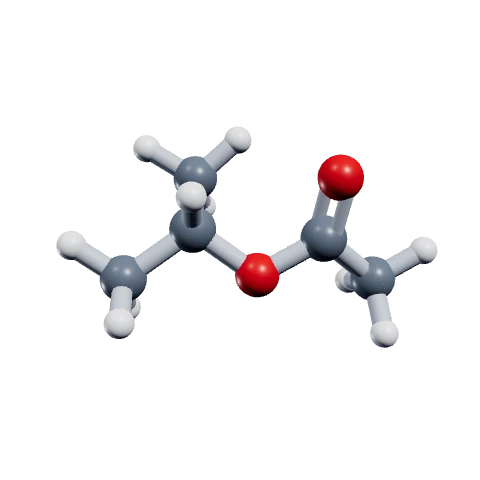
Isopropyl acetate is the ester formed from isopropyl alcohol and acetic acid — a colorless, highly flammable liquid solvent with a characteristic fruity, sweetish odor. It is not a household name because it rarely appears on a finished product label; it does its work in a process and leaves as vapor.
CAS 108-21-4 · C₅H₁₀O₂ (propan-2-yl acetate) · Molecular weight 102.13 g/mol · Specific gravity ~0.872–0.874 (20°C) · Boiling point 88.6°C (191.5°F) · Flash point 2°C (36°F, closed cup) · Water solubility ~2.9 g/100mL (poor). PubChem CID 7915
Structurally, it differs from ethyl acetate by one detail: the alcohol half is isopropyl (a branched, secondary carbon) instead of ethyl (a straight, primary carbon). That single branch point is the root of nearly every practical difference covered below — boiling point, water solubility, and hydrolytic stability.
It is fully miscible with most common organic solvents — alcohols, ketones, esters, hydrocarbons, and ethers — but only sparingly soluble in water, which is exactly the property that makes it useful for extraction and phase-separation work.
How is isopropyl acetate made?
Isopropyl acetate is produced by Fischer esterification — reacting isopropyl alcohol with acetic acid in the presence of an acid catalyst (commonly sulfuric acid), which drives off water and forms the ester. The reaction is an equilibrium, so industrial production typically removes water as it forms (via azeotropic distillation) to push the reaction toward completion and maximize yield.
The same reaction runs in reverse — slowly, and faster with heat, acid, or base present — which is the hydrolysis pathway discussed below. It is also the reason isopropyl acetate is not indefinitely stable in the presence of moisture: given enough time and water, it will revert toward acetic acid and isopropyl alcohol, its two starting materials.

Isopropyl acetate vs ethyl acetate: boiling point and volatility
Isopropyl acetate boils about 11°C higher than ethyl acetate — 88.6°C vs 77.1°C at atmospheric pressure — making it noticeably less volatile. That gap is small enough that both solvents are considered "fast-evaporating" next to something like PEG 200, but large enough to matter in coatings, adhesives, and distillation work where dry time or reflux temperature is a process variable.
| Property | Isopropyl Acetate | Ethyl Acetate |
|---|---|---|
| CAS number | 108-21-4 | 141-78-6 |
| Formula / MW | C₅H₁₀O₂ / 102.13 g/mol | C₄H₈O₂ / 88.11 g/mol |
| Boiling point | 88.6°C (191.5°F) | 77.1°C (171°F) |
| Density @ 20°C | ~0.872–0.874 g/mL | ~0.900–0.902 g/mL |
| Water solubility @ 20–25°C | ~2.9 g/100mL (poor) | ~8.0 g/100mL |
| Flash point (closed cup) | 2°C (36°F) | -4°C (24°F) |
| ICH Q3C solvent class | Class 3 (low toxic potential) | Class 3 (low toxic potential) |
| Odor | Fruity, sweetish | Fruity, sweetish (nail-polish-remover-adjacent) |
Practically, that means ethyl acetate flashes off faster on a substrate — useful when you want a quick-drying coating or a rapid HPLC mobile-phase evaporation — while isopropyl acetate's slower evaporation gives a longer open time in coatings and adhesives, and a wider safety margin before a process solvent boils away during a warm reflux or distillation step.
Boiling point under vacuum, with water, and at room temperature
Both esters boil far lower under vacuum. PubChem's NTP vapor-pressure data put ethyl acetate at 100 mmHg at 81°F (27°C) and isopropyl acetate at 100 mmHg at 96.3°F (36°C), which are their boiling points at that pressure. Wet ethyl acetate boils lower still: it forms a low-boiling azeotrope with water that boils at 70.4°C (HSDB).
Neither needs to boil to disappear. At 25°C ethyl acetate has a vapor pressure of 93.2 mmHg and isopropyl acetate 60.4 mmHg, so both evaporate readily from an open container at room temperature, ethyl acetate about half again as fast by that measure. That is also why their vapors (about 3 and 3.5 times as dense as air) collect at floor level in a poorly ventilated room.

Isopropyl acetate vs ethyl acetate: water solubility and extraction performance
Isopropyl acetate is noticeably "drier" than ethyl acetate — about 2.9 g dissolves per 100 mL of water, versus roughly 8.0 g for ethyl acetate, nearly a threefold difference. This is the number that matters most to anyone running a liquid-liquid extraction (LLE) or aqueous workup: the less an organic solvent dissolves in the water layer, the cleaner and faster the phase separation, and the less product is lost to the aqueous phase or wasted re-extracting it back out.
Both solvents are less dense than water and sit on top of the aqueous layer, and both are fully miscible with common organic co-solvents. But where a process needs the sharpest possible split between organic and aqueous phases — extractions, recrystallizations, and washes in API and fine-chemical synthesis — isopropyl acetate's lower water solubility is the practical reason it gets chosen over ethyl acetate, even though ethyl acetate is cheaper and more common.
In an LLE step, solvent that dissolves into the water layer is solvent (and dissolved product) you have to recover or lose. At ~2.9 g/100mL, isopropyl acetate carries roughly a third as much itself into the aqueous phase as ethyl acetate does at ~8.0 g/100mL — a real, measurable process advantage, not a marginal one.
This is also why the two solvents are not simply "better" or "worse" versions of each other. Ethyl acetate is cheaper, more volatile, and dissolves more readily in water — genuinely useful when a process wants fast evaporation or does not depend on a tight aqueous split. Isopropyl acetate trades a bit of that speed and cost for a drier, more hydrolysis-resistant solvent. Picking between them is a process decision, not a default.
Is ethyl acetate soluble in water, and which layer is on top?
Ethyl acetate is only partly soluble in water, not miscible: about 8.0 g dissolves in 100 mL at 25°C (HSDB; the ILO card gives 8.7 g at 20°C), and anything beyond that separates as a second layer. With a density of 0.9003 g/cm³ at 20°C it is lighter than water, so the ethyl acetate layer sits on top. Isopropyl acetate (0.8718 g/cm³) also floats.
In practice, check the layers before you drain a separatory funnel. A heavy load of dissolved product or a chlorinated co-solvent can raise the organic phase's density, and the quick test is to add a few drops of water and watch which layer they join. The water-rich layer also holds a few percent of dissolved ester, which is the loss the solubility figures above describe.
Ethyl acetate vs isopropyl alcohol: what is the difference?
Ethyl acetate is an ester (C₄H₈O₂, CAS 141-78-6) and isopropyl alcohol is an alcohol (C₃H₈O, CAS 67-63-0). Ethyl acetate boils at 77.1°C and dissolves only about 8 g per 100 mL of water; isopropyl alcohol boils at 82.3°C and mixes with water in all proportions. They are not interchangeable, although they do mix with each other, since isopropyl alcohol is miscible with most organic solvents.
Both are ICH Q3C Class 3 solvents with the same 50 mg/day (5,000 ppm) residual-solvent limit, both have an OSHA PEL of 400 ppm, and both are highly flammable (closed-cup flash points of -4°C and 12°C). Ethyl acetate is also not acetone: acetone is a ketone (C₃H₆O, CAS 67-64-1) that boils at 56°C.
Which is more resistant to hydrolysis: isopropyl acetate or ethyl acetate?
Isopropyl acetate is somewhat more resistant to hydrolysis than ethyl acetate. Both are esters of acetic acid and will slowly hydrolyze back into acetic acid plus their parent alcohol (isopropanol or ethanol) in the presence of water, especially under acidic or basic catalysis. But isopropyl acetate's alcohol group is secondary and branched, while ethyl acetate's is primary and linear — and that extra steric bulk around the ester carbonyl slows the nucleophilic attack that drives hydrolysis.
The practical consequence: isopropyl acetate holds up marginally better in processes with trace moisture exposure, aqueous workups, or longer hold times before use — one more reason it shows up in extraction and process chemistry where ethyl acetate's faster hydrolysis could shift a delicate acid/ester equilibrium.
Is isopropyl acetate an ICH Q3C Class 3 solvent?
Yes — isopropyl acetate is listed as an ICH Q3C Class 3 solvent, the same classification as ethyl acetate. Class 3 covers solvents with low toxic potential to humans, for which no health-based exposure limit is considered necessary; the ICH Q3C guideline permits Class 3 solvents at levels up to 50 mg/day in a pharmaceutical product without further justification, under Good Manufacturing Practice or other quality-based limits. Per the FDA-published Q3C tables, 50 mg per day corresponds to 5,000 ppm (0.5%) under Option 1, and higher amounts can be acceptable when justified by manufacturing capability and GMP. 2-Propanol (isopropyl alcohol) is on the same Class 3 list.
ICH Q3C classification describes the solvent's general toxic-potential category. It does not by itself qualify any specific lot as pharmaceutical-grade, and a formal residual-solvent specification still requires testing against your process and product. Confirm requirements against the current ICH Q3C guideline and your own quality unit.
For process chemists comparing isopropyl acetate and ethyl acetate purely on regulatory grounds, the two are on equal footing — the choice between them comes down to the physical-property differences above (boiling point, water solubility, hydrolytic stability), not solvent-class risk. Being Class 3 also means neither solvent requires the extensive toxicological justification that a Class 1 or Class 2 residual solvent would — a meaningful simplification when scaling a process from bench to pilot to production, since the residual-solvent specification in the final drug substance or product is easier to satisfy under standard GMP limits.
What is isopropyl acetate used for?
Isopropyl acetate's combination of moderate volatility, low water solubility, and broad organic-solvent miscibility makes it a working solvent across several industries:
- Coatings, inks & adhesives. Used as a solvent and diluent in paints, printing inks, nitrocellulose lacquers, and adhesive formulations, where its slower evaporation than ethyl acetate extends open/working time and gives a formulator more control over film leveling before the coating sets.
- Extraction & liquid-liquid workups. Its low water solubility makes it a preferred extraction solvent in fine-chemical and pharmaceutical process chemistry, giving cleaner phase separation than ethyl acetate and reducing the number of re-extraction passes needed to recover product from the aqueous layer.
- HPLC and analytical chemistry. Used as a mobile-phase component and extraction solvent in chromatography and sample-prep work, particularly where a moderately polar, low-water-solubility solvent is needed ahead of a separation step.
- Organic synthesis. A reaction solvent and reagent in the synthesis and purification of pharmaceuticals, agrochemicals, and specialty chemicals — chosen when a reaction or recrystallization needs an ICH Class 3 solvent with better hydrolytic stability than ethyl acetate.
- Cleaning & degreasing. An effective solvent for removing oils, greases, resins, and inks in industrial cleaning applications, including surface prep before coating or bonding steps.
- Flavor & fragrance work. Its fruity odor and volatility profile find use in fragrance and flavor compounding, always subject to the applicable food/fragrance-grade requirements — our Technical and ACS grades are industrial/laboratory products, not food-grade.
Across all of these roles, the pattern is the same one that shows up in the boiling-point and water-solubility comparison above: isopropyl acetate gets chosen over its cheaper, more common cousin ethyl acetate specifically when a process needs a slightly slower evaporation rate, a drier extraction, or a bit more resistance to hydrolysis — not because it is a universally "better" solvent, but because those specific properties matter for that specific step.
Is isopropyl acetate the same as isopropyl alcohol?
No. Isopropyl acetate is an ester; isopropyl alcohol (isopropanol, rubbing alcohol, CAS 67-63-0) is the alcohol used to make isopropyl acetate by reacting it with acetic acid. They are chemically related — one is derived from the other — but they are different compounds with different properties, different CAS numbers, and different uses. Isopropyl alcohol is best known as a cleaning and personal-care solvent; isopropyl acetate is an industrial process and coatings solvent, and the two are not interchangeable. Confirm which one your application actually calls for before ordering — we cover isopropyl alcohol's own concentration choices in our 70% vs 91% vs 99% isopropyl alcohol comparison.
Other names for isopropyl acetate, per PubChem: propan-2-yl acetate (the IUPAC name), 2-propyl acetate, 1-methylethyl acetate, isopropyl ethanoate and acetic acid isopropyl ester. Process chemists often shorten it to IPAc, which is easy to misread as IPA on a label, so order by CAS number (108-21-4).
Technical grade vs ACS grade isopropyl acetate: which do you need?
Alliance Chemical supplies isopropyl acetate at the same 99.98% purity in two grades, and the right one depends on what the purchase order or SOP actually specifies — not on which sounds more rigorous.
| Grade | Best for | What it is not |
|---|---|---|
| Technical Grade (99.98%) | Industrial coatings, inks, adhesives, cleaning, general process solvent use | Not lot-certified to ACS reagent specifications |
| ACS Grade (99.98%) | Laboratory analytical work, HPLC, research, quality-control testing where a documented reagent-grade spec is required | Not a food, USP, or pharmaceutical-ingestion grade |
If your SOP, customer spec, or lab protocol names "ACS Grade," order ACS Grade — the analytical certification is the point. If your application is industrial process or coatings work with no reagent-grade requirement, Technical Grade delivers the same 99.98% purity at a lower cost. Tell us the application before you order and we will confirm the grade fits — so you are not overpaying for a certification you do not need, or under-specifying one that you do.
Need the Certificate of Analysis? Just ask, we send it at no charge. Container sizes run from 1-quart bottles for lab trial quantities up through 5-gallon pails, 55-gallon drums, and bulk totes for production-scale use.
Common mistakes when buying or using isopropyl acetate
- Assuming it's interchangeable with ethyl acetate. They are similar, not identical — swapping one for the other mid-process changes evaporation rate, water pickup during extraction, and how fast the ester hydrolyzes. Re-validate the swap rather than assuming a drop-in replacement.
- Confusing it with isopropyl alcohol. An ester and an alcohol, with different CAS numbers, different reactivity, and different jobs. See the FAQ above — this mix-up shows up constantly in search and in casual conversation.
- Ordering ACS Grade when Technical Grade would do. Both are 99.98% purity; ACS Grade's reagent-grade certification is a real cost premium that only matters if your SOP or customer spec explicitly requires it.
- Leaving containers open or poorly sealed. Isopropyl acetate slowly hydrolyzes and absorbs moisture from humid air over time, which can quietly shift its purity and water content before you ever open the drum for use. Reseal promptly.
- Underestimating the flammability margin. A flash point of 2°C (36°F) is close enough to typical warehouse or shop temperatures that vapor can ignite without any deliberate heating — treat it with the same respect as acetone or MEK, not as a "mild" solvent.
Is isopropyl acetate flammable? Handling and storage basics
Yes — isopropyl acetate is highly flammable, with a flash point of 2°C (36°F, closed cup), meaning it can form an ignitable vapor near or below room temperature. Store it away from ignition sources, open flame, and incompatible oxidizers, in a cool, well-ventilated area, in tightly closed UN-rated containers, ideally in a flammables cabinet for smaller volumes.
Standard chemical-handling PPE — chemical-resistant gloves, eye/face protection, and use in a ventilated area or under local exhaust — applies for routine handling; consult the SDS for full respiratory-protection guidance if ventilation is limited. It is regulated as a flammable liquid for transport (UN 1220, Packing Group II), so plan freight and storage accordingly, particularly for larger tote or drum quantities.
Because both isopropyl acetate and ethyl acetate slowly hydrolyze in the presence of moisture, keep containers sealed between uses and avoid prolonged exposure to humid air, aqueous residues in transfer equipment, or storage near strong acids or bases that would accelerate the reaction. SDS for each product is on its product page. Need the Certificate of Analysis? Just ask, we send it at no charge. Review the SDS in full before first use.
How toxic is ethyl acetate, and can it go down the drain?
Ethyl acetate's main hazards are fire and vapor, not acute toxicity. Its GHS classification is H225 (highly flammable), H319 (serious eye irritation) and H336 (may cause drowsiness or dizziness); OSHA's PEL and NIOSH's REL are both 400 ppm, and the NIOSH IDLH of 2,000 ppm is set at 10% of the lower explosive limit. Isopropyl acetate carries the same three hazard statements, a 250 ppm OSHA PEL and an 1,800 ppm IDLH.
FDA lists ethyl acetate as a generally recognized as safe synthetic flavoring substance (21 CFR 182.60), but that covers food-grade flavor use, not industrial or ACS solvent grades. Read the SDS before handling either ester.
Do not pour either one down a sink. A waste liquid with a flash point below 60°C (140°F) has the characteristic of ignitability, EPA hazardous waste code D001 (40 CFR 261.21), and 40 CFR 403.5(b)(1) bars wastestreams with a closed-cup flash point below 60°C from public sewer systems. Collect spent solvent in a closed, labeled container for a licensed hazardous-waste handler, and check local rules for small lab quantities.
Isopropyl acetate key numbers & sources
| Key number | Value | Source |
|---|---|---|
| CAS Registry Number | 108-21-4 | PubChem CID 7915 |
| CAS Registry Number (ethyl acetate) | 141-78-6 | PubChem CID 8857 |
| Molecular formula / weight | C₅H₁₀O₂ / 102.13 g/mol | PubChem CID 7915 |
| Boiling point | 88.6°C (191.5°F) | CRC Handbook of Chemistry & Physics, via PubChem |
| Flash point (closed cup) | 2°C (36°F) | PubChem / NTP Chemical Repository |
| Water solubility @ 25°C | ~2.9 g/100mL (29,000 mg/L) | PubChem CID 7915 |
| ICH Q3C solvent class | Class 3 (low toxic potential) | ICH Harmonised Guideline Q3C(R9) |
| UN number (transport) | UN 1220, Flammable Liquid | PubChem CID 7915 |
| Boiling point (ethyl acetate) | 77.1°C (171°F) | PubChem CID 8857 |
| Water solubility @ 25°C (ethyl acetate) | ~8.0 g/100mL (80,000 mg/L) | PubChem CID 8857 |
| ICH Q3C Class 3 limit | 50 mg/day (5,000 ppm, Option 1) | FDA Q3C Tables and List |
Isopropyl Acetate 99.98% — Technical & ACS Grade
CAS 108-21-4. Certificate of Analysis on request at no charge, 1-quart bottles through 330-gallon totes. Not sure whether Technical or ACS Grade fits your process? Tell us the application and we'll spec the right grade with you.
Related: How Isopropyl Alcohol Is Made: From Refinery Gas to the First Petrochemical Ever Sold — the propylene route, the 1920 origin, and what Technical, USP and ACS Reagent Grade actually certify.
References & Authoritative Sources
Primary sources consulted for this article. Regulatory and physical-property figures above are drawn from these references.
- Isopropyl Acetate — thermophysical data — NIST Chemistry WebBook, SRD 69, National Institute of Standards and Technology. Accessed 2026-09-04.
- Ethyl Acetate — thermophysical data — NIST Chemistry WebBook, SRD 69, National Institute of Standards and Technology. Accessed 2026-09-04.
- PubChem Compound Summary: Isopropyl acetate (CID 7915), National Center for Biotechnology Information, U.S. National Library of Medicine. Accessed 2026-09-28.
- PubChem Compound Summary: Ethyl acetate (CID 8857), National Center for Biotechnology Information, U.S. National Library of Medicine. Accessed 2026-09-28.
- Q3C Tables and List, Guidance for Industry (ICH Revision 3, June 2017), U.S. Food and Drug Administration. Accessed 2026-09-28.
- 21 CFR 182.60, Synthetic flavoring substances and adjuvants, Electronic Code of Federal Regulations. Accessed 2026-09-28.
- 40 CFR 261.21, Characteristic of ignitability, Electronic Code of Federal Regulations, U.S. Environmental Protection Agency. Accessed 2026-09-28.
- 40 CFR 403.5, National pretreatment standards: prohibited discharges, Electronic Code of Federal Regulations, U.S. Environmental Protection Agency. Accessed 2026-09-28.
Frequently asked questions
What is the boiling point of ethyl acetate?
Ethyl acetate (CAS 141-78-6) boils at 77.1 °C (171 °F) at atmospheric pressure, per PubChem. Under vacuum it boils much lower: its vapor pressure reaches 100 mmHg at about 27 °C (81 °F). Wet ethyl acetate forms a low-boiling azeotrope with water that boils at 70.4 °C. Isopropyl acetate, its closest alternative, boils at 88.6 °C (191.5 °F).
What is the boiling point of isopropyl acetate?
Isopropyl acetate boils at 88.6 °C (191.5 °F) at atmospheric pressure, about 11 °C higher than ethyl acetate (77.1 °C), making it somewhat less volatile. At 100 mmHg it boils at about 36 °C (96.3 °F), per PubChem's NTP data. Its vapor pressure at 25 °C is 60.4 mmHg, versus 93.2 mmHg for ethyl acetate.
Is isopropyl acetate soluble in water?
Only slightly. About 2.9 g dissolves per 100 mL of water at 25 °C, roughly a third of ethyl acetate's solubility (about 8.0 g/100 mL). This lower water solubility is why isopropyl acetate is often preferred for liquid-liquid extraction: less solvent, and less dissolved product, ends up in the aqueous layer, and the phase split is cleaner.
Is ethyl acetate soluble in water, and is it on top of water?
Ethyl acetate is partly soluble, not miscible: about 8.0 g dissolves in 100 mL of water at 25 °C, and the rest forms a separate layer. Its density is 0.9003 g/cm³ at 20 °C, lighter than water, so the ethyl acetate layer sits on top in a separatory funnel. A heavily loaded or chlorinated organic phase can be denser, so confirm by adding a few drops of water.
What is the difference between ethyl acetate and isopropyl alcohol?
Ethyl acetate is an ester (C4H8O2, CAS 141-78-6) that boils at 77.1 °C and dissolves only about 8 g per 100 mL of water. Isopropyl alcohol is an alcohol (C3H8O, CAS 67-63-0) that boils at 82.3 °C and mixes with water in all proportions. They mix with each other, both are ICH Q3C Class 3 solvents and both have a 400 ppm OSHA PEL, but they are not interchangeable in a formula.
Is isopropyl acetate the same as isopropyl alcohol?
No. Isopropyl acetate is an ester (CAS 108-21-4); isopropyl alcohol (isopropanol, CAS 67-63-0) is the alcohol used to make it by reacting with acetic acid. They are chemically related but are different compounds with different uses: isopropyl alcohol is a cleaning and personal-care solvent, isopropyl acetate is a process and coatings solvent. The abbreviations IPAc and IPA are easy to confuse, so order by CAS number.
Is isopropyl acetate more resistant to hydrolysis than ethyl acetate?
Yes, somewhat. Isopropyl acetate's branched, secondary alcohol group provides more steric hindrance around the ester carbonyl than ethyl acetate's linear, primary group, which slows the hydrolysis reaction that breaks esters back down into acetic acid and alcohol. Both still hydrolyze slowly with moisture, faster with acid, base or heat, so keep containers sealed.
Is isopropyl acetate an ICH Q3C Class 3 solvent?
Yes. Isopropyl acetate is an ICH Q3C Class 3 solvent (low toxic potential), the same class as ethyl acetate and 2-propanol. Class 3 solvents are acceptable at 50 mg per day or less, which corresponds to 5,000 ppm (0.5%) under Option 1, without further justification; higher amounts can be justified by manufacturing capability and GMP. A residual-solvent specification still needs testing against your own product.
Can you pour ethyl acetate down the sink?
No. Ethyl acetate's flash point is -4 °C (24 °F), and a waste liquid with a flash point below 60 °C (140 °F) is an ignitable hazardous waste, EPA code D001 (40 CFR 261.21). Federal pretreatment rules (40 CFR 403.5) also bar wastestreams with a closed-cup flash point below 60 °C from public sewers. Collect spent ethyl acetate or isopropyl acetate in a closed, labeled container for a licensed hazardous-waste handler.
What is the CAS number for isopropyl acetate?
108-21-4. Its IUPAC name is propan-2-yl acetate, and it is also sold as 2-propyl acetate, 1-methylethyl acetate and isopropyl ethanoate. Ethyl acetate, its closest comparison solvent, is CAS 141-78-6. Because short names like IPAc and IPA get mixed up, the CAS number is the safest identifier on a purchase order or SDS.
What is isopropyl acetate used for?
Isopropyl acetate is used as a solvent in coatings, inks and adhesives; as an extraction solvent in pharmaceutical and fine-chemical process chemistry, where its low water solubility gives cleaner phase splits; in HPLC and analytical chemistry; as a reaction solvent in organic synthesis; and in industrial cleaning and degreasing. It is chosen over ethyl acetate when a process needs slower evaporation or a drier extraction.
Should I buy Technical Grade or ACS Grade isopropyl acetate?
Technical Grade (99.98%) fits industrial coatings, adhesives, cleaning, and general process use. ACS Grade (99.98%) fits laboratory, HPLC, and analytical work where a documented reagent-grade specification is required. Match the grade to what your SOP or customer spec actually names. Need the Certificate of Analysis? Just ask, we send it at no charge.
Related Chemical Collections
About the author
Andre Taki
This article is for informational purposes only.