



For decades, the most powerful industrial solvents were also the most dangerous to the people using them. That trade-off is ending — regulators are restricting the worst offenders, and ethyl acetate has become one of the chemicals manufacturers reach for when they need to keep the performance and drop the hazard.
If you have landed here because a safety data sheet, a customer specification, or a REACH notice told you to find an alternative to NMP (N-methyl-2-pyrrolidone) or DMF (dimethylformamide), this guide is the honest map: what ethyl acetate is, why it earns its “green solvent” label, exactly where it can replace NMP and where it cannot, and how to choose between Technical and ACS Reagent grades.
What is ethyl acetate, and why do chemists call it a “green” solvent?
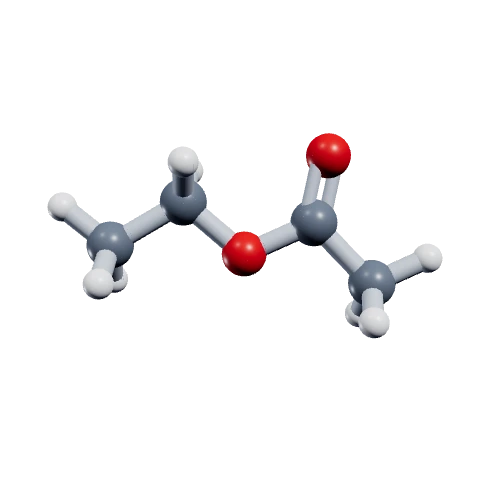
Ethyl acetate is the ester formed when ethanol reacts with acetic acid, giving the simple formula CH₃COOC₂H₅ (C₄H₈O₂). It is a clear, colorless liquid with the sweet, fruity smell most people recognize from nail-polish remover and ripe fruit — the same molecule that plants use to signal ripeness.
Its “green” reputation is not marketing; it is earned on three independent measures that solvent chemists actually use:
Low inherent toxicity. Ethyl acetate is classified as an ICH Q3C Class 3 residual solvent — the lowest-concern tier, with a permitted daily exposure of 50 mg/day. That is the same regulatory tier as ethanol and acetone, and a world away from NMP and DMF.
Bio-derivable feedstock. Both of its building blocks — ethanol and acetic acid — can be sourced from fermentation rather than petroleum. Bio-based ethyl acetate is commercially produced, which lets formulators lower the embodied-carbon footprint of a product without reformulating around a new molecule.
High recoverability. With a boiling point of just 77 °C, ethyl acetate distills off cleanly and cheaply, so closed-loop solvent recovery is practical. A solvent you can recapture and reuse is greener in practice, not just on paper.
Solvent-selection guides agree. On the CHEM21 solvent guide and the GSK/Pfizer/Sanofi industry guides, ethyl acetate is consistently ranked “recommended” (green), while NMP, DMF, and dichloromethane are flagged “hazardous” or “to be substituted.”
What is NMP, and why is the world racing to replace it?
NMP is being phased out of many uses because it is a proven reproductive toxicant, and regulators on both sides of the Atlantic have moved to restrict it.
N-methyl-2-pyrrolidone is a superb aprotic solvent — it dissolves things almost nothing else will, which is exactly why it became the default in lithium-ion electrode slurries, coil coatings, paint strippers, and polymer processing. But it is classified reprotoxic Category 1B (presumed to damage fertility and the unborn child), and that classification triggered regulatory action:
- EU REACH (Annex XVII, entry 71): since 2020, NMP use is restricted with a binding occupational exposure limit so low that many operations cannot realistically comply without engineering controls or substitution.
- US EPA (TSCA): EPA completed its risk evaluation for NMP and finalized risk-management rules restricting numerous consumer and commercial uses.
- DMF and dichloromethane are in the same boat: DMF is also reprotoxic 1B, and EPA moved to ban most uses of dichloromethane (methylene chloride) in 2024 after documented fatalities.
The result is a quiet, expensive scramble across coatings, electronics, and pharma to find solvents that deliver acceptable performance without the regulatory and human cost. Ethyl acetate is one of the first chemicals on that shortlist.
Can ethyl acetate actually replace NMP? An honest solvent-swap map

Yes for many uses, but no, it is not a universal one-for-one drop-in — and any supplier who tells you otherwise is selling, not engineering.
NMP and ethyl acetate occupy different regions of solvent space. NMP is a strongly polar, high-boiling, water-miscible aprotic solvent; ethyl acetate is a moderately polar, low-boiling, only-slightly-water-soluble ester. Where an application depends on NMP’s extreme dissolving power for stubborn polymers, ethyl acetate alone will not match it. Where the application needs a fast, clean, moderately polar solvent, ethyl acetate often wins outright. Here is the practical breakdown:
| Application | Can ethyl acetate replace NMP/DMF/DCM? |
|---|---|
| Coatings, inks & adhesive formulation | Yes, commonly. Ethyl acetate is a workhorse coating solvent; it is frequently blended to replace DCM and reduce NMP. |
| Pharmaceutical extraction & crystallization | Yes. A preferred Class 3 solvent for liquid-liquid extraction, recrystallization, and API isolation. |
| Chromatography (TLC / flash / prep) | Yes. Ethyl acetate / heptane systems are the green replacement for DCM-based mobile phases. |
| Electronics & precision cleaning | Often. Fast, low-residue, leaves no water spotting; good for many degreasing and flux-adjacent steps. |
| Lithium-ion cathode PVDF binder slurry | No — not a direct swap. That role needs NMP’s polymer solvency; industry is moving to water-based (aqueous) processing and specialty solvents, not ethyl acetate. |
| Heavy-duty polymer paint stripping | Partly. Ethyl acetate is part of modern non-DCM stripper blends, but rarely the sole active. |
The engineer’s rule: match the solvent to the job using Hansen solubility parameters and the relevant regulatory class, not by brand loyalty. Tell us the application and we will help you confirm whether ethyl acetate — alone or in a blend — is the right substitution before you buy a drum.
Where ethyl acetate fits in battery and electronics manufacturing

In the electronics and battery supply chain, ethyl acetate earns its place as a fast, low-residue cleaning and formulation solvent rather than as a cathode-slurry replacement.
The headline “NMP in batteries” story is about the cathode binder, where NMP dissolves PVDF — and as the table above notes, that specific step is migrating to water-based chemistry, not to ethyl acetate. But a battery gigafactory and an electronics line use solvents at dozens of other points, and ethyl acetate is a strong fit for many of them:
- Equipment and tooling cleaning between production runs, where fast evaporation and low residue matter.
- Adhesive and tape formulation for cell assembly and module bonding.
- Conformal-coating and electronics-prep blends where a low-toxicity, moderately polar solvent replaces DCM or NMP.
- Lab and QC work — extraction and chromatography in materials testing.
The honest framing is the valuable one: ethyl acetate does not make a battery, and it does not replace NMP in the one step everyone writes about — but it quietly displaces more hazardous solvents across the rest of the plant, which is where most of the exposure and compliance risk actually lives.
Ethyl acetate in pharmaceutical and fine-chemical production
In pharmaceutical manufacturing, ethyl acetate is one of the most-used solvents precisely because regulators treat it as low-concern.
Its ICH Q3C Class 3 status means that residual ethyl acetate in a drug substance is regulated with a generous limit (PDE 50 mg/day) and does not require the tight justification that Class 2 solvents like NMP, methanol, or acetonitrile demand. That single fact removes friction at every stage of process development. Common roles include:
- Liquid-liquid extraction of active pharmaceutical ingredients from aqueous reaction mixtures.
- Recrystallization and antisolvent crystallization to control purity and crystal form.
- Chromatographic purification, where ethyl acetate / heptane gradients replace dichloromethane.
- Coating and granulation steps in solid-dose manufacturing.
- Decaffeination and natural-product extraction in food and nutraceutical lines, where its low toxicity is essential.
Why grade matters here: for GMP, analytical, and reagent work, the consistency and documented impurity profile of ACS Reagent Grade ethyl acetate is usually required. For production cleaning and industrial formulation, Technical Grade is the cost-effective choice. The next section makes the call easy.
Technical Grade vs ACS Reagent Grade ethyl acetate: which do you need?
Choose by the tolerance your process has for trace impurities — not by paying for purity you will never use, and not by under-spec’ing a step where purity matters.
Alliance Chemical stocks both grades, identical in core chemistry (CAS 141-78-6, C₄H₈O₂, boiling point 77 °C) but different in certified purity and documentation:
| Factor | Ethyl Acetate (Technical) | Ethyl Acetate ACS |
|---|---|---|
| Certified purity / impurity control | High-purity industrial; COA free on request | Meets ACS reagent specifications; tightest control |
| Best for | Coatings, adhesives, cleaning, degreasing, industrial formulation | Lab, analytical, chromatography, pharma/GMP, reagent use |
| Cost per unit | Lower | Higher (pays for certification) |
| Pack sizes | 1 qt → 55 gal drum & pallets | 1 qt → 55 gal drum & pallets |
Rule of thumb: if a method, pharmacopeia, or analytical instrument is involved, buy ACS. If you are cleaning, coating, or blending at scale, Technical Grade does the job for less. Unsure? Send us the application and we will spec it.
How do you handle ethyl acetate safely?
Ethyl acetate’s main hazard is flammability, not chronic toxicity — the opposite of the NMP-class solvents it replaces.
With a flash point of −4 °C, ethyl acetate is an OSHA Class IB flammable liquid: its vapors ignite well below room temperature. The good news is that the controls are well understood and the toxicity ceiling is high.
- Eliminate ignition sources and use explosion-proof electrical equipment in handling areas.
- Ground and bond containers when transferring — the flowing liquid can build static charge.
- Ventilate. The OSHA PEL and NIOSH REL are both 400 ppm; the NIOSH IDLH is 2000 ppm. Good general ventilation usually keeps exposure far below these.
- Store in a cool, well-ventilated flammable-liquids cabinet, away from oxidizers and strong acids/bases.
- PPE: chemical splash goggles and butyl rubber or laminated film gloves (disposable nitrile is splash protection only against ethyl acetate, so change it as soon as it is wetted); avoid prolonged skin contact, which is drying.
Always work from the current SDS. Find the SDS in our document library, or ask us for it. Need the certificate of analysis? Just ask — we send it at no charge. Confirm local fire-code quantities for your facility before scaling up storage.
Key numbers & sources for ethyl acetate
The verified data below summarizes the regulatory and physical facts cited throughout this guide, with links to primary sources.
| Property / fact | Value | Source |
|---|---|---|
| CAS number | 141-78-6 | PubChem CID 8857 |
| Molecular formula / weight | C₄H₈O₂ / 88.11 g/mol | PubChem |
| Boiling point | 77 °C (170.6 °F) | PubChem |
| Flash point | −4 °C (24.8 °F) — Class IB flammable | NIOSH Pocket Guide |
| OSHA PEL / NIOSH REL | 400 ppm (1400 mg/m³) | NIOSH |
| NIOSH IDLH | 2000 ppm | NIOSH |
| ICH residual-solvent class | Class 3 (low toxic potential), PDE 50 mg/day | ICH Q3C(R8) |
| Green-solvent ranking | Recommended (green) | CHEM21 guide |
| NMP regulatory status | Reprotoxic 1B; REACH Annex XVII entry 71; EPA TSCA risk management | US EPA |
How does ethyl acetate compare to other green solvents?
Ethyl acetate is rarely the only green solvent on the table — it competes with acetone, isopropyl alcohol, and newer bio-solvents, and the right choice depends on polarity, boiling point, and water miscibility.
The reason a single “greenest solvent” does not exist is that solvents are selected by fit, not by virtue. The comparison below covers the low-toxicity solvents most often considered when moving off NMP, DMF, or dichloromethane:
| Solvent | Polarity / character | Boiling point | Best when you need… |
|---|---|---|---|
| Ethyl acetate | Moderately polar ester, low water solubility | 77 °C | Fast evaporation, extraction, coatings, chromatography; a true green workhorse |
| Acetone | Polar aprotic, fully water-miscible | 56 °C | Very fast flash-off, universal cleaning, miscibility with water |
| Isopropyl alcohol (IPA) | Polar protic alcohol | 82 °C | Electronics cleaning, low-residue wiping, disinfection-adjacent uses |
| 2-MeTHF / Cyrene (bio-solvents) | Polar aprotic, NMP-like | 80 / 227 °C | The closest aprotic match to NMP's dissolving power, at higher cost |
The practical takeaway: ethyl acetate is the default green choice for moderate-polarity work with fast recovery, acetone when full water miscibility helps, IPA for protic cleaning, and a specialty bio-solvent like Cyrene or 2-MeTHF only when you genuinely need to mimic NMP's aprotic strength. Many real substitutions end up as a blend.
Common mistakes when switching from NMP to a greener solvent
Most failed solvent substitutions fail for predictable reasons — and almost all of them are avoidable with a small upfront trial.
1. Treating the swap as a like-for-like volume replacement
NMP and ethyl acetate have different densities, evaporation rates, and solvency. A formulation tuned for NMP usually needs its ratios re-balanced, not just the solvent name changed. Reformulate, then validate.
2. Ignoring flammability when leaving a high-flash solvent
NMP has a high flash point (about 86 °C); ethyl acetate's is −4 °C. Moving to a greener solvent can move you up a fire-code class, so storage, electrical classification, and bonding/grounding all need a fresh review.
3. Buying the wrong grade for the job
Using ACS Reagent Grade for bulk cleaning wastes money; using Technical Grade in an analytical method risks failed results. Spec the grade to the step, every time.
4. Skipping the small-scale trial
The cheapest insurance in any substitution is a single validated batch before committing to drum or pallet volume. It catches residue, compatibility, and performance surprises while they are still cheap to fix.
Buying ethyl acetate from Alliance Chemical
Alliance Chemical supplies both grades of ethyl acetate, with bulk pricing from quarts to drums and pallets. Need the certificate of analysis? Just ask — we send it at no charge.
Whether you are substituting away from NMP, formulating a greener coating, or running analytical extractions, we will help you match the grade and pack size to the job — so you do not overpay for purity you do not need, or under-spec a step that matters. Fast quotes, recurring-supply scheduling, and grade-matching guidance come standard.
Order ethyl acetate — COA free on request
Pick the grade your process needs. Not sure? Tell us the application and we will spec it for you.
Related: Tert-Butyl Acetate (TBAc): The VOC-Exempt Solvent Guide — another lower-impact solvent switch.
Frequently asked questions
Is ethyl acetate a green solvent?
Yes. Ethyl acetate is rated a recommended (green) solvent on the CHEM21 and GSK industry solvent-selection guides, is an ICH Q3C Class 3 low-toxicity solvent, can be made from bio-derivable ethanol and acetic acid, and is easily recovered for reuse thanks to its low 77 °C boiling point.
Can ethyl acetate replace NMP?
For many uses, yes — ethyl acetate replaces NMP, DMF, and dichloromethane in coatings, adhesives, pharmaceutical extraction, chromatography, and cleaning. But it is not a universal one-for-one drop-in: it cannot match NMP's polymer solvency in the lithium-ion cathode PVDF binder slurry, which is moving to water-based processing instead. Match the solvent to the application using solubility parameters.
Why are manufacturers replacing NMP?
NMP is classified reprotoxic Category 1B (presumed to harm fertility and the unborn child). The EU restricts it under REACH Annex XVII entry 71 with a strict exposure limit, and the US EPA has finalized TSCA risk-management rules restricting many uses. DMF and dichloromethane face similar restrictions, driving demand for safer alternatives like ethyl acetate.
What is the difference between Technical Grade and ACS Reagent Grade ethyl acetate?
Both are chemically identical (CAS 141-78-6). Technical Grade is high-purity industrial material for coatings, adhesives, cleaning, and formulation. ACS Reagent Grade meets American Chemical Society specifications with the tightest impurity control and documentation, required for analytical, chromatography, pharmaceutical, and reagent work.
Is ethyl acetate flammable?
Yes, highly. Ethyl acetate has a flash point of −4 °C, making it an OSHA Class IB flammable liquid whose vapors ignite below room temperature. Eliminate ignition sources, use explosion-proof equipment, ground and bond containers during transfer, and store in a flammable-liquids cabinet away from oxidizers.
What is the CAS number and formula of ethyl acetate?
Ethyl acetate has CAS number 141-78-6 and molecular formula C4H8O2 (CH3COOC2H5), with a molecular weight of 88.11 g/mol and a boiling point of 77 °C.
Is ethyl acetate safe for pharmaceutical use?
Ethyl acetate is an ICH Q3C Class 3 residual solvent — the lowest-concern category — with a permitted daily exposure of 50 mg/day. It is widely used in pharmaceutical extraction, recrystallization, and chromatography. Use ACS Reagent Grade for GMP and analytical work.
Where can I buy ethyl acetate in bulk?
Alliance Chemical supplies both Technical Grade and ACS Reagent Grade ethyl acetate from 1-quart bottles to 55-gallon drums and pallet quantities, with grade-matching guidance for your application. Need the certificate of analysis? Just ask — we send it at no charge.
Sources
- CHEM21 solvent guide · Royal Society of Chemistry
- PubChem Compound Summary: Ethyl Acetate (CID 8857) · PubChem (NIH National Library of Medicine)
- NIOSH Pocket Guide · CDC
- US EPA · U.S. EPA
Related Chemical Collections
About the author
Andre Taki
This article is for informational purposes only.


