

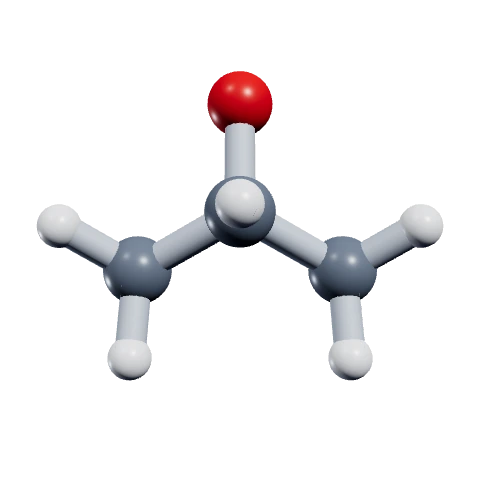


Almost every industrial chemical you can name was discovered in a laboratory and then scaled up. Isopropyl alcohol went the other way. It was scaled up first — out of a gas an oil refinery had no use for — and that decision, made in 1920, created an entire industry.

How is isopropyl alcohol made?
Isopropyl alcohol is made by adding water across the double bond of propylene — a reaction chemists call hydration. Propylene (C3H6) comes from cracking petroleum. There are two industrial routes, and both end at the same molecule.
The original route, and still a major one, is the indirect or strong-acid process. It runs in two stages:
- Absorption. Propylene gas is bubbled into concentrated sulfuric acid. The acid does not simply dissolve the gas — it chemically captures it, forming isopropyl hydrogen sulfate (and some di-isopropyl sulfate).
- Hydrolysis. Water is added. The sulfate ester breaks apart, releasing isopropyl alcohol and regenerating the sulfuric acid, which is reconcentrated and used again.
The crude alcohol is then distilled. Because isopropyl alcohol and water form an azeotrope at roughly 87.7% alcohol by weight, ordinary distillation cannot push it past that point — which is precisely why the concentration ladder on a supplier’s shelf has a step at 91% and another at 99%. Getting above the azeotrope requires azeotropic or extractive distillation, or a drying step, and that extra work is a real part of what you are paying for in a high-purity grade.
The short version: propylene + sulfuric acid → isopropyl hydrogen sulfate; then + water → isopropyl alcohol + sulfuric acid. The acid is a reusable carrier, not an ingredient consumed by the reaction.

What is isopropyl alcohol made from?
Isopropyl alcohol is made from propylene, and propylene is made from petroleum. That is the entire supply chain in one sentence, and it surprises people who assume rubbing alcohol is fermented like drinking alcohol.
It is not. Ethanol (drinking alcohol) is typically fermented from sugars by yeast. Isopropyl alcohol is a different molecule with a different carbon skeleton, and the economical way to make it is from a refinery stream. When crude oil is cracked to produce gasoline and diesel, the process also throws off a mixture of light hydrocarbon gases — ethylene, propylene, butenes. Propylene is the three-carbon one, and it is the feedstock.
Two practical consequences follow from that:
- IPA pricing tracks petrochemical feedstock, not agriculture. Propylene supply moves with refinery run rates and cracker economics.
- The feedstock being a byproduct says nothing about the finished product’s purity. What determines purity is the distillation and the specification it is tested against — which is what grade means. A 99.9% ACS Reagent Grade material and a 70% USP Grade material start from the same propylene.
Why was isopropyl alcohol the first petrochemical?
Because nobody had previously sold a chemical made from oil. Petroleum was refined into fuels, lubricants and waxes — products, not feedstocks. The light gases that came off cracking were burned or vented as a nuisance.
In 1920, Standard Oil of New Jersey began producing isopropyl alcohol from that propylene at its Bayway refinery in Linden, New Jersey. The American Fuel & Petrochemical Manufacturers dates the industry from exactly this point: “1920: Isopropyl alcohol produced at Standard Oil’s Bayway, New Jersey, plant is the first commercial petrochemical.”
The significance is not the alcohol. It is the precedent. Bayway demonstrated that a refinery’s waste stream could be the starting point for deliberately manufactured chemicals. Every petrochemical that followed — the plastics, the solvents, the synthetic fibres, the detergents — rests on that idea. A large share of the alcohol made at Bayway was promptly oxidised onward into acetone, which tells you how quickly the logic of building a chemical tree on petroleum took hold.
Worth being precise about: isopropyl alcohol was not discovered in 1920. Marcellin Berthelot had reported making it from propylene and sulfuric acid back in 1855. What happened in 1920 was commercial manufacture at scale — the difference between a laboratory curiosity and an industry.

What happened after 1920?
The immediate sequel was acetone. A large share of the isopropyl alcohol made at Bayway was oxidised straight onward into acetone — so the first petrochemical almost immediately produced the second. That is the pattern that defines the industry: each product becomes the feedstock for the next, and the tree grows outward from the refinery rather than from a laboratory.
Within two decades the same logic had produced synthetic rubber, the first commodity plastics, synthetic detergents and the solvent families that industry still runs on. The other light gases coming off the cracker found their own destinations: ethylene became polyethylene and ethylene glycol, the butenes became synthetic rubber feedstock. What had been a disposal problem in 1919 was, within a generation, the most valuable part of the barrel for anyone building chemicals rather than burning fuel.
It is a genuinely strange piece of history that the molecule which started all of it is not an exotic material at all. It is the least remarkable bottle in the building — and it is still, a century later, one of the highest-volume solvents we ship.
Who worked out the process?
The absorption method is credited to Carleton Ellis (1876–1941), an American industrial chemist working out of his own laboratory in Montclair, New Jersey. In 1916 he developed a way to make isopropyl alcohol from cracked refinery gases by absorbing the olefins in sulfuric acid — the method Standard Oil went on to operate at Bayway.
Ellis is one of the most prolific inventors in American history, holding 753 patents. His work runs through an implausible range of twentieth-century materials: margarine, polyester resins, anti-knock gasoline, paint and varnish removers. He is far less famous than the industries he seeded.

Indirect vs. direct hydration: the two routes used today
Modern isopropyl alcohol is made by one of two processes. Which one a plant uses mostly comes down to the purity of the propylene it can get.
| Indirect hydration (strong-acid) | Direct hydration | |
|---|---|---|
| How it works | Propylene absorbed into sulfuric acid to form a sulfate ester, then hydrolysed with water | Propylene and water reacted together over a solid or supported acid catalyst |
| Propylene purity needed | Tolerates lower-purity, dilute refinery streams | Requires high-purity propylene |
| Main drawback | Handling, reconcentrating and corrosion-managing large volumes of sulfuric acid | Lower conversion per pass, so more recycling |
| Historical role | The original 1920 Bayway route | Later development, now widely used |
A third route exists: isopropyl alcohol can be produced by hydrogenating acetone. That is often the preferred option where a producer has surplus acetone to place, which happens because acetone is itself a co-product of phenol manufacture.
Is rubbing alcohol made the same way?
The alcohol in it, yes. The product, not quite — and this is where most confusion lives.
“Rubbing alcohol” is a formulated consumer product, not a synonym for the chemical. It is typically isopropyl alcohol diluted with purified water to a stated strength such as 70% or 91%. Some formulations add denaturants or other excipients. The isopropyl alcohol going into it is manufactured exactly as described above; the retail bottle is that alcohol, diluted and packaged to a monograph.
So when you dilute 99% isopropyl alcohol with water, you are performing the last step of rubbing alcohol manufacture yourself. We cover the naming and the practical differences in detail in Rubbing Alcohol vs. Isopropyl Alcohol, and the concentration question in 70% vs. 91% vs. 99% Isopropyl Alcohol.
What grades of isopropyl alcohol are there, and which do you need?
Grade is the part of this that actually costs or saves you money, and it is not a measure of how the alcohol was made. Every grade below starts from the same propylene. What differs is the specification the finished material is tested and certified against.
| Grade | What it means | Typical use |
|---|---|---|
| Technical Grade | Meets an industrial purity specification without pharmacopoeial certification | Parts cleaning, degreasing, general shop and production use |
| USP Grade | Tested against the United States Pharmacopeia monograph | Applications where a pharmacopoeial specification is required by the buyer or the process |
| ACS Reagent Grade | Meets American Chemical Society reagent specifications — the tightest limits on individual impurities | Analytical chemistry and laboratory work where trace impurities matter |
The practical advice is unglamorous: buy the loosest grade that your application actually requires. ACS Reagent Grade costs multiples of Technical Grade, and it buys you tighter impurity limits — which is worth every cent in an analytical method and worth nothing at all if you are wiping down tooling. Paying for purity you cannot use is the most common avoidable cost in solvent procurement. Under-specifying a step that genuinely needs the tighter material is the more expensive mistake in the other direction.
| Product | Grade (as supplied) | From |
|---|---|---|
| Isopropyl Alcohol 50% | Technical Grade | $22 |
| Isopropyl Alcohol 50% | USP Grade | $25 |
| Isopropyl Alcohol 60% | Technical Grade | $23 |
| Isopropyl Alcohol 60% | USP Grade | $25 |
| Isopropyl Alcohol 70% | USP Grade | $24 |
| Isopropyl Alcohol 91% | USP Grade | $26 |
| Isopropyl Alcohol 99% | Technical Grade | $28 |
| Isopropyl Alcohol 99.9% | ACS Reagent Grade | $55 |
Not sure which grade your process needs?
Tell us the application and we will spec the grade — so you are not paying for purity you will never use, or under-spec’ing a step that matters. A Certificate of Analysis is available for every drum and tote, and we supply from 1 quart up to 330 gallon IBC totes with recurring supply for production accounts.
Four things buyers get wrong about how IPA is made
1. Assuming it is fermented
It is not. Isopropyl alcohol is synthesised from propylene. Only ethanol is routinely fermented, and it is a different molecule.
2. Reading “byproduct feedstock” as “low quality”
The propylene starts as a refinery byproduct. The finished alcohol is distilled and certified against a specification. ACS Reagent Grade material is among the purest solvents you can buy and it comes from exactly the same feedstock as Technical Grade.
3. Expecting to distil past 87.7% at home
The isopropyl alcohol–water azeotrope makes that impossible by simple distillation. If you need anhydrous material, buy 99% or 99.9% — the industrial process to break the azeotrope is not reproducible on a bench.
4. Treating percentage and grade as the same axis
They are independent. 99% is available as Technical Grade; 70% is available as USP Grade. Concentration tells you how much water is present. Grade tells you which specification the material was tested against. You have to choose both.
What makes isopropyl alcohol useful as a solvent?
The manufacturing route explains the supply. The molecule explains the demand. Isopropyl alcohol has an unusual combination of properties that very few other solvents match at anything like the price.
| Property | Value | Why it matters in practice |
|---|---|---|
| Miscibility with water | Completely miscible | It can be cut to any strength with water, which is why a concentration ladder exists at all |
| Boiling point | 82.6 °C (180.7 °F) | Evaporates quickly and completely at room temperature, leaving little behind |
| Density | ~0.785 g/cm3 at 20 °C | Lighter than water — relevant when you are buying by volume but costing by weight |
| Polarity | Polar, with a hydrocarbon tail | Dissolves both water-loving and oil-loving soils, which is the whole trick |
That last row is the important one. The hydroxyl group makes isopropyl alcohol behave like water; the three-carbon skeleton makes it behave like a hydrocarbon. It sits in between, which is why one drum of it displaces several more specialised solvents in a typical shop — and why the low-residue grades are the standard choice for wiping down surfaces that have to be genuinely clean afterwards.
How should isopropyl alcohol be handled and stored?
Isopropyl alcohol is a flammable liquid, and this is the property people most often underestimate because the material feels so ordinary.
Flash point: about 11.7 °C (53 °F), closed cup. That is below normal room temperature. An open container of isopropyl alcohol is giving off ignitable vapour on an ordinary day, not only when warmed.
Practical handling points that follow from the physical data:
- Vapour is heavier than air (vapour density ~2.1 relative to air). It travels along floors and collects in low spots, pits and drains, so an ignition source well away from the container can still reach it.
- Bond and ground when transferring in bulk. Pouring generates static, and the vapour is in the flammable range at ambient temperature.
- Store cool, closed and away from oxidisers. Keep containers sealed — the material is hygroscopic, and an open drum of 99% will slowly pull water out of the air and drift off specification.
- Higher concentration means lower flash point. A 99% material is a more serious fire risk than a 50% material. Choosing a lower concentration where it will do the job is a safety decision as well as a cost one.
Always work from the Safety Data Sheet for the specific product and concentration you have bought, not from a general figure for “isopropyl alcohol”. Find the SDS in our document library, or ask us for it.
What should you check on a Certificate of Analysis?
The Certificate of Analysis is the document that connects everything above to the drum actually standing in front of you. It is the evidence that the material was tested against the specification its grade claims. Four things are worth reading every time:
- Assay. The measured concentration, which should meet or exceed the labelled figure. A 99% material typically certifies at 99.0% minimum, not exactly 99.00%.
- Water content. Usually by Karl Fischer titration. For anything going near electronics, coatings or an anhydrous reaction, this is often the number that actually matters — more than the assay.
- Non-volatile residue. What is left after the solvent evaporates. If you are cleaning a surface that must be spotless, this is the figure that predicts whether you will see a film.
- Lot number and test date. The CoA has to correspond to the lot you received. A generic specification sheet is not a Certificate of Analysis, and the two are often confused.
An ACS Reagent Grade CoA will list limits on individual trace impurities that a Technical Grade CoA simply does not test for. That difference — the testing, not the alcohol — is most of the price gap between the two.
What sizes does isopropyl alcohol ship in?
Isopropyl alcohol is a regulated flammable liquid, so packaging is not purely a convenience decision — it determines how the material can be shipped and stored.
- Quarts and gallons — bench and maintenance quantities, including quart spray bottles on the 99% Technical Grade.
- 5 gallon pails — the usual step up for a shop consuming steadily.
- 15 and 55 gallon drums — production quantities, and the point at which cost per gallon improves substantially.
- 275 and 330 gallon IBC totes — continuous or high-volume use, typically on a recurring supply schedule.
All eight isopropyl alcohol products in the table above are stocked across that full range, from 1 quart to 330 gallon totes. Orders ship from our facility in Taylor, Texas, typically within 1–2 business days.
Key numbers and sources
| Fact | Value | Source |
|---|---|---|
| CAS number | 67-63-0 | PubChem CID 3776 |
| Formula / molar mass | C3H8O / 60.10 g·mol−1 | PubChem |
| Azeotrope with water | ~87.7% IPA by weight, boiling ~80.4 °C | Standard physical chemistry data |
| First commercial production | 1920, Standard Oil of New Jersey, Bayway refinery | AFPM |
| Status | First commercial petrochemical | AFPM; ICIS timeline |
| Carleton Ellis | 1876–1941, 753 patents | Wikipedia |
| Strong-acid process description | Absorption in H2SO4, then hydrolysis | IARC monograph, NCBI Bookshelf |
Related reading
- Rubbing Alcohol vs. Isopropyl Alcohol — why the two names are not interchangeable.
- 70% vs. 91% vs. 99% Isopropyl Alcohol — choosing a concentration.
- Isopropyl Alcohol for Electronics Cleaning — why residue and water content matter.
References & Authoritative Sources
Primary sources consulted for this article. Regulatory and physical-property figures above are drawn from these references.
- Isopropanol — thermophysical data — NIST Chemistry WebBook, SRD 69, National Institute of Standards and Technology. Accessed 2026-09-04.
Related: What Is Denatured Alcohol? Why the Government Poisons Perfectly Good Ethanol on Purpose — isopropyl alcohol is the denaturant in SDA Formula 3-C; this is the tax law that put it there.
Frequently asked questions
How is isopropyl alcohol made?
Isopropyl alcohol is made by hydrating propylene, a byproduct gas of petroleum cracking. In the indirect or strong-acid process, propylene is absorbed into concentrated sulfuric acid to form isopropyl hydrogen sulfate, which is then hydrolysed with water to release isopropyl alcohol and regenerate the acid. The crude alcohol is then distilled. Modern plants also use direct hydration, reacting propylene and water over a solid acid catalyst.
What is isopropyl alcohol made from?
It is made from propylene (C3H6), which comes from cracking petroleum. It is not fermented. Ethanol is the alcohol typically made by fermentation; isopropyl alcohol is a different molecule synthesised from a refinery gas stream.
Why is isopropyl alcohol called the first petrochemical?
Because it was the first chemical manufactured commercially from petroleum rather than simply refined out of it. Standard Oil of New Jersey began producing it from propylene at its Bayway refinery in Linden, New Jersey in 1920, and the American Fuel & Petrochemical Manufacturers dates the petrochemical industry from that event.
Who invented the process for making isopropyl alcohol?
The sulfuric acid absorption method is credited to Carleton Ellis (1876-1941), an American industrial chemist from Montclair, New Jersey, who developed it in 1916. Standard Oil operated it at commercial scale from 1920. Ellis held 753 patents, including work on margarine, polyester, anti-knock gasoline and paint remover.
Is rubbing alcohol made the same way as isopropyl alcohol?
The alcohol itself is made the same way. Rubbing alcohol is a formulated consumer product: isopropyl alcohol diluted with purified water to a stated strength such as 70% or 91%, sometimes with additional excipients. Diluting 99% isopropyl alcohol with water performs the final step yourself.
Why can't isopropyl alcohol be distilled above about 88%?
Isopropyl alcohol and water form an azeotrope at roughly 87.7% alcohol by weight, boiling near 80.4 degrees C. At that composition the vapour has the same ratio as the liquid, so ordinary distillation cannot concentrate it further. Producing 99% or anhydrous material requires azeotropic or extractive distillation or a separate drying step.
What is the difference between Technical Grade, USP Grade and ACS Reagent Grade isopropyl alcohol?
Grade describes the specification the finished material is tested against, not how it was manufactured. Technical Grade meets an industrial purity specification. USP Grade is tested against the United States Pharmacopeia monograph. ACS Reagent Grade meets American Chemical Society reagent specifications, with the tightest limits on individual impurities. All three start from the same propylene feedstock.
Does a byproduct feedstock mean isopropyl alcohol is low purity?
No. The propylene feedstock is a byproduct of petroleum cracking, but the finished alcohol is distilled and certified against a specification. ACS Reagent Grade isopropyl alcohol is among the purest solvents available commercially and is made from the same feedstock as Technical Grade material.
Related Chemical Collections
About the author
Andre Taki
This article is for informational purposes only.


