



Residue and water content come from the manufacturing route and the grade specification, not the bottle. Here is how IPA is actually made and what each grade certifies. How Isopropyl Alcohol Is Made →
Written by Andre Taki, Chief Commercial Officer at Alliance Chemical — an industrial & laboratory chemical supplier serving 55,000+ customers since 1998 (DLA Supplier · DoD Bronze Medal · BBB A+ · CAGE 1LT50). Need the Certificate of Analysis? Just ask — we send it at no charge. Last reviewed June 2026.
There is a four-dollar bottle in millions of homes, repair shops, and cleanrooms that quietly does the same job at both ends of the technology world. It wipes the thermal paste off a gaming CPU, lifts solder flux off a freshly repaired phone board, and — purified to a level most people never see — gives every silicon chip its final bath before it becomes the brain of a device. That bottle is isopropyl alcohol. This guide walks the whole electronics chain: which concentration to actually use, how to clean flux and thermal paste correctly, and what changes as you climb from the repair bench to a semiconductor fab.
Why do electronics techs reach for isopropyl alcohol?
Isopropyl alcohol is the go-to electronics solvent because it dissolves the contaminants that matter, dries quickly, and leaves nothing conductive behind. Most other household liquids fail at least one of those tests — water conducts and corrodes, oils smear, and harsh solvents attack plastics and conformal coatings.
Specifically, pure IPA:
- Dissolves rosin solder flux, light oils, skin oils, and adhesive residue — the exact gunk that builds up on boards and connectors.
- Evaporates fast and clean (boiling point 82.6 °C), so you are not left waiting or wiping.
- Leaves no conductive residue when it is pure — critical, because a residue that bridges two traces can cause leakage current or shorts.
- Is gentle on most electronics plastics and PCBs (always spot-test painted, rubberized, or coated surfaces first).
- Is cheap and widely available in the concentrations that actually work.
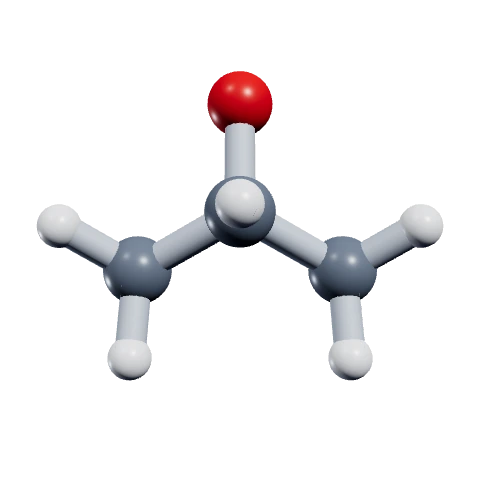
CAS Number: 67-63-0 | Formula: (CH₃)₂CHOH (C₃H₈O) | Boiling point: 82.6 °C | Flash point: ~12 °C (highly flammable). Same CAS regardless of concentration or grade.
Why not just use water, acetone, or a contact cleaner?
Because each of the obvious alternatives fails the electronics test in a different way. Water conducts, corrodes, and dries slowly. Acetone cleans aggressively but melts many plastics, dissolves silk-screen legends and some component markings, and attacks certain conformal coatings — it is the wrong default for a populated board. Aerosol “contact cleaners” vary wildly: some are IPA-based, others leave a lubricating film or use solvents that are hard on plastics. Pure isopropyl alcohol hits the sweet spot — strong enough to dissolve flux and oils, mild enough to leave most plastics and coatings alone, and clean enough to flash off with no residue. That is why it became the industry default rather than a niche product.
That combination is why one solvent quietly handles a huge range of electronics jobs. The same bottle that lifts flux also degreases connector pins and edge-card fingers, clears the residue a leaking electrolytic capacitor sprays across a board, wipes optical drive lenses and camera modules, preps surfaces for adhesive or conformal coating, and cleans the read/write heads and contacts that grime quietly degrades. It is the closest thing the electronics world has to a universal cleaner — which is exactly why it pays to understand the few places it does not belong (covered below).
What percentage of isopropyl alcohol is best for cleaning electronics?
For cleaning electronics, the highest practical concentration wins: 99% (or 99.9%) is best, 91% is acceptable for general cleaning, and 70% should be avoided. The single variable that decides this is water content — and with electronics, water is the enemy.
Every percentage point that is not alcohol is mostly water. That water (a) dries far more slowly, (b) can leave mineral spots or promote oxidation and corrosion on exposed metal, and (c) conducts electricity while it is still present. The lower the percentage, the more water you are painting onto your board.
| Concentration | ~Water | Best for | On electronics? |
|---|---|---|---|
| 70% USP | ~30% | Surface disinfection, first aid | No — too much water, slow dry, corrosion risk |
| 91% USP | ~9% | General cleaning, household electronics | OK — usable, but dries slower than 99% |
| 99% Technical | <1% | PCBs, flux, thermal paste, connectors | Best for most repair / shop work |
| 99.9% ACS Reagent | <0.1% | Precision optics, sensors, R&D, lab | Best for sensitive / residue-critical work |
If you only keep one bottle on the bench for electronics, make it 99%. If you already have 91%, it is fine for wiping down a keyboard or a case — just give it longer to dry and keep it off anything water-sensitive.
Is 70% isopropyl alcohol safe for electronics?

No — 70% isopropyl alcohol is not the right choice for electronics, even though it is the most common bottle on the shelf. The roughly 30% water it contains is exactly what you do not want near a circuit board.
70% IPA exists because that water actually helps it disinfect — it slows evaporation enough to keep surfaces wet for the contact time germs need, and it helps rupture cell walls. That is great for a countertop and useless for a motherboard. On electronics the same water means:
- Slow drying — minutes instead of seconds, leaving moisture in connectors and under components.
- Water spotting and mineral residue if the water is not deionized.
- Corrosion and oxidation risk on exposed copper, contacts, and battery terminals.
- Conductivity while wet — never apply to a powered device.
The rule: 70% to disinfect, 91%+ to clean, 99% to clean electronics. If a job involves traces, contacts, or anything that carries current, reach for 99%. Keep your 70% USP for surfaces and skin.
How do you remove solder flux with isopropyl alcohol?
To remove solder flux, brush 99% isopropyl alcohol onto the joints, scrub gently, lift the dissolved residue with a lint-free wipe, and let it flash off — repeating until the board looks clean and matte. Rosin-based fluxes (R, RMA, and most rosin-core solder) dissolve readily in IPA, which is why it is the standard post-soldering cleaner.
A clean, repeatable method:
- Power off and disconnect the board (and remove the battery where possible).
- Flood the flux with 99% IPA using an acid/flux brush, ESD-safe brush, or a saturated foam swab.
- Agitate gently to break up the sticky rosin — work it, do not just dab.
- Wick the dissolved residue away with a lint-free wipe or cloth so you remove it, rather than spreading a thin film.
- Repeat until no amber tackiness remains, then let it dry fully before powering on.
Rosin, no-clean, and water-soluble flux — which ones need IPA?
Not all flux behaves the same. Rosin (R, RMA) flux is the classic case: it is sticky, mildly active, and dissolves cleanly in isopropyl alcohol — IPA is its natural solvent. No-clean flux is formulated to leave a residue that is safe to leave behind if it was fully heat-activated; the trouble is hand-soldering and rework often under-heat it, leaving tacky, partially-active residue that is best removed — and IPA handles it. Water-soluble (organic-acid) flux is the exception: it is aggressively corrosive and must be removed, but it is designed to wash off with water (often warm DI water), not alcohol. Know which flux you used before you reach for a solvent.
Why bother: Left-behind active flux residue can absorb moisture and drive electrochemical migration (dendrite growth) between traces — slow, hidden failures that show up weeks later as intermittent faults or leakage. Cleanliness is measured by surface insulation resistance (SIR) and ionic-contamination testing, and the expectations live in standards like IPC J-STD-001 and IPC-A-610. For anything that has to last, clean it.
Can you clean a PCB, motherboard, or circuit board with isopropyl alcohol?
Yes — 99% isopropyl alcohol is the standard way to clean a PCB, motherboard, or any circuit board, as long as the board is powered off and you let it dry completely before reconnecting power. It safely lifts dust, flux, fingerprints, and spilled-liquid residue from the board and its connectors.
Cleaning thermal paste off a CPU or GPU
99% IPA is also the right tool for re-pasting. Old thermal paste wipes off the CPU or GPU heat-spreader and the cooler’s cold plate with a little 99% on a lint-free cloth or coffee filter; let it flash off, and the surface is ready for fresh paste. 70% leaves moisture you do not want trapped under a heatsink.
Heavier cleaning
For badly contaminated boards, repair shops use IPA in an immersion or ultrasonic bath, then dry thoroughly. This is also where buying IPA by the gallon, drum, or tote instead of tiny spray bottles starts to matter — bench-scale habits become a real line item at shop volume.
From the repair bench to the fab: how far does one molecule go?

The isopropyl alcohol on a hobbyist’s bench and the isopropyl alcohol in a multi-billion-dollar semiconductor fab are the exact same molecule — what changes is purity. As you climb the electronics chain, the contaminant you care about gets smaller and smaller, until you are counting individual particles and metal ions per billion.
- Repair bench & field service: 99% Technical Grade. Removes flux, paste, and grime. “No visible residue” is clean enough.
- Precision assembly, optics, sensors, R&D: 99.9% ACS Reagent Grade. Tightly specified, low residue-on-evaporation — for when a fingerprint of contamination matters.
- Semiconductor production fabs: certified SEMI / electronic grade — a tier above ACS, filtered to sub-micron particles and sub-ppb trace metals, used for the final wafer rinse and Marangoni drying.
Why does purity scale so dramatically? Because the defect you are fighting shrinks. On a repair board, “clean” means no visible flux and no conductive bridge you can measure. On a silicon wafer with features a few nanometers wide, a single dried-on water spot or a stray sub-micron particle can kill a die worth thousands of dollars — so the final isopropyl-alcohol rinse has to be cleaner than the surface it touches. That is the whole reason fabs use Marangoni drying, where a controlled IPA vapor pulls water off the wafer edge-first so it leaves zero droplets behind. Same molecule, same job (get the surface clean and dry with no residue), but the tolerance went from “looks clean” to “measured in parts per billion.”
That last step is its own story — see our deep dive on isopropyl alcohol in semiconductor wafer cleaning & drying and the broader chemistry in solvents in PCB manufacturing.
Honest grade note: our highest-purity IPA is 99.9% ACS Reagent Grade — excellent for R&D, pilot lines, optics, MEMS, and lab work. Production fabs require certified SEMI/electronic-grade IPA, which is a separate certification tier; we do not claim SEMI purity we do not certify. Tell us the application and we will tell you honestly whether ACS is the right fit.
Technical vs ACS vs SEMI: which isopropyl alcohol grade do you actually need?
For most electronics work you need 99% Technical Grade; step up to 99.9% ACS Reagent Grade only when residue or trace contamination is genuinely critical. Grade is a promise about what else is in the bottle, not just how much alcohol.
| Grade | What it guarantees | Use it for |
|---|---|---|
| USP (70% / 91%) | Meets pharmacopeia purity; water by design | Disinfection, general surface & case cleaning |
| 99% Technical | High purity, low water; not certified to a reagent spec | Flux, thermal paste, PCBs, connectors, shop work |
| 99.9% ACS Reagent | Certified ACS limits on water, residue & trace impurities | Optics, sensors, MEMS, R&D, residue-critical cleaning |
| SEMI / Electronic | Sub-ppb metals, sub-micron particle filtration | Wafer fabs (we supply up to ACS — see note above) |
What should you never clean with isopropyl alcohol?
Isopropyl alcohol is safe on most electronics, but a few surfaces and habits will cost you a screen, a speaker, or a board. Keep IPA away from these:
- Screen oleophobic coatings. The anti-fingerprint layer on phone and tablet glass is thin and IPA can wear it away over repeated use. Clean glass with a barely-damp microfiber, not a soaked alcohol wipe — save the 99% for the board inside, not the display.
- Speaker and microphone membranes. The thin diaphragms in micro-speakers can be deformed or have their coatings attacked by solvent. Do not flood them.
- Some rubbers, silk-screen legends, and soft-touch coatings. Certain rubberized cases and printed labels can soften, smear, or whiten. Spot-test an inconspicuous corner first.
- Powered or energized boards. IPA conducts while wet. Always power down, unplug, and remove the battery before cleaning.
Two technique mistakes that ruin good cleaning: using paper towels (they shed lint that traps under components — use lint-free wipes or swabs), and not letting the board dry fully before power-on. Even fast-drying 99% needs a moment in tight connectors. When in doubt, give it a minute.
Is isopropyl alcohol safe to handle, and how should you store it?
Isopropyl alcohol is safe to use with basic precautions, but it is highly flammable and the main hazard is fire, not toxicity. Its flash point is around 12 °C (53 °F), meaning the vapor can ignite at room temperature, so handling is about controlling ignition sources and ventilation.
- Keep it away from flame, sparks, and hot soldering irons. Do not clean a board near an active iron or hot-air station; let tools cool or move the cleaning step away.
- Work in a ventilated area and avoid breathing concentrated vapor; the higher the concentration, the faster it evaporates into the air.
- Wear nitrile gloves for repeated or prolonged contact — IPA degreases skin and can cause dryness and irritation.
- Mind ESD. Use ESD-safe brushes and a grounded mat when cleaning sensitive boards.
- Store tightly closed, upright, away from heat and ignition, in its original or a compatible solvent-rated container. Always keep the SDS on hand.
How do you buy isopropyl alcohol for electronics without overpaying?
Buy the concentration the job needs and the pack size your volume justifies — and stop paying retail prices for water. A drugstore 70% bottle is roughly one-third water; for electronics you want 99%, where nearly every dollar is solvent that actually cleans.
- Match the grade to the work — 91% for general cleaning, 99% for boards and flux, 99.9% ACS for precision. Do not over-buy purity you will never use, or under-spec a step that matters.
- Scale the pack size — quarts for the bench, gallons and 5-gallon pails for a shop, drums and 275-gallon totes for a production line. Cost-per-clean drops fast with volume.
- Get the paperwork — the SDS with every order and the Certificate of Analysis (COA) on request at no charge, so your purity and safety records hold up.
Isopropyl alcohol for electronics: key numbers & sources
The atomic facts behind everything above, with primary sources for verification:
| Property / fact | Value | Source |
|---|---|---|
| CAS Number | 67-63-0 | PubChem CID 3776 |
| Molecular formula | C₃H₈O / (CH₃)₂CHOH | PubChem |
| Boiling point | 82.6 °C (180.7 °F) | PubChem |
| Flash point (highly flammable) | ~12 °C (53 °F) | NIOSH Pocket Guide |
| OSHA PEL (8-hr TWA) | 400 ppm | OSHA |
| Electronics cleaning concentration | 99%+ preferred; avoid 70% | IPC-CH-65 cleaning guideline |
| Assembly cleanliness standards | IPC J-STD-001, IPC-A-610 | IPC |
Why you can trust this guide. The figures above are drawn from primary sources — PubChem, the NIOSH Pocket Guide, OSHA, and IPC assembly-cleanliness standards (J-STD-001 and IPC-A-610) — not marketing copy. Alliance Chemical has supplied industrial and laboratory chemicals since 1998 to more than 55,000 customers, sends the lot Certificate of Analysis on request at no charge, and is a DLA supplier with a DoD Bronze Medal and an A+ BBB rating. In our experience supplying everyone from one-person repair benches to contract electronics manufacturers and R&D labs, the hard question is rarely whether isopropyl alcohol is the right solvent — it is which purity you actually need. And we will tell you where our product stops: our highest IPA purity is 99.9% ACS Reagent Grade, ideal for repair, assembly, optics, MEMS, and R&D — production semiconductor fabs require certified SEMI/electronic-grade IPA, a separate tier we do not claim to supply.
Isopropyl alcohol, spec’d to your job
91% USP, 99% Technical, and 99.9% ACS Reagent Grade — quart to 275-gallon tote, with the SDS on every order and the COA on request at no charge. Not sure which grade? Tell us the application and we will spec it with you, so you are not overpaying for purity you will not use or under-spec’ing a step that matters.
Related: The Chemistry of Photonics Manufacturing — the wet-chemistry backbone of optical-device and silicon-photonics fabrication.
Frequently asked questions
What percentage of isopropyl alcohol is best for cleaning electronics?
99% (or 99.9%) is best for cleaning electronics because it has under 1% water, so it dries fast and leaves no conductive residue. 91% is acceptable for general cleaning, and 70% should be avoided on electronics because its ~30% water dries slowly and can promote corrosion.
Can I use 91% isopropyl alcohol to clean electronics?
Yes, 91% isopropyl alcohol can clean electronics and is fine for general jobs like keyboards, cases, and connectors. It dries slower than 99% because of its ~9% water content, so for boards, flux, and thermal paste, 99% is the better choice.
Is 70% isopropyl alcohol safe for electronics?
70% isopropyl alcohol is not recommended for electronics. Its roughly 30% water content dries slowly, can leave spots, and may promote corrosion on exposed metal and contacts. Use 70% for disinfection and 99% for cleaning electronics.
Why is higher concentration isopropyl alcohol better for electronics?
Higher concentration means less water, and water is the problem on electronics: it dries slowly, conducts while wet, leaves mineral spots, and can corrode copper and contacts. 99% IPA flashes off in seconds and leaves no conductive residue.
How do you remove solder flux with isopropyl alcohol?
Brush 99% isopropyl alcohol onto the flux, agitate to dissolve the rosin, then wick the residue away with a lint-free wipe and let it dry. Repeat until no amber tackiness remains. Rosin-based fluxes dissolve readily in IPA.
Can you clean a motherboard or PCB with isopropyl alcohol?
Yes. With the board powered off and the battery removed where possible, 99% isopropyl alcohol safely removes dust, flux, fingerprints, and spill residue from a PCB or motherboard. Let it dry completely before reconnecting power.
What isopropyl alcohol should I use to clean thermal paste?
Use 99% isopropyl alcohol on a lint-free cloth or coffee filter to remove old thermal paste from a CPU or GPU heat-spreader and the cooler cold plate. Avoid 70%, which leaves moisture that can be trapped under the heatsink.
What grade of isopropyl alcohol do semiconductor fabs use?
Production semiconductor fabs use certified SEMI / electronic-grade isopropyl alcohol, filtered to sub-micron particles and sub-ppb trace metals for the final wafer rinse and Marangoni drying. That is a tier above ACS Reagent Grade, which is excellent for R&D, optics, MEMS, and lab work.
Related Chemical Collections
About the author
Andre Taki
This article is for informational purposes only.


