



Search "n-butanol" and you get safety data sheets. Search "butyl alcohol" and you get a Wikipedia stub and four different chemicals that all answer to some version of the same name. Nobody has actually written the guide — the one that tells you which butanol you're holding, what grade to order, and why your paint supplier keeps calling it a "latent solvent" like that explains anything. This is that guide.
n-Butanol isn't exotic. It's a bulk commodity chemical that quietly shows up in the coatings on your car, the plasticizers in vinyl flooring, and the acetate ester in the nail polish remover under your sink. But the four-way naming collision around "butanol" and "butyl alcohol" causes more purchase-order confusion than almost any other solvent we sell. This guide sorts out the chemistry, the isomer confusion, the grade question, and the shipping paperwork — in that order.
What is n-butanol? The four-carbon alcohol you already own without knowing it
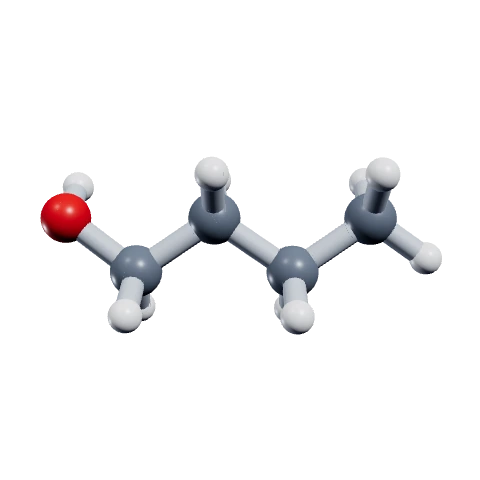
n-Butanol is a straight-chain primary alcohol with the molecular formula C₄H₁₀O — four carbons in an unbranched chain, with the hydroxyl (–OH) group sitting on the terminal (end) carbon. That terminal placement is what makes it a primary alcohol, and it's the detail that drives almost everything else in this guide: how it oxidizes, how it smells, and which industrial process wants it.
CAS 71-36-3 · C₄H₁₀O · Molecular weight 74.12 g/mol · Boiling point 117.7°C (243.9°F) · Flash point 29°C (84°F, closed cup) · Colorless liquid, characteristic banana/fusel-oil odor. PubChem CID 263
n-Butanol formula and structure
The formula of n-butanol is C₄H₁₀O, written CH₃CH₂CH₂CH₂OH or CH₃(CH₂)₃OH to show its structure: four carbons in an unbranched chain with the –OH group on carbon 1. Its molar mass is 74.12 g/mol, its IUPAC name is butan-1-ol, and its SMILES string is CCCCO. Drawn as a skeletal formula, it is a three-segment zigzag ending in OH.
| Property | n-Butanol (1-butanol) |
|---|---|
| Molecular formula | C₄H₁₀O (also written C₄H₉OH) |
| Condensed structural formula | CH₃CH₂CH₂CH₂OH = CH₃(CH₂)₃OH |
| IUPAC name | Butan-1-ol |
| SMILES | CCCCO |
| Molecular weight | 74.12 g/mol |
| Boiling point | 117.7°C (243.9°F) |
| Melting point | −89.8°C |
| Density | 0.810 g/mL at 20°C (floats on water) |
| Flash point (closed cup) | 29°C (84°F) |
Other names for n-butanol
n-Butanol is also sold as 1-butanol, n-butyl alcohol, butyl alcohol, normal butanol and butan-1-ol; older references call it 1-hydroxybutane or n-propyl carbinol. All of these mean CAS 71-36-3. On a shipping paper it appears under the group name "Butanols", UN1120.
At room temperature it's a clear, mobile liquid, slightly denser-smelling than ethanol but far less volatile — that higher boiling point and lower vapor pressure is exactly why coatings chemists prize it (more on that below). It's miscible with most common organic solvents (ethanol, ether, benzene, and most esters and ketones) but only partially miscible with water, which is the property that decides whether it separates cleanly out of a formulation or stays blended in.
Industrially, n-butanol is produced almost entirely by the oxo (hydroformylation) process — propylene, carbon monoxide, and hydrogen react over a rhodium or cobalt catalyst to form butyraldehyde, which is then hydrogenated to n-butanol. This is a mature, large-scale petrochemical process, and it's the reason n-butanol has been a stable-priced commodity solvent for decades rather than a specialty chemical.
A smaller but historically important share is produced via ABE (acetone-butanol-ethanol) fermentation, a bacterial pathway discovered over a century ago using Clostridium acetobutylicum to ferment sugars or starches into a mix of acetone, n-butanol, and ethanol. The process was a major industrial route for both munitions-grade acetone and n-butanol through the mid-20th century, before cheaper petrochemical routes displaced it. It hasn't disappeared, though — ABE fermentation is currently being revisited as a route to "biobutanol," a cellulosic-feedstock alternative fuel additive with a higher energy density and lower water affinity than ethanol, which makes it easier to blend into existing gasoline infrastructure without the phase-separation problems ethanol can cause.
Is n-butanol the same as "butyl alcohol"? Clearing up a genuinely confusing name
Yes and no — and this is exactly where most purchase orders go sideways. "Butyl alcohol" by itself is an ambiguous name: there are four distinct butanol isomers, and all four technically qualify as "a butyl alcohol." When a supplier, an SDS, or an old spec sheet says "butyl alcohol" with no other qualifier, it is almost always shorthand for n-butanol specifically — it's the highest-volume, default industrial isomer — but "almost always" is not "always," and mismatched isomers can quietly wreck a formulation.
Butanol vs n-butanol vs 1-butanol
n-Butanol and 1-butanol are the same compound, CAS 71-36-3. "Butanol" on its own is the family name for all four C₄H₉OH isomers, so the difference between butanol and n-butanol is general versus specific. Every n-butanol is a butanol, but a drum labeled only "butanol" could hold isobutanol, sec-butanol or tert-butanol.
The unambiguous names are the "n-" (normal, i.e. straight-chain) prefix, or the IUPAC name 1-butanol, which specifies exactly where the hydroxyl group sits (carbon 1, the end of the chain). If a spec sheet, SDS, or purchase order just says "butyl alcohol" or "butanol" with no isomer prefix, always confirm CAS 71-36-3 before you buy — that's the only number that guarantees you're getting the straight-chain primary isomer and not one of its three siblings.
When in doubt, order by CAS number, not by name. "Butyl alcohol," "butanol," and "1-butanol" are used loosely across the industry; CAS 71-36-3 is not.
n-Butanol vs isobutanol vs sec-butanol vs tert-butanol — which one do you actually need?
All four butanol isomers share the formula C₄H₁₀O, and none of the physical differences between them are visible on a drum label — you have to know the CAS number. They differ only in where the hydroxyl group sits and how the carbon chain is arranged, but that structural difference cascades into real, practical differences in solubility, boiling point, and how each one reacts.
| Isomer | CAS | Alcohol class | Boiling pt | Water solubility | Typical use |
|---|---|---|---|---|---|
| n-Butanol (1-butanol) | 71-36-3 | Primary | 117.7°C | ~63–77 g/L (6–8%) | Coatings, lacquer, plasticizers, butyl acetate |
| Isobutanol (2-methyl-1-propanol) | 78-83-1 | Primary (branched) | 107.9°C | ~85 g/L (8.5%) | Paint/ink solvent, biofuel research, isobutyl esters |
| sec-Butanol (2-butanol) | 78-92-2 | Secondary | 99.5°C | ~181 g/L (18%) | MEK synthesis feedstock, cleaning/degreasing blends |
| tert-Butanol (2-methyl-2-propanol) | 75-65-0 | Tertiary | 82–83°C | Fully miscible | Octane booster (historic), tert-butyl acetate synthesis, denaturant |
The pattern across the row is not a coincidence: as the hydroxyl group moves from the end of the chain toward the middle, and as the carbon chain branches, water solubility climbs and boiling point drops. tert-Butanol's hydroxyl carbon has no hydrogen attached to it at all — it's bonded to three other carbons instead — which is why it resists oxidation almost completely and why it dissolves in water at any ratio.
The classification also predicts reactivity. Primary alcohols like n-butanol oxidize cleanly, first to an aldehyde (butyraldehyde) and then to a carboxylic acid (butyric acid) — the same pathway your body uses to metabolize ethanol, and the reason improperly sealed n-butanol can develop a sharp, rancid-butter smell over time as trace oxidation occurs. Secondary alcohols like sec-butanol oxidize only as far as a ketone (methyl ethyl ketone, in this case — sec-butanol is MEK's direct feedstock). Tertiary alcohols like tert-butanol don't oxidize by the same route at all, because there's no hydrogen on the carbon bearing the hydroxyl group for the reaction to remove.
For nearly every coatings, plasticizer, and general-solvent application on this page, n-butanol (CAS 71-36-3) is the isomer you want — it's also the isomer we stock. If your process calls for one of the branched or secondary isomers instead (a biofuel R&D program built around isobutanol, or an MEK synthesis line that needs sec-butanol), that's a meaningfully different order — confirm the CAS number with your chemist before you buy.

Are butane and butanol the same thing?
No. Butane (C₄H₁₀, CAS 106-97-8) is a hydrocarbon gas that boils at about −0.5°C (31°F); butanol (C₄H₁₀O) is butane with one hydrogen replaced by an –OH group, which turns it into a liquid alcohol that boils at 117.7°C.
| n-Butane | n-Butanol | |
|---|---|---|
| Formula | C₄H₁₀ (CH₃CH₂CH₂CH₃) | C₄H₁₀O (CH₃CH₂CH₂CH₂OH) |
| CAS | 106-97-8 | 71-36-3 |
| Chemical family | Alkane | Primary alcohol |
| State at room temperature | Gas; shipped as a liquefied gas | Liquid |
| Boiling point | 31°F (about −0.5°C) | 117.7°C (243.9°F) |
| Water solubility | Slight | ~63–77 g/L near room temperature |
| DOT | UN1011, Division 2.1 flammable gas | UN1120, Class 3 flammable liquid |
| Typical use | Fuel gas, lighter fuel, aerosol propellant | Coatings solvent, butyl acetate and plasticizer feedstock |
What is n-butanol used for? 5 industries that run on 1-butanol
n-Butanol is used mainly as a slow-evaporating solvent in paints, lacquers and coatings, as the raw material for n-butyl acetate and butyl glycol ethers, as a building block for plasticizers such as dibutyl phthalate, and as an extraction solvent in fine-chemical purification.
n-Butanol is a bulk industrial solvent and chemical intermediate, and its highest-volume application is one most people never see: it disappears into finished products as a processing aid rather than showing up as an ingredient on a label.
- Coatings, paints & lacquer. n-Butanol is the classic "latent solvent" (or "coupling solvent") in nitrocellulose lacquers, alkyd enamels, and epoxy/polyurethane coatings — more on exactly what that role means below.
- Plasticizer production. n-Butanol is esterified with phthalic anhydride or adipic acid to make dibutyl phthalate (DBP) and related plasticizers used to keep PVC, vinyl flooring, and some films flexible.
- Butyl acetate synthesis. Reacted with acetic acid, n-butanol becomes n-butyl acetate — the fast-evaporating, fruity-smelling ester used across automotive refinish coatings and printing inks. See our n-butyl acetate guide for that side of the reaction.
- Extraction & purification. Its moderate water solubility and good organic-solvent miscibility make it useful in liquid-liquid extraction steps for antibiotics, hormones, and other fine-chemical purification processes.
- Glycol ethers & plasticizer intermediates. n-Butanol reacts with ethylene oxide to produce butyl glycol ethers (butyl cellosolve-type solvents) used in industrial and household cleaning formulations.
Two of those deserve a bit more detail because they're where most of Alliance Chemical's n-butanol volume actually goes. In plasticizer production, n-butanol's role is as a building block, not a solvent — it's esterified with a diacid (commonly phthalic anhydride) to build the two ester "arms" of a plasticizer molecule like dibutyl phthalate, which then gets blended into PVC resin to keep the finished vinyl flexible rather than brittle. The butanol itself doesn't end up in the plasticizer as a solvent; it becomes a covalently bonded part of the molecule.
In coatings, by contrast, n-butanol's job is almost entirely physical rather than chemical — it dissolves resin, controls viscosity and flow, and then evaporates out of the film as it cures, without becoming part of the final polymer network. That distinction (structural building block vs. process solvent that leaves) is worth knowing before you spec a grade or a quantity, since the two use cases consume n-butanol at very different rates relative to finished product volume.
| Key number | Value | Source |
|---|---|---|
| CAS Registry Number | 71-36-3 | PubChem CID 263 |
| DOT hazard class / UN number | Class 3, UN1120, Packing Group III | 49 CFR §172.101 |
| NIOSH exposure guidance | NIOSH REL ceiling 50 ppm (skin); OSHA PEL 100 ppm TWA | NIOSH Pocket Guide |
| Water solubility (room temperature) | ~63–77 g/L (~6–8%) | PubChem CID 263 |
| Flash point (closed cup) | 29°C (84°F) | PubChem CID 263 |
Is n-butanol soluble in water? The number that decides your formulation
Partially. n-Butanol dissolves in water at roughly 63–77 grams per liter near room temperature (about 6–8%). Published values vary by source: PubChem lists 63.2 and 68 g/L at 25°C and 7.7 g per 100 mL at 20°C, and NIOSH gives 9%. That is enough to matter, not enough to mix freely. Above that threshold, a water/n-butanol blend separates into two distinct layers, an effect you can watch happen in a bench beaker at the right ratio.
That partial miscibility is a feature, not a defect, in several of its core applications. In coatings, it's exactly why n-butanol is prized as a coupling solvent — it can bridge between water-soluble and oil-soluble components in a formulation without either fully dissolving or fully separating. In extraction chemistry, that same property lets n-butanol pull a target compound out of an aqueous phase while remaining a distinct, separable layer. Compare that to the isomer table above: sec-butanol's far higher solubility (~181 g/L) and tert-butanol's full miscibility make them poor substitutes anywhere this two-phase behavior is the point.
Which butanol is most soluble in water?
tert-Butanol. It mixes with water in every proportion, while sec-butanol dissolves to about 181 g/L, isobutanol to about 85 g/L at 25°C, and n-butanol to about 63–77 g/L near room temperature. Solubility rises as the chain gets more compact and the –OH moves toward the middle, because less of the molecule is exposed hydrocarbon.
Why is n-butanol the backbone of coatings and lacquer formulation?
In a nitrocellulose lacquer or an alkyd enamel, solvents aren't interchangeable — they're engineered to evaporate off the wet film in a specific sequence, and n-butanol's job in that sequence is to leave last.
A typical lacquer thinner blend layers three solvent tiers by volatility: a fast-evaporating "head" solvent (like acetone or MEK) that flashes off almost immediately and lets the film set; a mid-range "true" solvent that does most of the actual resin dissolving; and a slow, high-boiling "tail" or latent solvent — n-butanol's role — that stays in the film the longest. That slow release is what prevents "blushing" (a hazy, moisture-trapped finish that appears when fast solvents flash off too quickly in humid conditions) and gives the film time to level out and flow before it fully sets, instead of drying into a rough or orange-peel texture. Our nitrocellulose lacquer guide covers the fast- and mid-tier solvents that pair with n-butanol in a complete thinner system.
n-Butanol's boiling point (117.7°C) sits well above acetone (56°C) and MEK (79.6°C) — the gap is what lets it evaporate last and control film leveling instead of flashing off with everything else.

What's the difference between n-butanol and butyl acetate?
They're directly related but chemically distinct: n-butanol is the alcohol; n-butyl acetate is the ester you get when that alcohol reacts with acetic acid (a Fischer esterification, with water as the byproduct). Same four-carbon backbone, different functional chemistry, different job.
n-Butanol evaporates slowly and has a mild odor; n-butyl acetate evaporates faster and has a distinct fruity, "banana" smell that's become a signature scent of automotive body shops. In a coatings formulation, they're often used together rather than as substitutes — the acetate handles fast, mid-stage evaporation and the alcohol handles the slow tail end. See the full n-butyl acetate guide for the ester's specific role in automotive refinish coatings.
What grade of n-butanol should you buy?
Alliance Chemical stocks n-butanol in Technical Grade — the grade specified for essentially every application described in this guide: coatings and lacquer formulation, plasticizer and ester synthesis, industrial extraction, and general solvent use. Technical grade means the material meets a commercial purity specification suited to industrial processing; it is not certified to the ACS reagent specification used for analytical laboratory reference standards.
If your application is analytical (a reference standard for GC/HPLC calibration, or a regulated pharmaceutical process requiring a reagent-grade certificate of analysis against ACS specifications), talk to us before ordering — tell us the application and we'll confirm whether Technical grade meets your spec or whether you need a different reagent-grade source entirely. For every coatings, plasticizer, extraction, and general-solvent use on this page, Technical grade is the correct and cost-effective choice.
In practice, "Technical grade" for a bulk solvent like n-butanol typically means a purity specification in the high-90s percent range, with defined limits on water content and color (often measured on the APHA/Pt-Co color scale to catch trace oxidation or contamination), rather than the tighter multi-point purity and trace-metals specification an ACS reagent certificate requires. That's more than sufficient purity for coatings, ester synthesis, and industrial extraction — the applications where n-butanol's job is bulk performance, not analytical precision. Ask for the batch-specific Certificate of Analysis and we will send it at no charge, so you can confirm the actual purity and water content against your own spec before it goes into production.
Is n-butanol flammable? UN1120 shipping and storage rules
Yes. n-Butanol has a flash point of 29°C (84°F), which classifies it as a Class 3 flammable liquid under DOT and IATA/IMDG hazmat rules, shipped under UN1120, Packing Group III (a flash point of 23–60°C with a boiling point above 35°C puts a Class 3 liquid in Packing Group III under 49 CFR 173.121). That means it requires proper hazmat documentation, UN-rated packaging, and, for highway freight, FLAMMABLE placards once a vehicle carries 1,001 lb (454 kg) or more aggregate gross weight of placarded hazmat.
| Shipping fact | Detail |
|---|---|
| UN number | UN1120 |
| DOT hazard class | 3 (Flammable liquid) |
| Packing group | III |
| Proper shipping name | Butanols |
Store n-butanol in tightly sealed, corrosion-resistant containers (steel or HDPE), away from heat sources, open flame, and strong oxidizers, in a cool, dry, well-ventilated area. Because it's a primary alcohol, prolonged exposure to air allows slow oxidation toward butyraldehyde and butyric acid — keep drums closed between uses and avoid long-term storage in partially-full containers where headspace air can accelerate that reaction. The SDS is available on request. Need the Certificate of Analysis? Just ask, we send it at no charge. Consult the SDS in full before handling.
Health-wise, n-butanol is a moderate irritant rather than an acutely toxic material: vapor exposure irritates eyes, nose, and throat well below levels that cause systemic effects, which is actually a practical safety advantage — workers typically notice and leave a poorly-ventilated space before exposure becomes dangerous. NIOSH lists a ceiling exposure limit of 50 ppm with a skin notation, meaning liquid contact and prolonged skin exposure should be avoided even though it isn't classified as highly toxic on contact. Standard PPE — chemical-resistant gloves (nitrile or neoprene), safety glasses or goggles, and adequate ventilation or a respirator rated for organic vapors in enclosed spaces — is appropriate for routine handling.
Is butanol toxic?
n-Butanol is moderately toxic. Under GHS it is classified harmful if swallowed (H302), causes skin irritation (H315) and serious eye damage (H318), and may cause respiratory irritation (H335) and drowsiness or dizziness (H336). NIOSH sets a 50 ppm ceiling with a skin notation, OSHA's PEL is 100 ppm as an 8-hour average, and 1,400 ppm is immediately dangerous to life or health.
NIOSH lists eye, nose and throat irritation, headache, dizziness, drowsiness and central nervous system depression as exposure symptoms, and flags possible auditory nerve damage and hearing loss. EPA's IRIS file sets an oral reference dose of 0.1 mg/kg-day (1987, low confidence) and places n-butanol in cancer Group D, not classifiable, because there are no human or animal cancer data. Read the SDS before handling.
Is butanol drinkable?
No. Butanol is not a beverage alcohol; it is an industrial solvent classified harmful if swallowed, and it depresses the central nervous system. The SDS covers exposure response. Do not store it in food or drink containers.
What does 1-butanol smell like?
NIOSH describes 1-butanol as having a strong, characteristic, mildly alcoholic odor; food-additive references call it harsh fusel oil with a banana note. AIHA's mean odor detection threshold is 1.2 ppm, so most people smell it far below the 50 ppm NIOSH ceiling.
n-Butyl Alcohol, Technical Grade — 1 quart to 55-gallon drum
CAS 71-36-3. Need the Certificate of Analysis? Just ask — we send it at no charge. Tell us the application and we'll confirm Technical grade fits before you order.
Key numbers and sources
| Fact | Value | Source |
|---|---|---|
| CAS Registry Number | 71-36-3 | pubchem.ncbi.nlm.nih.gov |
| Molecular formula | C₄H₁₀O | pubchem.ncbi.nlm.nih.gov |
| Molecular weight | 74.12 g/mol | pubchem.ncbi.nlm.nih.gov |
| Boiling point | 117.7°C (243.9°F) | pubchem.ncbi.nlm.nih.gov |
| Flash point (closed cup) | 29°C (84°F) | pubchem.ncbi.nlm.nih.gov |
| Water solubility (room temperature) | ~63–77 g/L (~6–8%) | pubchem.ncbi.nlm.nih.gov |
| DOT hazard class / UN number | Class 3, UN1120, Packing Group III | ecfr.gov |
| NIOSH REL ceiling / OSHA PEL TWA | 50 ppm (skin) / 100 ppm | cdc.gov |
Frequently asked questions
What is n-butanol used for?
n-Butanol is used mainly as a slow-evaporating solvent in paints, lacquers and coatings, where it controls flow and leveling as the film dries. It is also the raw material for n-butyl acetate and butyl glycol ethers, a building block for plasticizers such as dibutyl phthalate, and an extraction solvent in fine-chemical purification.
What is the formula of n-butanol?
The molecular formula of n-butanol is C4H10O, written CH3CH2CH2CH2OH or CH3(CH2)3OH to show the structure: an unbranched chain of four carbons with the -OH group on carbon 1. Its molar mass is 74.12 g/mol, its IUPAC name is butan-1-ol, and its SMILES string is CCCCO. It boils at 117.7°C.
What is another name for n-butanol?
n-Butanol is also called 1-butanol, n-butyl alcohol, butyl alcohol, normal butanol and butan-1-ol (the IUPAC name). Older references use 1-hydroxybutane and n-propyl carbinol. All of these refer to CAS 71-36-3. Because 'butyl alcohol' and 'butanol' can also mean the branched isomers, order by the CAS number rather than the name.
What is the difference between butanol and n-butanol?
'Butanol' is the family name for the four C4H9OH isomers: n-butanol, isobutanol, sec-butanol and tert-butanol. n-Butanol is one specific member, the straight-chain primary alcohol with CAS 71-36-3, and it is the same compound as 1-butanol. A container labeled only 'butanol' could hold any of the four, so confirm the CAS number.
What is the difference between n-butanol and isobutanol?
n-Butanol is a straight-chain primary alcohol (CAS 71-36-3, bp 117.7°C); isobutanol is a branched-chain primary alcohol (CAS 78-83-1, bp 107.9°C) that dissolves somewhat better in water, about 85 g/L at 25°C versus roughly 63 to 77 g/L for n-butanol. They are used in overlapping but distinct applications and are not interchangeable in specification-driven formulations.
Are butane and butanol the same thing?
No. Butane is C4H10 (CAS 106-97-8), a hydrocarbon gas that boils at about -0.5°C and is used as fuel and aerosol propellant. Butanol is C4H10O: the same four-carbon chain with an -OH group, which makes it a liquid alcohol that boils at 117.7°C and works as a coatings solvent. Butane ships as UN1011, a flammable gas; n-butanol as UN1120, a Class 3 flammable liquid.
Is n-butanol soluble in water?
Only partially, about 63 to 77 grams per liter (roughly 6 to 8%) near room temperature; published values vary by source, and NIOSH lists 9%. Above that, n-butanol and water separate into two layers, which is why it works as an extraction solvent. Among the butanols, tert-butanol is fully miscible with water, sec-butanol dissolves to about 181 g/L and isobutanol to about 85 g/L.
Is butanol toxic to humans?
n-Butanol is moderately toxic. GHS classifies it as harmful if swallowed and as causing skin irritation, serious eye damage, respiratory irritation and drowsiness or dizziness. NIOSH sets a 50 ppm ceiling with a skin notation, OSHA's PEL is 100 ppm (8-hour average) and the IDLH is 1,400 ppm. EPA lists it in cancer Group D, not classifiable. Read the SDS before handling.
Is butanol drinkable?
No. Butanol is not a beverage alcohol. It is an industrial solvent classified as harmful if swallowed, and NIOSH lists headache, dizziness, drowsiness and central nervous system depression among its exposure symptoms. The SDS covers exposure response. Keep it out of food and drink containers.
What does 1-butanol smell like?
NIOSH describes 1-butanol as having a strong, characteristic, mildly alcoholic odor, and food-additive references describe it as harsh fusel oil with a banana note. The AIHA mean odor detection threshold is 1.2 ppm, so most people notice it far below the NIOSH ceiling of 50 ppm.
Is n-butanol flammable?
Yes. n-Butanol has a closed-cup flash point of 29°C (84°F), which makes it a DOT Class 3 flammable liquid shipped as Butanols, UN1120, Packing Group III. Its lower and upper explosive limits are 1.4% and 11.2% in air. Store it away from heat, open flame and strong oxidizers, with containers closed between uses.
What grade of n-butanol does Alliance Chemical sell?
Technical Grade, suited to coatings, plasticizer synthesis, extraction and general industrial solvent use. It is not certified to ACS reagent specifications for analytical reference standards, so contact us if your application requires that. Need the Certificate of Analysis? Just ask, we send it at no charge.
Sources
- PubChem Compound Summary: 1-Butanol (CID 263) · PubChem (NIH National Library of Medicine)
- 49 CFR §172.101 · Electronic Code of Federal Regulations
- NIOSH Pocket Guide · CDC
Related Chemical Collections
About the author
Andre Taki
This article is for informational purposes only.