

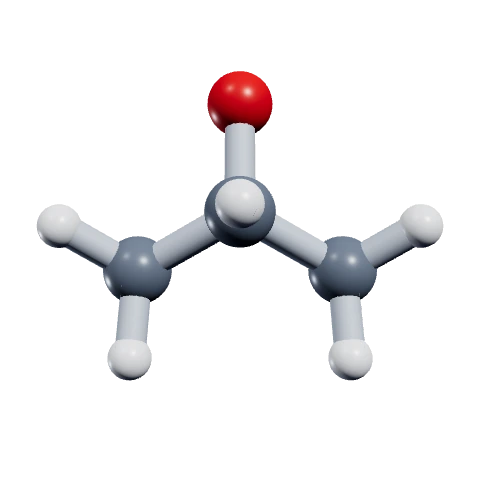


Every winter the same recipe goes around: rubbing alcohol, water, a squirt of dish soap, shake, spray. It works, and the chemistry behind it is simple. What the recipes rarely tell you is that the ratio decides how cold it keeps working. Mix it one way and it holds to about −4 °F. Mix it the other way, as some published recipes do, and it can freeze back onto the glass at a temperature that is routine on a cold winter morning.
This guide gives the recipe, then the numbers behind it: the freezing points of isopropyl alcohol and water mixtures from two published tables, what 70%, 91% and 99% alcohol do differently, how to free a frozen lock, and the handful of mistakes that crack windshields or start fires. Where popular advice overstates what a mix can do, we say so and show the arithmetic.
We sell isopropyl alcohol in 70%, 91% and 99% strengths, from a 1-quart bottle to a 330-gallon tote, and the 70% and 99% also come in 1-quart spray bottles. The buying section near the end covers which one to pick.
Last reviewed 14 October 2026 against the sources cited below. This is a practical chemistry guide, not medical, legal or regulatory advice. How we researched it is set out at the end.
How do you make homemade windshield de-icer?
Homemade windshield de-icer is two parts 70% isopropyl (rubbing) alcohol, one part water and a few drops of dish soap, mixed in a spray bottle. Spray it on the frost, wait about half a minute, and wipe or scrape the slush away with a plastic scraper.
The recipe (makes about 24 fl oz)
- 2 cups 70% isopropyl alcohol
- 1 cup water
- A few drops of liquid dish soap (optional; AAA’s version includes it)
- A clean, empty spray bottle that has never held a drink, labeled “DE-ICER — FLAMMABLE”
Result: about 47% alcohol by volume. Expect it to stay liquid to roughly −4 °F (−20 °C). For colder mornings, see the strength table below.
- Mix and label. Pour the alcohol into the bottle first, then the water, then the soap. Cap it and tip it gently; shaking hard makes the soap foam. Write the contents on the bottle.
- Start the car and turn the defroster on. Warming the glass slowly from inside helps, and it is the opposite of the sudden heat that cracks glass.
- Spray from the top down. Cover the frost evenly and let gravity carry the liquid down the glass. Spray away from your face and downwind.
- Wait about 30 seconds. Frost turns to slush; thick ice softens from the surface down.
- Wipe or scrape with plastic, never metal. AAA warns: “Never use a metal scraper, which can scratch the glass.” Run the wipers once the glass is mostly clear.
- Wipe drips off the paint. Then store the bottle indoors, away from heat and children.

What ratio of rubbing alcohol to water should you use?
Use two parts rubbing alcohol to one part water. The ratio matters more than any other choice, because it sets how cold the mix can get before it freezes back onto the glass, and the recipes in circulation do not agree on it.
- AAA (South Jersey club, and the AAA Mountain West Group’s Via magazine) gives one part rubbing alcohol to two parts water, plus a few drops of dish soap. The Via article adds that a homemade mix is less effective than commercial de-icer.
- The Farmers’ Almanac and Bob Vila give the reverse: two parts rubbing alcohol to one part water.
Those two recipes produce very different liquids. Starting from 70% rubbing alcohol, the arithmetic is:
| Mix | Alcohol in the spray (by volume) | Approximate freezing point |
|---|---|---|
| 70% rubbing alcohol, undiluted | 70% | about −20 °F (−29 °C) |
| 2 parts 70% : 1 part water | about 47% | about −4 °F (−20 °C) |
| 1 part 70% : 2 parts water | about 23% | about 15–20 °F (−6 to −10 °C) |
| 2 parts 91% : 1 part water | about 61% | about −10 °F or lower |
| 2 parts 99% : 1 part water | about 66% | about −15 °F |
Our estimates: nominal percent by volume, ignoring the slight shrinkage when alcohol and water mix, with freezing points interpolated from the Engineering ToolBox and Merck-index tables in the next section. Treat them as approximate, not measured.
The take: a 1:2 mix starts to freeze at about 15–20 °F, so on a 10 °F morning it can melt the frost and then glaze over again as it runs down the cold glass. That is our reading of the published freezing tables, not a test AAA reports. Two parts alcohol to one part water buys you roughly 20 more degrees. Below about 0 °F, use 91% or 99% alcohol in the same 2:1 ratio, or spray 70% undiluted.
How cold does a rubbing alcohol de-icer work?
A rubbing alcohol de-icer works down to roughly its own freezing point, which for common homemade mixes sits between about 20 °F and −20 °F, not anywhere near the −127 °F of pure isopropyl alcohol. Every drop of water you add raises the freezing point.
We could not find a peer-reviewed freezing curve for isopropyl alcohol and water that we could read. Two published tables exist, both by volume, and they agree well in the middle of the range but differ by up to 9 °C at the ends:
| Isopropyl alcohol, % by volume | Engineering ToolBox | Merck-index monograph |
|---|---|---|
| 20% | −7 °C (20 °F) | — |
| 25% | — | −6.7 °C |
| 30% | −15 °C (5 °F) | −8.3 °C |
| 40% | −18 °C (0 °F) | −13 °C |
| 50% | −21 °C (−5 °F) | −23 °C |
| 60% | −23 °C (−10 °F) | −32 °C |
| 70% | −29 °C (−20 °F) | — |
| 80% | −37 °C (−35 °F) | — |
| 90% | −57 °C (−70 °F) | — |
| 100% (pure) | −90 °C (−130 °F) | −89.5 °C |
Sources: Engineering ToolBox, Isopropanol (2-Propanol) based Freeze Protected Water Solutions; drugfuture.com Merck-style chemistry monograph for isopropyl alcohol. Pure isopropyl alcohol: NIOSH gives −127 °F; PubChem lists −87.9 to −90 °C across references.
Two popular claims do not survive this table:
- “Works down to about −10 °F.” The Farmers’ Almanac gives that figure for its 2:1 rubbing-alcohol mix. Made with ordinary 70% rubbing alcohol, a 2:1 mix is about 47% alcohol, which both tables put near −4 °F. Getting to −10 °F takes roughly 60% alcohol by volume, so a 2:1 mix with 91% or 99% alcohol.
- “Isopropyl alcohol freezes at −128 °F, so it won’t refreeze.” That is the freezing point of the pure liquid. Once it is diluted with water and then with the melted frost on your glass, the mix freezes far higher.
You may also see a far lower freezing point quoted for 70% isopropyl alcohol online. Traced back, it cites a consumer website rather than a handbook, it is roughly double the values in both tables above, and we do not use it.
Why does rubbing alcohol melt ice?
Rubbing alcohol melts ice because dissolving it in water lowers the temperature at which that water can freeze, an effect chemists call freezing-point depression. The OpenStax Chemistry 2e textbook defines it as “The decrease in freezing point of a dilute solution compared to that of the pure solvent,” and the same effect is why calcium and magnesium chloride melt ice on roads.
When the spray lands, alcohol mixes into the thin film of water on the surface of the frost. That mixture cannot stay frozen at the current temperature, so more ice dissolves into it, which dilutes the alcohol, and the process continues until the liquid is weak enough to freeze again or the frost is gone. That is why a stronger mix clears thicker frost and keeps working on colder mornings: it has more freezing-point depression to spend before it runs out.
Suresh Dhaniyala, a mechanical engineering professor at Clarkson University, described the windshield case in a 2024 article republished by PBS NewsHour: a mixture of rubbing alcohol and water leaves a liquid layer on the windshield that “will have a lower freezing point than water,” and it “will melt the frost layer without heating up the glass.”
Myth check: some guides claim that mixing alcohol with water warms the liquid, and that the warmth is what melts the ice. Calorimetry of water and isopropyl alcohol shows the heat released or absorbed depends on the proportions, and it is not what clears your windshield. Freezing-point depression is.
Is 70%, 91% or 99% isopropyl alcohol best for de-icing?
70% isopropyl alcohol is the best everyday choice for a de-icer spray, and 91% or 99% is worth it only when mornings regularly fall below about 0 °F. Stronger alcohol simply lets you add the same amount of water and still keep a lower freezing point.
| Strength | What it does as a de-icer | Watch out for |
|---|---|---|
| Isopropyl Alcohol 70% USP Grade | Mix 2:1 with water for about −4 °F, or spray it straight for about −20 °F. Our 70% is 70% alcohol and 30% deionized water by volume (assay 68.0–72.0%). | Flash point about 65–72 °F, closed cup |
| Isopropyl Alcohol 91% (USP Grade) | A 2:1 mix lands around 61% alcohol: about −10 °F or lower. | More flammable vapor than 70% |
| Isopropyl Alcohol 99% - Technical Grade | A 2:1 mix lands around 66%: about −15 °F. Also the base for a strong lock spray. | Flash point 53 °F (NIOSH); dries fast |
For a de-icer, the grade on the label does not change the chemistry; the alcohol content does. If you already keep 99% in the shop, our guide to making 70% from 99% isopropyl alcohol shows the dilution math, and 70% vs 91% vs 99% compares the three strengths for other jobs. The reason 91% is such a common retail strength is an azeotrope: isopropyl alcohol and water distill together at about 87.7% alcohol by weight, which we explain in the 91% wall.
Can you use rubbing alcohol to unfreeze a car door lock?
Yes: rubbing alcohol is what most aerosol lock de-icers are made of. The safety data sheet for one US lock de-icer, sold by Hopkins Manufacturing, lists isopropyl alcohol at “95.0 ~ 97.0” percent, with a little mineral oil and carbon dioxide as the propellant. Formulas vary by brand, so read the label of any can you buy.
- Use undiluted 91% or 99% alcohol for locks. Water is the problem inside a lock cylinder, so do not add more of it.
- Spray or drip a small amount straight into the keyhole, or dip the key in alcohol and insert it gently.
- Wait a minute and try the key with light pressure. Forcing a frozen key is how keys snap.
- Repeat if needed, then wipe the paint around the handle.
Many newer cars have no exterior keyhole, and the problem is a frozen handle or a door sealed shut by ice in the rubber gasket. The same spray softens ice along the door edge; push on the door to break the seal rather than pulling hard on the handle.

Is rubbing alcohol de-icer bad for car paint, wipers or window tint?
Rubbing alcohol de-icer is not directly harmful to car paint according to AAA, but it can strip wax, so wipe off drips. AAA’s South Jersey club puts it this way: “Homemade and commercial de-icing solutions are not directly harmful to your vehicle’s paint,” while noting they can remove wax over time; wash and rewax as part of normal winter care.
- Wiper blades and rubber seals: the Farmers’ Almanac warns that “Pure alcohol can damage the rubber wiper blades and trim seals.” We found no wiper maker or carmaker guidance either way. A diluted 2:1 spray, used for a few seconds and then wiped off, is a reasonable precaution; avoid soaking the blades in strong alcohol.
- Window tint: aftermarket tint film is applied to the inside of the glass, so a de-icer sprayed on the outside never touches it. For cleaning the inside of tinted glass, follow the film installer’s care instructions.
- Glass: the real danger to the windshield is not alcohol, it is heat. See the next section.
Why should you never pour hot water on a frozen windshield?
Hot water can crack a frozen windshield through thermal shock: one part of the glass expands faster than the rest. AAA’s advice is blunt: “Never use hot water to melt ice. This can crack glass by causing thermal shock and result in an expensive repair.” The Mountain West Group’s Via goes further: “Never use hot or warm water on your windshield, no matter how much ice has built up.”
Glass Doctor, a glass repair company, makes the same point: “Rapid temperature changes in glass can cause it to crack, and automotive glass is no exception.” A small chip or star break that would otherwise sit quietly all winter is the usual starting point for the crack.
An alcohol spray avoids the problem because it melts frost without adding heat. The cold mix and the cold glass are the same temperature; the alcohol changes where the melting point is, not how hot anything gets.
What is in store-bought de-icer and washer fluid?
Store-bought windshield de-icer sprays are usually methanol-based, not isopropyl alcohol. Prestone’s trigger-spray de-icer, for example, lists methanol at 50–100% and ethylene glycol at 2–10% on its safety data sheet, and its aerosol window-and-wiper de-icer lists methanol at 45–70%. Lock de-icers, as above, are the products that tend to be mostly isopropyl alcohol.
Winter windshield washer fluid is methanol and water. NAPA’s 0 °F washer fluid lists methanol at up to 23% by weight; a −20 °F blend from another maker lists 30%. That is why the color matters and the jug does not belong anywhere near a kitchen. MedlinePlus, from the National Library of Medicine, warns that “As little as 2 tablespoons (30 milliliters) can be deadly to a child.”
Do not make de-icer with methanol. Methanol is toxic in contact with skin as well as when swallowed, and a homemade spray bottle is exactly the kind of container that gets mistaken for something else. Isopropyl alcohol does the job for a homemade spray. If you need a washer fluid, buy one already blended and labeled for that purpose. Our article on why a methanol flame is invisible in daylight covers another reason methanol is handled differently.
How should you store and handle a homemade de-icer?
Store a homemade de-icer like the flammable liquid it is: in a labeled bottle, indoors, away from heat, flames and children. Even 70% isopropyl alcohol has a closed-cup flash point of about 65–72 °F, which means its vapor can catch fire at ordinary indoor temperatures.
- No flames, no sparks, no hot engine parts. Do not spray toward a running engine compartment, a lit cigarette or a space heater. NIOSH lists a lower explosive limit of 2.0% in air.
- Ventilate garages. Isopropyl alcohol vapor is about twice as heavy as air (PubChem), so it collects near the floor where water heaters and furnaces often sit.
- Never mix it with bleach. NIOSH lists chlorine among the incompatible materials for isopropyl alcohol.
- Keep it off your face. Isopropyl alcohol is an eye irritant; spray with the wind at your back.
- Never use a drink bottle. Use a clean spray bottle, write the contents on it, and keep it out of reach of children.
- Do not leave it in a hot car. In winter the cabin is cold, but the same bottle forgotten until spring sits in a closed car in the sun.
Isopropyl alcohol keeps for a long time in a closed container, though an open or loosely capped bottle loses alcohol to evaporation and gets weaker. Our guide on whether isopropyl alcohol expires covers what changes and what does not.
Why does frost form on your windshield overnight?
Frost forms when the glass cools below the frost point of the air, so water vapor turns straight into ice crystals on it. The National Weather Service explains that it happens “when the dewpoint (now called the frost point) is below freezing,” and that it is worst on clear, calm nights, when surfaces radiate heat to the open sky and cool faster than the air around them.
That is why a windshield can frost over when the forecast low was a few degrees above freezing: the weather station measures the air about five feet off the ground, while your windshield faces a clear sky. Parking under a carport, or covering the glass overnight, removes the clear-sky view and with it most of the frost.
Clearing the glass is also a legal matter in some states. Minnesota law, for example, says: “No person shall drive any motor vehicle with the windshield or front side windows covered with steam or frost ... to such an extent as to prevent proper vision.” Rules differ from state to state; clearing a small peephole and driving off is unsafe everywhere.
For the rest of the car’s winter prep, see our guides to winter battery care and antifreeze and coolant selection, and for driveways and walks, our calcium chloride de-icer guide.
Buying isopropyl alcohol for de-icing
For one car, a single quart of 70% isopropyl alcohol plus a pint of water makes about 1.5 quarts (48 fl oz) of 2:1 de-icer. Fleets, dealerships, rental lots and property managers going through it by the case can buy the same alcohol by the gallon, pail, drum or tote; every strength we carry runs from a 1-quart bottle to a 330-gallon IBC tote, and the 70% and 99% are also sold in ready-to-use 1-quart spray bottles.
- Isopropyl Alcohol 70% USP Grade: the everyday de-icer base
- Isopropyl Alcohol 91% (USP Grade): for colder climates
- Isopropyl Alcohol 99% - Technical Grade: for the coldest mornings and for locks
Safety data sheets are on every product page, and a certificate of analysis is available on request. Our isopropyl alcohol hub lists every grade, and rubbing alcohol vs isopropyl alcohol explains what the two labels mean.
How we researched this
We read the sources below on 14 October 2026: the NIOSH Pocket Guide and PubChem for isopropyl alcohol’s properties; two published freezing-point tables for isopropyl alcohol and water; AAA, the Farmers’ Almanac, Bob Vila and Glass Doctor for the recipes and warnings in circulation; manufacturers’ safety data sheets for commercial lock de-icer, windshield de-icer and washer fluid; the National Weather Service on frost; and Minnesota statute 169.71. The freezing points we give for specific homemade ratios are our own estimates, interpolated from the two tables by volume, and they are labeled as approximate. Where sources conflicted, we gave both and said which we used. Our 70% and 99% concentrations come from our own technical data sheets. The photographs in this article are illustrations, not test results.
Sources
- NIOSH Pocket Guide to Chemical Hazards: Isopropyl alcohol, CDC / NIOSH
- Isopropyl Alcohol (CID 3776), PubChem, National Library of Medicine
- Isopropanol (2-Propanol) based Freeze Protected Water Solutions, Engineering ToolBox
- Isopropyl Alcohol, chemistry monograph, DrugFuture chemical index
- Chemistry 2e, 11.4 Colligative Properties, OpenStax, Rice University
- How do I get ice off my car? Quick tips from an engineer, Suresh Dhaniyala, The Conversation via PBS NewsHour (2024)
- Tips for de-icing your windshield, AAA South Jersey
- How to defrost car windows quickly, AAA Mountain West Group, Via (2024)
- What’s the best way to de-ice a frozen windshield?, Farmers’ Almanac
- How to make homemade de-icer, Bob Vila
- Can you pour hot water on a frozen windshield?, Glass Doctor
- Lock Deicer safety data sheet, Hopkins Manufacturing Corporation
- Trigger De-Icer safety data sheet, Prestone (2019)
- Windshield Wash and Deicer Fluid 0 °F safety data sheet, Old World Industries for NAPA (2023)
- Windshield washer fluid poisoning, MedlinePlus, National Library of Medicine
- Dew and Frost, National Weather Service
- Minnesota Statutes 169.71, Windshield, Minnesota Office of the Revisor of Statutes
Frequently asked questions
What is the best homemade windshield de-icer?
Two parts 70% isopropyl (rubbing) alcohol to one part water, with a few drops of dish soap, in a labeled spray bottle. It is about 47% alcohol by volume and stays liquid to roughly -4 °F (-20 °C). For colder mornings, use 91% or 99% alcohol in the same ratio.
Does rubbing alcohol melt ice?
Yes. Isopropyl alcohol dissolves into the water film on ice and lowers its freezing point, so the ice melts at temperatures where plain water would stay frozen. It works until the melt dilutes the alcohol enough to freeze again.
What is the freezing point of isopropyl alcohol?
Pure isopropyl alcohol freezes at about -88 to -90 °C (NIOSH gives -127 °F). Mixtures with water freeze much higher: about -21 °C (-5 °F) at 50% by volume, according to published tables.
What is the freezing point of 70% isopropyl alcohol?
About -29 °C (-20 °F) for 70% by volume, according to the Engineering ToolBox table. We do not use a much lower figure that circulates online, because it is roughly double the published handbook values.
Can I use 99% isopropyl alcohol as a de-icer?
Yes. Mixed two parts alcohol to one part water it gives about 66% alcohol and a freezing point near -15 °F. Undiluted, it is a good lock de-icer. It is also more flammable than 70%, with a flash point of 53 °F.
Will rubbing alcohol de-icer damage car paint?
AAA says homemade and commercial de-icers are not directly harmful to a vehicle's paint but can strip wax over time. Wipe off drips, and wash and rewax as part of normal winter care.
Why add dish soap to a de-icer?
AAA's recipe includes a few drops of dish soap to help the liquid spread across the glass. It is optional; too much leaves streaks and foams in the bottle.
Can I use vinegar to de-ice a windshield?
We do not recommend it. The Farmers' Almanac says vinegar performs poorly on ice already bonded to glass and warns it can affect chrome trim and clear coat over time. Rubbing alcohol is the better-supported choice.
How do you unfreeze a car door lock?
Spray or drip undiluted 91% or 99% isopropyl alcohol into the keyhole, wait a minute, and turn the key gently. Most aerosol lock de-icers are mostly isopropyl alcohol; one brand's safety data sheet lists 95–97%.
Is it illegal to drive with a frosted windshield?
In some states, yes. Minnesota law bars driving with a windshield or front side windows covered with steam or frost to the point that it prevents proper vision. Rules vary by state, and driving through a small peephole is unsafe everywhere.
Related Chemical Collections
About the author
Andre Taki
This article is for informational purposes only.


