



Most people learn what fire looks like from wood, candles and gas stoves: orange, yellow, flickering, obvious. Methanol breaks that picture. In bright sun a methanol fire can be burning on a concrete pad, on a pit lane or on a lab bench and the only clues are heat shimmer, a smell, and whatever the fire is doing to the thing next to it. This article explains why, with the combustion chemistry, the numbers, the racing history that made the problem famous, and what it means if you store or pour methanol for a living.
What a methanol fire actually looks like
The Methanol Institute's Methanol Safe Handling Manual (5th edition, 2020) puts it plainly: without soot, methanol burns with flames that are "weakly light blue in color and nearly invisible to the naked eye in daylight," and because there are no black soot particles, "there is no smoke." Its property table lists the flame as "non-luminous blue flame / not visible to naked eye in daylight."
The word that matters is nearly. Indoors, in dim light, you can usually see a faint blue sheet over the liquid. Outdoors at noon the same flame washes out against the background. The manual goes further: "Methanol may be on fire and you may not be able to discern the hazard of a fire by looking for a flame." What you might see instead:
- Heat shimmer above a puddle or container, the same wavy distortion you see over a hot road.
- Secondary fires. Paper, rags, paint, tires, rubber hoses or clothing near the methanol catch and burn with ordinary yellow, smoky flames. Often the first visible sign of a methanol fire is something else burning.
- Blistering or scorching on surfaces with no flame you can point at.
- People reacting to heat they can feel but cannot see.
Why hydrocarbon flames glow and methanol flames don't
The yellow in a candle, a campfire or a gasoline fire is not the color of the combustion reaction itself. It is incandescent soot. When a fuel with long carbon chains burns in a diffusion flame (fuel on one side, air on the other), part of it cracks and polymerizes into carbon particles before it meets enough oxygen to burn completely. Those particles are heated to well over 1,000 °C and glow like the filament in an old light bulb. That broadband glow is so much brighter than anything else in the flame that it defines what we think fire looks like. When the particles escape unburned, they are the black smoke.
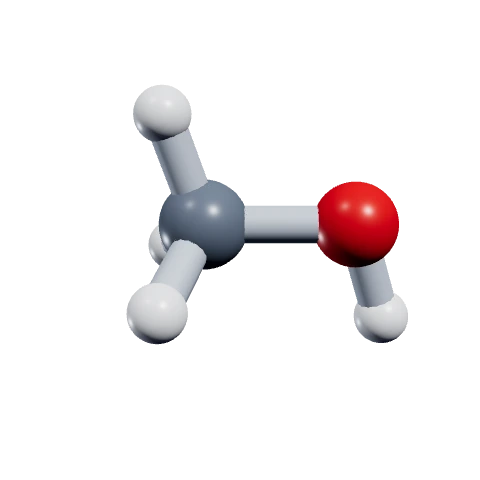
Methanol cannot play that game well. Look at the molecule:
Soot grows by linking carbon to carbon. Methanol has one carbon atom, so there is no carbon backbone to crack into soot precursors, and the oxygen already bonded in the molecule helps oxidize carbon before it can cluster. A 2019 review of methanol as an engine fuel in Progress in Energy and Combustion Science (Verhelst et al.) says it directly: "Having a single carbon atom it cannot easily form the carbonaceous particulate matter common from long-chain hydrocarbons," and notes that "methanol flames are practically invisible in sunlight."
The overall reaction is clean on paper and nearly clean in practice:
With no soot to glow, the light a methanol flame gives off comes from the gas molecules themselves. Excited radicals in the flame emit in narrow bands, much of it in the ultraviolet with only a weak blue in the visible range, and the hot combustion products, CO2 and water vapor, radiate in the infrared. Fire tests run for the maritime industry (the proFLASH project, RISE Research Institutes of Sweden, 2017) found that "non-sooty methanol flames emit radiation in the carbon dioxide band" at 4.3 µm "but little overall blackbody radiation." In other words: plenty of energy, almost none of it in the part of the spectrum your eyes are built for.
The same chemistry, a cooler flame. Methanol's adiabatic flame temperature is about 2,143 K, against roughly 2,275 K for gasoline. Verhelst et al. list it as the lowest of the fuels they compared. The Methanol Institute reports that methanol radiates only about 15% of its combustion heat, against about 36% for heptane, and releases heat at about one fifth the rate of a gasoline pool fire. Less radiated heat is a safety advantage (nearby objects and people heat up more slowly) and part of the same reason the flame is hard to see.
Methanol vs gasoline, side by side
| Property | Methanol | Gasoline | Why it matters |
|---|---|---|---|
| Carbon atoms per molecule | 1 | Many (a mixture of longer hydrocarbons) | No carbon chain means almost no soot, so no yellow glow |
| Adiabatic flame temperature | ~2,143 K | ~2,275 K | Cooler flame |
| Lower heating value | 20.1 MJ/kg | 42.9 MJ/kg | About twice the fuel mass for the same energy |
| Stoichiometric air/fuel ratio | 6.45 : 1 | 14.7 : 1 | An engine can burn far more of it per breath of air |
| Heat of vaporization | ~1,100 kJ/kg | ~180–350 kJ/kg | Strong cooling as it evaporates |
| Research octane number | 109 | — | Resists knock under boost |
| Flame in daylight | Pale blue, nearly invisible | Bright yellow-orange, smoky | You can see one and not the other |
Sources: Verhelst et al. 2019 (Tables 1–4); Methanol Institute Safe Handling Manual, 5th ed., Appendix B.
Water makes it worse before it makes it better
Methanol mixes with water in every proportion, which leads a lot of people to assume a hose settles the matter. It does not, at least not quickly.
How much water it takes depends on temperature, and there are three numbers worth knowing. At room temperature, small-scale tests cited by proFLASH ignited methanol/water mixtures containing up to about 65% water. Warm the liquid to about 39 °C (102 °F) and, per the Methanol Institute, it stays ignitable up to about 75% water, which is why the manual says "a 75v% water and 25v% methanol solution is considered to be a flammable liquid." And a pool that is already burning is far hotter than that: after water-spray tests, measurements "have shown a water content of up to 87.6 vol% at extinguishment." The Institute's fire-fighting table adds that application of water "will spread the fire until the dilution ratio reaches at least 3/1," and proFLASH puts it bluntly: "almost 90% water may be necessary for extinguishment."
The strangest finding is what the flame does while you dilute it. proFLASH reported that methanol flames hit with water spray "immediately turn from weakly blue to suppressed bright yellow" and then "become virtually invisible before extinguishment is achieved." The researchers spell out the danger: "There is hence a risk to believe that a methanol fire extinguishes when suppression... is interrupted." In their tests, well-diluted methanol flames were completely invisible to the naked eye, even against black walls, while the infrared camera still showed them burning.
A fire that looks out may not be out. With methanol, the moment the flame disappears is not proof that it has stopped burning. Keep applying agent, check with a thermal imager, and do not walk into the area, reopen containers or start cleanup on the strength of what your eyes tell you.
What this means for methanol/water blends
This is where the chemistry meets our own product line. We sell a premixed 60/40 methanol/DI water solution, a standard HPLC mobile phase and extraction solvent (we wrote about its use in aflatoxin testing for peanuts). Forty percent water sounds like a lot. It does not make the mixture non-flammable: small-flame tests have ignited methanol/water mixtures with up to about 65% water at room temperature, a warm blend ignites more easily still, and the Methanol Institute classes even a 75/25 water/methanol mix as a flammable liquid. Treat a 60/40 blend with the same fire controls as neat methanol, keep it away from ignition sources, and do not assume a spill of it is "mostly water."
What does work
The Methanol Institute lists carbon dioxide, dry chemical, water mist or fog, and alcohol-resistant AFFF (AR-AFFF) at 6% proportioning. Ordinary foam is a poor choice: methanol is a polar solvent, and the manual notes that conventional foam "will be decomposed" by it. AR foams form a polymer layer that holds up on polar liquids. Water still has a role, to cool exposures and dilute spills, but it is a slow extinguishing agent for methanol and in the early stages can carry burning liquid somewhere else.
How Indianapolis made methanol the safer fuel, and taught everyone it was invisible
American open-wheel racing ran on methanol for about four decades, and the reason was a fire everyone could see.
On the second lap of the 1964 Indianapolis 500, Dave MacDonald's car spun coming off turn four, hit the inside wall and the gasoline in its tank ignited. The burning car slid back across the track, Eddie Sachs hit it broadside, and seven cars were caught up in the crash. Sachs died at the scene; MacDonald died of his injuries that afternoon. (Reports that the car carried 80 to 100 gallons of fuel are overstated; car owner Mickey Thompson told Sports Illustrated that MacDonald's car carried 45 gallons.)
The sanctioning body, USAC, did not ban gasoline for 1965, whatever the popular retelling says. It changed the rules so that methanol became the obvious choice: a minimum of two pit stops, fuel capacity cut to 75 gallons in rubber bladder tanks, and gravity-fed refueling rigs only. Methanol's lower energy per gallon mattered less under a two-stop rule, and its fire behavior (lower radiant heat, water-miscible, no fireball of black smoke) mattered a great deal. Teams switched. Indy cars ran on methanol for roughly 40 years, moved to a 90/10 methanol/ethanol blend in 2006, and switched to 100% fuel-grade ethanol for 2007, according to a March 2007 Honda press release.
The tradeoff showed up in the pits. During a pit stop at the 1981 Indianapolis 500, a refueling nozzle on Rick Mears's car worked loose and sprayed fuel (the cars were still running methanol) around the car and crew. Mears was treated for first- and second-degree burns to his face and nose; his chief mechanic, Derrick Walker, and crew member Bill Murphy were also hospitalized. Mears told UPI afterward, "I didn't dare breathe for fear I'd inhale the flames." UPI's report that day describes the injuries rather than the flame itself.
Methanol is still a racing fuel. The 410-cubic-inch engines in World of Outlaws sprint cars, for example, are fueled by methanol.
Why racers put up with it
If a fuel you cannot see burning sounds like a bad trade, look at what methanol does inside an engine.
At roughly 1,100 kJ/kg, methanol absorbs far more heat as it evaporates than gasoline does. Per unit of intake air, Verhelst et al. calculate a sevenfold increase in the energy needed to evaporate the fuel. The charge going into the cylinder is denser and cooler.
A research octane number of 109 (motor octane 92) lets an engine run more boost and compression before detonation. Cooling and octane together are why supercharged and turbocharged race engines love it.
Methanol carries its own oxygen, so a stoichiometric mixture needs less than half the air gasoline does. More fuel per intake stroke offsets the lower energy per kilogram.
Lower flame temperature, about 15% radiant fraction and a slow heat release rate. The Methanol Institute cites a US EPA estimate that an all-methanol vehicle fleet would see about 90% fewer vehicle fires.
The cooling trick also explains methanol/water injection. The German air force's MW 50 system in the Second World War sprayed a roughly 50/50 methanol-water mix into supercharged aircraft engines to suppress detonation at full power. Water's heat of vaporization (about 2,257 kJ/kg) is higher still, so a methanol/water mist cools the charge hard; in MW 50 the methanol served mainly as an anti-detonant and secondarily as antifreeze.
The classroom version: fire you can't judge
The invisible-flame problem is not limited to race tracks and fuel depots. In October 2014 the U.S. Chemical Safety Board issued a safety bulletin after three flash fires in 48 days during educational demonstrations: at a science museum in Reno, Nevada; at STRIVE Prep, a school in Denver, where four students were burned, one seriously, and the flash fire "shot out about 12 feet"; and at a Cub Scout event in Illinois. All three involved burning methanol for a show: the Reno and Illinois demonstrations burned methanol with boric acid to make a green flame. The Board also pointed back to a 2006 Ohio classroom fire during the "Rainbow" demonstration, in which metal salts are burned in methanol to show colored flames.
The CSB's account of the Reno incident is the one to remember: "Although there had been no sign of flame from the cotton ball, it is likely that the lighter had actually ignited the cotton." In Denver the problem was the opposite: the flame was visible but "did not rise as high as he had hoped," so the teacher added methanol from a four-liter bulk container, and the flame flashed back into it. Either way the mechanism is the same. Someone pours from a large container onto an ignition source they cannot see, like smoldering cotton, or a flame they have underestimated, and the fire runs back up the stream. The Board's key lessons: do not use bulk containers of flammable chemicals in demonstrations when small quantities are enough, conduct a hazard review first, and put a safety barrier between the demonstration and the audience.
Never top up a methanol flame, a burner or a warming pan from a bottle. If you did not see the flame go out, assume it did not. Wait, verify with a thermal reading, and dispense from small, closed containers away from the work area.
Working with methanol when you can't see the fire
None of this makes methanol exotic. It is one of the most widely used solvents and chemical feedstocks in the world, handled safely every day. The invisible-flame property just means some habits that work for gasoline or diesel do not transfer. From the Methanol Institute's manual and the proFLASH test results:
- Detect heat, not light. The Institute says responders "should be equipped with infrared devices." A handheld thermal imager is the practical tool. For fixed detection, proFLASH found that infrared flame detectors could pick up even an obstructed methanol fire, while visual detectors "are generally not suitable."
- Stock the right extinguishing agents. AR-AFFF foam, CO2 or dry chemical near where methanol is stored and dispensed. Do not count on a garden hose.
- Control vapor and ignition. Methanol's closed-cup flash point is about 11–12 °C (52–54 °F), so it gives off ignitable vapor at ordinary room temperature. The flammable range is wide, about 6% to 36% in air. Bond and ground metal containers during transfer, and keep sparks and open flames out of the area.
- Remember the vapor is roughly air-weight. Its vapor density is about 1.1 (air = 1), so it does not rise away quickly the way hydrogen does. Ventilate.
- Treat blends as flammable. Methanol/water mixes with a lot of water in them can still ignite, as covered above.
Health hazards travel with the fire hazard
Methanol is shipped as a Class 3 flammable liquid with a subsidiary Division 6.1 toxic hazard (UN1230). The body converts it through formaldehyde to formic acid, which causes metabolic acidosis and can damage the optic nerve. NIOSH notes that skin absorption and inhalation can be "as effective as the oral route," and that symptoms may follow "an asymptomatic period of 1 to 72 hours." Wear chemical-resistant gloves and eye protection, work with ventilation, and never use methanol near food or drink. For anyone exposed, the answer is medical evaluation, not waiting to see if symptoms appear.
| Handling data | Value | Source |
|---|---|---|
| CAS / formula / molar mass | 67-56-1 / CH3OH / 32.04 g/mol | NIST WebBook |
| Boiling point | 64.7 °C (147 °F) | NIOSH Pocket Guide |
| Flash point (closed cup) | 11–12 °C (52–54 °F) | NIOSH; Methanol Institute |
| Flammable limits in air | 6.0% – 36% | NIOSH Pocket Guide |
| Autoignition temperature | 464 °C (867 °F); published values range ~385–464 °C | NFPA via PubChem; Methanol Institute |
| Vapor density (air = 1) | 1.11 | PubChem |
| Ignitable water content | ~65 vol% at room temp; ~75 vol% at 39 °C | proFLASH; Methanol Institute |
| Exposure limits | OSHA PEL 200 ppm TWA; NIOSH REL 200 ppm TWA, 250 ppm STEL [skin]; IDLH 6,000 ppm | NIOSH Pocket Guide |
| DOT shipping | UN1230, Class 3 (6.1) | 49 CFR 172.101 |
Which methanol to buy
We carry four methanol products. Grade is about impurity limits and documentation, not about how the liquid burns; every one of them has the fire behavior described above.
| Product | Typical buyer | Pack sizes |
|---|---|---|
| Methanol Technical Grade | Fuel blending, process solvent, cleaning, antifreeze and de-icing formulation, general manufacturing | 1 quart to 15-gallon drum |
| Methanol ACS Reagent Grade | Analytical labs, chromatography, spectroscopy, QC | 1 quart to 15-gallon drum |
| 60/40 Methanol/DI Water, Technical Grade | Extraction and rinse solvent where the ratio matters but reagent documentation does not | 1 quart to 15-gallon drum |
| 60/40 Methanol/DI Water, ACS Grade | HPLC mobile phase, mycotoxin and residue methods | 1 quart to 55-gallon drum |
If you are not sure which grade your method or process calls for, ask. We send a Certificate of Analysis on request, usually within 1–2 business days, at no charge (request a CoA).
Need methanol for your lab or process?
Technical and ACS Reagent Grade, plus premixed 60/40 methanol/DI water. Shipped from Texas with hazmat paperwork included and a CoA on request.
Shop MethanolReferences & Authoritative Sources
- Methanol Safe Handling Manual, 5th Edition — Methanol Institute, March 2020. Flame visibility (ch. 6), dilution and flammability, emergency response, Appendix B properties and fire-fighting media.
- proFLASH: Methanol fire detection and extinguishment — F. Evegren, RISE Research Institutes of Sweden, SP Rapport 2017:22. Flame radiation, water-spray behavior, detection tests.
- Methanol as a fuel for internal combustion engines — S. Verhelst et al., Progress in Energy and Combustion Science 70 (2019). Fuel properties, flame temperature, soot formation, octane.
- NIOSH Pocket Guide to Chemical Hazards: Methyl alcohol — Centers for Disease Control and Prevention. Flash point, boiling point, flammable limits, exposure limits.
- Methanol: Emergency Response Card — NIOSH. Routes of exposure and delayed symptoms.
- PubChem CID 887: Methanol — National Center for Biotechnology Information, U.S. National Library of Medicine. Autoignition temperature (NFPA), vapor density.
- Methanol — NIST Chemistry WebBook, SRD 69 — National Institute of Standards and Technology.
- Key Lessons for Preventing Incidents from Flammable Chemicals in Educational Demonstrations — U.S. Chemical Safety Board safety bulletin, October 2014.
- 1964 Indianapolis 500 — crash sequence (secondary source).
- Indianapolis 1964: the aftermath — 8W / Forix, quoting Sports Illustrated, June 22, 1964.
- 1965 Indianapolis 500 — USAC rule changes for 1965 (secondary source).
- Indy Racing League makes move to 100% fuel-grade ethanol — Honda press release, March 27, 2007.
- Rick Mears pit fire report — UPI, May 25, 1981.
- The Car: Sprint Car — World of Outlaws. The 410 engine is fueled by methanol.
- MW 50 — methanol-water injection in WWII aircraft engines (secondary source).
Frequently asked questions
Why is a methanol flame invisible in daylight?
Hydrocarbon flames look yellow because they make soot, carbon particles that glow as they heat. Methanol has one carbon atom and no carbon-carbon bonds, so it makes almost no soot. Its flame emits mostly ultraviolet and infrared light plus a weak blue, which washes out in sunlight. The Methanol Institute describes it as nearly invisible to the naked eye in daylight.
Does water put out a methanol fire?
Not quickly. Water spreads a methanol fire until the mix reaches at least 3 parts water to 1 part methanol, and fire tests measured roughly 88 to 90% water in the fuel before the fire went out. Alcohol-resistant foam (AR-AFFF), CO2 or dry chemical are the recommended agents.
Is a 60/40 methanol and water solution flammable?
Yes. Small-flame tests have ignited methanol/water mixtures with up to about 65% water at room temperature, and the Methanol Institute classes even a 75/25 water/methanol mix as a flammable liquid. A 60/40 methanol/water blend should be stored and handled like neat methanol.
Is a methanol flame hotter than a gasoline flame?
No. Methanol's adiabatic flame temperature is about 2,143 K versus about 2,275 K for gasoline, and it radiates only about 15% of its heat. It is harder to see, not hotter.
Why did Indy cars use methanol?
After the fatal gasoline fire at the 1964 Indianapolis 500, USAC changed the 1965 rules (two mandatory pit stops, smaller rubber bladder tanks, gravity refueling) in ways that made methanol the practical choice. It burns cooler, radiates less heat and mixes with water. Indy cars ran on methanol for about 40 years before switching to ethanol in 2007.
How do you detect a methanol fire?
With heat, not sight. Responders use thermal imaging cameras, and fire tests found infrared flame detectors work on methanol fires while visual detectors generally do not. Look for heat shimmer and secondary fires in nearby materials.
Related Chemical Collections
About the author
Andre Taki
This article is for informational purposes only.


