



The gas that would eventually make surgery survivable was discovered by an apothecary who never understood what he had made, named by a man who never made it, and turned into a liquid by a chemist trying to solve a smell.
The story continues in 1847: the doctor who put chlorinated lime at a Vienna delivery-room door — and was destroyed for proving it worked. Deaths fell from 10.65% to 1.98%, and the Semmelweis reflex is named for what happened next.
Who discovered chlorine?
Chlorine was first isolated in 1774 by Carl Wilhelm Scheele, a Swedish pharmacist working with the mineral pyrolusite. When he heated pyrolusite - manganese dioxide - with muriatic acid, the acid we now call hydrochloric acid, a heavy yellow-green gas came off with a sharp, choking odour. Scheele noticed something else immediately: the gas destroyed colour. It turned litmus paper white and bleached the colour out of flowers and leaves.
That bleaching property is the whole commercial story of chlorine chemistry, and it was observed in the first hour of the element being known to anyone. What Scheele did not have was a correct explanation. Working inside the phlogiston theory - the idea that combustible materials contained a fire-like element released on burning - he reasoned that the manganese dioxide had stripped phlogiston out of the muriatic acid, leaving a modified acid behind. He called the gas dephlogisticated muriatic acid air: not an element, but an acid with something removed.
Why the confusion mattered. If chlorine was a compound of an acid, then every acid had to contain oxygen - a rule Lavoisier had built into the foundations of chemistry. Chlorine turned out to be the counterexample that broke it.
Scheele was not a careless chemist; he was one of the most productive experimentalists of the century, with a claim to the discovery of oxygen independent of Priestley. The failure here was not observation but interpretation, and it stood for thirty-six years.
Why did it take 36 years to recognise chlorine as an element?
Chlorine was not accepted as an element until 1810, when Humphry Davy demonstrated that the gas could not be decomposed and therefore was not an oxide of anything.
In the intervening years the gas had already been renamed once. In 1785 Claude Louis Berthollet, working from Lavoisier’s framework, called it oxymuriatic acid - literally "oxygenated muriatic acid" - even though it showed no acidic behaviour. The name encoded a theory rather than an observation, and it stuck for a generation.
Davy attacked the problem directly: if oxymuriatic acid contained oxygen, that oxygen should be removable. It was not. He concluded the gas was a simple substance and gave it a name that described the only thing everyone could agree on - its colour. Chloros, Greek for yellow-green. The naming is a small lesson in scientific humility: after two theory-laden names had failed, the one that survived described what the bottle looked like.

Who invented bleach, and what were they actually trying to fix?
Liquid bleach as a product begins with Berthollet in 1785, who used chlorine to whiten textiles at the Javel works near Paris - the origin of the French name eau de Javel. But the version that matters chemically, and the one sold today, comes from Antoine Germain Labarraque in 1820.
Labarraque’s change was economic before it was medical. Berthollet’s liquor was made with potash, which was expensive. Labarraque prepared his solution from chlorine and aqueous sodium carbonate instead - soda rather than potash - producing sodium hypochlorite. Cheaper feedstock, more stable product, and the compound that would carry the entire category for the next two hundred years.
And the reason he was working on it at all is the part almost nobody knows. An 1826 account of his work records that Labarraque was led to the discovery while trying to destroy the infectious odour and prevent putrefaction in the materials used to manufacture catgut and other strings - that is, in workshops that boiled animal intestines.
The origin was a smell, not a disease. The commission that brought Labarraque the problem wanted the stench of the gut-dressing trade brought under control. The antiseptic property was found on the way to solving an industrial nuisance.

This ordering matters for how you read the rest of the century. Sodium hypochlorite was not invented to fight infection, because in 1820 infection as we understand it did not yet exist as a concept. It was invented to stop rot and the smell of rot - and it turned out that stopping rot and stopping infection are, at the chemical level, close to the same job.
How did a factory deodorant end up in a maternity ward?
In 1847 Ignaz Semmelweis, working in the First Obstetrical Clinic of the Vienna General Hospital, required doctors and medical students to scrub their hands in a chlorinated lime solution before examining patients - and the maternal death rate in his clinic collapsed.
Semmelweis had a puzzle with no theory to explain it. Two maternity clinics in the same hospital had sharply different death rates from puerperal fever. The one staffed by doctors and students was far deadlier than the one staffed by midwives. The difference he eventually fixed on was that the doctors came to the delivery room directly from performing autopsies, carrying an odour on their hands that ordinary soap did not remove.
He could not name what was being carried. Germ theory would not be established for decades. What he had was the smell, and a class of chemistry already known to destroy smells: the chlorine preparations. He chose chlorinated lime - calcium hypochlorite, the calcium counterpart of Labarraque’s sodium compound - and made the washing compulsory in late May 1847.

What the numbers actually show
A later statistical re-analysis of Semmelweis’s own monthly records puts average monthly mortality in the clinic at 10.65% for January 1841 to May 1847, before handwashing, and 1.98% for June 1847 to February 1849, after it - a risk ratio of 5.38 and an absolute reduction of 8.87 percentage points (P = 0.0042).
One number worth keeping. The same analysis frames the effect in a way that needs no statistics at all: for roughly every 11 women examined after handwashing began, one fewer died.
Two honest caveats belong with those figures. Popular retellings quote a wide spread of numbers - 18.27% to 1.27%, or 12% to 1% - and they do not all trace to the same records; the monthly-average figures above come from a peer-reviewed re-analysis of the original series. And the authors of that analysis note real variability in the pre-handwashing period, including an apparent seasonal pattern, which is exactly the kind of ambiguity Semmelweis’s contemporaries used to dismiss him.

Semmelweis was not rewarded for this. He was dismissed, his findings were rejected by much of the profession, and the mechanism that would have vindicated him arrived only after his death. The chemistry worked long before anyone could say why.
It is worth being precise about why he was rejected, because the usual telling - that doctors were too proud to admit they carried death on their hands - is only half of it. Semmelweis published late and thinly, his explanation invoked vague "cadaverous particles" rather than a mechanism anyone could test, and the statistical argument that reads as overwhelming today was not the kind of evidence mid-century medicine had learned to weigh. He had a result without a theory, in a period that trusted theory more than results. The chlorine chemistry was never the weak link; the explanation around it was.
What is sodium hypochlorite, chemically?
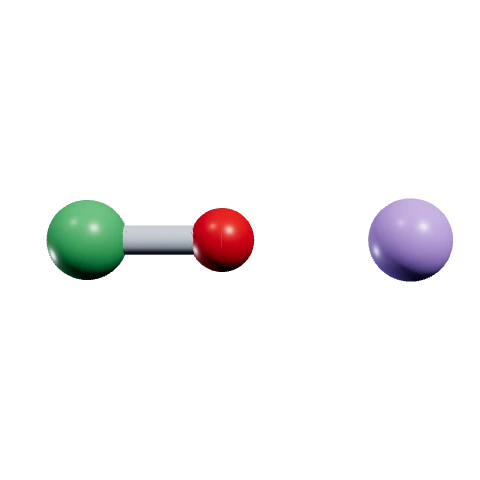
Sodium hypochlorite is the sodium salt of hypochlorous acid, formula NaOCl, molecular weight 74.44 g/mol, CAS number 7681-52-9. It is supplied as an aqueous solution, never as a dry powder for commercial use, and it is always alkaline.
In water it exists in equilibrium with hypochlorous acid (HOCl), and the position of that equilibrium is set by pH. Below about pH 7.5 the balance favours HOCl; above it, the hypochlorite ion (OCl-) dominates. This is why hypochlorite solutions are stabilised alkaline - typically pH 11 to 13 - and why letting the pH fall is a storage problem rather than a performance tweak.
| Property | Value |
|---|---|
| Formula | NaOCl |
| CAS number | 7681-52-9 |
| Molecular weight | 74.44 g/mol |
| Appearance | Clear pale greenish-yellow liquid |
| Typical solution pH | 11 - 13 (alkaline stabilised) |
| Common name | Bleach; liquid chlorine; eau de Javel (historical) |
Solution strength is quoted two ways and they are not interchangeable. Trade percent (weight/volume, grams of available chlorine per 100 mL) is the industrial convention; weight percent is lower for the same product. A "12.5%" industrial solution and a "12.5%" figure read off a consumer label are not necessarily describing the same thing, which is the single most common source of dosing errors.
It degrades on the shelf, and heat accelerates it. Hypochlorite solutions lose available chlorine over time - faster when warm, in light, or when the pH drifts down. Stronger solutions decay proportionally faster than weaker ones. Buy to your turnover rate, not to your storage capacity.
Where does chlorine come from today?
Essentially all commercial chlorine now comes from the electrolysis of salt water rather than from Scheele’s reaction of a mineral with acid. Passing a current through brine splits sodium chloride solution into chlorine gas at one electrode, hydrogen at the other, and sodium hydroxide - caustic soda - left in solution. Sodium hypochlorite is then made by reacting that chlorine back into a caustic soda solution, which is Labarraque’s 1820 chemistry run at industrial scale with both feedstocks made in the same plant.
This is the chlor-alkali process, and its structure has a commercial consequence worth understanding before you negotiate a price. Chlorine and caustic soda are co-products: you cannot make one without making roughly a fixed proportion of the other. Demand for the two is not correlated, so when caustic demand is strong and chlorine demand is weak, producers are effectively making chlorine they must place somewhere - and the reverse squeezes hypochlorite supply even when nothing about hypochlorite demand has changed.
Why your bleach price moves for reasons that have nothing to do with bleach. Because chlorine and caustic soda come out of the same cell in a fixed ratio, a swing in caustic markets propagates into hypochlorite pricing. We unpack the same mechanism from the other side in the caustic soda guide.
It also explains the historical shape of the industry. Berthollet needed a chemist to make chlorine before anyone could bleach anything with it; Labarraque needed cheap soda to make the sodium salt worth producing. Once electrolysis made chlorine and caustic soda fall out of the same process, the two-hundred-year-old bottleneck disappeared and hypochlorite became a commodity.
What do sodium hypochlorite concentrations mean, from 1% to 12.5%?
The concentration ladder exists because dilution costs money to ship and strength costs money to stabilise, so the right buy is the one closest to your working strength.
| Concentration | Grade (as supplied) | Typically bought for |
|---|---|---|
| 1% | Technical Grade | Low-strength working solutions where dilution error is the main risk |
| 2% | Technical Grade | Light-duty general use |
| 3% | Technical Grade | General-purpose dilute work |
| 5.25% | Water Treatment Grade | The classic household-bleach strength |
| 6% | Technical Grade | Slightly stronger general-purpose work |
| 8.25% | Technical Grade | Concentrated consumer-equivalent strength |
| 10% | Technical Grade | Industrial dosing where volume matters |
| 12.5% | Water Treatment Grade | Municipal and industrial water treatment feed stock |
How fast does it lose strength?
Decay is driven by three things you control and one you do not: temperature, light, pH, and starting concentration. Heat is the strongest lever - storage in an uninsulated shed through a Texas summer is a materially different product by autumn than the same drum kept cool. Light accelerates breakdown, which is why hypochlorite ships in opaque containers rather than clear ones. Letting pH drift down shifts the equilibrium toward hypochlorous acid and speeds loss, which is the reason the product is stabilised alkaline in the first place.
The counterintuitive one is starting concentration: a 12.5% solution loses available chlorine proportionally faster than a 5.25% solution under the same conditions. Buying the strongest grade "to be safe" can leave you dosing against a number that is no longer true. If your consumption is slow, a lower concentration bought more often is frequently the more accurate purchase as well as the cheaper one to hold.
Two grades appear in that table and the distinction is a supply specification, not a marketing tier. Our 5.25% and 12.5% are supplied as Water Treatment Grade; the 1%, 2%, 3%, 6%, 8.25% and 10% are supplied as Technical Grade. If your process, permit or SOP names a grade, match the grade first and the concentration second.
What should you never mix sodium hypochlorite with?
Never mix sodium hypochlorite with an acid, and never mix it with ammonia - the first releases chlorine gas and the second produces chloramines, and both send people to emergency rooms every year.
The acid reaction is the one that closes the historical loop in an unwelcome way: adding acid to hypochlorite regenerates the same yellow-green gas Scheele collected in 1774, except in an unventilated room rather than a laboratory. Muriatic acid poured near liquid chlorine at a pool is the classic version of this accident.
The combinations to keep apart: hypochlorite + any acid (including vinegar and muriatic acid) releases chlorine gas. Hypochlorite + ammonia or ammonia-containing cleaners forms chloramines. Hypochlorite + hydrogen peroxide is a vigorous reaction that wastes both. Store acids and hypochlorite separately, not merely on different shelves of the same cabinet.
We wrote this up in detail after a wave of search traffic on the subject: the pool-and-CleanTok mixing mistake behind everyone Googling "chlorine gas".
Which concentration should you buy?
Buy the concentration nearest your working strength that you will use before it degrades, and match any grade your process specifies before you optimise on strength.
Three questions that settle it
1. Does a permit, SOP or spec name a grade? If yes, that decides it. Water Treatment Grade and Technical Grade are not interchangeable just because the percentage matches.
2. How fast do you turn over stock? Hypochlorite is a decaying product. Buying a pallet of 12.5% for a job that consumes a pail a month means dosing against a moving target.
3. Are you diluting anyway? If your working strength is well under 5%, a higher concentration plus accurate dilution ships less water - but it also concentrates the consequences of a metering error.
Tell us the application and we will spec the grade and concentration with you, so you are not paying to ship water you do not need or under-spec’ing a step that matters. Need the Certificate of Analysis for your drum or tote? Just ask — we send it at no charge.
Key numbers and sources
| Fact | Value | Source |
|---|---|---|
| Chlorine first isolated | 1774, Carl Wilhelm Scheele, from pyrolusite + muriatic acid | Britannica |
| Scheele’s name for the gas | Dephlogisticated muriatic acid air (believed a compound) | Britannica |
| Proved an element, named chlorine | 1810, Humphry Davy, from Greek chloros | Britannica |
| Sodium hypochlorite first prepared | 1820, A. G. Labarraque, chlorine + aqueous sodium carbonate | IARC / NCBI Bookshelf |
| Why Labarraque was working on it | To destroy odour and putrefaction in catgut manufacture from animal intestines | 1826 account, PMC |
| Semmelweis handwashing introduced | Late May 1847, chlorinated lime, Vienna General Hospital | CDC EID |
| Monthly maternal mortality before | 10.65% (Jan 1841 - May 1847) | PMC re-analysis |
| Monthly maternal mortality after | 1.98% (Jun 1847 - Feb 1849), risk ratio 5.38, P = 0.0042 | PMC re-analysis |
| Sodium hypochlorite identity | NaOCl, CAS 7681-52-9, MW 74.44 g/mol | PubChem |
Sodium hypochlorite, from 1 quart to 15 gallon drums
Eight concentrations, Technical Grade and Water Treatment Grade, shipped from Taylor, Texas in 1-2 business days. Certificate of Analysis on request, no charge. Not sure which strength your process wants? Tell us the application and we will spec it with you.
- What Bleach Actually Is: Sodium Hypochlorite From 1% to 12.5% - the concentration ladder in practical detail.
- Using Sodium Hypochlorite for Water Purification - the modern descendant of Labarraque’s solution.
- Sodium Hypochlorite for Cooling Towers and AI Data Centers - dosing, cost and treatment.
- Top Applications of Sodium Hypochlorite 12.5% - where the strongest grade actually goes.
- Caustic Soda: Grades, Concentrations, and Why Its Price Follows Chlorine - the chlor-alkali link.
- Everyone’s Googling "Chlorine Gas" This Week - the mixing mistake to avoid.
Related: Who Discovered Ammonia? The Salt of Ammon and a 1,900-Year-Old Naming Mistake — Priestley caught his alkaline air the same year Scheele made his green gas.
Related: Does Bleach Expire? Sodium Hypochlorite Shelf Life, Decay Chemistry & Storage - how fast strength fades, and the storage rules that slow it.
Related: The Gas Mask Made of Photo Fixer: How Sodium Thiosulfate Met Chlorine in 1915 — what happened when chlorine became a weapon, and the chemical that answered it.
Frequently asked questions
Who discovered chlorine?
Carl Wilhelm Scheele, a Swedish apothecary, first isolated chlorine in 1774 by heating the mineral pyrolusite (manganese dioxide) with muriatic acid (hydrochloric acid). He observed a dense yellow-green gas that bleached litmus paper and flowers white.
What year was chlorine discovered?
1774. However, chlorine was not recognised as a chemical element until 1810, when Humphry Davy demonstrated it could not be decomposed and named it chlorine after the Greek chloros, meaning yellow-green.
Why did Scheele think chlorine was a compound?
Scheele worked within phlogiston theory. He reasoned that the manganese dioxide had removed phlogiston from the muriatic acid, leaving a modified acid, so he named the gas dephlogisticated muriatic acid air. Berthollet later renamed it oxymuriatic acid on the assumption it contained oxygen. Davy showed both were wrong.
Who invented bleach?
Claude Louis Berthollet first used chlorine to bleach textiles in 1785 at the Javel works near Paris, giving the name eau de Javel. Antoine Germain Labarraque produced sodium hypochlorite in 1820 by using soda instead of the more expensive potash, creating the compound sold as bleach today.
Why did Labarraque create sodium hypochlorite?
An 1826 account records that he was led to it while trying to destroy the infectious odour and prevent putrefaction in the materials used to manufacture catgut and other strings from animal intestines. The antiseptic use was discovered while solving an industrial odour problem.
Did Semmelweis use bleach?
He used chlorinated lime, which is calcium hypochlorite - the calcium counterpart of the sodium hypochlorite in modern bleach, sharing the same hypochlorite chemistry. He introduced compulsory handwashing in it at the Vienna General Hospital in late May 1847.
How much did maternal mortality fall after Semmelweis introduced chlorine handwashing?
A peer-reviewed re-analysis of his monthly records gives an average monthly mortality of 10.65% for January 1841 to May 1847 and 1.98% for June 1847 to February 1849 - a risk ratio of 5.38 and an absolute reduction of 8.87 percentage points (P = 0.0042).
What is the chemical formula of sodium hypochlorite?
NaOCl, with CAS number 7681-52-9 and a molecular weight of 74.44 g/mol. It is supplied as an alkaline aqueous solution, typically stabilised at pH 11 to 13, and loses available chlorine over time faster when warm or exposed to light.
Sources
- IARC / NCBI Bookshelf · NCBI (NIH)
- 1826 account, PMC · NCBI (NIH)
- CDC EID · CDC
- PMC re-analysis · PubMed Central (NIH)
- PubChem · PubChem (NIH National Library of Medicine)
Related Chemical Collections
About the author
Andre Taki
This article is for informational purposes only.


