

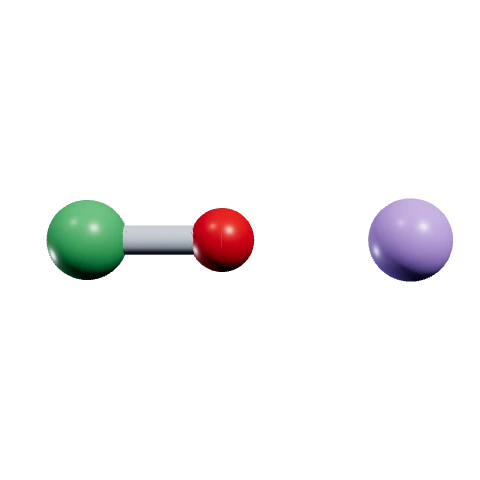


Bleach does not remove a stain. It destroys the stain's ability to absorb light. That single distinction explains almost everything people get wrong about sodium hypochlorite — including why a higher percentage is not a "stronger" chemical, and why a drum that sat through a Texas summer is not the drum described on its COA.
Almost everyone has used it. Very few have ever been told what it actually is. Here is the molecule.
What is bleach, chemically?
Household bleach is a 5–6% solution of sodium hypochlorite (NaOCl) in water. That is the entire product. The remaining 94–95% is water, plus a small amount of sodium hydroxide that keeps the pH high enough for the hypochlorite to stay stable.
Sodium hypochlorite is an oxidizer. In solution it exists in equilibrium with hypochlorous acid (HOCl), and the balance between the two shifts with pH — which is why hypochlorite chemistry is always a pH conversation, never just a percentage conversation.
Why bleach removes color: the chromophore story
Color exists because of chromophores — long chains of alternating single and double bonds that absorb specific wavelengths of visible light. The longer the conjugated chain, the deeper the color.
Hypochlorite oxidizes those chains and breaks the conjugation. Once the alternating-bond system is interrupted, the fragment can no longer absorb visible light in the same way, so it stops registering as colored.
The consequence is the part most people miss: the stain molecule is still physically present on the fabric. It has not been lifted, dissolved, or washed away. It has simply been rendered optically invisible. You did not clean the stain — you blinded it.
This is also why bleach and a surfactant do different jobs. A detergent physically removes soil. Bleach edits the part of the molecule that interacts with light. They are not substitutes for one another.
The concentration ladder: 1% to 12.5%
Sodium hypochlorite is sold across a wide concentration range, and the correct choice is a dilution-math question, not a strength contest. Alliance Chemical stocks eight:
| Concentration | Typical context |
|---|---|
| 1%, 2%, 3% | Dilute working solutions where handling a concentrate is impractical |
| 5.25%, 6% | The classic "household bleach" strength range |
| 8.25% | The concentrated consumer/light-commercial tier |
| 10%, 12.5% | Industrial and municipal bulk tiers |
Why 12.5% is not "stronger bleach"
12.5% sodium hypochlorite is roughly twice the available chlorine per gallon of 6% — it is not a different or more aggressive chemical. It is the same molecule with less water attached to it.
That distinction matters commercially. Buying at 12.5% and diluting on site means you are paying to ship half as much water for the same delivered chlorine. For a facility moving totes, that is the entire economic argument. For someone who needs a bucket of working solution, 6% delivered ready-to-use is often the smarter buy.
The correct question is never "how strong should I go?" It is "what concentration does my process actually call for, and what is the cheapest way to land that concentration on site?"
Bleach decays while it sits — and heat accelerates it
Sodium hypochlorite is thermodynamically unstable and degrades on its own into sodium chloride and sodium chlorate. Temperature is the dominant accelerant; concentration and trace metal contamination also matter.
The practical consequences:
- Fill date is a spec. A percentage on a label describes the product when it was filled, not necessarily when it arrives.
- Storage temperature is a spec. Ambient warehouse storage in a hot climate is materially different from a climate-controlled one.
- Higher concentrations decay faster. 12.5% does not hold its strength as patiently as 6%.
This is why the lot COA is on request at no charge, and why buyers who care about delivered available chlorine ask about fill date rather than relying on the label alone.
The same decay chemistry plays out at municipal scale, where the chlorine residual has to survive a journey of days through miles of distribution pipe. When it drops below 0.2 mg/L, a boil water notice becomes mandatory — we walk through why in what a boil water notice actually means.
What you must never mix with bleach
Never combine sodium hypochlorite with an acid, and never combine it with ammonia.
- Bleach + acid → chlorine gas. Common acidic products include many toilet bowl cleaners and descalers.
- Bleach + ammonia → chloramines. Some glass cleaners and a number of household products contain ammonia.
This is not a theoretical hazard. The CDC's Morbidity and Mortality Weekly Report documented a cluster of chlorine gas exposures in California caused by people mixing bleach with other cleaning products (MMWR, September 13, 1991). CDC also publishes current guidance on handling bleach safely.
Always consult the SDS for the specific concentration you are handling, and follow your facility's chemical compatibility procedures.
Sourcing sodium hypochlorite
Alliance Chemical stocks sodium hypochlorite in eight concentrations from 1% to 12.5%, in sizes from quart bottles to 330-gallon IBC totes, with the COA on request at no charge and typical shipping in 1–2 business days.
- Browse all sodium hypochlorite concentrations
- Sodium Hypochlorite 12.5% — the bulk industrial tier
- Sodium Hypochlorite 6% — the household-equivalent strength
- Related reading: Sodium Hypochlorite for Cooling Towers & AI Data Centers
- Related reading: Caustic Soda: Why Its Price Follows Chlorine
Written by Andre Taki, Chief Commercial Officer at Alliance Chemical.
Related: Who Discovered Chlorine? The 1774 Green Gas That Became Sodium Hypochlorite — the origin of the compound behind every concentration on this ladder.
Related: Does Bleach Expire? Sodium Hypochlorite Shelf Life, Decay Chemistry & Storage - how fast strength fades, and the storage rules that slow it.
Key numbers and sources
| Fact | Value | Source |
|---|---|---|
| Household bleach concentration | 5–6% | See article text |
| Industrial and municipal sodium hypochlorite concentration | 12.5% | See article text |
| Sodium hypochlorite formula | NaOCl | See article text |
| Minimum chlorine residual before boil water notice | 0.2 mg/L | See article text |
| Never combine sodium hypochlorite with ammonia | Bleach + ammonia → chloramines | cdc.gov |
| Never combine sodium hypochlorite with acid | Bleach + acid → chlorine gas | cdc.gov |
| Sodium hypochlorite is an oxidizer | Sodium hypochlorite is an oxidizer | See article text |
References & Authoritative Sources
Primary sources consulted for this article. Regulatory and physical-property figures above are drawn from these references.
- PubChem Compound Summary: Sodium Hypochlorite (CID 23665760) — National Center for Biotechnology Information, U.S. National Library of Medicine. Accessed 2026-09-04.
- Sodium Hypochlorite — thermophysical data — NIST Chemistry WebBook, SRD 69, National Institute of Standards and Technology. Accessed 2026-09-04.
Related reading: What Chemicals Really Cost Delivered: Quart vs Gallon vs Pail vs Drum vs Tote — what 12.5% sodium hypochlorite costs delivered at every size, from our own shipping records.
Frequently asked questions
Is bleach the same thing as chlorine?
No. Bleach is sodium hypochlorite (NaOCl) dissolved in water. Chlorine (Cl₂) is a gas. They are chemically related, and hypochlorite solutions release chlorine species in water, but they are distinct products with entirely different handling and storage requirements.
What percentage is household bleach?
Household bleach is typically 5.25% or 6% sodium hypochlorite. Concentrated consumer versions are usually around 8.25%. Industrial and municipal grades run to 10% and 12.5%.
Does bleach expire?
Yes. Sodium hypochlorite is thermodynamically unstable and degrades continuously into sodium chloride and sodium chlorate. Heat is the dominant accelerant, and higher concentrations decay faster. Both fill date and storage temperature affect the available chlorine you actually receive.
Why is bleach yellow-green?
The pale greenish-yellow tint is characteristic of the hypochlorite ion in solution. It deepens with concentration, which is why a 12.5% solution reads visibly more saturated than a 3% solution.
What is the difference between 10% and 12.5% sodium hypochlorite?
Only the amount of water. 12.5% carries roughly 25% more available chlorine per gallon than 10%, so you ship and store less liquid for the same delivered chlorine. It is the same molecule, not a more aggressive chemical. The trade-off is that higher concentrations lose strength faster in storage.
Can you dilute 12.5% sodium hypochlorite down to 6%?
Yes. Going from 12.5% to roughly 6% is about a 1:1 dilution — one part concentrate to a little over one part water. This is the standard reason facilities buy the concentrated tier: you pay to ship half as much water and make up the working strength on site. Always follow the SDS for the concentration you are handling.
Related Chemical Collections
About the author
Andre Taki
This article is for informational purposes only.


