



Every snow globe is a tiny physics experiment. You shake it, the glitter is thrown into the water, and then two forces fight: gravity pulling each flake down, and the liquid’s resistance holding it back. Plain water loses that fight quickly. Glycerin wins it, and how much glycerin you add decides whether your globe snows for three seconds or for half a minute.
Most snow globe recipes online tell you to add “a few drops” or “a dash” of glycerin. We did the math on those recipes using the standard glycerin and water tables, and a few drops changes the thickness of the water by almost nothing. This guide gives you a ratio that actually works, shows why it works, and covers the parts other tutorials skip: what clouds a globe, whether it can freeze in the mail, why you should never use antifreeze, and why a snow globe should not sit in a sunny window.
We sell Glycerin USP Grade and Deionized Water ACS Reagent Grade, the two liquids in this recipe, from a 1 quart bottle upward. The buying section near the end explains which grade to pick.
Last reviewed 2 November 2026 against the sources cited below. This is a practical craft and chemistry guide, not medical, legal or regulatory advice. How we researched it is set out at the end.

What liquid is in a snow globe?
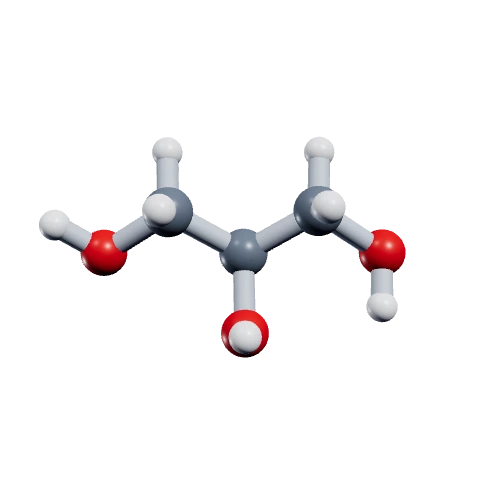
A snow globe is filled with water, usually purified water, often with glycerin added to slow the falling snow. The UK National Poisons Information Service describes how commercial globes changed over time: they “have previously contained fine fragments of bone/porcelain in distilled water. More recently however, contents have changed to calcium carbonate in distilled water with added glycerol to slow the fall of the fragments.” Glycerol and glycerin are the same molecule, propane-1,2,3-triol, CAS 56-81-5.
Some store-bought globes contain something else as well. The Tennessee Poison Center surveyed manufacturers and reported that “Four of 11 Snow Globe manufacturers companies reported the use of Ethylene Glycol (13% to 20%) during manufacturing.” Ethylene glycol is automotive antifreeze, and makers add it to stop globes freezing in transit. We come back to why you should never put it in a homemade globe in the safety section.
The very first snow probably wasn’t glitter at all. The Vienna firm that made the snow globe famous, Original Wiener Schneekugel, says Erwin Perzy I, who started it, was trying to brighten the new carbon-filament electric lamp with a water-filled glass “cobbler’s globe”, a glass ball of water that worked like a magnifying lens. He tried different powders in the water. One was semolina, which sank slowly and reminded him of snowfall. He called the result a “glass globe with snow effect” and founded his workshop around 1900. According to the US commissioners’ report on the 1878 Paris Exposition, as quoted by Mental Floss, snow-filled glass paperweights had already been shown there, with “a white powder which, when the paper weight is turned upside down, falls in an imitation of a snow storm.” The Perzy family still runs the Vienna firm and keeps its snow recipe a family secret.
Why do you need glycerin in a snow globe?
Glycerin makes the liquid thicker, so the glitter sinks more slowly and the “snow” lasts longer after each shake. It does this in two ways at once, and both come out of one equation.
When a small particle sinks through a liquid, it quickly reaches a steady speed where its weight is balanced by the drag of the liquid. George Stokes worked out that speed for a small sphere in 1851. As a Kent State University geology lecture puts it, “To get settling velocity, just balance the two forces, and solve for v!” The result is:
v = g · D² · (ρglitter − ρliquid) ÷ (18 · μ)
Here v is the fall speed, g is gravity, D is the particle size, the two ρ are the densities of glitter and liquid, and μ is the viscosity of the liquid, its thickness. Glycerin attacks the speed from both sides:
- It raises viscosity (μ, the bottom of the fraction). Pure glycerin is about 1,400 times as viscous as water at 20 °C.
- It narrows the density gap (the top of the fraction). Glycerin weighs about 1.26 g/mL against water’s 1.00, so the liquid gets closer to the weight of the glitter. Most craft glitter is cut from metallized polyester (PET) film. A 2026 review in Biology describes glitter as “typically flat, highly reflective, multi-layered,” and PET film weighs about 1.39–1.40 g/cm³ on manufacturer datasheets.
Stokes’ law is exact only for small spheres moving slowly, and glitter is a flat flake. A TU Delft lecture on particle settling notes that “The non-spherical shape of a particle reduces its settling velocity.” Flat flakes also wobble and tumble on the way down, which is what makes a snow globe look like snow. So read the numbers below as relative estimates, not stopwatch times.
How fast glitter falls, relative to plain water (estimate)
Our calculation from Stokes’ law, using PET at 1.39 g/mL and the 20 °C density and viscosity tables published by the Glycerine Producers’ Association (Segur and Oberstar data). Real flakes fall slower than spheres and flutter, so these are ratios, not times.
The short version: fall speed is the density gap divided by the thickness of the liquid. Glycerin makes the liquid thicker and closes the gap at the same time, so at a 1 : 3 ratio the glitter falls about three times slower than in water.
How much glycerin do you put in a snow globe?
Use about 1 part glycerin to 3 parts water by volume, then test and adjust. That is roughly 25% glycerin by volume, or about 30% by weight, and it gives a liquid about 2.5 times as viscous as water.
That is a lot more than most tutorials suggest, and here is why we disagree with them. The standard table for glycerin and water viscosity comes from a 1951 study by Segur and Oberstar, reproduced in the Glycerine Producers’ Association booklet Physical Properties of Glycerine and Its Solutions. It shows that viscosity barely moves at low concentrations and then climbs very steeply:
| Glycerin, % by weight | Viscosity at 20 °C (cP) | Times thicker than water | Density (g/mL) |
|---|---|---|---|
| 0 (water) | 1.005 | 1.0 | 0.998 |
| 10 | 1.31 | 1.3 | 1.022 |
| 20 | 1.76 | 1.8 | 1.047 |
| 30 | 2.50 | 2.5 | 1.073 |
| 40 | 3.72 | 3.7 | 1.099 |
| 50 | 6.00 | 6.0 | 1.126 |
| 70 | 22.5 | 22 | 1.181 |
| 90 | 219 | 218 | 1.235 |
| 100 | 1,410 | 1,403 | 1.261 |
Viscosity: Segur and Oberstar (1951) via the Glycerine Producers’ Association, Table 17. Density: Bosart and Snoddy via the same booklet, Table 3. The booklet itself notes “there is some disagreement in data from various sources.”
Now translate the popular recipes into those units (our arithmetic, using 1 US cup = 236.6 mL, 1 teaspoon = 4.93 mL and glycerin at 1.26 g/mL):
| Recipe says | Glycerin by weight | Thickness vs water | What you will see |
|---|---|---|---|
| “A few drops” or “a dash” | ~0.1% | ~1.0× | No visible change |
| 2–3 tsp per cup of water | ~5–7% | ~1.15–1.25× | Slightly slower |
| 1 part glycerin : 4 parts water | ~24% | ~2× | Clearly slower |
| 1 part glycerin : 3 parts water | ~30% | ~2.5× | Slow, even snowfall |
| 1 part glycerin : 2 parts water | ~38% | ~3.5× | Very slow, dreamy |
| 1 part glycerin : 1 part water | ~55% | ~8× | Glitter hangs; may cling to the figure |
Percent by weight and percent by volume are not the same thing for glycerin, because it is denser than water. The booklet’s conversion table shows that 30% by weight is only 25.5% by volume. When a recipe gives a percentage, it matters which one it means. Measuring by volume with a measuring cup, as most people do at home, a 1 : 3 mix lands close to 30% by weight.
Can you add too much? Several craft writers say yes. Martha Stewart’s recipe warns, “Don’t add too much, or the glitter will stick to the bottom of the jar when it’s flipped,” and Practically Functional says “If the glitter clumps up in a mound at the bottom of the jar, you have too much glycerine.” We have not measured that effect, but it fits the table: above about 1 : 1 the liquid gets syrupy fast. That is why we suggest starting at 1 : 3 and test-shaking before you seal.
How do you make a snow globe?
You make a snow globe by fixing a waterproof figure to the inside of a jar lid, filling the jar with a glycerin and deionized water mix and a little glitter, and sealing the lid so it cannot leak. The whole job takes about 30 minutes of work plus the drying time of your adhesive.
What you need (one pint jar)
- A clean glass jar with a screw lid, about 1 pint (16 oz). Smooth-sided jars give the clearest view.
- A small waterproof figure: plastic, resin or glazed ceramic. No bare metal, paper or painted wood.
- ½ cup Glycerin USP Grade
- 1½ cups Deionized Water ACS Reagent Grade
- 1–2 teaspoons of fine plastic glitter, or a mix of fine and chunky
- Waterproof two-part epoxy or clear silicone sealant, and fine sandpaper
That makes 2 cups of liquid at 1 : 3, enough for one pint jar or two half-pint jars. A 1 quart bottle of glycerin is enough for about eight pint globes at this ratio.
- Prepare the lid. Rough up the inside of the lid with sandpaper so the adhesive can grip. Martha Stewart’s method does the same: “Sand the inside of the lid until the surface is rough.”
- Fix the figure. Glue the figure to the center of the lid with waterproof epoxy or silicone. Check that it fits through the mouth of the jar, and let the adhesive harden fully, following the time on the package. Hot glue is the weak point in many recipes; one blogger reported “We used hot glue on some jars which worked, but some did not hold.”
- Mix the liquid separately. Stir ½ cup glycerin into 1½ cups deionized water in a measuring jug until there are no oily-looking swirls. Glycerin is thick and sinks, so stir for a full minute.
- Test-shake before you commit. Pour the mix into the jar, add the glitter, screw the lid on without glue, and turn it over. Too fast? Add a little glycerin. Glitter clinging or clumping? Add water. Adjust in small steps.
- Fill almost to the top. Leave a gap of a few millimeters. Many tutorials stress not filling to the brim; the LA County Library guide puts it plainly: “It is important to not fill water all the way to the top!” The figure will push up the level when the lid goes on.
- Seal it. Run a bead of epoxy or silicone around the inside of the lid’s rim and the jar’s threads, screw the lid on tightly, and wipe off any overflow. Let it set right side up (lid on top) so the wet seal is not under liquid pressure.
- Leak-test and flip. Once it has set, turn the jar over onto a paper towel for an hour. A dry towel means a good seal. Then shake it and enjoy the snow.
Why is my snow globe cloudy?
The best-documented cause of a cloudy snow globe is rust from metal inside the jar, followed by impurities in the water. One craft blogger posted this update months after making her globes: “After several months the metal on the bottle brush tree rusted and totally clouded the water.” The Vienna snow globe makers set the same rule for customers who send their own figures: the figure must be waterproof, colorfast and rust-proof.
Water quality is the other suspect. Most makers and repairers recommend purified water. One blogger explains that “Using distilled water to make Christmas snow globes will help to keep the water from getting murky and help reduce the likelihood of any rusting,” and the syndicated columnist Heloise advises refilling a cloudy globe with distilled water. Not everyone agrees: BBC Good Food says “Normal tap water is fine to use, but if you have particularly cloudy water you may wish to use filtered or store-bought water for the clearest effect.” No lab study we found measures how much tap water clouds a globe. Starting with purified water and nothing metal costs very little and removes two variables.

Deionized or distilled? Both are purified water. Distilled water is boiled and condensed; deionized water has its dissolved mineral ions removed by ion-exchange resin. For a snow globe, either removes the dissolved minerals that can leave a haze or film. We explain the difference in detail in Distilled vs. Deionized Water and how deionized water is made in this guide. The same logic applies to humidifier water.
Glycerin will not keep a globe from going cloudy. Some tutorials suggest it works as a preservative, but at snow globe strength it does not. The Glycerine Producers’ Association table of humidity over glycerin solutions puts even a 33% mix at about 90% relative humidity, a water activity of about 0.90. Clemson Cooperative Extension lists organisms such as Salmonella as able to grow at 0.91 and most molds at 0.80. A 1 : 3 globe is not a preserved liquid. One manufacturer surveyed by the Tennessee Poison Center added a separate additive against algae instead.
Can a snow globe freeze?
Yes. A water-only snow globe freezes at 32 °F, and water expands as it freezes, which can crack the glass or push out the seal. Glycerin lowers the freezing point, which is a side benefit of using enough of it. The standard freezing-point curve (Lane, reproduced by the Glycerine Producers’ Association and in the US Hazardous Substances Data Bank) gives these values:
| Mix | Glycerin by weight | Freezes at about |
|---|---|---|
| Plain water | 0% | 0 °C / 32 °F |
| Blog dose (3 tsp per cup) | ~7% | −1 °C / 30 °F |
| 1 : 3 glycerin to water | ~30% | −9.5 °C / 15 °F |
| 1 : 2 glycerin to water | ~38% | −14 °C / 6 °F |
| 50% by weight | 50% | −23 °C / −9 °F |
The 1 : 2 row is interpolated by us. Laboratories differ by a few degrees at higher strengths: at 50% by weight, values range from −23.0 °C to −28.8 °C in the booklet’s comparison table.
Pure glycerin behaves oddly here. It freezes near 18 °C (65 °F) but rarely does, because, in the booklet’s words, it has a “tendency to supercool.” The lowest freezing point of all is a mix of about two-thirds glycerin and one-third water, at about −46.5 °C. You will never need that in a snow globe, but it explains why glycerin is a freeze-protection ingredient in many products.
This is also why commercial makers turned to antifreeze. The UK poisons service notes: “Manufacturers have also started adding ethylene glycol, reportedly up to 20% of the volume of water to reduce the risk of freezing during transit or storage.” For a homemade gift, a 1 : 3 or 1 : 2 glycerin mix gives meaningful protection without it. We cannot promise a globe will survive any particular trip, so wrap it well and avoid leaving it in an unheated place in a deep freeze.
How do you make a homemade snow globe without glycerin?
You can slow glitter without glycerin by thickening the water with something else that dissolves in it, such as light corn syrup or clear school glue. Craft writers name both; one says “You can make snow globes with clear glue, water, or light corn syrup.” They work on the same principle, thickening the water, but they are less predictable: corn syrup can tint the water, and glue can haze it.
Some recipes, including BBC Good Food’s and a public library handout, suggest baby oil or vegetable oil instead. Oil does not mix with water, so you end up with two layers rather than one thick liquid. If you use oil, use it alone, not with water.
Propylene glycol, which we also sell, is another water-miscible liquid that thickens water. It is listed in 21 CFR 184.1666 as a food stabilizer and thickener. We do not print a viscosity figure for it here because we could not verify one from a primary source. Glycerin is the better-documented choice, with published tables for every strength. If you are curious how the two compare in other uses, see our fog fluid guide, which uses both.
Never use antifreeze or ethylene glycol. It may be in some store-bought globes, but it does not belong in a homemade one. The ILO-WHO International Chemical Safety Card says ethylene glycol is “Harmful if swallowed May cause damage to kidneys and central nervous system,” and PubChem describes it as “sweet tasting,” which is part of why pets drink it. Our propylene glycol vs ethylene glycol guide explains the difference.
What type of glycerin for snow globes?
Use clear, colorless glycerin of a known purity, and know its strength before you do the ratio math. Glycerin is sold as USP grade (made to the United States Pharmacopeia specification), technical grade, and as pre-diluted solutions.
- Glycerin USP Grade is our pick for a kitchen-table craft, especially with children helping. It is made to a published pharmacopeia standard, and it is the strength the ratios in this guide assume.
- Glycerin Technical Grade thickens water just the same. It is intended for industrial use and is a sensible choice for large batches of decorations.
- Pre-diluted glycerin, such as a 50% solution, is already part water. You need roughly twice as much of it for the same result. Check the label for whether the percentage is by weight or by volume before you calculate.
Glycerin is listed by the FDA in 21 CFR 182.1320, which says it “is generally recognized as safe when used in accordance with good manufacturing practice.” That status is about glycerin as a food ingredient. It is not a reason to drink snow globe liquid, which also holds glitter, adhesive and whatever was on the figure. Glycerin is also “hygroscopic”, meaning it pulls moisture from the air, so keep the bottle capped between uses. For more on grades, see Understanding Chemical Grades and our complete guide to glycerin.
Are snow globes safe?
A homemade snow globe made with glycerin and purified water is a low-risk craft, but glass, sunlight and store-bought liquids each carry a real hazard worth knowing. Here is what the records show.
Sunlight can start a fire. A round globe of liquid is a lens, which is exactly what Perzy’s cobbler’s globe was. The US Consumer Product Safety Commission has recalled snow globes for it. Hallmark’s 2008 recall said: “When exposed to sunlight, the snow globe can act as a magnifying glass and ignite nearby combustible materials, posing a fire hazard,” and the company had “received two reports of the snow globes igniting nearby materials.” Coldwater Creek recalled globes in 2018 because “Light refraction through the globes can singe or melt items in contact with or in the immediate proximity.” Keep globes off sunny windowsills and away from curtains in direct sun.
Glass can crack. The Museum of Modern Art recalled about 1,915 glass snow globes in 2024 because they “can crack or fracture, posing a laceration hazard.” Use a sturdy jar, avoid freezing, and let an adult handle the glass.
Store-bought liquid may contain antifreeze. If a store-bought globe breaks, the Northern New England Poison Center says to call Poison Help at 1-800-222-1222 if anyone swallows the liquid, and a veterinarian if a pet licks it up. The UK poisons service reviewed 50 cases, 47 of them in children under five, and found “Forty two (84%) patients were asymptomatic.” The risk is low, but not zero.
Glycerin stings in the eyes. PubChem’s toxicology record notes that glycerin dropped in the eye “causes a strong stinging and burning sensation, with tearing”. Have an adult do the pouring, and rinse with water if any splashes.
Flying with a snow globe? The TSA allows a snow globe in a carry-on only if it holds about 3.4 oz of liquid or less, roughly tennis-ball size, and the whole globe, base included, fits in your one quart-size resealable bag. “Larger snow globes must be packed in checked baggage.” A pint jar globe goes in the checked bag, or in the mail.
How we researched this
We read the sources below on 2 November 2026. Glycerin and water viscosity, density, freezing point, humidity and refractive index come from the Glycerine Producers’ Association booklet Physical Properties of Glycerine and Its Solutions (Segur and Oberstar, Bosart and Snoddy, and Lane data), checked against PubChem’s Hazardous Substances Data Bank record. Settling physics comes from university lecture notes from Kent State and TU Delft; glitter composition from a 2026 peer-reviewed review and PET film datasheets. Safety information comes from CPSC recall records, the UK National Poisons Information Service, the Tennessee and Northern New England poison centers, ILO-WHO chemical safety cards, eCFR and the TSA. Craft practice comes from Martha Stewart, BBC Good Food, Practically Functional, the LA County Library and makers’ blogs, and history from the Original Wiener Schneekugel firm and Mental Floss. The conversions of recipe doses to weight percent, the fall-speed ratios, and the 1 : 2 freezing point are our own arithmetic from those tables. Where sources disagree, as on tap water and on how much ethylene glycol commercial globes contain, we say so. Product names and pack sizes come from our live catalog. The photographs in this article are illustrations, not test results.
Sources
- Physical Properties of Glycerine and Its Solutions, Glycerine Producers’ Association, hosted by the American Cleaning Institute
- Glycerol (CID 753), PubChem, National Library of Medicine
- Lecture 11: Introduction to Settling Velocity, Department of Geology, Kent State University
- Dredge Pumps and Slurry Transport, Lecture 01B, TU Delft OpenCourseWare (2004)
- Futia, Pastorino et al., review of conventional and alternative glitter, Biology (2026)
- Mylar technical data, TAP Plastics
- Harbon et al., Behind the scenes of snow globe toxicity, UK National Poisons Information Service (2016)
- What are the concerns when snow globes break?, Tennessee Poison Center, Vanderbilt University Medical Center (2017)
- Broken snow globe? There may be more than water inside, Northern New England Poison Center
- Hallmark Recalls Jumbo Snow Globes Due to Fire Hazard, US Consumer Product Safety Commission (2008)
- Coldwater Creek Recalls Snow Globes Due to Fire Hazard, US Consumer Product Safety Commission (2018)
- The Museum of Modern Art Recalls Glass Snow Globes Due to Laceration Hazard, US Consumer Product Safety Commission (2024)
- ICSC 0270 Ethylene glycol, ILO-WHO International Chemical Safety Cards
- 21 CFR 182.1320 Glycerin, Electronic Code of Federal Regulations
- 21 CFR 184.1666 Propylene glycol, Electronic Code of Federal Regulations
- What Can I Bring? Snow Globes, Transportation Security Administration
- Available Moisture in Foods, Clemson Cooperative Extension (2018)
- Geschichte (History), Original Wiener Schneekugel, Vienna
- A Brief History of Snow Globes, Mental Floss
- Snow Globes, Martha Stewart
- How to make a snow globe, BBC Good Food
- How to Make a Snow Globe, Practically Functional
- DIY Snow Globe activity, LA County Library (2025)
- DIY Snow Globe, Hearth and Vine
- How to make Christmas snow globes, The Sweetest Occasion
- Beauty and the Beast inspired snow globe, The Keeper of the Cheerios (2017)
- How to make a snow globe without glycerin, Mothercould
- Heloise, Don’t let cloudy water rain on your snow globe, Post Bulletin (2013)
Frequently asked questions
Why do you need glycerin in a snow globe?
Glycerin makes the water thicker and closer in weight to the glitter, so each flake sinks more slowly. By Stokes' law, a 1 : 3 glycerin to water mix slows the fall about three times compared with plain water. Without glycerin, glitter drops to the bottom in a few seconds.
How much glycerin do you put in a snow globe?
Start with 1 part glycerin to 3 parts water by volume, for example ½ cup glycerin to 1½ cups water. That is about 30% by weight and about 2.5 times as viscous as water. A few drops or a teaspoon or two per cup changes the thickness by only about 0–25%, which is why those globes still snow fast.
How do you make a homemade snow globe without glycerin?
Thicken the water with another water-soluble ingredient, such as light corn syrup or clear glue, and test-shake before sealing. Both work but can tint or haze the liquid. Oil does not mix with water, so do not combine the two, and never use antifreeze.
What type of glycerin for snow globes?
Use clear, colorless glycerin of known strength. USP grade is a good choice for a home craft and matches the ratios in this guide. If you use a pre-diluted glycerin, such as a 50% solution, use about twice as much.
What liquid is in a store-bought snow globe?
Usually purified water, often with glycerin to slow the snow, and calcium carbonate or plastic flakes as the snow. Some manufacturers have also added ethylene glycol (antifreeze), reported at 13–20%, to stop freezing in transit, so handle the liquid from a broken store-bought globe with care.
Can I use tap water in a snow globe?
You can, and BBC Good Food says it is fine, but most makers and repairers recommend distilled or deionized water to keep the globe from going murky over time. Purified water removes dissolved minerals from the list of things that can cloud the globe. Avoid metal parts inside the jar, which are the best-documented cause of cloudiness.
Why did my glitter clump at the bottom?
Usually there is too much glycerin, or too much glitter. Several craft writers report that glitter sticks to the bottom or clumps when the mix is too strong. Pour off some liquid, add water, and use a teaspoon or two of glitter rather than a heap.
Will a homemade snow globe freeze in the mail?
A water-only globe freezes at 32 °F. A 1 : 3 glycerin mix freezes at about 15 °F and a 1 : 2 mix at about 6 °F, which helps, but no ratio can rule out every cold trip. Pack the globe well and avoid long stays in unheated places in a hard freeze.
Can you take a snow globe on a plane?
Only small ones in a carry-on. The TSA allows a snow globe in a carry-on bag if it holds about 3.4 oz of liquid or less and the whole globe, base included, fits in your quart-size bag. Larger globes must go in checked baggage.
How do you fix a cloudy snow globe?
If the globe can be opened, empty it, rinse the jar and figure, remove or seal any metal parts, and refill with a fresh glycerin and deionized water mix. Heloise suggests refilling with purified water using a turkey baster. If metal has rusted inside, cloudiness will come back until the metal is gone.
Related Chemical Collections
About the author
Andre Taki
This article is for informational purposes only.


