



Every week somebody orders a 55-gallon drum of deionized water, opens it, draws off two gallons, and leaves the rest sitting in the shop with the bung loose. Six weeks later they call because a rinse step stopped passing, or a coolant blend came out of spec, and they want to know whether we shipped them bad water.
We did not. What they are running into is the single most counter-intuitive property of the product: deionized water is the only thing on our shelf that begins losing its specification the instant you open the container — not over months, but over minutes. Understanding why explains almost everything else people find confusing about DI water, including why you cannot practically make it at home, why distilled is not a drop-in substitute, and why choosing a pack size is an engineering decision rather than a purchasing one.
What is deionized water?
Deionized water is water that has had its dissolved mineral ions removed by ion exchange — the calcium, magnesium, sodium, potassium, chloride, sulfate, nitrate and bicarbonate that ordinary water picks up from rock, soil and pipe. What is left is water plus whatever non-ionic material the process was never designed to catch.
That last clause is the part that matters, and it is the part almost every consumer-facing explanation leaves out. Deionization is not a filter and it is not a purification method in the general sense. It is a chemically specific operation that targets ions. Dissolved organic carbon, particulates, bacteria, pyrogens and dissolved gases are largely unaffected by it. Water can leave a deionizer reading a beautiful number on a resistivity meter and still be entirely wrong for your application.
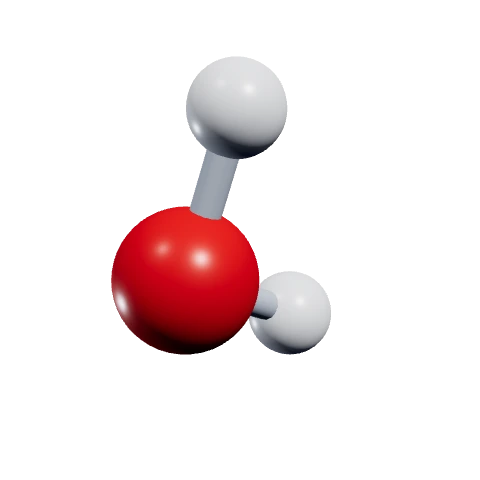
Chemical identity: water, H₂O, CAS 7732-18-5. Deionization does not change the substance — it changes what else is dissolved in it. "Deionized water" is a statement about process and purity, not about a different molecule.
Practically, that gives you a simple mental model. Tap water is water plus minerals plus organics plus gases plus microbes. Deionized water is that same water with the ionic column emptied out. Whether that is sufficient depends entirely on which column your process is sensitive to — and for a lot of industrial work, ions are exactly the column that matters, because ions are what conduct, what scale, what corrode, and what interfere with an analytical measurement.
How is deionized water made?
Deionized water is made by passing feed water through ion-exchange resin, which trades the dissolved ions for hydrogen and hydroxide — the two ions that simply recombine into more water. The contaminants are not strained out. They are swapped.
There are two resin beds doing two halves of the job:
- Cation resin, charged into its hydrogen (H⁺) form, holds onto incoming positive ions — Ca²⁺, Mg²⁺, Na⁺ — and releases H⁺ in their place.
- Anion resin, charged into its hydroxide (OH⁻) form, holds onto incoming negative ions — Cl⁻, SO₄²⁻, HCO₃⁻ — and releases OH⁻ in their place.
The H⁺ and OH⁻ released into the stream then do the obvious thing: they combine to form H₂O. The dissolved solids end up bound to the resin, and the water leaving the column is measurably less conductive than the water that went in. That is the whole trick, and it is elegant precisely because the by-product of the exchange is the product itself.
Two-bed vs. mixed-bed. Running the cation and anion resins as separate vessels (two-bed) is cheaper to regenerate but leaves a higher residual, because the water sees each chemistry only once. Blending both resins into a single vessel (mixed-bed) is effectively thousands of tiny cation/anion stages in series, which is how the highest resistivities are reached. Most high-purity DI water sees a mixed bed as its final polish.
Resin does not last forever. Every ion it captures occupies a site, and when the sites are full the bed is exhausted and has to be regenerated — the cation resin with a strong acid to force it back into the hydrogen form, the anion resin with caustic to force it back into hydroxide. That is why a water-treatment plant is, underneath, an acid-and-caustic consumer; it is the same logic that puts hydrochloric acid aboard a nuclear submarine and keeps caustic soda on the consumables list of every demineralizer program in the country.
Distillation gets to a similar destination by a completely different road — boiling the water and condensing the vapour, so the non-volatile material is left behind in the pot. Different mechanism, different residual profile, and the difference has real consequences; there is a section on that below.
Why does deionized water go bad after you open the drum?
Because you removed the ions that were keeping it stable, and water with nothing dissolved in it is one of the most aggressive solvents in an ordinary industrial building. Purity, in this one case, is not a stable state. It is a stressed one.
Think about what drives dissolution. A solvent that already carries a load of dissolved material has little thermodynamic appetite for more. Strip that load out and you have created the opposite condition — maximum driving force to dissolve the first thing available. In a warehouse, the first thing available is the atmosphere.
Air is roughly 0.04% carbon dioxide, and CO₂ is appreciably soluble in water. Once dissolved it does not sit there inertly; it hydrates to carbonic acid, which dissociates:
CO₂ + H₂O ⇌ H₂CO₃ ⇌ H⁺ + HCO₃⁻
Those are ions. You spent money and resin capacity removing ions, and the air puts them back for free. Because resistivity is an ionic measurement, the meter registers the loss immediately.
In a classic demonstration, ultrapure water at 18.2 MΩ·cm left open in a beaker falls to roughly 4 MΩ·cm in about one hour from atmospheric CO₂ alone. Its pH drifts from 7.0 down toward roughly 5.6. Source: Sigma-Aldrich / Merck, lab water contaminants.
Read that number again in operational terms. It is not a shelf-life measured in months. An open container of high-purity DI water loses most of its headline resistivity inside a coffee break. Nothing has gone wrong, nobody contaminated it, and the drum was not defective. It simply did the thermodynamically obvious thing.
To be clear about what this does and does not mean: a sealed container is stable. The exchange that degrades deionized water requires contact with atmosphere, so water filled and closed at the plant stays on specification in an unopened drum or tote for a long and perfectly ordinary shelf life — which is why we ship it in sealed containers, with the certificate of analysis for the lot on request at no charge. The clock this section describes starts when you break the seal. Everything below is about what happens after that moment, not about what arrives on your dock.
Carbon dioxide is only the fastest offender. The same driving force works on everything the water touches:
- Container walls. DI water will pull ions out of glass and out of many metals. This is why high-purity water is shipped and stored in HDPE rather than steel, and why a "clean" stainless bucket is not a neutral vessel.
- Plumbing and fittings. Brass fittings, galvanised line and solder joints all donate ions to water that badly wants them.
- Airborne dust and organics. Not ionic, so the resistivity meter will not warn you, which makes this failure mode quieter and in some applications worse.

The practical rule: headspace is the enemy. A drum that is half air is a drum that is half-committed to equilibrating with that air. If a container will be open and drawn down over weeks, you are not storing DI water — you are storing water that is slowly returning to being ordinary. Match the pack size to the burn rate, keep it sealed between draws, and dispense closed where you can.
How pure is deionized water — and what do the numbers actually mean?
DI water purity is reported as electrical resistivity in megohm-centimetres, because ions are what carry current — so the harder the water is to conduct through, the fewer ions it contains. It is an indirect measurement that happens to be fast, continuous and cheap, which is why the entire industry standardised on it.
The scale has a hard ceiling. Water self-ionises very slightly into H⁺ and OH⁻, so even theoretically perfect water conducts a little. That floor of conductivity corresponds to 18.2 MΩ·cm at 25 °C — about 0.055 µS/cm. You cannot beat it, and any claim above it is a calibration problem rather than a purity achievement.
| Parameter | ASTM D1193 Type I reagent water | What it tells you |
|---|---|---|
| Resistivity at 25 °C | ≥ 18 MΩ·cm | Ionic load only. Says nothing about organics, particles or microbes. |
| Conductivity at 25 °C | ≤ 0.056 µS/cm | The same measurement expressed as its reciprocal. |
| Total organic carbon (TOC) | < 50 ppb | The column resistivity is blind to. Matters in analytical and semiconductor work. |
| Reference temperature | 25 °C | Not optional. Resistivity is strongly temperature-dependent; an uncompensated reading is not comparable. |
ASTM D1193 defines four types of reagent water, of which Type I is the most stringent; the full specification is worth buying if you are writing a method against it. The figures above are the Type I limits, and the standard itself is the authority — see ASTM D1193.
What we actually ship. Alliance Chemical’s Deionized Water is supplied as ACS Reagent Grade, and every order carries a certificate of analysis tied to the lot number on your container. If your method is written against a specific standard, read the CoA against the method rather than against a marketing adjective — that is what the document is for.
And the honest limitation, because it is the one that causes real failures: a resistivity meter is blind to everything that is not an ion. Water can read 18 MΩ·cm while carrying organic carbon, particulates or bacteria that will wreck a rinse step or a culture. If your sensitivity is organic rather than ionic, resistivity is the wrong instrument to be reassured by.
Is deionized water the same as distilled water?
No — they are produced by different mechanisms and leave behind different residuals. Distillation is a phase change: the water is boiled and the vapour condensed, so anything that will not travel as vapour stays in the pot. That removes dissolved minerals, but it also carries over anything volatile enough to ride along with the steam. Deionization is a chemical exchange that is ruthless about ions and indifferent to everything else. The result is that DI water usually reaches a far higher resistivity, while distilled water can be the better choice where non-ionic and biological content is the concern.
Which one your process wants is a genuine engineering question with a longer answer than belongs here. We wrote the head-to-head separately: Distilled vs. Deionized Water: Which High-Purity Water Is Right for Your Application.
Can you drink deionized water?
It is not sold, tested or labelled as drinking water, and there is no good reason to drink it. That is the answer that matters commercially, and it is worth separating from the folklore that surrounds this question.
The internet tends to argue two extremes: that DI water is dangerous and will strip minerals out of your body, or that it is identical to bottled water. Neither is a useful frame. Small incidental exposure is not the hazard it is often made out to be. But DI water carries no mineral content, tastes flat and metallic to most people, and is chemically aggressive toward the plumbing and containers it sits in — which is precisely why a product intended for drinking would be re-mineralised before packaging.
The practical position: our Deionized Water and Battery Water are supplied as industrial and reagent-grade products for process use. They are not drinking-water products, they are not produced under a drinking-water program, and they should not be substituted into one. If you need water for people, buy water that is sold and labelled for people.
Can you make deionized water at home?
You can make something. You cannot hold a specification. Small DI cartridges are genuinely available and genuinely work for a while — the chemistry does not care whether the resin is in a treatment plant or a plastic canister on a bench. The problem is not making the water. The problem is knowing when you have stopped making it.
Three failure modes account for nearly every DIY disappointment we hear about:
- Resin exhausts silently, and then it does something worse than nothing. As a bed approaches capacity it stops being uniformly effective and begins to pass ions through — breakthrough. There is no colour change, no alarm, no drop in flow. The water still looks exactly like water.
- Without a meter you are flying blind. Resistivity is the only cheap way to know what you have, and if you are not measuring continuously you are asserting a specification rather than verifying one. This is the real reason home DI is unsuitable for anything that has to be defensible.
- Nothing controls the non-ionic column. No TOC control, no microbial control, no particulate control, and — per the section above — no protection at all once the water hits room air.
There is also a cost illusion worth naming. People compare the price of resin against the price of purchased water and conclude that DIY wins. That comparison is almost never the real one. The cost that decides it is the batch you scrap, the rinse you redo, the analytical run you repeat, or the coolant loop you flush because water you believed was in spec was not. A purchased lot of water should have a certificate of analysis attached to its lot number, which is not a formality — it is the audit trail that lets you rule the water out when something downstream goes wrong.
What is a substitute for deionized water — and what does substituting cost you?
There is no universal substitute, because "pure" is not one property. The right question is never "what else is clean?" but "which contaminant is my process actually sensitive to?" Answer that and the substitution question usually answers itself.
| Application | What it is sensitive to | Is distilled acceptable? | Is tap ever acceptable? |
|---|---|---|---|
| Lead-acid battery top-off | Dissolved metals and chloride reaching the plates | Usually yes | No — minerals accelerate plate contamination and self-discharge |
| Glycol coolant dilution (industrial, data-centre) | Ions that consume inhibitor and seed corrosion | Acceptable, DI preferred | No — hardness and chloride shorten inhibitor life |
| Electronics and PCB rinsing | Ionic residue left after dry-off | Generally inadequate | No |
| Analytical and reagent preparation | Ions and organic carbon that bias the measurement | Not equivalent; the method decides | No |
| Steam raising and humidification | Hardness that deposits as scale | Yes | Only with treatment |
| Cosmetic and personal-care formulation | Ions that destabilise emulsions; microbial load | Depends on the formulation | No |
| Solar panel and glass final rinse | Minerals that dry as visible spotting | Yes | No — spotting is the entire failure mode |

Reverse-osmosis permeate deserves a note of its own, because it is the substitution people reach for most often. RO removes the large majority of dissolved solids and is an excellent pre-treatment — most DI systems are fed by RO precisely because it protects the resin and extends its life. What RO permeate is not is a finished high-purity water. It typically lands orders of magnitude short of Type I resistivity. Feeding a polisher with it is correct; treating it as the polished product is not.
What is deionized water used for?
DI water is used wherever dissolved ions would either interfere with a measurement, deposit as scale or residue, or drive corrosion. Those three consequences cover most of the industrial demand.
- Coolant and heat-transfer blending. Glycol concentrates are diluted with DI water so the inhibitor package is not spent neutralising the water itself. See Propylene Glycol + DI Water in Thermal Systems and the glycol inhibitor chemistry guide.
- Battery maintenance. Topping off flooded lead-acid cells, where tap-water minerals accumulate on the plates. See Battery Acid vs. Battery Water.
- Electronics and semiconductor rinsing. Final rinses where any ionic residue left behind after drying becomes a defect.
- Laboratory reagent preparation. Making up standards and dilutions, where the water must not contribute to the result. See The Chemist’s Guide to Dilution.
- Glass and panel cleaning. Spot-free final rinses, including solar panel and connector cleaning.
- Data-centre thermal loops. Where water chemistry is a design parameter rather than a consumable. See Direct-to-Chip vs. Immersion Cooling.
How much deionized water should you buy at once?
Pack size is a specification decision, not a purchasing decision — because of everything in the degradation section above. This is the one place where buying in bulk can actively work against you, and it is worth being blunt about it.
The instinct is to take the largest container available and enjoy the lower unit cost. For most chemicals that instinct is right. For DI water it is right only if you will consume the container quickly, or dispense from it without repeatedly opening it to atmosphere. A 55-gallon drum drawn down two gallons at a time over a year will spend most of that year as a partially full vessel equilibrating with room air, and the water at the end will not be the water you paid for.
A workable way to size it:
- Match the container to the burn rate. Aim to finish a container in weeks rather than seasons. Several smaller units often beat one large one on delivered quality even where they lose on unit price.
- Dispense closed where the application justifies it. A pump or a spigot that limits air exchange preserves far more of the specification than pouring from an open bung.
- Reseal immediately, every time. The degradation clock runs while the container is open, and it runs fast.
- Do not decant into metal. Buckets and funnels are containers too, and DI water will take ions from them.
- Keep the CoA with the lot. When something downstream goes wrong, the ability to rule the water in or out immediately is worth more than the paperwork costs you.
We stock the full ladder from 1 quart to 330-gallon IBC totes precisely so this can be an engineering choice. Current sizes and pricing live on the product pages — Deionized Water: bulk and lab sizes — rather than in an article that would be out of date by the time you read it.
Key numbers and sources
| Fact | Value | Source |
|---|---|---|
| Chemical identity | Water, H₂O — CAS 7732-18-5 | PubChem CID 962 |
| Theoretical maximum resistivity | 18.2 MΩ·cm at 25 °C (≈ 0.055 µS/cm) | Self-ionisation limit of pure water |
| ASTM D1193 Type I resistivity | ≥ 18 MΩ·cm at 25 °C | ASTM D1193 |
| ASTM D1193 Type I TOC | < 50 ppb | ASTM D1193 |
| Resistivity loss in open air | 18.2 → ~4 MΩ·cm in about 1 hour | Sigma-Aldrich / Merck |
| pH drift from atmospheric CO₂ | 7.0 down toward ~5.6 | Puretec |
| Atmospheric CO₂ concentration | ~0.04% by volume | NOAA Global Monitoring Laboratory |
| Alliance grade supplied | ACS Reagent Grade | Product specification |
| Pack range | 1 quart to 330-gallon IBC tote | Deionized Water sizes |
References & authoritative sources
- Water — thermophysical data — NIST Chemistry WebBook, SRD 69, National Institute of Standards and Technology. Accessed 2026-09-04.
- ASTM International. D1193 — Standard Specification for Reagent Water. store.astm.org
- Sigma-Aldrich / Merck. Water Contaminants: Types, Sources and Impacts in the Lab. sigmaaldrich.com
- Thermo Fisher Scientific. Ultrapure Water Myths. fishersci.com (PDF)
- Puretec Industrial Water. The Relationship Between pH and Deionized Water. puretecwater.com
- National Center for Biotechnology Information. PubChem Compound Summary: Water, CID 962. pubchem.ncbi.nlm.nih.gov
- NOAA Global Monitoring Laboratory. Trends in Atmospheric Carbon Dioxide. gml.noaa.gov
Deionized water from Alliance Chemical
ACS Reagent Grade deionized water, from 1 quart to a 330-gallon tote. Certificate of analysis on request at no charge, tied to the lot number on your container. Tell us the application and we will help you size the pack to your burn rate — on this product that is a specification question, not a discount question.
Related reading
- Distilled vs. Deionized Water: Which High-Purity Water Is Right for Your Application
- Battery Acid vs. Battery Water: A Complete Guide for Plant & Fleet Managers
- Propylene Glycol + DI Water in Thermal Systems: The Practical Guide
- How to Clean Solar Panels, Connectors & Cable Terminations
- The Chemist’s Guide to Dilution: From C₁V₁ to Real-World Application
Related: What Water Should You Put in a Humidifier? Distilled, Deionized, Tap Water and the White Dust Problem — what that purity means inside a humidifier, where tap-water minerals become white dust.
Frequently asked questions
What is deionized water?
Deionized water (DI water) is water whose dissolved mineral ions - calcium, magnesium, sodium, chloride, sulfate and bicarbonate - have been removed by passing it over ion-exchange resin. The chemical identity is unchanged: it is still water, H2O, CAS 7732-18-5. Deionization targets ions specifically, so dissolved organics, particulates, bacteria and dissolved gases are largely unaffected by it.
How is deionized water made?
By ion exchange. Cation resin in its hydrogen form captures positive ions and releases H+ in their place; anion resin in its hydroxide form captures negative ions and releases OH-. The released H+ and OH- combine to form more water. Mixed-bed systems blend both resins in one vessel, which is how the highest resistivities are reached. Exhausted resin is regenerated with acid and caustic.
Why does deionized water lose purity after the container is opened?
Because water with nothing dissolved in it is an aggressive solvent, and the nearest thing available is air. Atmospheric carbon dioxide dissolves and forms carbonic acid, which dissociates into H+ and bicarbonate - ions, which is exactly what resistivity measures. Ultrapure water left open falls from 18.2 megohm-cm to roughly 4 megohm-cm in about an hour, and its pH drifts from 7.0 toward about 5.6.
How pure is deionized water, and what does the resistivity number mean?
Purity is reported as electrical resistivity in megohm-centimetres, because ions carry current. The theoretical ceiling is 18.2 megohm-cm at 25 C, about 0.055 microsiemens/cm, set by water's own self-ionisation. ASTM D1193 Type I reagent water requires at least 18 megohm-cm at 25 C and less than 50 ppb total organic carbon. Resistivity is blind to anything that is not an ion.
Is deionized water the same as distilled water?
No. Distillation is a phase change that leaves non-volatile material behind in the pot but can carry over volatiles. Deionization is a chemical exchange that is ruthless about ions and indifferent to everything else. DI water generally reaches much higher resistivity, while distilled water can be preferable where non-ionic or biological content is the concern.
Can you drink deionized water?
It is not produced, tested or sold as drinking water and there is no good reason to drink it. It carries no mineral content, tastes flat, and is chemically aggressive toward plumbing and containers. Alliance Chemical supplies deionized water as an industrial and reagent-grade product for process use, not under a drinking-water program.
Can you make deionized water at home?
You can produce something with a small resin cartridge, but you cannot hold a specification. Resin exhausts silently and begins passing ions through with no visible warning, and without a resistivity meter you are asserting purity rather than verifying it. Nothing in a home setup controls organic carbon, particulates or microbial load, and none of it protects the water once it meets room air.
How much deionized water should I buy at once?
Match the container to how fast you will use it. Because an opened container begins equilibrating with atmospheric carbon dioxide within minutes, a large drum drawn down slowly over months will not deliver the same water at the end that it did at the start. Several smaller containers, or closed dispensing from a larger one, often beat one large open drum on delivered quality.
Related Chemical Collections
About the author
Andre Taki
This article is for informational purposes only.


