

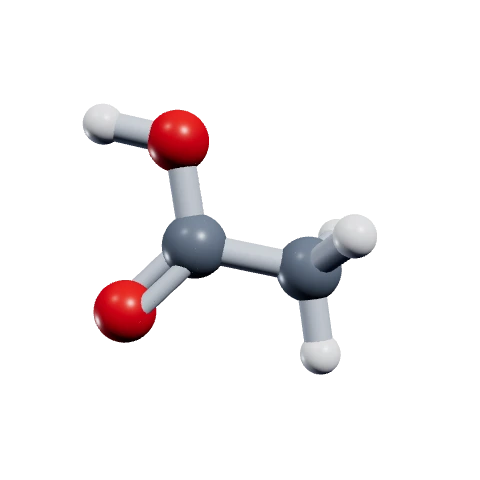


Search for a homemade drain opener and the first answer is always the same: pour in a cup of baking soda, chase it with a cup of vinegar, and watch it foam. The foam is real and it looks like work is happening. The question is what the foam is made of, and whether any of it touches the stuff blocking your pipe. We sell the strong chemicals that do act on clogs, so we have no reason to oversell the kitchen version, and no reason to dismiss it either. Here is the chemistry, with the arithmetic shown.
What happens when baking soda meets vinegar
Baking soda is sodium bicarbonate, NaHCO3, a weak base. Vinegar is acetic acid, CH3COOH, in water. FDA guidance defines vinegar as at least 4 g of acetic acid per 100 mL, and the 5% on a household label means 5 g per 100 mL. An acid and a base react until one of them is gone:
The products are sodium acetate (a salt), water and carbon dioxide. The step in the middle is carbonic acid, H2CO3, which is unstable and falls apart into water and CO2. That gas is the fizz. So the foam you see is the acid and the base cancelling each other out. Nothing in the products is a strong acid or a strong base, and that matters for what comes next.
The reaction runs one molecule to one molecule, which means the amounts have to be balanced by moles, not by cups. Using molar masses from PubChem (NaHCO3 84.007 g/mol, acetic acid 60.05 g/mol), here is what 100 g of baking soda needs to react completely:
| Step | Calculation | Result |
|---|---|---|
| Moles of baking soda | 100 g ÷ 84.007 g/mol | 1.190 mol |
| Acetic acid needed (1:1) | 1.190 mol × 60.05 g/mol | 71.5 g |
| 5% vinegar needed | 71.5 g ÷ 0.05 g/mL | about 1,430 mL, roughly 6 US cups |
| CO2 released | 1.190 mol, ideal gas at 25 °C and 1 atm | about 29 L (52 g) |
| Sodium acetate formed | 1.190 mol × 82.03 g/mol | about 98 g, in roughly 1.4 L of water |
Put plainly, 100 g of baking soda, a bit under half a cup, needs more than a liter of vinegar before the soda is used up.
The popular recipe is not balanced
Arm & Hammer's own recipe page, titled "Deodorize Drain Soda," calls for 1 cup of baking soda, 1 cup of vinegar and 1 cup of warm water. Run that through the same arithmetic. We assumed a cup of baking soda weighs about 220.8 g (a baking conversion chart figure; a scooped cup varies, and we could not confirm it against a USDA record) and that the vinegar is 5%:
- 1 US cup of 5% vinegar is 236.6 mL and holds about 11.8 g of acetic acid, which is 0.197 mol.
- 1 cup of baking soda is about 2.63 mol. The vinegar is the limiting ingredient by a factor of more than 13.
- Only about 16.5 g of the roughly 220 g of baking soda reacts. That is about 7.5%.
- The reaction makes about 4.8 L of CO2, a little over a gallon of gas, and about 16 g of sodium acetate.
If your cup of baking soda weighs 180 g the figure is about 9%, and at 260 g it is about 6%. The conclusion does not move: more than nine-tenths of the baking soda is still baking soda when the foam stops.
| Mix | Baking soda that reacts | CO2 | What is left |
|---|---|---|---|
| 1 cup baking soda + 1 cup 5% vinegar | about 16.5 g of about 220 g (7.5%) | about 4.8 L | Sodium acetate, plus about 200 g of unreacted baking soda |
| 1 cup baking soda + about 13 cups 5% vinegar | All of it | about 64 L | Dilute sodium acetate, no excess acid or base |
| 100 g baking soda + about 6 cups 5% vinegar | All of it | about 29 L | About 0.8 M sodium acetate |
The Arm & Hammer page is about deodorizing, and we will come back to that. It does not claim the recipe clears a blockage.
What is left in the drain
Take the best case, where the two reagents are mixed in exact balance. The leftover is dilute sodium acetate. Acetic acid has a pKa of 4.76, so its salt is the conjugate base of a weak acid and makes a slightly basic solution. From the dissociation constant, a solution of about 0.83 M sodium acetate comes out near pH 9.3 (our calculation, ideal-solution assumptions). PubChem lists 1% sodium acetate at pH 8.0 to 9.5, which agrees.
In the realistic case, with the soda in excess, the liquid sits close to the pH of baking soda itself: PubChem gives pH 8.3 for a 0.1 M solution. Baking soda dissolves only to about 9.6 g per 100 g of water at 20 °C, so with roughly 200 g left over in about two cups of liquid, much of it stays in the trap as undissolved powder.
For scale, vinegar straight from the bottle is about 0.83 M acetic acid, pH around 2.4 by our calculation. After the reaction it is a salt solution near pH 9. Compare that with the chemistry that does act on grease:
The numbers side by side. Leftover baking soda and vinegar: about pH 8 to 9. A 0.05% sodium hydroxide solution: about pH 12. A 5% sodium hydroxide solution: about pH 14 (PubChem). The pH scale is logarithmic, so pH 9 and pH 14 differ by a factor of 100,000 in hydroxide concentration.
Both reagents are consumed and the products are mild. That is the whole mechanism, and it is the reason the recipe is gentle on pipes. It is also the reason it has little to say to a plug of fat.
What a clog is made of
A drain clog is rarely one thing. The background section of a US patent on drain cleaners (US 3,965,048) describes household clogs as a combination of fatty substances, protein or cellulose fibers, and soap, with soap forming an insoluble curd in hard water because of calcium and magnesium. A 1999 S.C. Johnson patent (US 6,418,803) notes the folk belief that hair is the main cause, with wads of hair visible at the pop-up valve, and that less was known about what builds up farther down the line.
Each component has different chemistry:
| Part of the clog | What it is, chemically | What acts on it |
|---|---|---|
| Grease and cooking fat | Triglycerides: three fatty acid chains joined to glycerol by ester bonds | Heat softens it. A strong base cleaves the ester bonds (saponification) and makes soap |
| Soap curd | Fatty-acid salts of calcium and magnesium, insoluble | Mostly mechanical removal. We did not find a source for a household chemistry that dissolves it |
| Hair | Keratin, a protein with a high cysteine content, held together by disulfide bonds | Mechanical removal. Strong base alone did not break down hair in a patent's test data (below) |
| Fibers, food solids | Cellulose and protein | Mechanical removal |
Look at the column on the right. Nothing there says "a weak salt solution with some gas in it."
Does the fizz push the clog out?
The other common explanation is pressure: the gas builds up and shoves the blockage along. Poison Control (the National Capital Poison Center's public site) addressed this directly in an article on drain cleaners. It says carbon dioxide from the reaction could in theory create pressure, then adds:

"Drains are not airtight, the carbon dioxide gas can escape through drain cover, so the gas generally does not build up enough pressure to release clogged drain contents. In addition, the combination of baking soda and vinegar is unlikely to be strong enough to melt away tough drain clogs due to oil and grease."
Our arithmetic agrees with that. The recipe makes about a gallon of gas, spread over a minute or two, into a pipe that is open at the other end. We also looked for a controlled, published test of baking soda and vinegar on a real clog, from a consumer-testing group, a university extension service or a journal. We did not find one. What we found was plumbing-company blogs and videos. So we are not going to write "tests show" in either direction. The position here rests on stoichiometry and on Poison Control's statement.
Why does it feel like it worked? Foam is dramatic, and a slow drain sometimes clears for unrelated reasons, such as the warm water in the recipe. That part is our inference, not a sourced finding. We could not find a dated origin for the habit, so we are not going to invent one.
What baking soda and vinegar can do
Mild, temporary deodorizing
Arm & Hammer markets baking soda for deodorizing a drain, and baking soda is a weak base (pH about 8.3 at 0.1 M), so it is a reasonable thing to rinse through a drain that smells. Treat it as mild and short-lived. It is housekeeping, not a repair.
Hot water, which is the part that can soften fat
Poison Control notes that heat helps melt grease in drain cleaners that generate heat. Hot water softening fat is plausible chemistry, but we found no controlled source that isolates the effect, so we will call it a reasonable step and not a guarantee. If any part of the baking soda recipe is doing something to a greasy trap, our read is that the hot water is the active ingredient, not the foam.
Do not pour boiling water down PVC. Charlotte Pipe, a PVC manufacturer, states that Schedule 40 PVC drain-waste-vent pipe is for non-pressure use where the operating temperature will not exceed 140 °F. That is 60 °C. Boiling water at sea level is 100 °C, or 212 °F. A full kettle is above the pipe's working limit. Hot tap water is a different thing from a boiling kettle. Cast iron drain systems are rated higher (212 °F, limited by the gasket), so know what your pipe is.
Mechanical first
If the drain is slow or stopped, the order of operations is boring. A cup plunger on a sink, a flange plunger on a toilet, or a hand-cranked drain snake removes hair and fibers directly, which is the part chemistry handles worst. A trap you can unscrew and empty into a bucket takes five minutes and shows you what the clog really is. Do that before you reach for a bottle, for two reasons: it works on the materials a chemical does not, and it means that when you do use a chemical you are not pouring it into standing water you cannot see through.
When people use stronger chemistry
Many conventional drain openers are built on sodium hydroxide (lye). A solid drain opener of the old formulation, sodium hydroxide with aluminum chips and sodium nitrate, is described in the background of US patent 4,080,305: dissolving in water generates heat, and the heat helps remove fatty plugs and promotes emulsification and saponification. Saponification is the soap-making reaction. The base attacks the ester bonds in a triglyceride and releases glycerol plus fatty-acid salts, which are soap:

We covered that reaction in more detail in the role of sodium hydroxide in soap creation and drain maintenance, and the grades and concentrations of lye are laid out in our caustic soda guide. That is why a lye product acts on grease where leftover baking soda does not. It is also why the same product is a hazard: a 5% solution is about pH 14, and PubChem's record notes that short skin contact can cause second and third degree burns.
Hair is the exception. In a S.C. Johnson patent (US 9,487,742), the data showed that sodium hydroxide alone did not break down hair, which the patent itself calls surprising. A 4 to 12% sodium hypochlorite solution removed roughly 70 to 90% of the hair weight in the same tests. So a lye product is a grease tool, and hair is still a job for a snake or for pulling it out by hand. We are not suggesting you reach for bleach, either: mixing hypochlorite with a drain product is its own hazard, covered below.
What we sell for drains
Two of our products get bought for drain work, and they are very different from each other:
| Product | What it is | Notes |
|---|---|---|
| Komodo Drain Cleaner | Sodium hydroxide, Technical grade | UN1823, Class 8. Danger, causes severe skin burns and eye damage. Sold by the bag. The lye route for grease |
| Drain Hammer | 93% sulfuric acid, Technical grade | UN1830, Class 8. Danger. Concentrated sulfuric acid chars wood and most other organic matter (PubChem). Plumbing contractors buy it. Sizes from 1 quart to totes |
| Sodium hydroxide flakes | Sodium hydroxide, Technical grade | The same chemistry as lye-based openers, sold as a bulk chemical rather than a drain product |
Neither is a retail, family-kitchen product, and neither is something to combine with another product. Both come with a Safety Data Sheet (Komodo, Drain Hammer). Section 8 of each lists chemical safety goggles or a face shield, chemical-resistant gloves and protective clothing, with an eyewash and quick-drench shower accessible. Section 10 lists strong acids, strong bases and reactive metals as incompatible. For the acid side, our sulfuric acid concentration guide explains why 93% behaves so differently from the 30% and 70% grades.
Two material notes. Sodium hydroxide attacks aluminum and zinc and releases flammable hydrogen (PubChem), so lye in an aluminum or galvanized fitting is a bad idea. And dilute sulfuric acid attacks most metals, while concentrated acid is non-corrosive to lead and mild steel. We could not find any source that measures pipe temperature after dosing with either product, so we are making no claim about what either does to PVC.
Where concentrated vinegar fits
We also sell acetic acid as concentrated vinegar at 10%, 30%, 50% and 75%, all Technical grade. A stronger vinegar is a stronger acid, not a stronger drain cleaner. Used on baking soda it only consumes the soda faster and makes gas faster. Our vinegar strength guide covers what each strength is for. It does not belong in a drain with a lye product, which brings us to safety.
Do not mix drain products
Never mix drain cleaners with each other, and never pour a second product into a drain while the first is still sitting in the trap. The New Jersey Department of Health's hazard alert says different brands of drain cleaner "can react dangerously when combined. Never mix them." Its example is a plumber who poured a sulfuric acid drain solvent into a drain that already held bleach. Chlorine gas was released. Bleach plus any acid makes chlorine gas.
Three combinations to know:
- Lye plus an acid. PubChem describes sodium hydroxide as reacting "rapidly and exothermically with acids," and says it generates considerable heat when a solution is mixed with acid. Vinegar is an acid. So is a sulfuric acid drain product. A lye product that failed to clear a drain is not helped by a cup of vinegar afterward. The two will react in the trap, with heat, and with whatever you are standing over.
- Acid plus bleach. Chlorine gas. We wrote about the mechanism in our piece on mixing hydrogen peroxide and vinegar, and the same logic applies to any acid you pour near hypochlorite.
- A chemical after a chemical. If the first product did not move, assume it is still in the trap and still active. Poison Control's guidance on splashback is the reason: injury can occur if a drain cleaner "is poured from too high up, or if too much product is poured into a completely blocked drain." A blocked drain does not take the liquid. It sits, and you are the nearest thing to it.
Dilution and heat
Concentrated sulfuric acid and solid sodium hydroxide both release heat in water. Three university safety procedures (UC Santa Barbara, CSU Dominguez Hills, University of Washington) say the same thing for the acid: add the acid to water, slowly, never the reverse, to limit splashing of concentrated acid. PubChem's note on sodium hydroxide says much heat is evolved when the solid is dissolved in water, "so cold water and caution must be used," and that solutions of 40% or more can heat above their boiling point and erupt. We did not find a heat-of-dilution figure for sulfuric acid that we could cite, so we give none.
Protective equipment
For either product, the Safety Data Sheets call for chemical safety goggles or a face shield, chemical-resistant gloves and protective clothing. The Komodo SDS lists an OSHA exposure limit of 2 mg/m3 for sodium hydroxide; the Drain Hammer SDS lists 1 mg/m3 for sulfuric acid. Pour low and slow, never into a completely blocked drain, and keep the room ventilated.
If it splashes on you
Flush skin or eyes with running water for at least 15 minutes (MedlinePlus, for both sodium hydroxide and sulfuric acid), and call Poison Help at 1-800-222-1222. Do not use vinegar or lemon juice. MedlinePlus's page on drain cleaner poisoning says not to give vinegar or lemon juice for a skin or eye splash because it "may cause more severe burning." Vinegar is not a lye neutralizer on a person.
So what should you do
- Slow drain, light smell: a plunger, then hot tap water. Baking soda and a splash of vinegar if you want the deodorizing step. Expect mild, temporary results.
- Stopped drain: open the trap or use a snake. This is the step that works on hair, fibers and food solids.
- Grease, and mechanical tools did not reach it: that is the case a strong base is designed for. Read the SDS first, wear the equipment, use one product, and do not follow it with a second.
- Repeated clogs, old pipes, or a main line: call a plumber. A camera inspection tells you whether it is a clog or a pipe problem.
Need the SDS before you buy?
Every Alliance product ships with a Safety Data Sheet, and a Certificate of Analysis is available on request at no charge. Sodium hydroxide, sulfuric acid and concentrated acetic acid ship from Taylor, Texas.
See Komodo Drain CleanerReferences & Authoritative Sources
- What's in Drain Cleaner. Poison Control, National Capital Poison Center. Baking soda and vinegar statement, splashback, heat, hotline.
- Deodorize Drain Soda. Arm & Hammer. The 1 cup + 1 cup + 1 cup recipe.
- PubChem compound records: sodium bicarbonate, acetic acid, sodium acetate, carbon dioxide, sodium hydroxide, sulfuric acid. NCBI, U.S. National Library of Medicine. Molar masses, pKa, pH, solubility, reactivity.
- Molar gas constant R. NIST CODATA. Used for the CO2 volumes.
- CPG Sec. 525.825, Vinegar. U.S. FDA. Minimum 4 g acetic acid per 100 mL.
- Baking ingredient conversions. Baking Like a Chef. Cup mass of baking soda used in the arithmetic (secondary source).
- US 3,965,048 (clog composition, background), US 6,418,803 (S.C. Johnson, hair clogs), US 9,487,742 (S.C. Johnson, hair dissolution data), US 4,080,305 (NaOH, aluminum and nitrate drain cleaner, background). Google Patents.
- A Review of Keratin-Based Biomaterials for Biomedical Applications. PMC. Hair keratin, cysteine and disulfide bonds.
- Neutralization of Fatty Acids and Hydrolysis of Triglycerides. LibreTexts. Saponification.
- PVC DWV submittal and Value Engineering pad. Charlotte Pipe and Foundry. 140 °F PVC limit; cast iron 212 °F.
- Hazard Alert: Mixing Cleaners. New Jersey Department of Health.
- MedlinePlus: Drain cleaner poisoning, Sodium hydroxide poisoning, Sulfuric acid poisoning. U.S. National Library of Medicine.
- Sulfuric acid dilution procedures: UC Santa Barbara, CSU Dominguez Hills, University of Washington.
- Safety Data Sheets: Komodo Drain Cleaner and Drain Hammer. Alliance Chemical. Sections 3, 8, 9, 10.
Frequently asked questions
Does baking soda and vinegar unclog drains?
Not reliably. The two react with each other into sodium acetate, water and carbon dioxide gas, leaving a mildly basic salt solution (about pH 9) that does not act on grease or hair. Poison Control says the combination is unlikely to be strong enough to melt away tough drain clogs due to oil and grease.
Is it safe to put baking soda and vinegar in your drain?
On its own, yes. The two react into sodium acetate, water and carbon dioxide, and what is left is a mildly basic salt solution. The risk comes from combining it with other products: never pour it into a drain that already has a chemical drain cleaner in it, and never follow it with one. Poison Control warns that splashback injuries happen when a product is poured from too high up or into a completely blocked drain.
How long should you wait after putting baking soda and vinegar down the drain?
Waiting longer does not help. The reaction stops as soon as the vinegar is used up, which is when the fizzing stops. After that the drain holds leftover baking soda and salty water, and neither one acts on grease or hair however long it sits. In the common 1 cup + 1 cup recipe, about 7.5% of the baking soda reacts and the rest stays as powder.
What works better, a lye drain opener or baking soda and vinegar?
For a grease clog, lye. Sodium hydroxide reacts with fats and turns them into soap (saponification), while baking soda and vinegar mainly react with each other. For hair, neither is a good answer: in a published S.C. Johnson patent test, sodium hydroxide alone did not break down hair, so a drain snake or pulling the hair out is the better route. Lye is a corrosive: goggles and gloves, and never mix it with another drain product.
Why does baking soda and vinegar fizz?
Baking soda (NaHCO3) is a weak base and vinegar (acetic acid) is an acid. They react 1:1 to form sodium acetate, water and carbon dioxide, and the CO2 is the fizz. The foam is the acid and base cancelling each other out.
How much baking soda does the 1 cup + 1 cup recipe actually react?
About 7.5%. One cup of 5% vinegar holds about 0.197 mol of acetic acid, which reacts with about 16.5 g of baking soda. A cup of baking soda is roughly 220 g (an assumed figure), so more than 90% is left unreacted.
What does baking soda and vinegar actually do in a drain?
It can give a mild, temporary deodorizing rinse, which is how Arm & Hammer frames its own recipe. If the recipe helps a greasy trap at all, the warm water is the likelier cause, since heat softens fat. We found no controlled published test either way.
Can I pour boiling water down my drain?
Not on PVC. Charlotte Pipe states Schedule 40 PVC drain pipe is for non-pressure use where the operating temperature will not exceed 140 F (60 C), and boiling water is 212 F (100 C). Hot tap water is different from a boiling kettle.
What breaks down grease in a drain?
Grease is made of triglycerides. A strong base such as sodium hydroxide (lye) cleaves their ester bonds in a reaction called saponification and produces soap. Hair is different: in a manufacturer's patent test, sodium hydroxide alone did not break down hair, so a plunger or snake is the better tool for it.
Is it safe to mix drain cleaners or follow one with another?
No. The New Jersey Department of Health warns that different drain cleaners can react dangerously when combined, and sodium hydroxide reacts rapidly and exothermically with acids such as vinegar. Use one product, wear goggles and gloves, and for a splash flush with water for at least 15 minutes and call Poison Help at 1-800-222-1222. Do not use vinegar on a splash.
Related Chemical Collections
About the author
Andre Taki
This article is for informational purposes only.


