

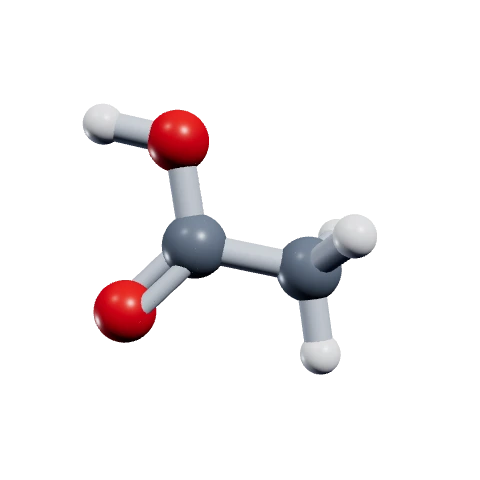


A cleaning trend tells you to combine hydrogen peroxide and vinegar in one spray bottle for a stronger homemade cleaner. The chemistry is real — but so is the catch. Mixed together, the two slowly form peracetic acid, the same oxidizing acid that food and water-treatment plants handle under ventilation and protective gear. In a closed bathroom it is an irritant, not an upgrade. Used correctly, both have a place — just not in the same bottle.
Key Facts
- Hydrogen peroxide and vinegar (acetic acid) react to form peracetic acid (CAS 79-21-0), a strong oxidizing acid used in industry — not a gentle household cleaner.
- Peracetic acid is an eye, skin, and respiratory irritant. NIOSH tracks it as an occupational hazard, and federal regulators have studied worker exposure to it.
- Combining the two does not make a stronger everyday cleaner — it makes a different, more aggressive chemical that off-gases and should never be sealed in a closed container.
- The safe approach is sequential: use one, wipe or rinse, then use the other — never blend or store them together. And never add bleach to either.
If your feed has handed you a cleaning hack lately, there is a good chance it involved two bottles you already own: hydrogen peroxide and white vinegar. Pour both into one spray bottle, the clip promises, and you get a budget “super-cleaner” that beats anything on the store shelf. It sounds thrifty and clever. The chemistry underneath it is real — which is exactly why it is worth slowing down before you mix.
Here is the honest version. Hydrogen peroxide and vinegar do react. What they make is not a magnified version of either one — it is a third chemical, peracetic acid, that industry takes very seriously. Health agencies have been clear that combining the two at home is a step down in safety, not a step up in cleaning power.
What happens when you mix hydrogen peroxide and vinegar
Mix hydrogen peroxide and vinegar and you start an equilibrium reaction that forms peracetic acid (also written peroxyacetic acid, CAS 79-21-0) plus water. Vinegar is dilute acetic acid; hydrogen peroxide is the oxidizer; together they trade atoms to make a peroxy-acid that is a stronger oxidizing agent than either ingredient on its own.

The reaction does not stop when you stop spraying — the mixture keeps generating peracetic acid and venting it into the air.
That is the part the hack leaves out. The reaction does not stop politely once you are done spraying. As long as the two sit together they keep generating peracetic acid and releasing gas — which is why a sealed bottle of the mixture can build pressure, and why the air above it turns sharp. You did not make a cup of stronger peroxide. You made a small, uncontrolled batch of an industrial oxidizer.
Why the “super-cleaner” idea spreads
The hack spreads because it is half right. Peracetic acid genuinely is a powerful, widely used industrial chemical — food and beverage plants, breweries, and municipal water-treatment systems rely on it to control bacteria and other microbes, and the EPA registers products built around it. Used in those settings it is effective and well understood.
What does not travel through the internet is the rest of the sentence: it is used at controlled concentrations, in ventilated spaces, by people in goggles, gloves, and respirators, with the contact time and rinse worked out in advance. A spray bottle on a bathroom sink has none of that. The molecule is the same; the conditions are not — and the conditions are most of the safety.
The dangerous part: fumes, irritation, and never bleach
Peracetic acid is an irritant to the eyes, skin, and respiratory tract. The National Institute for Occupational Safety and Health (NIOSH) lists it in its Pocket Guide to Chemical Hazards, and federal regulators have specifically studied worker exposure to it. Those are the steps you take for a workplace hazard — not for something you whip up next to your toothbrush. In a small, closed room the fumes from a fresh mix are enough to leave people coughing, with burning eyes.
The most hazardous move in the whole trend, though, is not even the original recipe — it is what people reach for when the first pass underwhelms.
Never add bleach. Mixing an acid with chlorine bleach releases chlorine gas — a classic, genuinely dangerous combination that the U.S. CDC warns about directly.
Chlorine gas burns the eyes, nose, throat, and lungs, and at higher concentrations it can be life-threatening. If a cleaning pass is not working, the fix is to rinse the surface and switch products — never to layer acids, peroxides, and bleach on top of one another. You can read the CDC’s chlorine fact sheet for the specifics.
The safe way: use them one at a time
None of this means hydrogen peroxide and vinegar are useless around the house. Used separately and in sequence, they are a long-standing, sensible pairing:

The benefit people are chasing comes from alternating the two — one step, then the next — not from brewing them together.
- Apply one, then wipe. Spray the surface with hydrogen peroxide, let it dwell a few minutes, then wipe it down.
- Follow with the other as a separate step. Use vinegar afterward (or reverse the order) — not in the same bottle, not at the same moment.
- Keep them in their own containers. Never combine them into one bottle, and never store a pre-mixed blend — it off-gases.
- Work with airflow and gloves. Open a window or run a fan, and wear gloves for anything stronger than household strength.
The benefit people are chasing — two cleaners each doing their own job — is real. You get it by alternating them, not by brewing them together.
The other famous kitchen pairing has the opposite problem. Baking soda and vinegar do not make anything stronger: they neutralize each other into salty water and carbon dioxide. Here is why that fizz does so little in a drain.
Where peracetic acid actually belongs
Peracetic acid is not a villain; it is an industrial chemical that belongs in industrial hands. It is produced and shipped at known concentrations, with a Safety Data Sheet and a Certificate of Analysis on request at no charge, and dosed into closed equipment and process water under controlled conditions. That is the line between a tool and a hazard — not the molecule, but the dose, the containment, and the training around it.
It also helps to see where the household bottles sit next to the concentrated grades they are sometimes confused with:
| Bottle | Typical strength | Where it fits |
|---|---|---|
| Drugstore hydrogen peroxide | ~3% | General home use, first aid kits |
| Alliance hydrogen peroxide | 12% Technical – 30% ACS | Concentrated stock; dilute to the job |
| Kitchen white vinegar | ~5% acetic acid | Cooking, light cleaning |
| Alliance concentrated vinegar | 10% – 30% | Industrial and agricultural strength |
Stronger is not automatically better. The skill is matching the concentration to the surface and the task — and keeping reactive chemistries in separate bottles.
Alliance’s Take
We sell both of these — hydrogen peroxide across a range of strengths, plus concentrated vinegar and acetic acid — so it would be easy for us to cheer on a hack that gets people buying. We would rather be useful. The whole point of buying a defined grade and concentration is control: you know exactly what is in the bottle, you get an SDS with it and the Certificate of Analysis on request at no charge, and you dilute it to the job instead of guessing.
If you want the cleaning power people are chasing, the answer is the right concentration used the right way — not an uncontrolled reaction in a spray bottle. Tell us the surface and the task and we will point you to the grade that fits, whether that is 12% technical-grade hydrogen peroxide, 30% ACS hydrogen peroxide, or 30% concentrated vinegar. Alliance Chemical has supplied chemicals to everyone from households to the Department of Defense since 1998.
Related: Hydrogen Peroxide for Blood Stains: Why It Fizzes and How to Get Blood Out of Clothes, Sheets and Carpet — what you can safely combine peroxide with on a stain, and what you cannot.
Sources
Related Chemical Collections
About the author
Andre Taki
This article is for informational purposes only.


