



Walk the cold side of any craft brewery and you will find the same quiet workhorse: a chiller pushing sub-freezing glycol through fermenter jackets, brite tanks, and draft lines. Equipment makers will happily sell you the chiller — but almost nobody explains the fluid inside it. Which glycol? What concentration? Food grade or inhibited? Mixed with what water? Replaced how often?
Those questions matter more than the horsepower rating, because the fluid is the part of the system that actually touches a heat-exchange surface a few millimeters from your beer. This guide answers them the way a chemical supplier can: with specs, freeze-point numbers, and honest per-gallon math.
What does glycol actually do in a brewery chiller system?
Glycol is the antifreeze that lets your chiller circulate coolant colder than water could ever go — typically 26–28°F — without freezing solid in the lines. Pure water turns to ice at 32°F; a 33% propylene glycol mix stays liquid down to roughly 5–8°F, so the chiller can hold a reservoir well below freezing and still pump it through jackets and coils on demand.
That sub-freezing reservoir is what gives a brewery independent, simultaneous temperature control: one fermenter holding an ale at 68°F, the next lagering at 50°F, a third crash-cooling toward 33°F — all fed by the same loop. When a fermenter drifts above its setpoint, a solenoid opens, cold glycol runs through that vessel’s jacket, and the controller closes the valve when the target is hit.
One boundary worth stating plainly: a glycol chiller is for holding fermentation temperatures and crash cooling. It is not designed to knock boiling wort down to pitching temperature — that is the job of an immersion or counterflow wort chiller. Sizing a glycol system to do the wort chiller’s work is the most common way small breweries end up with an overworked, under-recovered loop.
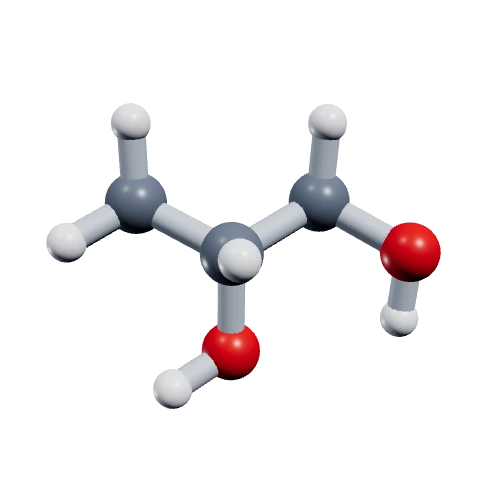
Propylene glycol at a glance: formula C₃H₈O₂ · CAS 57-55-6 · molecular weight 76.09 · boiling point ~370°F (188°C) · fully miscible with water. Source: PubChem CID 1030.
What is the best glycol for a brewery chiller?
The best glycol for a brewery chiller is propylene glycol — specifically a food-grade (USP) or food-plant-appropriate concentrate diluted to 30–35% with high-purity water. That answer is nearly universal across chiller manufacturers, and the reason is regulatory as much as thermal: propylene glycol is affirmed GRAS (Generally Recognized As Safe) by the FDA under 21 CFR 184.1666, while ethylene glycol — the other common heat-transfer glycol — is toxic and has no business near a beverage process.
Within propylene glycol, you are choosing between two families, both of which we stock:
- Propylene Glycol USP Grade — 99.9% pharmaceutical-grade purity, no additives. The default for any loop where a failure could put coolant on the product side.
- 100% Propylene Glycol Inhibited — propylene glycol with a corrosion-inhibitor package that protects steel, copper, and brass in closed loops, the way HVAC and industrial systems are run.
Both are also available pre-diluted to the brewery ratio — 30% Propylene Glycol USP Grade and 30% Propylene Glycol Inhibited — blended with deionized water so you can pour straight into the reservoir. Which family you should run depends on your loop, and that decision gets its own section below.
Can you use automotive antifreeze (ethylene glycol) in a brewery?
No. Automotive antifreeze is ethylene glycol (CAS 107-21-1), and it is genuinely toxic — the body metabolizes it into compounds that can cause kidney failure. Public-health agencies document poisonings from surprisingly small ingested amounts, which is why it is treated as a medical emergency; see the CDC/ATSDR profile on ethylene glycol toxicity.
The failure mode that makes this non-negotiable: a glycol jacket is a welded envelope around your fermenter, and a brite-tank coil sits in the tank itself. A pinhole leak — rare, but real — puts your coolant in your beer. If that coolant is propylene glycol, you are dumping a batch. If it is ethylene glycol, you may be recalling one. Never run automotive or RV engine antifreeze in a beverage-plant loop, and never “top up” a propylene loop with ethylene product.
Automotive coolants add a second problem on top of the base fluid: their inhibitor packages (silicates, phosphates, organic acid technology blends) are formulated for engine metallurgy, not food plants. Even ethylene-glycol-free “RV & marine” antifreeze is a poor choice — it is made to be dumped through potable plumbing once, not to run for years in a heat-transfer loop.
If you are comparing the two glycols in depth — thermal performance, toxicity, environmental handling — we keep a full propylene glycol vs. ethylene glycol guide.

USP or inhibited propylene glycol — which do you actually need?
USP if a failure can reach your beer; inhibited if the loop is fully isolated from product and you want the corrosion protection. That is the honest one-line answer, and it is worth unpacking because this is the decision brewers most often get wrong in both directions.
USP grade is propylene glycol at pharmaceutical purity with nothing added. Its virtue is exactly that emptiness: if a jacket weld weeps, the fluid that touched a product-contact surface was food-grade. The tradeoff is that unprotected glycol slowly oxidizes into mildly acidic byproducts, and there is no inhibitor film protecting your steel — so USP loops want cleaner makeup water, an annual fluid check, and somewhat more frequent replacement.
Inhibited propylene glycol carries a corrosion-inhibitor package that buffers pH and protects the mixed metals in a closed loop. It is the standard choice in HVAC and process-cooling systems and typically lasts longer between changes. The tradeoff mirrors USP’s: the inhibitor package is an industrial additive, not a food ingredient, so it belongs in loops that are genuinely isolated from product — glycol-to-air HVAC, isolated process skids, cold-room coils.
| Your situation | Run this | Why |
|---|---|---|
| Fermenter jackets, brite-tank coils, draft/glycol power packs — anything a leak could put in beer | Propylene Glycol USP Grade (or pre-mixed 30% USP) | Product-adjacent surfaces call for a food-grade fluid; GRAS listing covers the base chemical |
| Fully isolated closed loop: HVAC chillers, cold-room coils, process skids that never touch product | 100% Propylene Glycol Inhibited (or pre-mixed 30% Inhibited) | Inhibitor package protects steel/copper and extends fluid life |
| Not sure whether your loop is “isolated enough” | USP | The conservative default — you give up some corrosion protection, never the food-safety posture |
One thing not to do: mix the two. Blending inhibited fluid into a USP loop quietly ends its food-grade status; blending USP into an inhibited loop dilutes the inhibitor package below its design concentration. Pick one fluid per loop, and flush before switching.
What concentration of propylene glycol should you run?
Run 30–35% propylene glycol by volume for a typical brewery loop — enough to protect a 26–28°F reservoir with margin, without paying the thermal penalty of an over-rich mix. The working rule: your mix’s freeze point should sit 10–15°F below the coldest temperature your chiller will hold.
| Propylene glycol (% by volume) | Typical freeze point | Where it fits in a brewery |
|---|---|---|
| 20% | ~18°F (−8°C) | Too thin for crash-cooling reservoirs; slush risk at setpoint |
| 30% | ~8°F (−13°C) | The workhorse minimum for a 26–28°F reservoir |
| 35% | ~2°F (−17°C) | The sweet spot when you crash hard or your chiller runs cold |
| 40% | ~−6°F (−21°C) | Outdoor line runs, cold climates, aggressive lagering programs |
| 50% | ~−27°F (−33°C) | Overkill for breweries — reserved for industrial low-temp duty |
Freeze points are typical published values for aqueous propylene glycol; verify your actual mix with a refractometer rather than trusting the label on the pail.
The counterintuitive part is that more glycol is not safer. Glycol carries less heat than water and gets viscous as concentration rises, so an over-rich mix moves less heat per pass and makes your pump work harder — a 50% loop can noticeably slow a cold crash compared to 35%. Concentration is freeze protection, not performance; use the minimum that protects your setpoint with margin. Our propylene glycol and DI water thermal-systems guide covers the heat-transfer math in more depth.

What water should you mix glycol with — tap, distilled, or deionized?
Deionized or distilled water — not tap. The glycol is only half your loop; the other 65–70% is water, and everything dissolved in that water stays in the system for years. Municipal tap water carries chlorides that pit stainless steel, and hardness minerals that drop out as scale exactly where you least want them: on heat-exchange surfaces, where a millimeter of scale acts as insulation against the cooling you are paying for.
Chiller and fluid manufacturers specify low-chloride, low-hardness makeup water for exactly this reason, and inhibited fluids assume clean dilution water in their inhibitor chemistry. The practical options:
- Deionized water — ions stripped to near-zero; the clean-slate choice for charging and top-ups.
- Distilled water — functionally similar for this purpose; use whichever you can source economically. (The differences that matter elsewhere are covered in our distilled vs. deionized explainer.)
- Pre-diluted glycol — our 30% USP and 30% Inhibited blends are already mixed with deionized water, which removes the water question (and the mixing labor) entirely.
Top-up rule: when the reservoir level drops, top up with pre-mixed glycol at your loop’s concentration — not straight water. Repeated water-only top-ups quietly dilute the loop until, one cold night, the reservoir slushes. If you must correct concentration, measure first, then adjust.
How much glycol does your system actually need?
Total system volume times target concentration — that is the whole calculation. The work is in getting an honest system volume: reservoir capacity plus jacket volumes plus every foot of supply and return line. Your chiller manual lists the reservoir; fermenter manufacturers list jacket volumes; for lines, half a gallon per 10 feet of 1-inch pipe is a serviceable field estimate.
A worked example for a small 3-BBL craft setup:
| Component | Volume |
|---|---|
| Chiller reservoir | 40 gal |
| 3 × jacketed 3-BBL fermenters (~4 gal per jacket) | 12 gal |
| Supply/return lines (~60 ft of 1" insulated pipe) | 3 gal |
| Total system volume | 55 gal |
| Glycol required at 33% | ~18 gal of concentrate (+ ~37 gal DI water) |
From there you have two buying routes, and both are legitimate:
- Concentrate + your own DI water: an 18-gallon charge is a 15-gallon drum plus a few gallons, or four 5-gallon pails with a pail to spare for top-ups. Cheapest per gallon of finished mix; you supply the water and the mixing.
- Pre-diluted 30%: a single 55-gallon drum of 30% Propylene Glycol USP Grade charges the whole example system ready-to-pour — no water sourcing, no ratio math, and the dilution water is already deionized.
Homebrew-scale readers: the same math applies, just smaller. A 1-BBL or conical setup with an 8-gallon reservoir typically needs 3–4 gallons of concentrate — one case, not one drum.
How do you maintain a brewery glycol loop?
Test it once a year, and top up correctly in between — a glycol loop asks for very little, but it does ask. The failure pattern is never dramatic; it is a loop that quietly drifted thin over two years of water top-ups, then froze a line or grew something during a heat wave.
The annual check takes fifteen minutes:
- Concentration: pull a sample and read it with a glycol refractometer (or hydrometer). If the freeze point no longer sits 10–15°F below your setpoint, correct with concentrate.
- pH: healthy glycol runs neutral-to-slightly-alkaline. A reading drifting acidic means the glycol is oxidizing (USP) or the inhibitor package is depleting (inhibited) — both are replace-soon signals, because acidic fluid starts working on your steel.
- Eyes and nose: the fluid should be clear and nearly odorless. Cloudiness, stringy growth, or a sour smell means biological activity or breakdown — drain, flush, refill.
Service life depends on duty and housekeeping more than the calendar: inhibited fluid in a clean closed loop commonly runs 3–5 years; USP fluid, lacking inhibitors, is usually on a shorter test-driven cycle. Either way, replace on test results, not on vibes — the refractometer and a pH strip together cost less than one dumped batch.
While you are on the maintenance mindset: the same discipline applies to the hot side of your cellar. Our CIP chemistry guide for breweries and distilleries covers the caustic-and-acid side of keeping tanks honest.
What about draft systems? Glycol power packs and long-draw lines
Everything above applies to the taproom side of the business too, because a long-draw draft system is just a miniature glycol loop. Any time beer travels more than about 25 feet from cooler to faucet, a glycol power pack pumps chilled glycol through a trunk line that runs bundled alongside the beer lines, holding the beer at serving temperature the whole way to the tower. Restaurants, stadiums, and multi-tap bars run thousands of these systems, usually without anyone thinking about the fluid inside until a line freezes or the beer pours warm and foamy.
The fluid rules are the same, tightened one notch: power packs live above ceilings and behind walls in food-service spaces, and the trunk bundle presses glycol tubing directly against beer lines for its entire run. That adjacency is exactly the scenario food-grade fluid exists for — run USP-grade propylene glycol at roughly 30–35%, mixed with clean water. Power-pack reservoirs are small (often 3–7 gallons), so a single case of quarts or one pre-diluted 30% USP pail typically charges the system with fluid left over for top-ups.
Two draft-specific habits pay for themselves. Keep the reservoir topped with pre-mix rather than water — small reservoirs drift off-ratio fast, and a thin mix is behind most frozen-trunk-line service calls. And when a draft tech services the system, ask what they are refilling it with; more than one warm-pouring bar has discovered its power pack was topped up with whatever jug was on the truck.
Buying smart: what brewery glycol really costs
Glycol from brewing-equipment retailers runs roughly $77 per gallon of concentrate in 2.5-gallon jugs. Buying the identical chemical from a chemical supplier at chemical-supplier pack sizes changes the math substantially:
| Product | Pack | Price | Per gallon |
|---|---|---|---|
| Typical homebrew-retailer glycol | 2.5 gal | ~$192 | ~$77 |
| Propylene Glycol USP Grade | 5-gal pail | $324.34 | $64.87 |
| Propylene Glycol USP Grade | 55-gal drum | $2,400 | $43.64 |
| 100% Propylene Glycol Inhibited | 5-gal pail | $220 | $44.00 |
| 100% Propylene Glycol Inhibited | 55-gal drum | $2,050 | $37.27 |
| 30% Propylene Glycol USP Grade (ready-to-pour) | 5-gal pail | $175.20 | $35.04 |
Two buying notes from the product-specialist side of the desk. First, buy for your loop, not the discount: the cheapest fluid is the wrong purchase if it puts an inhibitor package next to your beer. Second, tell us the application when you order — jacketed fermenters vs. an isolated cold-room loop get different recommendations, and matching the grade to the loop is the difference between paying for purity you need and purity you don’t. Need the Certificate of Analysis for your drum, pail or tote? Just ask — we send it at no charge. 1–2 business day dispatch is standard.
Running a brewery, cidery, winery, or kombucha operation in Central Texas? We are Texas-based — ask about recurring drum programs and local delivery options for cellar chemicals.
Key numbers & sources
The load-bearing facts from this guide in one place, with primary sources:
| Fact | Value | Source |
|---|---|---|
| Propylene glycol identity | C₃H₈O₂, CAS 57-55-6, MW 76.09, BP ~188°C | PubChem CID 1030 |
| Food-safety status | GRAS for intended food uses | FDA, 21 CFR 184.1666 |
| Ethylene glycol hazard | Toxic on ingestion; kidney damage; medical emergency | CDC/ATSDR medical management guideline |
| Brewery working mix | 30–35 vol% PG; reservoir 26–28°F | Industry practice; verify per chiller manual |
| Freeze margin rule | Mix freeze point 10–15°F below coldest setpoint | Standard heat-transfer-fluid guidance |
Related: Ethylene Glycol: The Complete Guide to Antifreeze, Coolant Blends, Grades & Safety — the dedicated ethylene glycol pillar: blend freeze-point tables, inhibited vs uninhibited, grades, and buying guidance.
Related: Elixir Sulfanilamide: The 1937 Poisoning That Created the FDA — the 1937 diethylene glycol disaster that made propylene glycol the standard safe glycol, and created the modern FDA.
Related: Why Water Splits Iron: The 1784 Quebec Shell Experiments and How Propylene Glycol Keeps Boats, RVs, Cabins and Loops Alive Through Winter — the concentration table a brewery chiller shares with every other closed loop.
Frequently asked questions
What is the best glycol for a brewery chiller?
Propylene glycol diluted to 30-35% by volume with deionized or distilled water. Use USP (food-grade) propylene glycol for fermenter jackets, brite-tank coils, and any loop where a leak could reach the beer; inhibited propylene glycol is appropriate only for loops fully isolated from product. Never use ethylene glycol (automotive antifreeze) - it is toxic.
Can I use automotive antifreeze in a glycol chiller?
No. Automotive antifreeze is ethylene glycol, which is toxic to humans and animals, and its corrosion-inhibitor additives are formulated for engines, not food plants. A pinhole leak in a fermenter jacket would put toxic coolant in your beer. Use propylene glycol, which is FDA GRAS-listed under 21 CFR 184.1666.
What temperature should brewery glycol run at?
Most breweries hold the glycol reservoir at 26-28 degrees F. That is cold enough to crash-cool beer toward 33 degrees F and hold lagering temperatures, while a 30-35% propylene glycol mix (freeze point roughly 2-8 degrees F) protects the loop with 10-15 degrees of margin.
What ratio of glycol to water should I use?
30-35% propylene glycol by volume for a typical brewery system. The rule of thumb: the mix freeze point should sit 10-15 degrees F below your coldest reservoir setpoint. Avoid over-concentrating - glycol above about 40% carries less heat and pumps harder, which slows crash cooling.
How often should I change the glycol in my chiller?
Test annually with a glycol refractometer and pH strips, and replace on results rather than a fixed calendar. Inhibited propylene glycol in a clean closed loop commonly lasts 3-5 years; USP glycol runs a shorter, test-driven cycle because it has no inhibitor package. Falling pH, cloudiness, or a mix that cannot hold its freeze point are replace-now signals.
Is propylene glycol safe if it leaks into beer?
Propylene glycol itself is GRAS-listed by the FDA, which is exactly why breweries use it - but any batch that coolant has reached should still be dumped, and if the fluid was inhibited glycol the additives are not food-grade. This failure mode is the reason product-adjacent loops should run USP-grade glycol.
Can I mix USP and inhibited propylene glycol?
Avoid it. Adding inhibited fluid to a USP loop ends its food-grade status; adding USP fluid to an inhibited loop dilutes the corrosion-inhibitor package below its design concentration. Run one fluid per loop, and drain and flush before switching families.
Why is my glycol slushy or my chiller struggling?
Slush means the concentration is too low for your setpoint - usually from months of topping up with plain water. Sluggish cooling with no slush often means the opposite: an over-rich mix that is too viscous to move heat efficiently. Either way, read the actual concentration with a refractometer and correct toward 30-35%.
Sources
- PubChem Compound Summary: Propylene Glycol (CID 1030) · PubChem (NIH National Library of Medicine)
- 21 CFR 184.1666 · Electronic Code of Federal Regulations
- ethylene glycol toxicity · CDC
Related Chemical Collections
About the author
Andre Taki
This article is for informational purposes only.


