

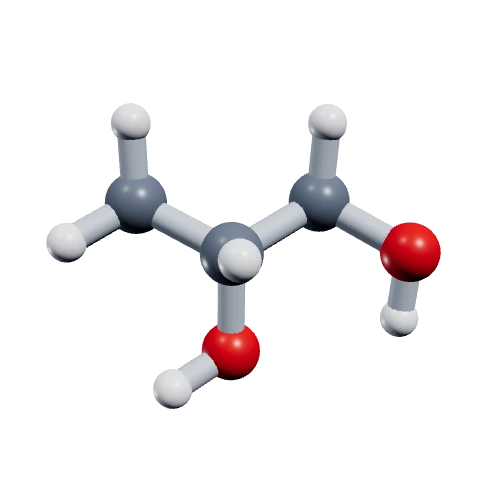


Quick answer
Propylene glycol is made by hydrating propylene oxide, so every propylene glycol supply question is really a propylene oxide question. Propylene oxide can be made five different ways, and they are not interchangeable businesses: the oldest route, chlorohydrin, produces about 2.1 tons of calcium chloride for every ton of propylene oxide, while the newest route, HPPO, produces only water. On Sept. 8, 2025, INEOS halted propylene oxide and propylene glycol production at its Cologne site in Germany, after its CEO told European politicians the plant's annual gas bill ran €100 million above an equivalent US site. That is what a route change looks like from the outside.
Most buyers meet propylene glycol as a finished drum with a grade on the label. It arrives as USP or technical, inhibited or uninhibited, and the purchase decision usually stops at concentration and certificate of analysis. That is a reasonable place to stop, right up until the supply stops behaving predictably.
Underneath the drum there is a manufacturing decision made decades ago, in a specific country, using a specific chemistry, and that decision is now being unwound across Europe. Understanding it explains more about glycol availability over the next five years than any single price assessment will.
The molecule behind the molecule
Propylene glycol is not made from scratch. It is made from propylene oxide, a small, strained, highly reactive epoxide, by adding water across the ring. The Evonik-Uhde process paper describes propylene oxide plainly as a chemical "mainly used as raw material in polyurethane and propylene glycol synthesis" — polyurethane foam first, glycol second.
That single arrow is why propylene glycol supply is structurally downstream of something most glycol buyers never track. If a propylene oxide unit stops, the glycol unit attached to it stops too. When INEOS halted Cologne, it did not halt propylene oxide or propylene glycol. It halted both, because they are the same plant wearing two names.
Five routes, five very different businesses
The interesting part is that propylene oxide has no single manufacturing method. It has five commercial ones, and what separates them is not the propylene oxide — that comes out essentially the same — but what else comes out alongside it. Evonik and Uhde published the comparison directly:
| Process | Feedstock | Co-product, per ton of propylene oxide |
|---|---|---|
| HPPO | propylene, H2O2 | water only |
| Chlorohydrin | propylene, Cl2, Ca(OH)2 | 2.1 t calcium chloride |
| PO/SM | propylene, air, ethylene, benzene | 2.3 t styrene monomer |
| PO/MTBE | propylene, isobutane, methanol, O2 | 2.8 t MTBE |
| PO/CU (cumene) | propylene, H2, air | water only |
Read that column again. A PO/MTBE plant produces nearly three times more MTBE than it does propylene oxide. It is, by tonnage, a fuel-additive plant that happens to make an epoxide. A PO/SM plant is a styrene plant with a valuable side stream. Only HPPO and the cumene route make propylene oxide and essentially nothing else.
The chlorohydrin problem
Chlorohydrin is the oldest route and the most chemically direct: react propylene with chlorine in water to form propylene chlorohydrin, then strip the hydrogen chloride back off with lime to close the epoxide ring. The IARC monograph on propylene oxide describes exactly this — "synthesis of propylene chlorohydrin from propylene and chlorine in water and subsequent dehydrochlorination of propylene chlorohydrin to propylene oxide."
The chlorine does not stay in the product. It leaves as salt. IARC puts the arithmetic bluntly: "up to 2 mol of salt (sodium or calcium chloride) in the form of dilute brine solution are generated per mole of propylene oxide."

So a chlorohydrin plant is not really a propylene oxide plant. It is a chlorine consumer and a brine producer that yields propylene oxide in between. It needs a chlorine supply next door, a lime supply, and somewhere for a large volume of dilute salt water to go. Every one of those is a cost line, and every one of them is exposed to local energy and regulatory conditions. Evonik and Uhde name the consequence directly: "the formation of calcium chloride is an environmental burden."
Why the co-product routes carry a different risk
The co-product routes avoid the brine but inherit a stranger problem: they tie the economics of propylene oxide to a market that has nothing to do with propylene oxide. The Evonik-Uhde paper is precise about why that hurts — co-production "gives an unforeseeable volatility to the process economics as the markets for propylene oxide and styrene monomer or MTBE show completely different growth rates and growth dependencies."
In practice: a PO/SM operator facing a collapsed styrene market is producing 2.3 tons of a product it cannot sell well for every ton of propylene oxide it can. The rational move is to cut rates on both. Glycol buyers then experience a propylene oxide shortage that was actually a styrene problem.
Why this matters for sourcing
When a propylene oxide outage is announced, the useful question is not "how big was the plant" but "which route was it." A chlorohydrin outage usually traces to chlorine, lime, energy or effluent. A PO/SM or PO/MTBE cut often traces to a market you were not watching at all. The two recover on completely different timelines.
The route that makes only water
HPPO — hydrogen peroxide to propylene oxide — solves the co-product problem by eliminating co-products. Propylene is oxidised directly by hydrogen peroxide over a titanium silicalite (TS-1) catalyst in methanol solvent. The oxygen goes into the ring; the leftover hydrogen and oxygen leave as water.
The reaction runs above 95% selectivity and is strongly exothermic at −220 kJ/mol, which is why reactor heat removal is the core engineering problem in the design. The TS-1 catalyst that makes it possible was developed by ENI in the mid-1980s; the first commercial HPPO plant started up in 2008 in South Korea, operated by SKC under an Evonik-Uhde licence. Writing in 2011, the process authors noted that since that 2008 start-up, "more than 60% of all realized and announced propylene oxide projects are dedicated to the HPPO technology."
That figure is now more than a decade old, and it should be read as a direction of travel rather than a current market share. But the direction has not reversed. New propylene oxide capacity is overwhelmingly not chlorohydrin.
What Cologne actually signals
This is the context for the most concrete recent data point. On Sept. 8, 2025, INEOS halted production at its propylene oxide and propylene glycol facilities in Cologne, Germany, as reported by Chemical & Engineering News. Trade coverage of the shutdown identified the Cologne propylene oxide unit as a chlorohydrin plant.
The stated reason was not chemistry, it was cost. The closure followed an open letter that INEOS CEO Sir Jim Ratcliffe sent to European politicians in February 2025, arguing that European regulation had made the site uncompetitive. C&EN reports his figures: the Cologne site's annual gas bill ran €100 million — about $117 million — higher than an equivalent site in the United States, its electricity bill €40 million higher, and its carbon tax bill was climbing toward what he called "a shocking" €100 million.
Put the two halves together. The chlorohydrin route is the most energy- and chlorine-intensive way to make propylene oxide, and it was being run in the region with, in the words of INEOS Inovyn business director Arnaud Valenduc, "European gas prices around three times higher than the US." The route that costs the most energy was operating where energy costs the most. That is not a market cycle. That is a structural mismatch, and it resolves in one direction.
The distinction worth keeping
A force majeure is a temporary supply event and it gets lifted. A plant closure removes capacity permanently and the tonnage does not come back when demand recovers — it has to be rebuilt somewhere else, usually on a different process, usually on another continent. Cologne was the second kind.
What this means when you buy propylene glycol
None of this changes the specification. Propylene glycol from an HPPO-fed unit and propylene glycol from a chlorohydrin-fed unit are the same molecule, and both are held to the same grade requirements — USP against the monograph, technical against the seller's own specification. Route does not appear on a certificate of analysis and it should not change what you accept.
What it changes is where the material is coming from and how far it travelled. As European chlorohydrin capacity retires and new capacity is built elsewhere on newer routes, the supply map redraws. For a buyer, three habits follow from that:
Ask what the lead time assumes, not just what it is
A quoted lead time is a snapshot of a routing. When capacity moves between continents, the number can be accurate today and structurally different next quarter. The question worth asking is what supply point it depends on.
Separate a grade problem from a supply problem
If USP material is tight and technical is not, that is a monograph and certification issue, not a propylene oxide issue. If both are tight at once, look upstream at the epoxide. The two have different fixes and confusing them wastes a purchasing cycle. Our propylene glycol versus ethylene glycol guide covers where the grade lines actually fall.
Know which glycol your application actually requires
Some systems specified for propylene glycol on toxicity grounds genuinely require it. Others inherited the specification and never revisited it. That is worth knowing before a tight market forces the question — not during one. For one worked example of a system where the choice is genuinely load-bearing, see our guide to glycol for brewery chillers.
From the warehouse
We stock propylene glycol USP grade and technical grade, plus inhibited blends for closed-loop thermal systems, in Taylor, Texas. The practical thing we can tell you that a market report cannot: what is physically on the floor right now, what the current lot's certificate of analysis says, and what it will actually take to get it to your dock. Ask for the COA before you order, not after — we will send it within one business day.
References
- Jaeger, B.; Bärz, M.; Schemel, J.; Kolbe, B. "The Evonik-Uhde HPPO Process for Propylene Oxide Production." DGMK Conference: Catalysis — Innovative Applications in Petrochemistry and Refining, Dresden, Germany, October 4–6, 2011. DGMK-Tagungsbericht 2011-2, ISBN 978-3-941721-17-3, pp. 65–66.
- International Agency for Research on Cancer. "Propylene Oxide." In Some Industrial Chemicals, IARC Monographs on the Evaluation of Carcinogenic Risks to Humans. NCBI Bookshelf, NBK507443.
- Scott, A. "Europe's specialty chemical makers feel the heat." Chemical & Engineering News, September 24, 2025.
- National Center for Biotechnology Information. PubChem Compound Summary for CID 6378, Propylene Oxide, and CID 1030, Propylene Glycol. National Library of Medicine.
Related: BASF Wants Evonik. The Last Time Evonik Bought a Peroxide Maker, the FTC Sued — Evonik, the peroxide maker BASF approached in September 2026, and how the peroxide market is structured.
Frequently asked questions
How is propylene glycol made?
Propylene glycol is produced by hydrating propylene oxide - adding water across the strained epoxide ring. Because the glycol unit sits directly downstream of a propylene oxide unit, propylene glycol availability is structurally tied to propylene oxide production.
What is the chlorohydrin process?
The oldest commercial route to propylene oxide. Propylene reacts with chlorine in water to form propylene chlorohydrin, which is then dehydrochlorinated with lime to close the epoxide ring. IARC notes that up to 2 mol of salt, as dilute brine, is generated per mole of propylene oxide - about 2.1 tons of calcium chloride per ton of product.
What is the HPPO process?
HPPO (hydrogen peroxide to propylene oxide) oxidises propylene directly with hydrogen peroxide over a titanium silicalite TS-1 catalyst in methanol. Its only co-product is water. The reaction runs above 95 percent selectivity and is strongly exothermic at -220 kJ/mol.
Does the manufacturing route change propylene glycol quality?
No. Propylene glycol from an HPPO-fed unit and from a chlorohydrin-fed unit is the same molecule and is held to the same grade requirements - USP against the monograph, technical against the seller's specification. The route does not appear on a certificate of analysis and should not change what you accept.
Why did INEOS stop propylene oxide and propylene glycol production at Cologne?
INEOS halted both units on September 8, 2025. Chemical & Engineering News reported the closure followed an open letter from CEO Sir Jim Ratcliffe stating the site's annual gas bill ran about 100 million euros higher than an equivalent US site, its electricity bill 40 million euros higher, and its carbon tax bill was rising toward 100 million euros.
Related Chemical Collections
About the author
Andre Taki
This article is for informational purposes only.


