

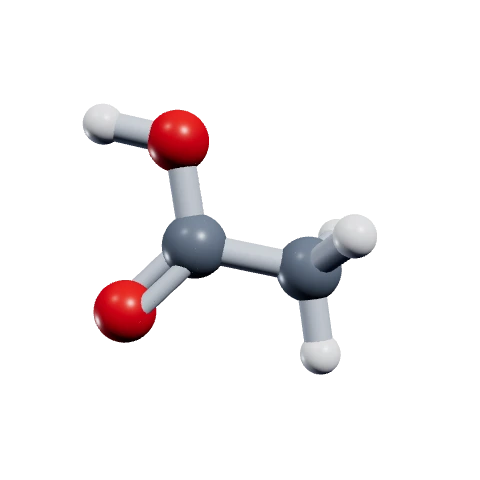


On Tuesday 22 September 2026, Ineos said two of the three acetyls plants on its Saltend site in Hull had already stopped and the third would follow within days. The units are to be “mothballed until further notice.” They are, in the company’s words, “the last remaining acetyls units in Europe,” and the company’s chairman gave a single reason: “I’m sure people will find it hard to believe that we are being forced to mothball some of the most efficient plants in Europe but with gas prices now 12 times the level in the US and 8 times that of China, we just cannot compete.”
If you buy ethyl acetate or glacial acetic acid, the obvious question is what a shutdown in England has to do with a drum in Texas or Ohio. The useful answer is not a price forecast. It is the recipe. Acetic acid and ethyl acetate made the way Hull makes them are two of the most gas-intensive molecules on a solvent shelf, and the arithmetic shows exactly how much of each drum began as gas. That arithmetic explains this week’s decision, and it tells you which part of the market to keep an eye on.
This is a market-structure piece. It takes no view on energy policy on either side of the Atlantic. It is not advice to buy or sell on any schedule. Every figure comes from the company’s own statements, a trade publication or a published technical source, all listed at the end.
What happened, in order
The shutdown makes more sense against the site’s history. Saltend has made acetic acid for almost a century, and every major process change in that time was about making the molecule from cheaper carbon with less waste. The last change it could not make was the price of the gas.
| When | What happened |
|---|---|
| 1930 | Acetic acid production begins at Saltend, on the Humber east of Hull. |
| 1982 | The A4 plant is commissioned to make acetic acid. The A5 plant, making acetic anhydride and acetic acid, follows in 1989. |
| 1998 | A4 is “enhanced with BP Cativa technology”, the iridium-catalysed version of methanol carbonylation that BP developed to replace the older rhodium process. |
| 2001 | BP starts up its AVADA ethyl acetate plant at Hull, at 220,000 tonnes a year then the largest ethyl acetate plant in the world, making the ester directly from ethylene and the site’s own acetic acid. |
| 2010 | A new reformer is commissioned on the site. Chemistry World describes the site’s spare hydrogen as coming from its conversion of methane to synthesis gas. |
| 2020 | Ineos acquires the acetyls business from BP. |
| 28 September 2023 | Ineos announces it will buy the Eastman Texas City site and its 600,000-tonne acetic acid plant, which already ran on Ineos’s licensed Cativa technology. Its chief executive says the site is “ideally placed to take advantage of competitively priced feedstocks.” |
| 2025 | Ineos spends about £30 million (reported as roughly $40 million) switching Hull’s fuel from natural gas to the spare hydrogen its own reformer produces, cutting the site’s gas consumption by about a third. |
| 22 September 2026 | Two of the three plants have stopped; the third is to stop within days. All three are to be mothballed until further notice. |
Two points stand out in the table. First, the site had already done the obvious efficiency work: the switch to hydrogen fuel was only a year old. Second, the plant stayed in the company. The same owner, holding the same licence, bought a larger plant on the Texas Gulf Coast three years ago and said at the time why it wanted that location. The trade press reports Ineos is keeping about 250 direct staff on the Hull site, and Chemistry World stresses that the plants are idled, not demolished, and could restart if the gas price or the fuel source changes.
Two reactions that keep every atom
Acetic acid and ethyl acetate share a production chain, and both steps are additions: two molecules go in, one comes out, and nothing is thrown away. That makes the arithmetic unusually clean, and it is the reason gas matters so much.
Step one: acetic acid by methanol carbonylation. Methanol and carbon monoxide are passed over a dissolved metal catalyst with an iodide promoter, and the carbon monoxide inserts into the methanol’s carbon–oxygen bond:
The older Monsanto process does the same reaction with rhodium. BP’s iridium system, Cativa, was developed to run with less water in the reactor, which means fewer drying columns and fewer by-products. The two systems are similar enough to share equipment, which is how Saltend’s A4 plant was converted in place in 1998 rather than rebuilt.
Step two: ethyl acetate by direct addition. Most of the world’s ethyl acetate is made by the textbook route, esterifying ethanol with acetic acid and removing the water that forms. Hull’s AVADA process (“AdVanced Acetates by Direct Addition”) skips the ethanol. It adds acetic acid straight across the double bond of ethylene, in the gas phase, over silica beads impregnated with a silicotungstic heteropoly acid:
The same study credits the route with about 20% lower energy use and 35% lower feedstock losses than a conventional esterification unit, and no stream of reaction water to treat. It was, and is, a very good way to make ethyl acetate. It is also a route with no step that does not begin with gas or a cracker.
The one-sentence version. Hull’s acetic acid is methanol plus carbon monoxide, and its ethyl acetate is that acetic acid plus ethylene. Methanol and carbon monoxide are both made from synthesis gas, and on this site the synthesis gas is made from methane.
The gas arithmetic
This is the part worth keeping. Because both reactions keep every atom, the molar masses give the feedstock bill directly, with no yield assumptions beyond perfect conversion. Real plants lose a few percent, which shifts the numbers slightly but not the argument.

One tonne of acetic acid needs 32.04 ÷ 60.05 = 0.534 tonnes of methanol and 28.01 ÷ 60.05 = 0.466 tonnes of carbon monoxide. One tonne of ethyl acetate needs 60.05 ÷ 88.11 = 0.682 tonnes of acetic acid and 28.05 ÷ 88.11 = 0.318 tonnes of ethylene. Multiply through and the whole chain collapses into one line:
| Per tonne of product | Methanol | Carbon monoxide | Ethylene |
|---|---|---|---|
| Acetic acid (carbonylation) | 534 kg | 466 kg | — |
| Ethyl acetate (direct addition) | 364 kg | 318 kg | 318 kg |
Where those inputs come from is the whole story. Methanol and carbon monoxide are both made from synthesis gas, a mix of carbon monoxide and hydrogen, which in Europe and North America is made from natural gas and in China largely from coal. Ethylene comes from a steam cracker and reaches Saltend by the UK ethylene pipeline.
So a tonne of ethyl acetate made the Hull way is about 364 grams of methanol, 318 grams of carbon monoxide and 318 grams of ethylene in every kilogram, and nothing else. Roughly two-thirds of its mass arrived as synthesis-gas chemistry. On top of that feedstock, the site burns fuel to run the reformer and to heat the distillation columns that purify both products. Gas enters the plant twice, as feedstock and as fuel, and the 2025 switch to hydrogen fuel could address only the second.
That is why Ineos quoted a gas ratio rather than a labour cost, a tax or a demand figure. When the input is mostly gas and the reaction wastes nothing, there is no process improvement left to absorb a gas price twelve times higher than a competitor’s. The only remaining lever is location, and Ineos had already used it once, in Texas City.
The China comparison works a little differently. Ineos put European gas at eight times the cost of “coal-based” Chinese production, and that wording matters. Much Chinese methanol and carbon monoxide comes from gasifying coal rather than reforming gas. The chemistry downstream of the synthesis gas is identical; the carbon just enters the chain as coal instead of methane. On a certificate of analysis, the molecule is the same whichever feedstock it started from.
Same owner, same catalyst, same molecule. The acetic acid Ineos makes in Texas City and the acetic acid it made in Hull come from the same licensed iridium chemistry. The difference between running and mothballing is what the methanol, the carbon monoxide and the fuel cost at each site.

Where the missing European tonnes come from
Ineos was plain about the replacement: in its statement, European customers who relied on Hull will now be supplied from the United States and from China. Chemistry World adds that as plants in a chemical cluster close, the ones left lose “efficient interconnections” and shared services get proportionally more expensive. One closure can make the next one more likely.
For a US buyer, the useful lesson is structural, and it is not a price call. Acetic acid and ethyl acetate are now traded goods in Europe, not locally made ones. A continent that used to balance its own acetyls now draws on the same North American and Asian capacity that serves everyone else. Nobody can say from outside how much extra export pull that creates, or when. What can be said is which inputs to watch, because the arithmetic above names them.
What to actually watch
Methanol, first. It is the largest single input by mass in both products, a little over half of every tonne of acetic acid. Methanol has its own story this year, covered in our September piece on the methanol squeeze. Any move in methanol reaches acetic acid through that 534-kilogram ratio, whichever continent the plant is on.
The gas spread, second. The Hull decision is the transatlantic gas spread turned into a plant closure. The company’s own statements say the units are idled, not dismantled, and could restart if the fuel economics change. A narrowing spread is the signal that would bring those 500,000 tonnes of acetic acid back to Europe. A widening one would put pressure on the next European plant that makes something out of synthesis gas.
Ethylene, third, and only for ethyl acetate. Direct addition ties ethyl acetate to the cracker. Esterification ties it to ethanol instead. Most of the world’s ethyl acetate is made from ethanol, so for most drums the second input is fermentation ethanol, not cracker ethylene. Hull was the exception, and its exit leaves more of the market on the ethanol route.
None of these is a reason to buy ahead of need. They are the three lines to read when a supplier explains a price change “because of Europe.”
What this means on a specification
None of this changes which grade you need. The molecule is defined by its formula, not by the continent or the route. What changes, when supply shifts between producers, is which certificate lines are worth a second look.
| Product and use | What to specify | What actually moves the result |
|---|---|---|
| Ethyl acetate for coatings, lacquers, printing inks, adhesives and leather finishing | Technical grade, assay stated, with water and acidity on the certificate | Water and acidity together. Ethyl acetate slowly hydrolyses back to acetic acid and ethanol when it picks up water, so a wet lot drifts acidic in storage. Keep drums closed and bungs tight. |
| Ethyl acetate for extraction, chromatography and laboratory work | ACS reagent grade | Residue after evaporation and the alcohol content. Ethanol-route material can carry residual ethanol; a reagent specification bounds it where a technical one may not. |
| Glacial acetic acid for synthesis, esterification and pH control | Technical glacial, assay 99%-plus | Water. Glacial acetic acid is hygroscopic, and water is the impurity that changes its behaviour as a reagent and a solvent. |
| Glacial acetic acid for titration, buffers and analytical standards | ACS reagent grade | Assay and the trace-metal and residue lines together. A reagent specification sets all of them; a technical lot may meet the assay and still miss on residue. |
Two practical points follow, one for each product.
Glacial acetic acid freezes at about 16.6 °C (62 °F). That is where the word “glacial” comes from: the pure acid freezes into ice-like crystals in a cold room. As autumn arrives, drums in unheated warehouses and trailers start to solidify. That is normal and reversible; warm the container gently and the acid melts back unchanged. It also gives a crude check on purity. Water lowers the freezing point, so a lot sold as glacial that never freezes in a cold building is worth a look at the water line on its certificate.
Ethyl acetate is a Class 3 flammable liquid with a flash point well below room temperature. Order the pack size you can use and store properly, not the one that looks cheapest per gallon. A half-used drum pulls in moist air every time it is opened, and moisture is what drives the acidity drift described above.
A word on what this article does not say. It describes how acetic acid and ethyl acetate are made at Saltend and in Texas City, what the company that owns both sites said about why one stopped, and where the inputs to that chemistry come from. It makes no claim about ours: where the ethyl acetate or acetic acid we list is manufactured, by which route, or how our own inventory position is affected by this week’s decision. Nobody writing this has verified any of that, and a market-structure article is the wrong place to guess.
Common questions
Why did Ineos shut down the Hull acetyls plants?
Energy cost. Ineos said European gas prices are 12 times the US level and 8 times the cost of coal-based Chinese production. At Hull, gas is both the fuel and the source of the synthesis gas behind the acetic acid feedstocks. The site had already switched its fuel to hydrogen in 2025, cutting gas use by about a third, and still could not compete.
Is the Hull acetyls shutdown permanent?
No, not as announced. Ineos said the three units will be mothballed until further notice, not demolished, and trade press reports that about 250 direct staff remain on site. Chemistry World notes the plants could restart if gas prices fall or cheaper fuel is secured. Until then, European demand is being supplied from the United States and China.
What is ethyl acetate made from?
Usually ethanol and acetic acid, by esterification, which is the route behind most of the world’s supply. Hull used a different route, BP’s AVADA process, which adds acetic acid directly to ethylene over a heteropoly acid catalyst. Both routes give the same molecule, CH3COOC2H5, CAS 141-78-6. Only the second input differs: fermentation ethanol in one case, cracker ethylene in the other.
Why does the price of natural gas matter so much to acetic acid?
Because acetic acid is methanol plus carbon monoxide, and both are made from synthesis gas. Outside China, synthesis gas is made mostly from natural gas. A tonne of acetic acid needs about 534 kilograms of methanol and 466 kilograms of carbon monoxide, and the reaction wastes no atoms. Nearly the whole feedstock bill, plus the fuel to run the plant, therefore traces back to gas.
Does this change which grade of ethyl acetate or acetic acid I should buy?
No. The molecule and the grade specifications are the same whatever the route or the country of manufacture. What is worth doing when supply is shifting between producers is to check the certificate lines that vary lot to lot. For ethyl acetate that means water and acidity. For glacial acetic acid it means water and residue.
Why does glacial acetic acid freeze in a cold warehouse?
Pure acetic acid freezes at about 16.6 °C, or 62 °F, well above the temperature of an unheated building in autumn and winter. That is what “glacial” refers to. Freezing is harmless and reversible: warm the container gently and it melts back unchanged. Water lowers the freezing point, so a glacial lot that never solidifies in the cold may be wetter than its label suggests.
References & Authoritative Sources
The shutdown, capacities, site history and gas-price statements are from Ineos and the trade press. The process chemistry is from published technical sources. The stoichiometry is computed from standard molar masses.
- INEOS idles Europe’s last world-scale Acetyls plant as energy prices hit 12 times US level — Ineos, 22 September 2026. The chairman’s statement; two plants stopped and the third to follow; supply to be replaced from the US and China.
- Hull site profile — Ineos. Site capacities: acetic acid 500 kt, acetic anhydride 150 kt, ethyl acetate 200 kt a year.
- Our history — Ineos Acetyls. Acetic acid at Saltend from 1930; A4 commissioned 1982; A5 1989; A4 enhanced with BP Cativa technology 1998; new reformer 2010; Ineos acquires acetyls from BP 2020.
- INEOS announces the acquisition of the Eastman Texas City site — Ineos, 28 September 2023. The 600 kt acetic acid plant running licensed Cativa technology; “ideally placed to take advantage of competitively priced feedstocks.”
- Ineos temporarily closes UK acetyls plants — Chemistry World, 25 September 2026. The 2025 hydrogen-fuel conversion using spare hydrogen from the site’s methane-to-syngas reforming; about 250 direct staff retained; plants could restart; cluster effects of closures.
- Ineos Idles Europe’s Last World-Scale Acetyls Plants — Chemical Processing, September 2026. Capacities, end uses, and the roughly $40 million hydrogen investment that cut gas use by 33%.
- INEOS idles Europe’s last world-scale acetyls plant — Hydrocarbon Engineering, 22 September 2026. Mothballed “until further notice”; the gas-price ratios.
- Ineos to shutter UK acetyls plants — C&EN, September 2026. The shutdown in the context of European chemical capacity.
- Economical and beneficial environmental impact on industrial production of ethyl acetate — University of Liverpool, REF impact case study. AVADA: direct addition of acetic acid to ethylene over silicotungstic heteropoly acid on silica; Hull, 2001, 220,000 tonnes a year; 100% atom efficiency; about 20% less energy and 35% lower feedstock losses than esterification.
- Production using BP’s Avada ethyl acetate process kicks off — ICIS, 10 December 2001. Start-up of the Hull plant; ethylene by pipeline and acetic acid from the Saltend plants.
- Cativa process — Wikipedia. The iridium carbonyl iodide catalyst, ruthenium promotion, lower water and fewer by-products than the rhodium (Monsanto) process, and compatibility with the same plant.
- Acetic acid and Ethyl acetate — PubChem, US National Library of Medicine. Molar masses, melting point of acetic acid, flammability of ethyl acetate.
- The Complete Guide to Ethyl Acetate — Alliance Chemical. The evergreen ethyl acetate article this update hangs from: properties, uses and grades.
- Glacial Acetic Acid: The Complete Guide — Alliance Chemical. Grades, strengths and handling of 99% acetic acid.
The ethyl acetate and acetic acid we stock

The workhorse solvent for coatings, inks, adhesives and leather finishing. Quart to 55-gallon drum; keep it dry.

Reagent grade for extraction, chromatography and lab work, where residue and alcohol content are specified, not just assay.

99%-plus acetic acid for synthesis and pH control, quart to 330-gallon tote. Also as ACS reagent grade.
Not sure whether your process needs technical or reagent grade?
Tell us the application, the specification you are held to and how you store the material. We will tell you whether technical ethyl acetate does the job, whether the reagent limits on residue and alcohol actually buy you anything, and what pack size keeps glacial acetic acid dry. You get the right answer, not the nearest thing in stock.
See every acetic acid grade and strengthKey numbers and sources
| Number | What it is | Source |
|---|---|---|
| 12× / 8× | European gas price against the US level, and against coal-based Chinese production | Ineos, 22 September 2026 |
| 500 / 150 / 200 kt | Saltend capacity: acetic acid, acetic anhydride, ethyl acetate | Ineos Hull site profile |
| 534 kg + 466 kg | Methanol and carbon monoxide per tonne of acetic acid | Stoichiometry (32.04 + 28.01 = 60.05) |
| 364 / 318 / 318 kg | Methanol, carbon monoxide and ethylene per tonne of ethyl acetate by direct addition | Stoichiometry (60.05 + 28.05 = 88.11) |
| 600 kt | Texas City acetic acid plant bought by Ineos in 2023, on licensed Cativa technology | Ineos, 28 September 2023 |
| 16.6 °C (62 °F) | Freezing point of pure acetic acid | PubChem |
Frequently asked questions
Why did Ineos shut down the Hull acetyls plants?
Energy cost. Ineos said European gas prices are 12 times the US level and 8 times the cost of coal-based Chinese production. At Hull, gas is both the fuel and the source of the synthesis gas behind the acetic acid feedstocks. The site had already switched its fuel to hydrogen in 2025, cutting gas use by about a third, and still could not compete.
Is the Hull acetyls shutdown permanent?
No, not as announced. Ineos said the three units will be mothballed until further notice, not demolished, and trade press reports that about 250 direct staff remain on site. Chemistry World notes the plants could restart if gas prices fall or cheaper fuel is secured. Until then, European demand is being supplied from the United States and China.
What is ethyl acetate made from?
Usually ethanol and acetic acid, by esterification, which is the route behind most of the world's supply. Hull used a different route, BP's AVADA process, which adds acetic acid directly to ethylene over a heteropoly acid catalyst. Both routes give the same molecule, CH 3 COOC 2 H 5 , CAS 141-78-6. Only the second input differs: fermentation ethanol in one case, cracker ethylene in the other.
Why does the price of natural gas matter so much to acetic acid?
Because acetic acid is methanol plus carbon monoxide, and both are made from synthesis gas. Outside China, synthesis gas is made mostly from natural gas. A tonne of acetic acid needs about 534 kilograms of methanol and 466 kilograms of carbon monoxide, and the reaction wastes no atoms. Nearly the whole feedstock bill, plus the fuel to run the plant, therefore traces back to gas.
Does this change which grade of ethyl acetate or acetic acid I should buy?
No. The molecule and the grade specifications are the same whatever the route or the country of manufacture. What is worth doing when supply is shifting between producers is to check the certificate lines that vary lot to lot. For ethyl acetate that means water and acidity. For glacial acetic acid it means water and residue.
Why does glacial acetic acid freeze in a cold warehouse?
Pure acetic acid freezes at about 16.6 °C, or 62 °F, well above the temperature of an unheated building in autumn and winter. That is what "glacial" refers to. Freezing is harmless and reversible: warm the container gently and it melts back unchanged. Water lowers the freezing point, so a glacial lot that never solidifies in the cold may be wetter than its label suggests.
Related Chemical Collections
About the author
Andre Taki
This article is for informational purposes only.


