

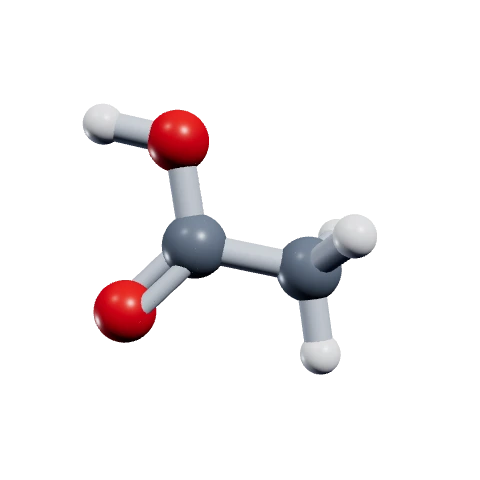


If you took chemistry after about 1934, you were probably shown a chlorine atom on the end of a carbon chain with a row of shrinking arrows running away from it: the chlorine pulls electrons, the next carbon pulls a little less, the next a little less again, fading out over three or four bonds. It is called the inductive effect, it is on nearly every organic chemistry syllabus, and in September 2026 it had its biggest week in public since it was named. ScienceDaily ran the Cardiff University release under the headline “Chemistry textbooks have been getting this wrong for nearly 100 years.”
The joke writes itself: a century of students drew those arrows, got full marks for them, and the arrows were not doing what the diagram said. The better story is that the numbers the arrows were drawn to explain are fine. They are measured acid strengths, most of them for acids in the acetic acid family, and they still hold. What changed is the story told about them. This article sets out what the paper found, which numbers to keep, where the old picture breaks, and why the whole argument started with the acid that Alliance Chemical sells by the gallon.
A note on scope before the science. Alliance Chemical took no part in the research, has no relationship with the authors, and is not taking a side in how any exam board should mark the topic. Every figure below is taken from the paper itself, which is open access, or from the university and the publications named in the references.
What the paper actually says
The paper is “Rethinking the Nature and Extent of Inductive Effects in Organic Compounds,” by Mark C. Elliott and Colan E. Hughes of Cardiff University, Edwin C. Johnson of the University of Newcastle in Australia and Kasimir P. Gregory of the University of New England, published in the Journal of Chemical Education in May 2026 under a CC-BY licence. Its central sentence is in the abstract:
The authors got there by calculating where the electrons actually sit. They took simple neutral molecules such as 1-fluoropentane and 1,1,1-trifluoropentane and computed the charge on every atom with three separate charge models, NPA, Hirshfeld and CM5, because “the charge on an atom” has no single agreed definition and a result that survives three methods is harder to argue with. The finding was the same each time: a real pull at the carbon attached to the halogen, a small and messy change at the next carbon, and nothing measurable after that. In the paper’s words, with the common electronegative elements found in neutral organic compounds “there is no meaningful electronic effect beyond two bonds, and beyond one bond the trends are small and are complicated by hyperconjugation.”
That is not a new idea dropped from nowhere, and the authors say so. Earlier computational work by Wiberg, and by Nolan and Linck, had already found little onward transmission down an alkyl chain. The paper’s complaint is that this “appears not to be widely known and has had little impact on textbooks.” The Cardiff release quotes the lead author directly: “Instead, we show that the inductive effect in a neutral molecule does not extend beyond one bond.”
The consequence is already visible. ScienceDaily’s write-up of the release reports that “two A-level exam boards have since announced reviews of how they teach the inductive effect and directly cited the research as part of the reason for doing so.” Co-author Edwin Johnson put the stakes plainly: “If a foundational concept is taught inaccurately, misunderstandings can carry into more advanced science and research.”
The one-sentence version. The acid strengths in your textbook are right; the row of fading arrows drawn to explain them is not, because in a neutral molecule the electron pull stops after about one bond.
The 80, 8, 2 ladder: the numbers you can keep
Most of the teaching of the inductive effect, the paper notes, “derives from the acidity of carboxylic acids.” The authors reproduce the classic data set as their own Figure 2, and it is worth reading as a ladder. Each rung is an acid with one chlorine atom, moved one carbon further from the acid group. Acid strength is reported as pKa, where lower means stronger and each whole unit is a factor of ten.
| Acid | Stronger than its parent by | Aqueous pKa | Parent acid pKa | Where the chlorine sits |
|---|---|---|---|---|
| Chloroacetic acid | about 80× | 2.86 | 4.76 (acetic acid) | On the carbon next to the acid group |
| 3-Chloropropanoic acid | about 8× | 3.98 | 4.87 (propanoic acid) | One carbon further away |
| 4-Chlorobutanoic acid | about 2× | 4.52 | 4.82 (butanoic acid) | Two carbons further away |
The factors come straight from the pKa gaps: a difference of 1.90 units is 101.90, about 79; 0.89 units is about 7.8; 0.30 units is about 2.0. Eighty, eight, two. That falling ladder is the most famous picture in physical organic chemistry, and it is real. A chlorine near the acid group makes a big difference to how readily the acid gives up its proton, and a chlorine further away makes a smaller one.
Stacking halogens on the same carbon, the same figure shows, works the way everyone expects. Acetic acid at 4.76 becomes chloroacetic acid at 2.86, dichloroacetic acid at 1.26 and trichloroacetic acid at 0.64. That last step is a factor of roughly 13,000 in acid strength from swapping three hydrogens for three chlorines, and it puts trichloroacetic acid close to the strong acids even though it is a carboxylic acid on paper. The paper agrees with both of these conclusions outright: halogenation makes a carboxylic acid more acidic, and more halogens make it more acidic still.
Where the old arrows go wrong
The paper lists four conclusions that textbooks draw from these numbers and grades them. Points 1 and 2, above, are correct. The other two are not.
| What textbooks conclude | The paper’s verdict |
|---|---|
| 1. Halogenation makes a carboxylic acid more acidic | Correct |
| 2. More halogens exert a larger effect | Correct |
| 3. The effect is larger for the more electronegative halogens | Incorrect in the gas phase: chloroacetic acid is more acidic than fluoroacetic acid there |
| 4. The halogen’s pull is felt several bonds away, shrinking at each bond | Leads to “assumptions about the nature of charge transmission that are not supported by the evidence” |
The key to point 4 is a distinction the arrows hide. The pKa ladder is not a measurement of the neutral acid. It is a measurement of an equilibrium between the neutral acid and its charged conjugate base, the carboxylate anion, sitting in water. The authors find that charge behaves differently from the neutral case: “transmission of electron-density along an alkyl chain behaves differently in charged molecules than in neutral molecules.” When the acid loses its proton, the new negative charge spreads out over the whole molecule, and how well the molecule can spread it, its polarizability, decides how stable the anion is.
So a chlorine two carbons away can still stabilize the anion a little, not because its pull ran down the chain bond by bond in the neutral acid, but because the anion’s electron cloud reaches out to it. The paper is careful to separate those two statements: “the fact that the effect diminishes with distance (between the halogen and the carboxylate) does not imply that the magnitude of the effect diminishes along the chain at each additional atom.” The distance dependence is real; the relay race is not.
The same logic explains a detail most students are told to ignore. In the authors’ gas-phase calculations, longer-chain acids with no halogen at all come out slightly more acidic than acetic acid, “due to the higher polarizability of the longer alkyl groups acting to stabilize the conjugate base.” In water the order flips; the paper notes that solution pKa data are “significantly influenced by solvent effects.” Which is the point: the number in the table is the chemistry of the molecule plus the chemistry of the water around it, and the arrow drawn on the neutral molecule was never the whole explanation.
The fluorine surprise
Point 3 is where most people who studied chemistry will stop and reread. Fluorine is the most electronegative element, so every textbook ranks fluoroacetic acid as more acidic than chloroacetic acid. In water it is: the paper’s Figure 2 gives 2.59 against 2.86. But remove the water and the order reverses. The authors’ calculated ionization enthalpies, where a lower number means an easier ionization, are 1,395.8 kJ/mol for chloroacetic acid and 1,408.2 kJ/mol for fluoroacetic acid, against 1,451.4 kJ/mol for acetic acid itself, and they note that gas-phase measurements show chloroacetic acid is the stronger acid there too.
Their explanation takes one line: “Polarizability of the halogen is more important than electronegativity.” A chlorine atom is larger and its electron cloud is softer, so when the acid ionizes the chlorine soaks up more of the new negative charge than a fluorine does. The water result runs the other way because, as the paper puts it, the carboxylate anions carrying the smaller halogens are better solvated. That is a statement about water, not about fluorine’s pull, and the conclusions section says so as bluntly as a journal allows:
Trifluoroacetic acid is more acidic than trichloroacetic acid in water, 0.23 against 0.64 in the same figure. The paper’s objection is to the word “because.” The answer on the exam paper can be right while the reason behind it is wrong, and the paper’s whole argument is that students should learn the reason.
It started with acetic acid
The reason this is an acetic acid story, not just a textbook story, is in the paper’s first paragraph. The effect was introduced, though not named, by Gilbert N. Lewis in his 1916 paper “The Atom and the Molecule.” His example was the acid in the ladder above:
Christopher Ingold gave it the name and the arrows in 1934, writing the chain as Cl←CH2←CH2←CH3 to show “the sequential permanent polarization of bonds.” Neither man could calculate the charge on an atom. The paper is generous about that: the pioneers worked “in very different times,” and because quantum chemical methods were limited, “assumptions, rather than calculations, about the nature of charge transmission were invoked.” The arrows were a reasonable guess about why chloroacetic acid is eighty times stronger than acetic acid. It took supercomputers and ninety years to check the guess.
That makes acetic acid the fixed point of the whole debate. Its aqueous pKa of 4.76 is the zero on every version of the ladder, including the new one, and it is a measured property of the molecule, not a model. Nothing in the paper moves it. The same goes for every figure a buyer or a lab actually uses: the pH of a given dilution, where an acetate buffer sits, how much base a titration consumes. Those follow from the measured constant, whichever story is told about its chlorinated cousins.
Strong is not the same as concentrated. Glacial acetic acid is about 99% pure and still a weak acid, because pKa describes how much of it ionizes, not how much is in the bottle. At 0.1 mol/L, about 1.3% of acetic acid molecules are ionized and the pH is about 2.9. Chloroacetic acid at the same concentration is far more ionized. Concentration is a purchasing decision; strength is a property of the molecule.
What this means on a specification
Nothing in the paper changes which grade of acetic acid you need. It is a reminder that the property that governs most real uses of acetic acid is the one measured number, 4.76, and that the grade you buy should match how precisely your process depends on it.
| Use | What to specify | Why pKa 4.76 matters there |
|---|---|---|
| Acetate buffers, HPLC mobile phases, titration standards | ACS reagent glacial acetic acid, assay and impurity limits stated | An acetate buffer holds its pH best within about one unit of 4.76. Impurities that are themselves acids or bases shift the buffer, so the reagent specification is buying you a predictable pH, not just purity. |
| Teaching labs, demonstrations of weak-acid behaviour | ACS reagent glacial, diluted in the lab to the strength the experiment needs | A weak-acid titration curve with its half-equivalence point at pH 4.76 is the cleanest classroom proof of what pKa means. A known starting assay keeps the numbers honest. |
| Synthesis, esterification, solvent use, pH adjustment in process water | Technical glacial acetic acid | Here acetic acid is a reagent or a mild acid, and assay drives the result more than trace impurities. Technical grade is usually the economical choice. |
| Descaling, cleaning, weed and surface work | A pre-diluted strength that matches the job, so nobody dilutes glacial acid by hand | Concentration, not pKa, sets how fast it works. A 30% or 50% solution arrives ready and removes the most hazardous step, handling the 99% material. |
Three practical points follow.
First, ask for the certificate of analysis for your lot. For buffer and analytical work the useful lines are assay, residue after evaporation and the specified trace metals, and they are lot-specific. A typical-values sheet is not the same document.
Second, respect the freezing point. Glacial acetic acid freezes at about 16.6 °C, roughly 62 °F, which is why it is called glacial. A drum that arrives solid in winter is not a quality problem; warm it gently and completely before sampling, because a partly thawed container is not uniform.
Third, dilute acid into water, never the reverse, with eye protection and acid-resistant gloves, in a ventilated space. Glacial acetic acid is corrosive and combustible, and its vapour is strongly irritating well before it is a fire concern. The safety data sheet on each product page sets out the handling in full.
A word on what this article does not say. It reports a peer-reviewed argument about how an electronic effect is explained, and quotes its authors and their university. It does not second-guess any teacher’s or exam board’s current mark scheme, and it makes no claim about ours beyond the grades, sizes and documents listed on our product pages. Alliance Chemical does not sell chloroacetic, trichloroacetic or trifluoroacetic acid; they appear here as the textbook examples they are. Students should follow their own exam board’s current specification while the reviews run.
Common questions
What is the inductive effect?
It is the shift of electron density through the sigma bonds of a molecule toward a more electronegative atom, such as chlorine or fluorine. Textbooks have long taught that the shift relays down a carbon chain and fades over three or four bonds. The 2026 Journal of Chemical Education paper by Elliott, Johnson, Gregory and Hughes argues that in a neutral molecule it is effectively limited to one bond.
Were chemistry textbooks really wrong for 100 years?
Partly. The acid-strength data that textbooks use are correct and are reproduced in the paper. What the authors reject is the explanation: the picture of a pull that relays bond by bond through a neutral chain. They attribute the long-range part of the trend to polarizability of the charged carboxylate and to solvation. Two A-level exam boards have announced reviews of how the topic is taught.
Why is chloroacetic acid so much stronger than acetic acid?
In water its pKa is 2.86 against 4.76 for acetic acid, a difference of 1.90 units, which makes it about 80 times stronger. The chlorine sits one bond from the carbon bearing the acid group and stabilizes the negative charge of the anion left when the proton leaves. The paper finds chlorine’s polarizability matters more to that stabilization than its electronegativity alone.
Is fluoroacetic acid stronger than chloroacetic acid?
In water, yes: pKa 2.59 against 2.86. In the gas phase, no: chloroacetic acid is the stronger acid, and the paper’s calculated ionization enthalpies agree, 1,395.8 kJ/mol against 1,408.2 kJ/mol. The authors conclude that polarizability outweighs electronegativity, and that the water result reflects better solvation of the anions carrying smaller halogens.
Does this change the pKa of acetic acid?
No. The aqueous pKa of acetic acid, 4.76, is a measured constant and the paper uses it as its baseline. Buffer calculations, titration end points and the pH of any dilution all follow from that number and are unaffected. What the research changes is the explanation of why halogenated relatives of acetic acid are stronger acids.
Which acetic acid grade should a school or university lab buy?
ACS reagent grade glacial acetic acid, diluted in the lab, for titrations, buffers and any experiment whose result depends on a known assay. Technical glacial is suited to synthesis and general use where trace impurities do not affect the result. For cleaning or demonstrations where only concentration matters, a pre-diluted solution avoids handling the 99% material at all.
References & Authoritative Sources
Every pKa value, calculated enthalpy and quotation from the research is taken from the open-access paper; the exam-board statement and author quotes are from the Cardiff University release as published by ScienceDaily; the historical quotations are from the paper’s introduction and the 1916 original.
- Rethinking the Nature and Extent of Inductive Effects in Organic Compounds — M. C. Elliott, E. C. Johnson, K. P. Gregory and C. E. Hughes, Journal of Chemical Education 2026, 103(6), 3156–3164, DOI 10.1021/acs.jchemed.6c00141. CC-BY 4.0.
- Open-access full text on PubMed Central (PMC13262726) — Figure 2 aqueous pKa values; Table 1 calculated ionization enthalpies; the four textbook conclusions; the conclusions section.
- Chemistry textbooks have been getting this wrong for nearly 100 years — ScienceDaily, 14 September 2026, source: Cardiff University. Quotes from Mark Elliott and Edwin Johnson; the two A-level exam-board reviews.
- Why I think it’s time to change how we teach the inductive effect — Mark Elliott, opinion, Chemistry World, 3 June 2026.
- The Atom and the Molecule — G. N. Lewis, Journal of the American Chemical Society 1916, 38, 762–785. The chloroacetic acid passage quoted in the paper’s introduction.
- Glacial Acetic Acid: The Complete Guide — Alliance Chemical. Properties, grades, freezing point and handling of 99% acetic acid.
The acetic acid we stock

The reagent for buffers, titrations and teaching labs, where a known assay keeps pKa 4.76 predictable. Quart to pallet.

For synthesis, esterification, solvent use and process pH adjustment, where assay drives the result. Quart to pallet.

Pre-diluted acetic acid, 5% to 75%
When only concentration matters, a ready strength removes the step of diluting 99% acid by hand.
Not sure whether your lab needs reagent or technical grade?
Tell us what the acetic acid is for, the parameter your result is measured against and the volume you use, and we will tell you whether ACS reagent grade is buying you something real or whether technical grade does the job. That is the right answer, not the nearest thing in stock.
See every acetic acid grade and strengthKey numbers and sources
| Number | What it is | Source |
|---|---|---|
| 1 bond | Reach of the inductive effect in a neutral molecule | J. Chem. Educ. 2026, abstract |
| 4.76 / 2.86 | Aqueous pKa of acetic acid and chloroacetic acid; about 80× in acid strength | Paper, Figure 2 |
| 80× / 8× / 2× | Effect of one chlorine at 1, 2 and 3 carbons from the acid group (pKa gaps 1.90, 0.89, 0.30) | Paper, Figure 2; arithmetic |
| 1,395.8 vs 1,408.2 kJ/mol | Calculated ionization enthalpy, chloroacetic vs fluoroacetic acid | Paper, Table 1 |
| 2 | A-level exam boards reviewing how they teach the effect | Cardiff University via ScienceDaily |
Frequently asked questions
What is the inductive effect?
It is the shift of electron density through the sigma bonds of a molecule toward a more electronegative atom, such as chlorine or fluorine. Textbooks have long taught that the shift relays down a carbon chain and fades over three or four bonds. The 2026 Journal of Chemical Education paper by Elliott, Johnson, Gregory and Hughes argues that in a neutral molecule it is effectively limited to one bond.
Were chemistry textbooks really wrong for 100 years?
Partly. The acid-strength data that textbooks use are correct and are reproduced in the paper. What the authors reject is the explanation: the picture of a pull that relays bond by bond through a neutral chain. They attribute the long-range part of the trend to polarizability of the charged carboxylate and to solvation. Two A-level exam boards have announced reviews of how the topic is taught.
Why is chloroacetic acid so much stronger than acetic acid?
In water its pKa is 2.86 against 4.76 for acetic acid, a difference of 1.90 units, which makes it about 80 times stronger. The chlorine sits one bond from the carbon bearing the acid group and stabilizes the negative charge of the anion left when the proton leaves. The paper finds chlorine's polarizability matters more to that stabilization than its electronegativity alone.
Is fluoroacetic acid stronger than chloroacetic acid?
In water, yes: pKa 2.59 against 2.86. In the gas phase, no: chloroacetic acid is the stronger acid, and the paper's calculated ionization enthalpies agree, 1,395.8 kJ/mol against 1,408.2 kJ/mol. The authors conclude that polarizability outweighs electronegativity, and that the water result reflects better solvation of the anions carrying smaller halogens.
Does this change the pKa of acetic acid?
No. The aqueous pKa of acetic acid, 4.76, is a measured constant and the paper uses it as its baseline. Buffer calculations, titration end points and the pH of any dilution all follow from that number and are unaffected. What the research changes is the explanation of why halogenated relatives of acetic acid are stronger acids.
Which acetic acid grade should a school or university lab buy?
ACS reagent grade glacial acetic acid, diluted in the lab, for titrations, buffers and any experiment whose result depends on a known assay. Technical glacial is suited to synthesis and general use where trace impurities do not affect the result. For cleaning or demonstrations where only concentration matters, a pre-diluted solution avoids handling the 99% material at all.
Related Chemical Collections
About the author
Andre Taki
This article is for informational purposes only.


