



Squeeze a lemon and you get citric acid. Read the label on a can of lemon soda, a bag of sour candy or a jar of salsa and you will find citric acid again, but almost none of that came from a lemon. It came from a tank of sugar water and a mold most people know from the black spots on an old onion, and the mold was filtered out long before the acid reached the can. The switch happened because of a single paper published in 1917, and it is one of the least-told stories in food chemistry.
Where does citric acid come from?
Almost all commercial citric acid comes from fermentation: a microorganism, usually the mold Aspergillus niger, is grown on a sugar source and excretes citric acid into the liquid, which is then purified into crystals. A 2010 review in the Brazilian Journal of Microbiology puts microbial production at about 99% of world output, and that figure is repeated in the USDA Agricultural Marketing Service's 2015 technical report on citric acid. A small share of the microbial total uses Candida yeasts instead of mold, so the accurate phrasing is "mostly A. niger," not "all of it."
World production passed 2 million tonnes a year by 2015, up from under half a million two decades earlier, and China made roughly 59% of it that year and is by far the largest exporter; the EPA's 2023 supply-chain profile, drawing on World Bank trade data, shows China exporting 1,067 million kg in 2021, about nine times as much as Belgium, the second-largest exporter.
The acid is still present in lemons, limes and oranges, where it was first found. It is just no longer economical to get it from them. Fresh lemon juice holds about 48 grams of citric acid per liter, roughly 5%, and every kilogram of fruit has to be grown, picked, shipped and pressed. A fermentation tank turns cheap sugar into a broth that is several percent citric acid in days, all year round, in a building.
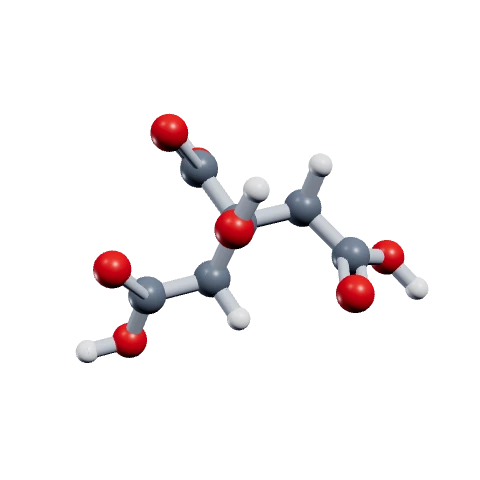
Same molecule, different route. Citric acid from a lemon and citric acid from a fermenter are both 2-hydroxypropane-1,2,3-tricarboxylic acid, C6H8O7, molar mass 192.12 g/mol (anhydrous). A molecule carries no record of where it was made.
Why did the world's citric acid once come from Sicilian lemons?
Before the 1920s, citric acid was a by-product of the Sicilian lemon trade, and Italy controlled its price. The Swedish chemist Carl Wilhelm Scheele first isolated the acid from lemon juice in 1784. For more than a century after, the commercial route was the same idea at scale: press cull lemons, neutralize the juice with lime to precipitate calcium citrate (sold as "citrate of lime"), ship that, and convert it back to citric acid with sulfuric acid.
Sicily had the raw material. According to the U.S. Tariff Commission's 1921 survey of the trade, 30 to 50% of Sicilian lemons were culls unfit for export as fruit, against about 10% in California, and those culls became citrate. In 1908 Italy created the Camera Agrumaria, a government citrus chamber in Messina that handled almost all citrate of lime and citric acid, fixed prices periodically and allotted monthly deliveries to buyers around the world. Over 90% of the citric acid used in the United States was made from imported raw material, most of it Sicilian citrate.
World War I exposed how fragile that was. The Tariff Commission recorded Italian citrate of lime rising from 16.5 cents a pound in 1914 to 61.5 cents by December 1919. Pfizer, which had sold citric acid made from lemon-derived raw material since the 1880s, puts the price of citric acid itself at $1.25 a pound in 1919. American food and drug makers wanted a source that did not run through a single foreign price-setter.
The first attempt at mold fermentation failed
The idea that a fungus could make citric acid was not new. In 1893 the German botanist Carl Wehmer showed that a mold he called Citromyces (now classified in Penicillium) converted sugar into citric acid, and he patented the process in the United States in 1894 (US 515,033). It was tried industrially and abandoned. Wehmer himself blamed contamination of his fermentation liquors and the unreliable strength of his cultures, and later workers found it far too slow. One design choice made it worse: Wehmer neutralized the acid with chalk as it formed, which kept the broth close to neutral, exactly where bacteria thrive.
What did James Currie discover in 1917?
James N. Currie showed that the black mold Aspergillus niger makes citric acid in large amounts if you starve it of nitrogen, feed it plenty of sugar and, crucially, start the fermentation acidic. His paper, "The citric acid fermentation of Aspergillus niger," appeared in the Journal of Biological Chemistry in July 1917 (volume 31, pages 15 to 37). Currie was working in the research laboratories of the USDA's Dairy Division, not at a drug company.
The acid start was the whole trick. Currie screened about 20 cultures of A. niger and found that under the right conditions all of them produced citric acid "in abundance," with yields ranging from none at all to over 50% of the sugar consumed. His recommended medium was acidified with hydrochloric acid to pH 3.4–3.5. Few bacteria grow below about pH 3.5, so the contamination that ruined Wehmer's process simply could not get started, while the mold tolerated acidity down to about pH 1.4 to 1.6. Where Wehmer had fought the acid, Currie made it his first line of defense.
The details of the work are specific enough to picture. Currie grew his cultures in 200 cc Erlenmeyer flasks holding 50 cc of sugar medium at 28 °C, then scaled to pans holding a liter of 15% cane sugar solution. The mold formed a floating, wrinkled mat whose folds hung 5 to 6 centimeters down into the liquid. Acidity climbed by roughly 2% a day and reached about 10% by day eight, when he pressed around 800 cc of liquor out of each mat with a hand filter press. One liquor he measured with a hydrogen electrode read pH 1.46, which he charted against lemon and lime juice.

The detail that surprises people: Aspergillus niger is the same species that causes black mold on stored onions. Its black color comes from its spores. Currie recorded that when the citric acid fermentation is going well, "the mold does not spore but remains white." The mat that makes the acid is a pale, felt-like layer, not a black crust.
How did Pfizer turn a pan of mold into an industry?
Chas. Pfizer & Co. hired Currie and spent most of a decade turning his flasks into a factory. The American Chemical Society dates the hire to 1917; Pfizer's own history files the achievement under 1919, the year it opened a pilot plant. The project had a name that says exactly what it did: SUCIAC, for "Sugar Under Conversion to Citric Acid."
The scale-up was practical rather than glamorous. According to the ACS commemorative booklet for Pfizer's landmark, Currie began with a large flat pan bought at a five-and-ten store, then cut it into smaller, shallower pans, which improved the yield because the mold grows as a surface mat and needs air. In 1919 Pfizer also hired a 16-year-old assistant for Currie named Jasper Kane, who would spend his career on fermentation. Pfizer built a full SUCIAC plant in 1924, and it began operating in 1926. In 1933 Kane replaced refined sugar with cheaper molasses.
The economics followed. Pfizer's history records the price of citric acid falling from $1.25 a pound in 1919 to 20 cents, a drop it dates to 1939. More than 5,000 tons were made in the United States in 1929. On the Italian side, the leading Palermo citric acid works stopped production in 1931–32, and by the mid-1930s fermentation output far exceeded extraction from citrus. The safe summary is that mold had replaced lemons as the world's main source of citric acid by the 1930s.
What citric acid had to do with penicillin, and what it did not
The fermentation skills Pfizer built on citric acid led directly to its World War II penicillin program, but the famous deep-tank method did not come from citric acid, and the story is often told wrong. Pfizer did try to grow citric acid in deep, submerged tanks, and it failed. The submerged method first worked in 1929 on a different product, gluconic acid, using stirred tanks, pH control and sterile air. In 1942 Kane proposed applying that gluconic acid process to penicillin, and Pfizer's plant on Marcy Avenue in Brooklyn opened on 1 March 1944 with fourteen 7,500-gallon tanks. The American Chemical Society designated the work a National Historic Chemical Landmark, "Development of Deep-tank Fermentation," in 2008.
Three versions of this story that are wrong: Pfizer did not invent or discover citric acid (Scheele isolated it in 1784, and Pfizer sold lemon-derived citric acid for decades before Currie). Currie did not use molasses (he used cane sugar; molasses came with Kane in 1933). And the price did not collapse "within a few years": Pfizer's own figure puts 20 cents a pound in 1939.
How is citric acid made today?
Citric acid is made today by fermenting a sugar source with selected strains of A. niger, removing the mold, and purifying the acid out of the broth in several chemical steps. The feedstock is usually molasses, corn-derived glucose or other starch hydrolysates. Most modern plants use submerged fermentation in large aerated tanks, although surface and solid-state methods are still used in places. The purification, as described in the USDA AMS 2015 technical report, is where the mold is left behind:
- Remove the biomass. The mold (mycelium) is filtered or centrifuged out of the fermentation broth.
- Drop out oxalate. Lime is added under conditions that precipitate calcium oxalate, a by-product, which is removed.
- Precipitate calcium citrate. Milk of lime added to the hot liquor (above about 90 °C) precipitates the citric acid as calcium citrate, which is filtered and washed. This is the same salt the Sicilian trade shipped a century ago.
- Release the acid with sulfuric acid. Treating calcium citrate with 60 to 70% sulfuric acid frees citric acid into solution and leaves insoluble calcium sulfate (gypsum), roughly a tonne of gypsum per tonne of citric acid.
- Polish. Activated carbon and/or ion exchange remove color and trace ions.
- Crystallize. The solution is evaporated and crystallized. Crystals formed below 36.5 °C are the monohydrate; above that temperature they are anhydrous.
Some plants replace the lime and gypsum steps with solvent extraction; FDA regulation 21 CFR 173.280 describes an amine solvent-extraction process for recovering citric acid from A. niger fermentation liquor. Ion exchange and electrodialysis are also used.

Is citric acid made from black mold safe?
The U.S. Food and Drug Administration lists citric acid as generally recognized as safe (GRAS) under 21 CFR 184.1033, with use limited only by good manufacturing practice. That regulation, affirmed in 1994, names the ways citric acid may be produced: recovery from sources such as lemon or pineapple juice, fermentation with Candida yeasts, and solvent extraction from A. niger fermentation liquor. It is worth being precise here: the regulation mentions A. niger in connection with that solvent-extraction route and does not describe the lime-and-gypsum purification in its text.
People searching "citric acid black mold" have usually met a 2018 paper in Toxicology Reports by Iliana E. Sweis and Bryan C. Cressey, which proposed that "manufactured citric acid" might trigger inflammatory reactions. It is worth knowing what that paper is. It reports four case histories of people who described joint pain, muscle pain, breathing difficulty, fatigue or abdominal cramps within hours of eating certain foods, and who identified citric acid afterwards by reading labels. There were no controls, no blinded challenge, no dose measurement and no analysis of the citric acid itself. The authors write that "We cannot conclusively affirm that MCA is the causative factor in the subjects' inflammatory symptoms," and call for double-blind studies. The paper raises a question; it does not answer one.
We have not found published measurements, in either direction, of residual mold protein in purified citric acid, so we will not tell you it contains none and we will not tell you it contains some. What the process shows is that the mold is physically removed at the first step, and the acid then goes through precipitation as a calcium salt, conversion with sulfuric acid and crystallization before it is sold. If you have a diagnosed sensitivity, that is a conversation for your doctor, not for a chemical supplier.
Where the "mold" worry comes from: Aspergillus niger is an organism most people know from spoiled onions and damp walls. The citric acid it makes is excreted into the liquid around it; the mold is the factory, not the product.
Is manufactured citric acid the same as the citric acid in lemons?
Yes, chemically they are the same compound: C6H8O7, CAS 77-92-9 in its anhydrous form. FDA's own identity paragraph describes citric acid as "a naturally occurring constituent of plant and animal tissues." Your body makes it too: citric acid (as citrate) is the first intermediate of the citric acid cycle, the Krebs cycle, which runs in nearly every cell that uses oxygen.
What differs between a lemon and a bag of crystals is everything around the molecule. Lemon juice carries water, sugars, other acids, flavor compounds and variation from fruit to fruit. Purified citric acid is a single compound at a stated assay, which is precisely why manufacturers use it: the same weight gives the same sourness and the same pH every time.
Whether a food made with fermented citric acid can be labeled "natural" is a labeling question rather than a chemistry one. FDA has not formally defined "natural" for food labels; its longstanding policy is that the term means nothing artificial or synthetic has been added that would not normally be expected in the food. We are not the right people to rule on a specific label, and neither is a molecule.
Citric acid at a glance
| Property | Anhydrous | Monohydrate |
|---|---|---|
| Formula | C6H8O7 | C6H8O7·H2O |
| CAS number | 77-92-9 | 5949-29-1 |
| Molar mass | 192.12 g/mol | 210.14 g/mol |
| Crystallizes | Above 36.5 °C | Below 36.5 °C |
| pKa values (25 °C) | 3.13, 4.76, 6.40 (NIST) | |
| Weight substitution | 1.000 g | 1.094 g delivers the same citric acid |
Swapping forms in a recipe or formula: monohydrate carries one water molecule per acid molecule, so it is about 91.4% citric acid by weight. To replace 100 g of anhydrous citric acid, use about 109.4 g of monohydrate (210.14 ÷ 192.12 = 1.094). Going the other way, multiply by 0.914.
Which citric acid grade do you actually need?
Choose the grade by what the citric acid will touch and what paperwork the job requires, not by the highest purity on the page. Alliance Chemical carries citric acid in six forms, and they are not interchangeable:
| Product | Form | Typical use |
|---|---|---|
| Citric Acid Monohydrate - USP Food Grade | Crystals | Food and beverage acidulant, formulation where a USP monograph is specified |
| Citric Acid Anhydrous - Food Grade | Crystals, no water of crystallization | Food, canning, bath and cosmetic formulation, dry blends where added water matters |
| Citric Acid Monohydrate - ACS Reagent Grade | Crystals | Laboratory buffers and analytical work |
| Citric Acid Anhydrous - ACS Reagent Grade | Crystals | Laboratory and analytical work where an anhydrous basis is required |
| Citric Acid 50% Solution Technical Grade | Liquid concentrate | Descaling, metal cleaning, equipment and industrial pH adjustment |
| Citric Acid 25% Solution (Technical Grade) | Ready-to-dilute liquid | Descaling and cleaning where handling a weaker solution is simpler |
Two rules of thumb. If it goes into something people eat, drink or put on their skin, start with one of the two food-grade crystal products in the first two rows. A coffee or espresso machine counts: it touches what you drink, so our descaling guide uses the food-grade crystals and gives the ratios. If it is cleaning scale off a boiler, a heat exchanger or process equipment that never contacts food, a technical grade solution does the same chemistry without paying for certification you will not use. The technical grade solutions are not for food or analytical use.
Not sure which form fits the job?
Tell us what the citric acid is going into, how much you use a month and whether you need crystals or liquid, and we will point you to the right grade and pack size. Need the Certificate of Analysis? Just ask, and we will send it over at no charge.
Monohydrate, USP Anhydrous crystals ACS Reagent Grade 50% SolutionKey numbers and sources
| Number | What it is | Source |
|---|---|---|
| 1784 | Carl Wilhelm Scheele isolates citric acid from lemon juice | ACS; Ciriminna et al. 2017 |
| 1893 / US 515,033 | Wehmer's Citromyces citric acid fermentation and its U.S. patent (1894) | Google Patents; Currie 1917 |
| 16.5¢ → 61.5¢/lb | Italian citrate of lime, 1914 to December 1919 | U.S. Tariff Commission, 1921 |
| pH 3.4–3.5 | Currie's acidified medium that kept bacteria out | Currie, J. Biol. Chem. 31:15–37 (1917) |
| 1919 | Pfizer SUCIAC pilot plant; citric acid $1.25/lb | ACS landmark booklet; Pfizer history |
| 20¢/lb (1939) | Citric acid price after fermentation scaled | Pfizer history |
| ~99% | Share of world citric acid made by microbial fermentation | Max et al. 2010; USDA AMS 2015 |
| >2 million t / 59% | World production by 2015 / China's share | Ciriminna et al. 2017 |
| 1,067 million kg | China's citric acid exports, 2021 (Belgium second at 114 million kg) | U.S. EPA 2023, from World Bank WITS |
| ~48 g/L | Citric acid in fresh lemon juice | Penniston et al., J. Endourol. 2008 |
| 36.5 °C | Crystallization boundary: monohydrate below, anhydrous above | USDA AMS 2015 |
| 3.13 / 4.76 / 6.40 | pKa values at 25 °C | NIST, Goldberg et al. 2002 |
| 192.12 / 210.14 g/mol | Molar mass, anhydrous (CAS 77-92-9) / monohydrate (CAS 5949-29-1) | PubChem |
| 21 CFR 184.1033 | FDA GRAS affirmation for citric acid | eCFR |
References & Authoritative Sources
The history is from Currie's original paper, the U.S. Tariff Commission, the American Chemical Society and Pfizer; the process and supply figures are from USDA, EPA and peer-reviewed reviews; the constants are from NIST and PubChem.
- The citric acid fermentation of Aspergillus niger — Currie, J. N., Journal of Biological Chemistry 31(1):15–37, 1917. Cultures, medium, pH and yields.
- Tariff Information Surveys: Citric Acid — U.S. Tariff Commission, 1921. Camera Agrumaria, Sicilian citrate trade and prices.
- US Patent 515,033 — Carl Wehmer, 1894. Citric acid by Citromyces fermentation.
- Development of Deep-tank Fermentation — American Chemical Society National Historic Chemical Landmark, Pfizer, Brooklyn, 2008, and its commemorative booklet. Currie, SUCIAC, Kane, gluconic acid, penicillin.
- Pfizer: Our History — Pfizer. Citric acid price, $1.25 (1919) to 20¢ (1939).
- Biotechnological production of citric acid — Max, B. et al., Brazilian Journal of Microbiology, 2010. Share of world production by fermentation.
- Citric acid: emerging applications of key biotechnology industrial product — Ciriminna, R. et al., Chemistry Central Journal, 2017. Production volume, China's share, history.
- Citric Acid Technical Report — USDA Agricultural Marketing Service, 2015. Fermentation and purification steps.
- Citric Acid Supply Chain Profile — U.S. EPA, 2023. Export volumes by country.
- 21 CFR 184.1033 Citric acid — Electronic Code of Federal Regulations. GRAS status and permitted production routes.
- Use of the Term Natural on Food Labeling — U.S. FDA. Policy on the term “natural.”
- Potential role of the common food additive manufactured citric acid in eliciting significant inflammatory reactions — Sweis, I. E. and Cressey, B. C., Toxicology Reports 5:808–812, 2018. Four case reports.
- Quantitative assessment of citric acid in lemon juice, lime juice, and commercially-available fruit juice products — Penniston, K. L. et al., Journal of Endourology 22(3):567–570, 2008.
- Black Mold of Onion — Utah State University Extension. Aspergillus niger on onions.
- Thermodynamic quantities for the ionization reactions of buffers — Goldberg, R. N. et al., J. Phys. Chem. Ref. Data 31:231, 2002. Citric acid pKa.
- Citric Acid (CID 311) — PubChem, National Library of Medicine. CAS, formula, molar mass.
Frequently asked questions
How is citric acid made?
Commercially, citric acid is made by fermentation. Selected strains of the mold Aspergillus niger are grown on a sugar source such as molasses or corn-derived glucose and excrete citric acid into the liquid. The mold is removed, the acid is precipitated as calcium citrate, released with sulfuric acid, polished with carbon or ion exchange, and crystallized. About 99% of world supply is made by microbial fermentation.
Is citric acid made from mold?
Most of it is. About 99% of commercial citric acid comes from microbial fermentation, mostly with Aspergillus niger; a small share uses Candida yeasts. The mold is the factory, not the product: it is filtered out before the acid is purified and crystallized.
Who discovered how to make citric acid from mold?
Carl Wehmer showed in 1893 that a Penicillium-type mold could make citric acid, but his process failed commercially. James N. Currie, a USDA chemist, published the workable method with Aspergillus niger in the Journal of Biological Chemistry in 1917; his key step was starting the fermentation at pH 3.4 to 3.5 so bacteria could not grow. Pfizer then scaled it, opening a pilot plant in 1919.
Why isn't citric acid made from lemons anymore?
Cost and supply. Fresh lemon juice holds about 48 grams of citric acid per liter, and before the 1920s supply ran through Sicily's citrus trade, where Italy set prices. Fermentation turns cheap sugar into citric acid year-round; Pfizer records the price falling from $1.25 a pound in 1919 to 20 cents by 1939.
Is citric acid made from black mold safe?
The FDA lists citric acid as generally recognized as safe (GRAS) under 21 CFR 184.1033. A 2018 paper in Toxicology Reports proposed that manufactured citric acid might trigger inflammatory reactions, but it describes four case histories without controls, and its authors state they cannot conclusively affirm causation. Anyone with a diagnosed sensitivity should talk to their doctor.
Is manufactured citric acid the same as the citric acid in lemons?
Yes. Both are C6H8O7 (CAS 77-92-9 anhydrous), molar mass 192.12 g/mol. FDA describes citric acid as a naturally occurring constituent of plant and animal tissues. The difference is purity: lemon juice contains many other compounds, while purified citric acid is a single compound at a stated assay.
What is the difference between citric acid monohydrate and anhydrous?
Monohydrate (CAS 5949-29-1, 210.14 g/mol) carries one water molecule per acid molecule and crystallizes below 36.5 degrees C; anhydrous (CAS 77-92-9, 192.12 g/mol) has none and crystallizes above that temperature. Use about 1.094 g of monohydrate to replace 1 g of anhydrous.
Did citric acid fermentation lead to penicillin?
Partly. Pfizer's fermentation expertise came from citric acid, but its attempt to make citric acid in deep submerged tanks failed. The deep-tank method first worked for gluconic acid in 1929, and Pfizer applied that process to penicillin, opening its Brooklyn plant on 1 March 1944. The American Chemical Society named the work a National Historic Chemical Landmark in 2008.
About the author
Andre Taki
This article is for informational purposes only.


