

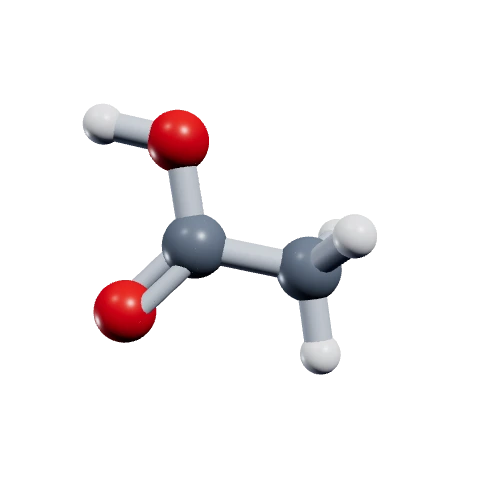


Vinegar does one useful job in a washing machine, and it is not the job most guides give it. It does not soften fibers the way fabric softener does, it does not set dye, and it is not a substitute for detergent. What it does is cancel out the alkaline film that detergent and hard water leave behind. When that film is what is making your towels stiff, scratchy or musty, a vinegar rinse helps. When it is not, the vinegar does very little.
This guide covers the chemistry with real numbers, the doses that cleaning experts and an extension service publish, the genuine disagreement between washing-machine makers about vinegar and rubber seals, and the two popular claims that do not hold up. It also answers the question no top-ranking page answers: how much to use if your vinegar is 10% or 30% instead of the 5% sold in grocery stores.
We sell 10% Vinegar – Concentrated Industrial Strength and 30% Vinegar – Concentrated Industrial Strength. Both are technical-grade acetic acid solutions sold for industrial and commercial cleaning, and both carry a Danger label. That is why every laundry instruction in this guide starts with dilution.
Last reviewed 21 October 2026 against the sources cited below. This is a practical household chemistry guide, not medical, legal or regulatory advice. How we researched it is set out at the end.
Vinegar in laundry at a glance
Use household-strength (5%) white distilled vinegar, or concentrate diluted to 5%, and add it at the rinse. This table is the short version of everything below.
| Job | 5% vinegar | When | If you have 30% |
|---|---|---|---|
| Stiff towels, detergent residue | ¼–½ cup | Final rinse | Pre-dilute 1 : 5, then the same ¼–½ cup |
| Musty-smelling loads | ½ cup | Wash or rinse | Pre-dilute 1 : 5 |
| Presoak | 1 cup per gallon of water | Before washing | 2 tbsp + 2 tsp per gallon |
| Empty-washer cleaning cycle | 1–4 cups, if your manual allows | Hot cycle, then water-only rinse | Up to ⅔ cup, poured into the drum |
| Laundry stripping | None in the soak | Separate rinse afterward only | Same |
| Loads with chlorine bleach | Never | — | Never |

What does vinegar actually do in the washing machine?
Vinegar neutralizes alkaline residue and dissolves mineral deposits; that is the whole mechanism. Laundry detergents are built to run alkaline. One detergent patent describes an in-use pH “of above 8, or from about 9 to about 13, or from about 9.5 to about 11.5, or from about 10 to about 11.” Alkaline wash water is good at lifting oils and soils, but whatever detergent and dissolved minerals are not rinsed away dry into the fabric.
Acetic acid is the opposite. The “white” or “distilled” vinegar sold in grocery stores is what FDA guidance calls distilled vinegar, “the product made by the acetous fermentation of dilute distilled alcohol,” and the same guidance says a diluted vinegar should never be sold at less than 4 percent acetic acid. Grocery white vinegar is usually labeled 5%, which works out to about 50 g of acetic acid per liter, or 0.83 mol/L. With a pKa of 4.76, that solution sits at roughly pH 2.4:
[H+] ≈ √(1.74 × 10−5 × 0.83) ≈ 3.8 × 10⁻³ M → pH ≈ 2.4
In the rinse, the acid does two things. It neutralizes leftover alkaline detergent, and it reacts with calcium carbonate, the main mineral in hard-water scale, to form calcium acetate, which dissolves and rinses away:
CaCO3 + 2 CH3COOH → Ca(CH3COO)2 + H2O + CO2
Olivia Pratt, scientific advisor at the UK consumer group Which?, puts it the same way: “These alkaline deposits can be neutralised by the acidic properties of vinegar, which contains acetic acid.”
So vinegar is a rinse aid, not a detergent and not a softener. It helps in proportion to how much alkaline residue and hard-water scale your laundry is carrying. In soft water with a correctly dosed detergent, there is little for it to do.
Is vinegar a fabric softener?
No: vinegar makes fabric feel softer by taking residue away, while fabric softener works by adding a coating. Commercial softeners are cationic surfactants, often called quats. Their positive charge makes them stick to fibers, and one softener patent describes them depositing “electrostatically, forming a monolayer.” Vinegar leaves nothing behind. When a towel feels softer after a vinegar rinse, it is because the stiff detergent-and-mineral film is gone.
That difference matters most for towels. Consumer Reports’ laundry expert Rich Handel advises skipping fabric softener because “it can leave a layer of residue on your clothes, irritate sensitive skin and reduce the absorption of your towels.” A residue-removing rinse does not have that drawback.
Be realistic about the size of the effect, though. When Which? tested methods for fluffier towels on two identical towels, adding 250 ml of white vinegar to the drawer on a 40 °C cotton cycle, its verdict on the vinegar rinse was: “Results: Disappointing.” Vinegar is not magic. It fixes a residue problem; it cannot rebuild worn-out cotton loops.
How much vinegar do you put in a load of laundry?
Most published guidance lands at ¼ to ½ cup of 5% white vinegar per load, added to the rinse. Here is who says what, all at household 5% strength:
| Use | Dose (5% vinegar) | Source |
|---|---|---|
| Rinse / fabric-softener cup | ½ cup (118 mL) | Cleaning pro quoted by Bob Vila |
| Rinse, everyday loads | ¼–½ cup | Tom’s Guide |
| Musty-smelling loads | ½ cup in the wash | Bob Vila |
| Presoak | 1 cup per gallon of water | Healthline |
| Empty washer cleaning cycle | 1 cup | UF/IFAS Extension, Jackson County |
| Empty washer cleaning cycle (Samsung) | 4 cups in the tub | Samsung Canada |
Add it at the rinse, not with the detergent. Detergent needs its alkaline pH to clean, and acid poured in alongside it works against it. The fabric-softener compartment releases during the final rinse, which is why it is the usual spot. Whether you should use that compartment for vinegar at all is a question for your washer’s manual (see the section on washing machines below).
How do you dilute 30% vinegar for laundry?
Mix 1 part 30% vinegar with 5 parts water to get household 5% strength; for 10% vinegar, mix 1 part with 1 part water. The arithmetic is the standard dilution equation, C1V1 = C2V2: to get 5% from 30%, you need one sixth of the volume, so 1 part concentrate goes into 6 parts total.

| Your vinegar | Concentrate : water | Equals ½ cup of 5% | Equals 1 cup of 5% | Equals 4 cups of 5% | For laundry? |
|---|---|---|---|---|---|
| 10% | 1 : 1 | 59 mL (¼ cup) | 118 mL (½ cup) | 473 mL (2 cups) | Easiest to use |
| 30% | 1 : 5 | 20 mL (4 tsp) | 39 mL (2 tbsp + 2 tsp) | 158 mL (⅔ cup) | Pre-dilute into a jug |
| 50% | 1 : 9 | 12 mL | 24 mL | 95 mL | Not recommended |
| 75% | 1 : 14 | 8 mL | 16 mL | 63 mL | Not recommended |
Volumes use NIST conversions: 1 US cup ≈ 237 mL, 1 tablespoon = 14.79 mL, 1 teaspoon = 4.93 mL. Acid strengths are normally stated by weight; 30% vinegar has a density of about 1.04, so mixing by volume lands within a few percent of the target, which is close enough for laundry.
Measuring teaspoons of a corrosive concentrate every wash day is how splashes happen. The safer routine is to dilute once into a labeled jug and then measure that jug exactly like grocery vinegar:
Make one gallon of 5% laundry vinegar
- Gear up. Splash goggles and acid-resistant gloves before you open the concentrate.
- Water first. Put about 3 quarts of cold water into a clean, empty plastic gallon jug. Always add acid to water, not water to acid.
- Add the concentrate. From 30%: pour in 2⅔ cups (631 mL). From 10%: use a half-gallon jug of water and a half gallon of 10% instead.
- Top up and mix. Fill to the 1-gallon mark with water, cap it, and invert gently a few times.
- Label it. Write “5% vinegar – laundry” and the date on the jug. Never store it in a drink bottle.
Then use ¼–½ cup of the jug per load, the same as store-bought white vinegar.
Why not just pour 4 teaspoons of 30% into the dispenser and let the rinse water dilute it? Because the dispenser holds the liquid undiluted, against plastic and rubber, until the rinse starts. Even ordinary “cleaning vinegar,” which is only a little stronger than 5%, draws a warning from cleaning writers: Bob Vila advises against it for laundry because such products “have a higher acid content and can bleach clothing or even damage your washing machine.” Our 10% and 30% are stronger still, and our product labels for both carry the signal word Danger and the hazard statement H314, “Causes severe skin burns and eye damage.”
Why does strength matter so much? Because hazard classification steps up with concentration. The harmonized European limits printed on a standard acetic acid safety data sheet are a useful map:
| Acetic acid strength | EU classification (specific concentration limits) | What that means at home |
|---|---|---|
| Under 10% (grocery 5%) | Below these skin and eye limits | Normal household handling |
| 10% to under 25% | Eye Irrit. 2 (H319), Skin Irrit. 2 (H315) | Gloves and eye protection |
| 25% to under 90% | Skin Corr. 1B (H314) | Corrosive: goggles, acid-resistant gloves, dilute before use |
| 90% and above | Skin Corr. 1A (H314) | Not a household product |
Source: concentration limits as listed on the acetic acid safety data sheet in the references. Our own labels classify both our 10% and 30% vinegar as Danger, H314, which is more conservative than the EU table for 10%; follow the label on the product you actually have.
Skip 50% and 75% vinegar for laundry. The doses become a few milliliters, which are hard to measure accurately, and those strengths are classed as corrosive. If 50% or 75% is what you already have, see our vinegar dilution calculator and the 10% / 30% / 50% / 75% strength guide.
Is vinegar safe for your washing machine?
The honest answer is that washing-machine makers disagree, so your machine’s manual is the deciding vote. Here is the split as published:
| Source | Position on vinegar in the washer |
|---|---|
| Good Housekeeping Institute | “We don’t recommend adding vinegar to the washing machine with any regularity. Over time it can degrade the hoses and internal parts of the machine.” Also: “Once in a while likely won’t hurt.” |
| Consumer Reports | “Never use anything other than a dedicated laundry detergent in your washing machine. That goes for vinegar, liquid soap and dish detergent.” |
| Which? | “Manufacturers advise against adding vinegar directly to washing machines because it could damage the rubber seals and hoses over time.” |
| Maytag, Whirlpool | Both warn that vinegar can damage soft components such as rubber seals and hoses (as reported by SlashGear, linking each brand’s own guidance). Whirlpool, Maytag and Amana recommend affresh, a washer cleaner from the same company. |
| Samsung Canada | Publishes a cleaning routine for removing hard-water buildup: four cups of white vinegar in the empty tub on the longest, hottest cycle, then a water-only rinse cycle. |
We could not find a published materials test showing exactly what household-strength vinegar does to washer gaskets, so we are not going to invent a mechanism. What the sources agree on is frequency: occasional use is the most anyone endorses, and nobody endorses concentrate.
If your manual does not prohibit it, the lowest-risk way to use vinegar is:
- Use household strength (5%) only, pre-diluted as above.
- Use it occasionally, for a residue or hard-water problem, rather than in every load.
- Keep the dose at ¼–½ cup for a load of laundry.
- Never run vinegar in the same load or cycle as chlorine bleach.
- Follow any vinegar cleaning cycle with a water-only rinse cycle, as Samsung specifies.
Can you clean a washing machine with vinegar?
Yes, if your manufacturer allows it: run an empty hot cycle with vinegar, then an empty rinse cycle with water only. Samsung Canada’s routine is: “Ensure the washing machine is empty, then add four cups of white vinegar to the tub,” select “the longest and hottest wash cycle available, without adding any detergent,” then “Run another wash cycle with hot water only, no detergent, to rinse away any remaining vinegar and loosened buildup.” The University of Florida IFAS Extension office in Jackson County gives a lighter version: a regular cycle with one cup of vinegar and no clothing.
Converted to concentrates, four cups of 5% equals about 2 cups of 10% or ⅔ cup of 30%. Pour pre-diluted vinegar into the drum, not concentrate into the dispenser. If you have a Whirlpool-group machine, the manufacturer’s own recommendation is a dedicated washer cleaner rather than vinegar.
Vinegar’s job here is the mineral side: hard-water scale and detergent buildup. It is not a germ treatment, as the next section explains.
Does vinegar get rid of smells in laundry?
Vinegar helps with the smell that comes from residue, which is the most common reason clean towels and gym clothes still smell. Body oils, detergent and hard-water minerals build up in thick fabrics and hold odor. Dissolving that layer is what a vinegar rinse does well, and a ½ cup of 5% vinegar in the wash is the usual dose for a musty load.
Two limits are worth stating plainly. First, vinegar does not perfume anything; it removes smells rather than adding one, and the vinegar smell itself rinses out as the laundry dries. Second, vinegar is not a germ treatment. Taylor Robertson of Heritage Park, quoted by Bob Vila, makes the same distinction: vinegar “is effective for removing buildup,” but it is not a germ treatment, and during illness you “may need to use other methods in addition to vinegar.” Our vinegar is not registered or sold as a germ-control product, and you should not use it as one.
If a smell comes back within a day or two of washing, the problem is usually too much detergent, a washer that needs cleaning, or laundry left damp in the drum, not a lack of vinegar.
Does vinegar set dye or stop colors from bleeding?
No; adding vinegar to the wash does not set dye in finished clothing, and this is one of the most repeated laundry myths. Iowa State University Extension’s AnswerLine is direct about it: “A common myth is that washing the product in vinegar or salt ‘fixes’ the color and prevents it from crocking or bleeding.”
The myth has a chemical origin. “Acids help set some acid dyes in the dyeing process,” AnswerLine explains, but “while vinegar is an acid, attempting to use it after the fact, offers no ‘fixing’ protection.” Cotton clothes are mostly colored with dyes that acid does not fix at all. When a vinegar soak seems to work, “it is only because the free dye remnants were removed in the washing.” For cotton that keeps bleeding, AnswerLine points to a cationic dye-fixing pretreatment instead.
The practical advice is boring and correct: wash new dark or bright items separately or with similar colors for the first few washes, in cold water.
Can you use vinegar for laundry stripping?
Not in the same soak: the standard stripping recipe is alkaline, and vinegar would cancel it out. Laundry stripping, popularized on social media, means a long hot soak to pull built-up residue out of towels and sheets. This Old House gives the usual recipe: “one part borax, one part washing soda, and two parts powdered detergent: 1/4 cup borax, 1/4 cup washing soda, and 1/2 cup detergent,” soaked for 4–6 hours with occasional stirring.
Washing soda is sodium carbonate, the same chemical as soda ash. Its job, in This Old House’s words, is that it “softens water and lifts oils and soils from fabrics.” Pour vinegar into that soak and the acid reacts with the carbonate, fizzing off carbon dioxide and leaving you with a weaker, less alkaline soak. If you want a vinegar rinse, do it afterward as a separate step, once the stripping water has been drained and the load has been rinsed.
Three cautions. Stripping is hard on fabric, and This Old House lists items to leave out, including “delicate fabrics like silk or wool,” “dark-colored items that may fade” and “synthetic materials like spandex or athletic wear.” Wear rubber gloves, because a hot carbonate soak is irritating to skin. And do not read too much into the gray water: much of the color can be dye or natural oils leaching out of the fabric, not only dirt.
We sell Soda Ash Technical Grade, which is sodium carbonate in technical grade for industrial use. We do not sell borax.
Why are my towels still stiff after using vinegar?
If towels stay stiff after a vinegar rinse, the cause is usually something vinegar cannot fix on its own. Work through these in order:
| Likely cause | What points to it | What to try |
|---|---|---|
| Too much detergent | Suds in the rinse; towels feel coated | Cut the detergent dose to the line on the cap for your load size and water hardness |
| Fabric softener film | Towels feel slick but absorb poorly | Stop using softener on towels; Consumer Reports says it can “reduce the absorption of your towels” |
| Hard water | White scale on fixtures; dull, gray whites | A regular vinegar rinse, or a stripping soak followed by a separate rinse |
| Worn cotton | Old towels, thin pile | Nothing in the wash restores worn loops; Which? found a vinegar rinse “Disappointing” on its own |
| Over-drying | Line-dried or long high-heat cycles | Shake towels out before drying and avoid over-drying |
Which vinegar laundry tips are myths?
Several of the most shared vinegar laundry tips are wrong or overstated. Here is what the evidence supports:
| Claim | Verdict | Evidence |
|---|---|---|
| “Vinegar is a natural fabric softener” | Overstated | It removes residue; it leaves no softening film. Which? rated a vinegar rinse “Disappointing.” |
| “A vinegar soak fixes dye in new clothes” | Myth | Iowa State University Extension: after-the-fact vinegar “offers no ‘fixing’ protection.” |
| “Vinegar can replace detergent” | False | Consumer Reports: use only a dedicated laundry detergent in the washer. |
| “Vinegar is a germ treatment for laundry” | Not supported | A cleaning professional quoted by Bob Vila says it removes buildup but is not a germ treatment. |
| “Add baking soda for extra power” | Counterproductive | The two neutralize each other into sodium acetate, water and CO2. |
| “Stronger vinegar works better” | Risky | At 25% acetic acid and above it is classed corrosive; dilute to 5% first. |
| “Vinegar is always fine in any washer” | Disputed | Whirlpool and Maytag warn about seals and hoses; Samsung Canada publishes a vinegar cleaning cycle. |
What should you never mix with vinegar in the laundry?
Never mix vinegar with chlorine bleach, and do not combine it with hydrogen peroxide or baking soda either. The New Jersey Department of Health’s hazard alert on mixing cleaners is specific:
Bleach + vinegar: “When chlorine bleach is mixed with an acid, chlorine gas is produced. Even low levels of chlorine gas for short periods can irritate your eyes, nose, and throat, and cause coughing and breathing problems.” The same alert lists vinegar as producing “harmful vapors, including chlorine and chloramine, which can burn the eyes and lungs.”
In laundry terms, that means no bleach and vinegar in the same load, and no vinegar in a dispenser that still holds bleach. If it has already happened, ventilate the room, leave it, and read our guide to chlorine gas from mixed cleaning products.
Hydrogen peroxide + vinegar: the NJ alert notes that “together they form peracetic acid, which can irritate the eyes, skin, and lungs.” Using them in separate steps is fine; storing them premixed is not. Our article on the viral peroxide-and-vinegar mix explains the chemistry, and our hydrogen peroxide stain guide covers peroxide on fabric by itself.
Baking soda + vinegar: this one is not dangerous, just pointless. The fizz is the two neutralizing each other into sodium acetate, water and carbon dioxide, which leaves you with neither an acid nor a base. Our baking soda and vinegar drain article walks through the same reaction.
Which vinegar should you buy for laundry?
If you only want vinegar for laundry, grocery 5% white vinegar is the simplest choice. Concentrated vinegar makes sense when you use a lot of it for laundry, cleaning and other jobs, or when storage space and shipping weight matter. That is where our two laundry-friendly strengths come in:
| Product | Grade | Makes 5% at | Best for |
|---|---|---|---|
| 10% Vinegar – Concentrated Industrial Strength | Technical Grade | 1 : 1 with water | The easiest dilution to get right; doubles your vinegar per gallon stored |
| 30% Vinegar – Concentrated Industrial Strength | Technical Grade | 1 : 5 with water | High-volume users; one gallon makes six gallons of 5% |
Both are technical grade, sold for industrial and commercial use, and should be treated as chemicals rather than as grocery vinegar: they are not food products. Both come in sizes from a single quart to drums and IBC totes, and a lot-specific Certificate of Analysis is available on request. Handle the concentrate as its label says, with splash goggles and acid-resistant gloves, and store it in its original container away from bleach.
For everything else concentrated vinegar does around a home or shop, see the many uses of 10% and 30% vinegar, and for the difference between the two names on the label, acetic acid vs vinegar.
Key numbers and sources
| Figure | Value | Source |
|---|---|---|
| Minimum acetic acid in diluted vinegar | 4% | FDA CPG Sec. 525.825 |
| Acetic acid pKa (25 °C) | 4.76 | PubChem CID 176 |
| pH of 5% vinegar | ≈ 2.4 | Calculated from the pKa above |
| Detergent in-use pH | about 9 to 11 | US Patent 7,820,610 B2 |
| CAS number, acetic acid | 64-19-7 | PubChem CID 176 |
| Dilution to 5% | 10% → 1:1; 30% → 1:5; 50% → 1:9; 75% → 1:14 | C1V1 = C2V2 |
| 1 US cup / tablespoon / teaspoon | ≈ 237 / 14.79 / 4.93 mL | NIST OWM |
| Corrosive threshold (EU) | 25% acetic acid and above: Skin Corr. 1B | Acetic acid SDS (references) |
| Shipping classification, 30% vinegar | UN2790, Class 8 corrosive | 49 CFR 172.101 |
| Washer cleaning dose (Samsung) | 4 cups 5% vinegar, then a water-only rinse | Samsung Canada |
How we researched this
We read every source below on 21 October 2026 and quote them verbatim. Doses are attributed to whoever published them; we did not run our own wash tests. The pH figure is calculated from acetic acid’s published pKa, and the dilution table is plain C1V1 = C2V2 arithmetic using NIST volume conversions. Where manufacturers disagree, we show both positions rather than picking one, and where we could not find a primary source (for example, a gasket-compatibility test), we say so. The two photographs in this article are illustrations, not test results. Hazard and shipping information for our products is taken from our own product labels and product pages, and the dilution and handling guidance was checked against them by Andre Taki, Chief Commercial Officer and DOT Hazmat–certified.
Sources
- CPG Sec. 525.825 Vinegar, Definitions, U.S. Food and Drug Administration
- Acetic acid (CID 176), PubChem, National Library of Medicine
- US 7,820,610 B2, laundry detergent composition, Google Patents
- How to get fluffy towels, Which?
- Rookie’s guide to laundry (Consumer Reports), NBC 5 Dallas-Fort Worth
- The hack that can damage your laundry machine (Good Housekeeping), AOL
- What does vinegar do to a washing machine?, SlashGear
- Remove hard water buildup from your Samsung washer, Samsung Canada
- Cleaning your laundry with vinegar, UF/IFAS Extension Jackson County
- How to use vinegar in laundry: 6 dos and don’ts, Bob Vila
- Vinegar in laundry, Healthline
- Vinegar to set color???, Iowa State University Extension AnswerLine
- What is laundry stripping?, This Old House
- Hazard alert: mixing cleaners, New Jersey Department of Health
- Approximate conversions from U.S. customary measures to metric, NIST Office of Weights and Measures
- Acetic acid safety data sheet, University of Washington IsoLab
Frequently asked questions
How much vinegar do you put in a load of laundry?
Most guidance is 1/4 to 1/2 cup of 5% white vinegar per load, added to the rinse. With 10% vinegar, use half as much (or dilute 1:1 first); with 30% vinegar, dilute 1 part to 5 parts water first and then use the same 1/4 to 1/2 cup.
Can you put vinegar in the fabric softener dispenser?
That is where most guides put it, because the dispenser releases during the final rinse. Check your washer's manual first, since some manufacturers advise against vinegar in the machine, and only ever put household-strength (5%) vinegar there, never concentrate.
Is vinegar safe for my washing machine?
Manufacturers disagree. Whirlpool, Maytag, Good Housekeeping, Consumer Reports and Which? advise against regular use because of rubber seals and hoses, while Samsung Canada publishes a vinegar cleaning cycle. Follow your manual, and if you use vinegar, use it occasionally and at 5%.
Can you use vinegar and laundry detergent together?
Not in the same step. Detergent cleans best at an alkaline pH and acid works against it, so add detergent to the wash and vinegar to the rinse.
Does vinegar soften towels?
It can make towels feel softer by removing stiff detergent and hard-water residue, but it is not a fabric softener and leaves no coating. In a Which? test, a vinegar rinse gave disappointing results, so expect a modest change.
Does vinegar get rid of smells in laundry?
It helps when the smell comes from built-up residue in towels and gym clothes, which is the usual cause. It is not a germ treatment, so it is not a substitute for other methods during illness.
Does vinegar set dye or stop colors bleeding?
No. Iowa State University Extension calls it a common myth; any improvement comes from washing loose dye out, not from fixing the dye that remains.
Can I mix vinegar with borax or washing soda for laundry stripping?
Do not put vinegar in the same soak. Washing soda is alkaline sodium carbonate and vinegar neutralizes it, so use vinegar only as a separate rinse after the stripping soak has been drained.
How do I dilute 30% vinegar for laundry?
Mix 1 part 30% vinegar with 5 parts water to make 5% vinegar, adding the vinegar to the water. For a gallon, put about 3 quarts of water in a jug, add 2 2/3 cups (631 mL) of 30% vinegar, and top up to 1 gallon.
Is white vinegar the same as distilled vinegar?
In grocery stores, yes: "white" and "distilled white" vinegar are the product FDA guidance calls distilled vinegar, made by fermenting dilute distilled alcohol, usually sold at 5% acetic acid. Distilled refers to the alcohol it starts from, not to distilled water.
Can I use 50% or 75% vinegar for laundry?
We do not recommend it. The doses shrink to a few milliliters that are hard to measure safely, and those strengths are corrosive. Use 10% or 30% vinegar diluted to 5% instead.
Related Chemical Collections
About the author
Andre Taki
This article is for informational purposes only.


