

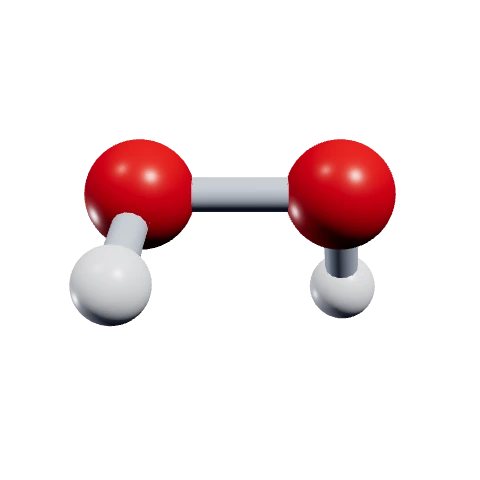


Pour a little hydrogen peroxide on a fresh blood stain and it erupts into white foam within a second. Most people take that fizz as proof the peroxide is “working.” It is, but not in the way they think. The foam is the stain fighting back: an enzyme inside the blood is tearing the peroxide apart into water and oxygen gas. The cleaning happens alongside it, more slowly, and only if you did the first step right.
This guide explains what is actually happening on the fabric, then gives the step-by-step method for clothes, sheets, mattresses, carpet, upholstery and grout, using what university extension services publish rather than folklore. It covers the mistake that sets a blood stain permanently, which fabrics peroxide can damage, what you can and cannot mix it with, and why forensic labs have used the same reaction since 1901.
We sell hydrogen peroxide in eight strengths, so we will be plain about which one you need. For a home laundry room, that is ordinary 3%. Stronger grades only make sense when you dilute them yourself for volume work, and we show the math for that at the end.
Last reviewed 8 October 2026 against current extension-service stain guidance and the peer-reviewed sources cited below. This is a stain-removal guide for fabrics and household surfaces only. How we researched it is set out at the end.
Does hydrogen peroxide remove blood stains?
Yes. Hydrogen peroxide at household strength (3%) lifts blood stains from white and colorfast washable fabrics, and it is one of the standard steps in extension-service stain guides. The University of Georgia’s textile extension sets out the full sequence: “Soak in cool water 30 minutes or longer. If stain remains, soak 30 minutes or longer in lukewarm water with enzyme pre-soak. Rinse. Rub detergent into any remaining stain. Rinse. If stain still remains, put a few drops of 3 percent hydrogen peroxide on stain for 1-3 minutes. Rinse thoroughly. Launder.”
Notice where peroxide sits in that list: last, not first. Cold water removes most of a fresh stain on its own. Enzymes and detergent take care of most of what is left. Peroxide is the finishing step for the faint brown or yellow shadow that refuses to go, which is exactly the part it is best at, because that shadow is colored material it can oxidize.
Two limits are worth stating up front. Peroxide is a bleach, a gentle one, so it can lighten some dyes (more on that below). And it works best on stains that have not been set by heat. A blood stain that went through a hot wash and a tumble dryer is a different, harder problem.

Why does hydrogen peroxide fizz on blood?
Hydrogen peroxide fizzes on blood because blood contains catalase, an enzyme that breaks hydrogen peroxide (H₂O₂) down into water and oxygen gas, and the oxygen escapes as bubbles. The overall reaction is simple: 2 H₂O₂ → 2 H₂O + O₂. Catalase exists to protect cells from peroxide, and a review in Nutrition Journal notes that its “greatest activity is present in liver and erythrocytes,” meaning red blood cells.
Catalase is fast. A 2024 review in Redox Biology describes it as having “the highest turnover number” of any enzyme found in living things, able to process “tens of millions molecules of H₂O₂ per second.” Published figures for the exact rate differ a lot between sources, but every one of them puts catalase among the fastest enzymes known. That speed is why the foam appears almost the instant peroxide touches fresh blood.
There is a lot of gas to come out. Our own arithmetic: 3% hydrogen peroxide holds about 30 grams of H₂O₂ per liter, and when it all decomposes it gives off roughly ten times its own volume in oxygen at room temperature. A teaspoon of peroxide can make a surprising amount of foam.
The fizz and the cleaning are two different reactions. The bubbles are catalase destroying peroxide. The whitening is peroxide oxidizing the colored part of the stain, breaking up what an ACS Omega paper calls “the conjugated system responsible for its color.” Catalase competes with that. This is why fresh, wet blood foams hard and why you may need a second application: the first dose is partly spent on the enzyme.
The fizz is not unique to blood. Catalase occurs in most living tissue, and trace metals such as iron and copper also break peroxide down; PubChem notes that commercial peroxide carries a stabilizer “to counteract the catalytic effect of traces of impurities such as iron, copper, and other heavy metals.” So a weak fizz on an old, dried stain tells you about the stain, not about whether your bottle has gone flat. If you want to check the bottle, see our guide to whether hydrogen peroxide expires.
Why should you use cold water on blood stains?
Use cold water on blood stains because heat sets them. Blood is mostly protein, and hot water does to it what a frying pan does to an egg white. The University of Kentucky Cooperative Extension puts it directly: “If hot water is used first, it cooks the protein and causes coagulation between the fibers in the yarns of the fabric, making the stain more difficult to remove.”
Once the protein has coagulated inside the yarn, it is locked in place mechanically, not just stuck to the surface. Cold water, by contrast, keeps the proteins soluble so they can rinse out. The same Kentucky guide says “Fresh protein stains can be removed by soaking and agitating in cold water before washing,” and UGA adds: “Always use cool water when removing blood stains. Always treat blood stains as soon as possible. Set blood stains can be extremely difficult to remove.”

Heat matters at every stage, not just the first rinse. Do not put a blood-stained item in the dryer until the stain is completely gone, and do not iron over a stain to “dry it out.” Check the fabric in daylight after washing, while it is still damp. If any shadow remains, treat it again before drying.
How do you get blood out of clothes?
To get blood out of clothes, flush the stain from the back with cold water, soak it in cold water, treat what remains with an enzyme detergent, and finish any last trace with a few drops of 3% hydrogen peroxide before washing in cool water. In full:
- Flush from the back. Turn the garment inside out and run cold water through the stain so it is pushed out of the fabric the way it came in, rather than deeper into it. Do not scrub hard yet; that spreads the stain.
- Soak in cold water. Submerge the area in cold water for at least 30 minutes, as UGA advises. Fresh stains often disappear completely at this point.
- Enzyme step. For anything left, soak in lukewarm (not hot) water with an enzyme laundry pre-soak or rub in a liquid detergent that lists enzymes. Kentucky Extension notes that some pretreatment products “have enzymes that break down protein stains, such as blood.” Rinse.
- Spot-test the peroxide. On a seam allowance or inside hem, dab a drop of 3% peroxide, wait a few minutes and check for any change in color.
- Apply peroxide to the stain. Put a few drops of 3% hydrogen peroxide on the remaining stain for 1 to 3 minutes. Expect foam on fresh blood. Blot, do not rub.
- Rinse and wash cool. Rinse thoroughly in cold water, then launder on a cool cycle. Kentucky notes that “Thorough rinsing is needed to remove bleach from fabrics.”
- Inspect before drying. Air-dry, or check carefully before using the dryer. Repeat steps 3 to 6 if a shadow remains.
For denim, dark cotton and anything with bright dyes, stop after step 3 unless your spot test was clean. An enzyme detergent and patience will usually finish the job without any bleach at all.
How do you get blood out of sheets and a mattress?
Get blood out of sheets the same way as clothes: strip the bed immediately, flush and soak the stain in cold water, use an enzyme detergent, then finish with 3% peroxide on white or colorfast cotton. Sheets are usually the easy case, because most are white or pale cotton or cotton blends that tolerate peroxide well. Strip them before the stain dries, and resist the instinct to put them straight into a hot wash.
A mattress is harder, because you cannot soak it and you do not want liquid soaking into the foam. Work with as little liquid as possible:
- Blot, never pour. Dampen a clean white cloth with cold water and press it onto the stain, then press with a dry cloth to lift the moisture back out. UGA’s upholstery advice applies: “If the blood stain is still wet, sponge or blot with cold water. This should remove it.”
- Use peroxide sparingly. For a remaining stain on a white or pale ticking, apply a small amount of 3% peroxide with a cloth or a spray bottle set to mist, let it foam briefly, then blot. Do not saturate the surface.
- Rinse and dry. Blot with a cloth dampened in plain cold water to take up any peroxide residue, then let the mattress dry fully, with a fan if you have one, before making the bed.
- Read the label first. Memory foam and specialty covers often carry the manufacturer’s own cleaning instructions, and some warranties exclude certain cleaning methods.
No extension service we found publishes mattress-specific guidance, so treat the steps above as an application of the general cold-water, blot-and-spot-test rules to a surface you cannot wash.
How do you remove blood from carpet and upholstery?
Remove blood from carpet and upholstery by blotting with cold water first, then, only after a hidden spot test, applying a little 3% hydrogen peroxide to the remaining stain and blotting it out. As with a mattress, the rule is to move the stain into a cloth, not deeper into the pile or padding.
- Blot up as much as possible with a dry white cloth or paper towel, working from the outside of the stain inward so it does not spread.
- Blot with a cloth dampened in cold water. Repeat with clean sections of the cloth until no more color transfers.
- Test 3% peroxide on a hidden area: inside a closet, under furniture, or on the underside of a cushion. Wool, silk and many dyed synthetic carpets can lighten.
- If the test is clean, moisten the remaining stain with a small amount of peroxide, let it work for a few minutes, then blot.
- Blot with plain cold water to rinse, then press dry with a towel.
For hard surfaces, UGA describes a poultice method for blood on marble using “a poultice (paste) of water, powdered detergent and hydrogen peroxide bleach,” applied thickly to the stain. Natural stone is easily etched by acids, so never substitute vinegar or other acidic cleaners on marble or limestone.
How do you remove dried or old blood stains?
Remove dried or old blood stains with a long cold-water soak followed by an enzyme pre-soak, which breaks the protein down so it can rinse out, then finish any remaining discoloration with 3% hydrogen peroxide. Dried blood takes longer because the proteins have bonded to the fibers as they dried. Peroxide alone often struggles here, because it works on the color while the dried protein that holds that color in the yarn is still there.
- Soak longer. Give the item several hours or overnight in cold water, changing the water if it turns pink.
- Use an enzyme pre-soak. This is the key step for old stains. Kentucky Extension cautions not to use enzyme presoaks on silk or wool, “since enzymes digest protein” and those fibers are protein too.
- Then peroxide, more than once if needed. Apply 3% peroxide for a few minutes, rinse, and repeat. Several short applications are kinder to fabric than one long one.
- Accept the limit. A stain that has been through a hot wash and a dryer may never come out completely. Kentucky’s point about protein “coagulation between the fibers” is the reason.
Will hydrogen peroxide bleach or damage fabric?
Hydrogen peroxide can lighten some dyed fabrics, because it is a bleach, but at 3% it is far gentler than chlorine bleach and is considered safe for all fiber types when used correctly. Kentucky Extension says: “Hydrogen peroxide is safe for all fibers, but test for colorfastness on dyed fabrics,” and, comparing the two bleaches, “Chlorine bleach is more effective than oxygen bleach but might damage some fibers, dyes, and finishes.”
That is why it is called an oxygen bleach, the same family as the sodium percarbonate in “oxygen” laundry boosters, which releases hydrogen peroxide in water. When it breaks down it leaves nothing behind but water and oxygen; the ACS Omega study of laundry bleaching describes it as producing “only water and oxygen.”
| Fabric | 3% hydrogen peroxide? | Watch out for |
|---|---|---|
| White cotton, linen, sheets, towels | Yes | Rinse thoroughly before drying |
| Colorfast cotton and polyester | Yes, after a spot test | Bright reds, blues and blacks can lighten |
| Denim, dark and bright dyes | Only if the spot test is clean | Light patches that look worse than the stain |
| Wool and silk | Spot test, briefest contact, or leave to a professional | Do not use enzyme presoaks on these protein fibers |
| “Dry clean only”, leather, suede | No | Take to a professional cleaner and say it is blood |
Three rules prevent nearly all peroxide damage. Use 3%, not stronger: Kentucky warns, “Do not use the stronger solution sold for bleaching hair.” Keep the contact time short and rinse well. And keep the bottle away from light and heat, which break peroxide down; that is why it is sold in opaque brown bottles.
Can you mix hydrogen peroxide with baking soda, vinegar or bleach?
You can combine hydrogen peroxide with baking soda as a paste for scrubbing stains, but you should never mix it with vinegar in a container or combine it with chlorine bleach. These three pairings get confused online, and they behave very differently.
Baking soda: fine, as a paste. Baking soda does not react dangerously with 3% peroxide; it adds a mild abrasive. Tioga County, New York publishes a stained-grout recipe: “Make a paste of ¾ cup baking soda, ¼ cup hydrogen peroxide, and 1 tablespoon dish soap. Apply to grout, wait 5–10 minutes, scrub, and rinse.” The same paste works on a blood stain on grout, a light-colored countertop seam or a tub surround. Mix it fresh each time and do not store it in a closed container, since the peroxide slowly gives off oxygen.
Vinegar: never in the same container. The New Jersey Department of Health’s hazard alert on mixing cleaners says: “Hydrogen peroxide and vinegar – Together they form peracetic acid, which can irritate the eyes, skin, and lungs.” Using one, rinsing, and then the other is a different thing from pre-mixing them in a bottle. We cover the chemistry in detail in why the viral peroxide-and-vinegar cleaner is brewing industrial acid.
Chlorine bleach: do not combine. The same New Jersey alert gives the general rule: “Never mix cleaning products, especially anything containing bleach.” There is no reason to use both on one stain. Choose one bleach, rinse completely, and if it did not work, rinse again before trying anything else. For what happens when bleach meets other household cleaners, see bleach and ammonia: the chloramine gas reaction.
Cold water first. Peroxide last. Rinse between everything.
Why do crime labs use hydrogen peroxide to detect blood?
Crime labs use hydrogen peroxide to detect blood because the heme groups in hemoglobin speed up oxidation reactions in its presence, which can turn a colorless test chemical pink or make a solution glow. This is a different property from the catalase fizz. Catalase destroys peroxide; heme uses it to oxidize something else.
The oldest version still in use is the Kastle–Meyer test. A 2022 history of spot tests in ChemTexts records that it was “developed by the American chemist Joseph Hoeing Kastle (1864–1916) in 1901 and that was further improved by the German physician and chemist Erich Meyer (1874–1927) in 1903.” The Washington, DC Department of Forensic Sciences describes how it works in its procedure manual: the test “relies on the peroxidase-like activity of the heme groups associated with the hemoglobin contained in red blood cells. In the presence of hydrogen peroxide, this peroxidase-like activity will catalyze the oxidation of phenolphthalin, which is colorless in solution, into phenolphthalein resulting in a pink colored solution.”

Luminol, the spray that makes blood glow blue in the dark, relies on the same partnership. The ChemTexts history notes that the luminol test, “developed by the German forensic scientist Walter Specht (1907–1977) in 1937, is based on the capability of blood to enhance the luminescence of luminol in an alkaline solution of hydrogen peroxide.”
Both are presumptive tests, not proof. The DC procedure is explicit that “A confirmatory test may be required to positively identify a stain as containing blood,” and that “Plant peroxidases react similarly to blood.” For anyone treating a stain at home, the takeaway is simpler: the same molecule that lifts the stain out of your sheets has been one of forensic science’s basic reagents for more than a century.
What strength of hydrogen peroxide should you use for stains?
Use 3% hydrogen peroxide for stains on fabric and household surfaces. It is the strength every extension guide specifies, and the US Agency for Toxic Substances and Disease Registry (ATSDR) describes household peroxide as a “dilute form (3% to 10%).” Stronger is not better for stains. It risks the fabric and your skin, and ATSDR warns that “At a concentration of 10%, which is found in some hair-bleaching solutions, it is strongly irritating and may be corrosive.”
Where a stronger grade earns its place is volume. Hotel housekeeping teams, commercial laundries, cleaning contractors and facilities that go through gallons of 3% a month can buy a concentrate and dilute it. One part 12% to three parts water gives 3%. Here is the math on our current one-gallon list prices for Technical Grade:
| Buy | Price | Makes this much 3% | Cost per gallon of 3% |
|---|---|---|---|
| 3% Technical Grade, 1 gallon | $19.79 | 1 gallon | $19.79 |
| 3% Technical Grade, 4-gallon case | $47.06 | 4 gallons | $11.77 |
| 12% Technical Grade, 1 gallon | $20.60 | 4 gallons (1 part + 3 parts water) | $5.15 |
List prices on alliancechemical.com on 8 October 2026, before shipping. Prices change; check the product page.
If you dilute a concentrate. Wear chemical-splash goggles and nitrile gloves, add the peroxide to the water rather than the reverse, use clean plastic containers (never metal), and label the diluted bottle with its strength and the date. ATSDR notes that “Solutions that are 5% or greater can cause injury to the eye surface if splashed in the eye.” Never put any strength of peroxide in a food or drink container.
For a household, buy ready-to-use Hydrogen Peroxide 3% Technical Grade and skip the dilution step entirely. For volume users who already handle concentrates safely, Hydrogen Peroxide 12% Technical Grade is the economical choice. Our Technical Grade peroxide is sold for cleaning and industrial use, not for personal care. For every strength we sell and what each is for, see which hydrogen peroxide concentration to buy and the complete hydrogen peroxide concentration guide.
The short version: rinse a blood stain with cold water straight away and never apply heat until it is gone. Soak, use an enzyme detergent, then finish with a few drops of 3% hydrogen peroxide for 1 to 3 minutes. Spot-test dyed fabrics, blot rather than soak mattresses and carpet, rinse thoroughly, and never pre-mix peroxide with vinegar or bleach.
How we researched this
We read the current stain-removal publications from the University of Georgia and University of Kentucky extension services, the New Jersey Department of Health hazard alert on mixing cleaners, ATSDR’s hydrogen peroxide guidelines, PubChem, a county government cleaning guide, and peer-reviewed papers on catalase, peroxide bleaching and forensic blood tests. Every quotation was checked against the source text on 8 October 2026. Where sources disagreed, such as on catalase’s exact rate, we said so rather than pick the most dramatic figure. The oxygen-volume figure is our own calculation from the concentration. The photographs in this article are illustrations, not test results. We are a chemical distributor, not a laundry lab; we have not run our own stain trials, and we make no claim about any product beyond stain removal and cleaning.
Key numbers and sources
All web sources were read on 8 October 2026. Quotations are verbatim.
- Remove Stains From Blood (HOMECARE 1-4), University of Georgia Cooperative Extension
- Stain Removal for Washable Fabrics (HE 2-840), University of Kentucky Cooperative Extension Service
- Targeting catalase in cancer, Glorieux and Buc Calderon, Redox Biology (2024)
- The importance of antioxidants which play the role in cellular response against oxidative/nitrosative stress: current state, Kurutas, Nutrition Journal (2016)
- Boosting Peroxide Reactivity: New Mn(II) Chelidamate Catalysts for Efficient Low-Temperature Bleaching, Manco et al., ACS Omega (2026)
- Hydrogen Peroxide (CID 784), PubChem, US National Library of Medicine
- Medical Management Guidelines for Hydrogen Peroxide, Agency for Toxic Substances and Disease Registry (CDC)
- Hazard Alert: Mixing Cleaners, New Jersey Department of Health
- How to Clean Using Baking Soda, Tioga County, New York
- Forensic Biology SOP FBS02: KM Testing, Department of Forensic Sciences, Washington, DC
- Spot tests: past and present, ChemTexts (2022)
- Forensic application of the luminol reaction as a presumptive test for latent blood detection, Barni et al., Talanta (2007)
Frequently asked questions
Does hydrogen peroxide remove dried blood?
Often, but not on its own. Soak dried blood in cold water for several hours, use an enzyme pre-soak to break down the protein, then apply 3% hydrogen peroxide to whatever discoloration remains and repeat if needed. Stains that went through a hot wash or a dryer may not come out completely.
Why does hydrogen peroxide bubble on blood?
Blood contains catalase, an enzyme that splits hydrogen peroxide into water and oxygen gas very quickly. The bubbles are that oxygen escaping. The foam shows the enzyme is active; the stain lifting is a separate, slower oxidation reaction.
How long should I leave hydrogen peroxide on a blood stain?
University of Georgia Extension advises a few drops of 3% hydrogen peroxide for 1 to 3 minutes, then a thorough rinse and laundering. Several short applications are safer for fabric than one long soak.
Should I use hot or cold water on blood?
Always cold. Hot water cooks the proteins in blood and coagulates them between the fibers of the yarn, which makes the stain much harder to remove. Keep everything cool, including the wash cycle, until the stain is gone.
Will hydrogen peroxide bleach my clothes?
It can lighten some dyes because it is an oxygen bleach, although at 3% it is much gentler than chlorine bleach. Test it on a hidden seam first, keep the contact time short, and rinse thoroughly. White cotton, linen and colorfast fabrics usually tolerate it well.
Can I use hydrogen peroxide on a mattress?
Yes, sparingly. Blot the stain with cold water first, then apply a small amount of 3% peroxide with a cloth or fine mist, let it foam briefly and blot it out. Do not saturate the mattress, blot with plain water afterward, and let it dry completely. Check the manufacturer's care label first.
Can I mix hydrogen peroxide and baking soda?
Yes, as a fresh paste for scrubbing stains on grout and hard surfaces. Tioga County, New York suggests three-quarters of a cup of baking soda, a quarter cup of hydrogen peroxide and a tablespoon of dish soap. Do not store the paste in a sealed container. Never mix peroxide with vinegar or chlorine bleach.
What percentage of hydrogen peroxide is best for stains?
Use 3%, the household strength specified in extension-service stain guides. Stronger solutions risk damaging fabric and are irritating or corrosive to skin and eyes. Volume users can dilute 12% with three parts water to make 3%.
Related Chemical Collections
About the author
Andre Taki
This article is for informational purposes only.


