



Every few years the internet rediscovers that the secret ingredient in nacho cheese has a formula that spells nacho. This Thanksgiving week it is happening at a scale it never has before. Google search interest in sodium citrate in the United States is running at about seven times its usual level, and among the rising searches Google ties to the word chemical this week is, word for word, “nacho cheese chemical compound”.
This article takes no position on anyone’s mac and cheese. It checks the joke against the formula, explains what the salt does to cheese using a dairy-science review and the federal cheese standard, and works out the part most posts skip: sodium citrate is citric acid that has been neutralized, and the numbers for doing that are simple. Where a number is our arithmetic, it says so.
Why is everyone searching for sodium citrate this week?
Because it is cheese-sauce season, and the trick has reached a new audience. Google Trends puts United States search interest in sodium citrate at 72 in the week of 15 November and 100 in the week of 22 November, on a scale where 100 is the busiest week in the period. The typical week over the past year sat at 14. In five years of weekly data, no earlier week had passed 19.
A flat year, then 7 times the usual
Google search interest in “sodium citrate”, United States, weekly index (100 = the busiest week).
We could not trace the jump to a single post, and we are not going to guess at one. The timing fits the calendar. A student-written science magazine described the pattern on 17 November, in a piece about Thanksgiving macaroni and cheese: “a much more interesting video that I came across told viewers to add a bit of sodium citrate to their cheese sauce”. Among Google’s rising searches related to the word chemical this week were “chemical formula for sodium citrate” and “nacho cheese chemical compound”. People are not only buying the powder. They are checking the formula.
Does the sodium citrate formula really spell nacho?
Yes, with one honest footnote. Cook’s Illustrated put it this way in its explainer on the ingredient:
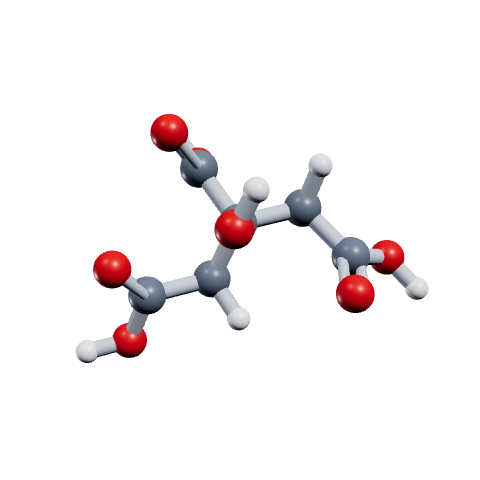
Trisodium citrate is three sodium ions and one citrate ion. Written the way salts usually are, metal first, that is Na3C6H5O7: Na, C, H, O. The footnote is that chemists have more than one way to order a formula. PubChem and the Code of Federal Regulations both use the convention that lists carbon first, then hydrogen, then everything else alphabetically, which gives C6H5Na3O7. Same atoms, same compound, less appetizing. The count is the part that never changes: 3 sodium, 6 carbon, 5 hydrogen, 7 oxygen.
Count the nacho: Na₃C₆H₅O₇
One unit of sodium citrate. Tap an element to light up its atoms; drag to turn.

All 21 atoms: 3 sodium, 6 carbon, 5 hydrogen, 7 oxygen
What does sodium citrate actually do to cheese?
It takes calcium away from the proteins. Cheese is a network of casein proteins holding fat and water, and calcium is what ties that network together. Heat an aged cheese on its own and the tight protein clumps stay clumped while the fat runs out, which is the greasy, grainy sauce everyone has made once. Cook’s Illustrated describes the fix: “Sodium citrate is the best known of a few different ingredients known as melting salts”, and when cheese is warmed with it, “the sodium substitutes itself for some of the calcium that’s helping the proteins cling”. The freed proteins go back to work holding fat and water together.
Dairy scientists call these ingredients calcium sequestering salts. A 2023 review in the journal Molecules opens with the industrial picture: “Phosphates and citrates are calcium sequestering salts (CSS) most commonly used in the manufacture of processed cheese”. The federal standard for pasteurized process cheese lists sodium citrate by name among its permitted emulsifying agents and sets a ceiling, allowing them “in such quantity that the weight of the solids of such emulsifying agent is not more than 3 percent of the weight of the pasteurized process cheese”. A little goes a long way. Our article on what phosphoric acid does in food covers the phosphate half of that list.
| In the pot | What it does | Result when heated |
|---|---|---|
| Aged cheese alone | Calcium keeps the casein proteins bound to each other | Proteins clump, fat pools |
| Cheese plus sodium citrate | Citrate binds calcium; sodium takes its place on the protein | Proteins loosen and hold fat and water together |
| Cheese plus plain citric acid | Lowers the pH without supplying sodium | Soupy or grainy, per Modernist Cuisine |
Can you make sodium citrate from citric acid and baking soda?
Yes. That is what sodium citrate is. The FDA’s own definition of the food ingredient says it “is the sodium salt of citric acid” and that “It is prepared by neutralizing citric acid with sodium hydroxide or sodium carbonate.” A plant uses those two bases. A kitchen has a gentler relative of sodium carbonate in the cupboard: sodium bicarbonate, which is baking soda. The acid and the baking soda react in water, and the fizz is carbon dioxide leaving:
The three is the whole trick. The Molecules review describes how “Citrate salts are obtained by replacing the hydrogen atom from the tribasic citric acid with suitable cations”. Tribasic means citric acid has three acidic hydrogens to give up. Each baking soda takes one. Stop at one or two and you have made a different, still-sour salt, not the one in the nacho formula.
How much baking soda does it take per gram of citric acid?
About 1.31 grams of baking soda for each gram of anhydrous citric acid, on our arithmetic. PubChem gives the molar masses: citric acid 192.12, sodium bicarbonate 84.007. Three bicarbonates weigh 252.02, and 252.02 divided by 192.12 is 1.31. The figure below scales that to a batch that matches 10 grams of the sodium citrate sold in jars, which is the dihydrate.
15.1 grams go in. 4.5 grams leave as fizz.
What it takes to match 10 g of jarred sodium citrate (the dihydrate), from anhydrous citric acid and baking soda.
Into the water
After the fizzing stops
| If the citric acid is | Molar mass | Baking soda per gram |
|---|---|---|
| Anhydrous (no water in the crystal) | 192.12 g/mol | 1.31 g |
| Monohydrate (one water per molecule) | 210.14 g/mol | 1.20 g |
The second row matters more than it looks. Citric acid is sold in both forms, and a gram of monohydrate carries about 9 percent less acid than a gram of anhydrous. Use the wrong row and the mix ends up with leftover baking soda or leftover acid. Weigh, do not measure by the spoon: the two powders pack differently, and the ratio is by mass.
Why not just add citric acid to the cheese?
Because the acid alone does the opposite of what you want. Modernist Cuisine, whose macaroni and cheese recipe is built on sodium citrate, is blunt about it: “You cannot substitute citric acid for sodium citrate in this recipe.” The reason is acidity. The salt loosens the proteins without making the sauce more acidic, while, in the same source’s words, “Citric acid will lower the pH level and will result in a soupy or grainy texture instead of a silky emulsion.”
That is also why the full three-to-one neutralization matters. A mix that is short on baking soda still contains free acid and behaves like the grainy case. A mix with too much pushes the sauce the other way, toward alkaline. The neutral salt in the middle is the one that works, and it is the only one of the three that spells anything.
Where else does the same chemistry show up?
Anywhere calcium is in the way. Citrate’s grip on calcium helps citric acid dissolve the chalky mineral film that hard water leaves behind, and the acid and its sodium salt together make one of the standard laboratory buffers. Our guide to citric acid beyond the citrus zest walks through those uses, and how citric acid is made tells the story of the mold fermentation that replaced lemons. The same acid-plus-baking-soda fizz, run for show and not for supper, is the engine of this year’s bubbling Halloween cauldron. And if the price of the powder has caught your eye, our report on the 2026 citric acid duty cases covers the trade side.
What this means on a specification
A viral formula is a kitchen story, but citric acid is bought on paper every day, and the same two details decide whether the numbers above hold: which crystal form, and which grade. The table matches each listing to what to check before ordering.
| Use | Listing | What to check on the CoA |
|---|---|---|
| Food and beverage formulation | Citric Acid Anhydrous - Food Grade | Assay; water content (confirms the anhydrous form); heavy metals |
| Same, where the monohydrate is specified | Citric Acid Monohydrate - USP Food Grade | Assay; water content near one mole per mole; adjust the ratio to 1.20 |
| Laboratory buffers and analytical work | Citric Acid Anhydrous - ACS Reagent Grade | Assay; residue on ignition; listed trace limits |
About claims. This article describes the chemistry of sodium citrate and a neutralization worked from published molar masses. The grade names in the table are the storefront’s listing titles. The regulations quoted describe the ingredients in general, not any lot. Alliance Chemical makes no claim about ours beyond what the certificate of analysis and safety data sheet for a lot state.
Common questions
Does the formula for sodium citrate spell nacho?
Yes. Trisodium citrate is Na3C6H5O7, and the element symbols in that order are Na, C, H and O. Databases such as PubChem write the same compound as C6H5Na3O7, with carbon first, so the spelling depends on the convention. The atom count does not: 3 sodium, 6 carbon, 5 hydrogen and 7 oxygen.
What does sodium citrate do in cheese sauce?
It binds calcium. Calcium holds the casein proteins in cheese together, and when citrate takes it up, sodium takes its place and the proteins loosen. They can then hold fat and water together as the cheese melts, so the sauce stays smooth and does not split into clumps and oil.
Can I make sodium citrate from citric acid and baking soda?
Yes. Sodium citrate is the sodium salt of citric acid, made by neutralizing the acid. With baking soda the balanced equation needs three sodium bicarbonates for each citric acid, which is about 1.31 grams of baking soda per gram of anhydrous citric acid on our arithmetic. The reaction happens in water and releases carbon dioxide.
How much citric acid and baking soda equals 10 grams of sodium citrate?
On our arithmetic, about 6.5 grams of anhydrous citric acid and 8.6 grams of baking soda match 10 grams of sodium citrate dihydrate, the form usually sold. About 4.5 grams leaves as carbon dioxide, roughly 2.5 litres of gas at room temperature. These are equation quantities, not a tested recipe.
Can I use citric acid in place of sodium citrate in mac and cheese?
Not on its own. Modernist Cuisine states that citric acid cannot be substituted for sodium citrate in its recipe, because the acid lowers the pH and gives a soupy or grainy texture. The acid has to be fully neutralized first, which is what turns it into sodium citrate.
Why are searches for sodium citrate so high right now?
Google Trends shows United States search interest in sodium citrate at 100 in the week of 22 November 2026, about seven times a typical week of the past year and the highest weekly reading in five years. The rise lines up with Thanksgiving cheese-sauce cooking and with rising searches for the nacho cheese formula. We did not find a single post that explains it.
References & Authoritative Sources
Regulatory text is from the Code of Federal Regulations; molar masses are from PubChem; the mechanism is from a peer-reviewed review and Cook’s Illustrated. Search figures are Google Trends data pulled on 23 November 2026. Calculations labelled as ours are our arithmetic.
- 21 CFR 184.1751, Sodium citrate — U.S. Food and Drug Administration. Definition and preparation.
- 21 CFR 133.169, Pasteurized process cheese — U.S. Food and Drug Administration. Permitted emulsifying agents and the 3 percent limit.
- A Review on the Effect of Calcium Sequestering Salts on Casein Micelles: From Model Milk Protein Systems to Processed Cheese — Deshwal, Gómez-Mascaraque, Fenelon and Huppertz, Molecules 28(5), 2085, 2023.
- The Secret Ingredient That Makes Nacho Cheese So Melty — Paul Adams, Cook’s Illustrated, 29 January 2017.
- Silky Smooth Macaroni and Cheese Recipe — Modernist Cuisine, 23 October 2012. Why citric acid is not a substitute.
- Sodium Citrate: The Secret to a Creamy Cheese Sauce — Kayla Dang, Charged Magazine, 17 November 2026.
- Trisodium citrate, PubChem CID 6224; Citric acid, CID 311; Sodium bicarbonate, CID 516892 — National Library of Medicine. Formulas, molar masses, 3D conformer.
- Google Trends: sodium citrate, United States — weekly index, 12-month and five-year views, read via DataForSEO on 23 November 2026.
What we stock


Buying citric acid by the pail or pallet?
Tell us the form, the grade and the volumes you use. We will send the safety data sheet and, on request, a certificate of analysis for the lot, and quote by the pack, pail or pallet.
Read the citric acid guideKey numbers and sources
| Figure | Value | Source |
|---|---|---|
| Sodium citrate formula | Na3C6H5O7, 258.07 g/mol (dihydrate 294.10) | PubChem |
| Baking soda per gram of citric acid | 1.31 g anhydrous; 1.20 g monohydrate | Our arithmetic |
| Emulsifying agent limit in process cheese | Not more than 3 percent by weight | 21 CFR 133.169 |
| Search interest, week of 22 Nov 2026 | Index 100 against a typical 14 | Google Trends |
Frequently asked questions
Does the formula for sodium citrate spell nacho?
Yes. Trisodium citrate is Na3C6H5O7, and the element symbols in that order are Na, C, H and O. Databases such as PubChem write the same compound as C6H5Na3O7, with carbon first, so the spelling depends on the convention. The atom count does not: 3 sodium, 6 carbon, 5 hydrogen and 7 oxygen.
What does sodium citrate do in cheese sauce?
It binds calcium. Calcium holds the casein proteins in cheese together, and when citrate takes it up, sodium takes its place and the proteins loosen. They can then hold fat and water together as the cheese melts, so the sauce stays smooth and does not split into clumps and oil.
Can I make sodium citrate from citric acid and baking soda?
Yes. Sodium citrate is the sodium salt of citric acid, made by neutralizing the acid. With baking soda the balanced equation needs three sodium bicarbonates for each citric acid, which is about 1.31 grams of baking soda per gram of anhydrous citric acid on our arithmetic. The reaction happens in water and releases carbon dioxide.
How much citric acid and baking soda equals 10 grams of sodium citrate?
On our arithmetic, about 6.5 grams of anhydrous citric acid and 8.6 grams of baking soda match 10 grams of sodium citrate dihydrate, the form usually sold. About 4.5 grams leaves as carbon dioxide, roughly 2.5 litres of gas at room temperature. These are equation quantities, not a tested recipe.
Can I use citric acid in place of sodium citrate in mac and cheese?
Not on its own. Modernist Cuisine states that citric acid cannot be substituted for sodium citrate in its recipe, because the acid lowers the pH and gives a soupy or grainy texture. The acid has to be fully neutralized first, which is what turns it into sodium citrate.
Why are searches for sodium citrate so high right now?
Google Trends shows United States search interest in sodium citrate at 100 in the week of 22 November 2026, about seven times a typical week of the past year and the highest weekly reading in five years. The rise lines up with Thanksgiving cheese-sauce cooking and with rising searches for the nacho cheese formula. We did not find a single post that explains it.
About the author
Andre Taki
This article is for informational purposes only.