

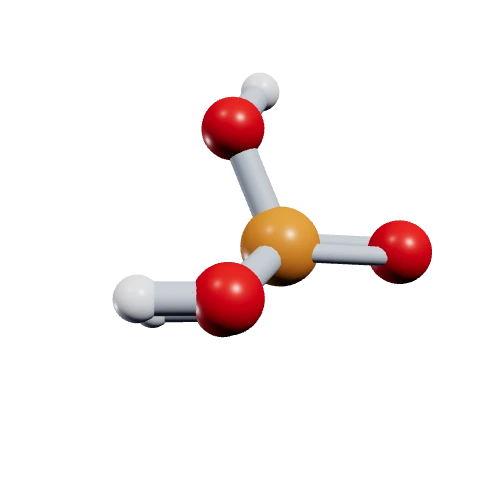


Open a can of baking powder, a slice of processed cheese, a pack of deli ham and a bottle of cola. Four unrelated products, four different aisles. They share an ancestor: a grey rock dug out of a sedimentary phosphate deposit, dissolved in acid, and purified until it was clean enough to eat.
Most writing about phosphoric acid in food gets stuck on one question — is it in your soda — and stops there. That is the least interesting thing phosphates do. The acid itself only performs one job in the food supply, as an acidulant. Its salts do the structural work: they lift dough, stop cheese from splitting into oil and curd, and keep muscle protein from squeezing out its water in a hot pan. This article is about that work, and about which grade you actually need to do it.
What is phosphoric acid used for in food?
Phosphoric acid has exactly one direct role in food — it is an acidulant and acidity regulator, listed as E338 in the EU and affirmed GRAS by the FDA under 21 CFR 182.1073. Every other appearance of "phosphate" on an ingredient panel is a salt made from that acid, and each salt is chosen for a mechanical job rather than a flavour one.
That distinction is the whole point, and it is why reading an ingredient list as "phosphoric acid is in everything" is wrong. The acid is a raw material. What reaches the food is usually a specific, purpose-built salt.
| What you see on the panel | What it actually is | The job it does |
|---|---|---|
| Phosphoric acid (E338) | H3PO4, the acid itself | Sharp acid bite; drops pH in colas and some jams |
| Monocalcium phosphate | Ca(H2PO4)2, acid + lime | Leavening acid — reacts with baking soda to make CO2 |
| Sodium acid pyrophosphate (SAPP) | Condensed sodium phosphate | Slower leavening acid; delays the rise until the oven |
| Sodium phosphates (E339) | Mono-, di-, tri-sodium phosphate | Emulsifying salts in processed cheese |
| Sodium tripolyphosphate (STPP) | Condensed sodium phosphate | Water-holding in cured and further-processed meat |
Is phosphoric acid safe to eat?
In the US it is regulated as a food ingredient, not a contaminant. FDA lists phosphoric acid as generally recognized as safe (GRAS) for use in food in accordance with good manufacturing practice under 21 CFR 182.1073. In the EU it is authorized as additive E338, and the European Food Safety Authority's 2019 re-evaluation of phosphates set a group acceptable daily intake of 40 mg per kg of body weight per day, expressed as phosphorus, across phosphoric acid and its salts (EFSA Journal 2019;17(6):5674).
Two things get confused in this question. The first is concentration: in a cola it sits at fractions of a percent, while the 75% and 85% material we ship is a corrosive liquid (UN1805, Class 8) that causes severe skin burns and eye damage and is handled with goggles and gloves, never tasted. The second is diet: whether a particular diet carries too much phosphorus overall is a question for nutrition research and your doctor, not for a chemical supplier, and we make no health claims either way.
Is it "natural"? It is a mineral acid made from mined phosphate rock rather than from petroleum, but there is no FDA definition of "natural" that settles the label question, so we do not use the word for it.
Are phosphates acidic?
Some are and some are not, and the reason is one of the cleanest ideas in acid-base chemistry. Phosphoric acid has three hydrogens it can give up, one at a time, at very different strengths: pKa values of roughly 2.1, 7.2 and 12.3 (PubChem CID 1004). Replace one, two or all three of those hydrogens with sodium and you get three different salts with three very different personalities.
| Salt | Hydrogens left | Roughly, in a 1% solution |
|---|---|---|
| Monosodium phosphate (NaH2PO4) | Two | Acidic, about pH 4.5 |
| Disodium phosphate (Na2HPO4) | One | Mildly alkaline, about pH 9 |
| Trisodium phosphate (Na3PO4) | None | Strongly alkaline, about pH 12 |
That is why the same family shows up on opposite sides of a recipe: monocalcium phosphate is the acid in baking powder, while trisodium phosphate is alkaline enough to be sold as a heavy-duty cleaner (our TSP guide). "Phosphate" on a label tells you the family, not whether it lowers or raises pH.
Where does USP/FCC phosphoric acid actually come from?
It comes out of the ground as phosphate rock, and the route it takes from ore to bottle is what determines whether it can legally go near food. There is no synthetic shortcut — phosphorus is mined, not manufactured.
Two industrial routes dominate. The wet process digests phosphate rock with sulfuric acid, producing phosphoric acid plus gypsum; it is cheap, high-volume, and the resulting acid carries residual metals and fluoride that must be stripped out before it can meet a food specification. The thermal process burns elemental phosphorus and hydrates the oxide, giving a much cleaner acid at much higher energy cost. Modern USP/FCC material is generally purified wet-process acid — solvent-extracted and defluorinated until it meets the compendial limits.
Why this matters commercially: the difference between our Technical Grade and our USP/FCC grade is not concentration — both are available at 85%. It is the purification history and the impurity ceiling. You cannot make a technical acid food-legal by diluting it.
For the full manufacturing comparison and the industrial applications that sit outside food, see our phosphoric acid uses, grades and rust removal guide.
How do phosphates make baked goods rise?
Baking powder is a packaged acid-base reaction, and in most modern formulations the acid half is a phosphate salt. Sodium bicarbonate supplies the carbonate; the phosphate supplies the proton that liberates it as carbon dioxide. Without an acid, the soda alone leaves a soapy alkaline taste and very little lift.
Monocalcium phosphate — Ca(H2PO4)2, made by reacting phosphoric acid with lime — is the classic fast-acting leavening acid. It starts releasing gas as soon as the batter is wet. That is a problem for anything that sits before baking, which is why double-acting powders pair it with a slower partner such as sodium acid pyrophosphate that holds most of its reaction back until oven heat arrives.
A genuinely old invention. Calcium acid phosphate as a leavening agent was patented on 26 April 1856, and the Rumford Chemical Works began producing it shortly after — work the American Chemical Society recognises as a National Historic Chemical Landmark. Phosphate leavening predates the refrigerator.
Formulators talk about a leavening acid's neutralizing value — how much soda a given weight of acid will consume. Matching that value is what keeps a finished crumb from tasting either metallic (too much acid) or soapy (too much soda), and it is why swapping one phosphate for another is never a straight 1:1 substitution.

Why does processed cheese melt smoothly instead of splitting?
Because sodium phosphates pull the calcium out of the protein network. In natural cheese, casein proteins are held together in clusters bridged by calcium ions; heat that structure and the bridges hold while the fat runs out, which is why a heated cheddar slice separates into an oily puddle and a rubbery mass.
Emulsifying salts — monosodium, disodium and trisodium phosphate, sodium tripolyphosphate and their relatives — sequester that calcium and swap the divalent Ca2+ for monovalent Na+. The casein then hydrates and swells instead of clumping, and the freed protein can do what protein does well at an oil-water boundary: emulsify the fat and hold it there. The salts also buffer pH, which keeps the whole system in the narrow window where it stays stable.
The counter-intuitive part: the phosphate is not an emulsifier in the surfactant sense. It does not coat the fat droplets. It modifies the protein so that the protein becomes the emulsifier. That is why the category is called emulsifying salts.

How do phosphates keep cured meat from cooking out dry?
They raise the muscle's water-holding capacity, so less moisture is expelled when the protein contracts under heat. Condensed phosphates such as sodium tripolyphosphate shift pH away from the point where myofibrillar proteins are at their tightest, and help dissociate the actomyosin complex, which opens the protein lattice enough to retain brine.
Published work on further-processed meat has measured STPP at 0.3%, 0.5% and 0.7% inclusion significantly increasing water-holding capacity and reducing cook loss in patties. Polyphosphates additionally show antioxidative behaviour in meat systems, which slows the development of warmed-over flavour.
Hard regulatory ceiling. Under 9 CFR 424.21, phosphates in meat food products are limited to 0.5% of the finished product, and 5% of the phosphate in pickle at a 10% pump level. Poultry carries the same 0.5% of total product limit. This is a compliance number, not a formulation preference.
Is phosphoric acid in Coca-Cola — and what is it doing there?
Yes, and it is the one place in this article where the acid appears as itself rather than as a salt. Coca-Cola's published ingredient list for the original formula is carbonated water, high fructose corn syrup, caramel colour, phosphoric acid, natural flavours and caffeine — with phosphoric acid functioning as the acidity regulator that supplies the drink's tartness.
Cola is the unusual case. Most soft drinks use citric acid, which brings its own fruit-like sourness. Phosphoric acid is chosen precisely because it does not taste of fruit: it delivers a clean, flat, sharp acidity that cuts a heavy sugar load without arguing with the caramel and spice notes. Swap in citric and the drink stops tasting like cola.
That acidity is measurable. In a 2016 survey of US beverages published in the Journal of the American Dental Association, Coca-Cola Classic measured pH 2.37 (Reddy et al., JADA 2016), which places it among the most acidic soft drinks tested.
Phosphoric acid vs. citric acid: which acidulant should you use?
Choose phosphoric acid when you want acidity without flavour, and citric acid when the sourness is part of the flavour you are building. They are not interchangeable on taste, and they behave differently on metals and in chelation.
| Phosphoric acid | Citric acid | |
|---|---|---|
| Acid type | Inorganic, mineral | Organic, tricarboxylic |
| Flavour contribution | Flat, clean, sharp — no fruit note | Bright, fruity sourness |
| Typical use | Colas, some jams, acidity regulation | Citrus and berry drinks, candy, descaling |
| Metal chelation | Forms phosphate conversion layers | Strong chelator of calcium and iron |
| Supplied as | Liquid solution, 5%-85% | Crystalline solid |
If your job is descaling rather than formulating, citric is usually the friendlier tool — we cover the ratios in our espresso machine descaling guide. For rust conversion on steel, phosphoric is the correct acid and citric is not; see how to use phosphoric acid for rust removal.
Which grade of phosphoric acid do you need — USP/FCC, Technical or ACS?
Match the grade to the regulatory exposure of the step, not to the concentration you want. Concentration and grade are independent variables: we stock 85% in all three grades, and the price difference reflects purification, documentation and testing rather than strength.
| Grade | Specified against | Use it when |
|---|---|---|
| USP / FCC | US Pharmacopeia / Food Chemicals Codex | The acid or its salt ends up in a consumable product, or contacts one |
| Technical Grade | In-house industrial specification | Metal prep, rust conversion, descaling, water treatment, cleaning |
| ACS Grade | American Chemical Society reagent specs | Analytical work, QC labs, method validation, calibration |
The expensive mistake in both directions. Buying ACS Grade for a wash step wastes money on a purity nobody will ever measure. Buying Technical Grade for a step with food contact creates a documentation gap you cannot close after the fact — the certification has to exist at the point of manufacture. Tell us the application and we will spec the grade against it.
How do you dilute and handle concentrated phosphoric acid safely?
Add acid to water, never the reverse, and treat 85% as the corrosive liquid it is. Phosphoric acid is less aggressive than sulfuric or hydrochloric, which makes it easy to get complacent about — it still causes serious eye damage and skin burns at concentration.
- Put on the right PPE first. Chemical splash goggles, a face shield for volumes above a litre, nitrile or neoprene gloves, and a chemical-resistant apron.
- Charge the vessel with water before any acid moves. Start from roughly three-quarters of the final volume in water.
- Add the acid slowly into the water, stirring throughout. Dilution is exothermic; a slow addition keeps the heat manageable and prevents local boiling and spatter.
- Let it return to ambient temperature, then adjust to final volume. Measuring hot gives you a concentration that drifts as it cools.
- Label the diluted container immediately with the concentration, the grade, the date and the lot it came from, so the CoA stays traceable to what is actually in the vessel.
Materials note: phosphoric acid attacks ordinary carbon steel and many aluminium alloys — that reactivity is exactly what makes it useful as a rust converter. Store and transfer in HDPE, polypropylene, PVDF or an appropriately selected stainless. Keep it off galvanised surfaces.
What do typical phosphate use levels look like by application?
Use levels are small and tightly bounded — phosphate functions are catalytic or structural rather than bulk, so the numbers live in fractions of a percent. The table below is an orientation guide for the ranges discussed in the literature and permitted by regulation; your own formulation work and the applicable specification always govern.
| Application | Phosphate species | Typical order of magnitude | Bounded by |
|---|---|---|---|
| Cured / further-processed meat | Sodium tripolyphosphate | 0.3-0.5% of product | 0.5% hard cap, 9 CFR 424.21 |
| Processed cheese | Mono-, di-, tri-sodium phosphate, STPP | Low single-digit percent of blend | Standard of identity for the cheese type |
| Chemically leavened baked goods | Monocalcium phosphate, SAPP | Set by neutralizing value against the soda | Crumb pH and taste balance |
| Cola-type soft drinks | Phosphoric acid (E338) | Fractions of a percent | Target finished pH and flavour profile |
Treat every figure here as an orientation range rather than a recipe. Standards of identity, category-specific limits and your own process validation decide the real number, and they differ by product class and by market.
How do you read a Certificate of Analysis for USP/FCC phosphoric acid?
The CoA is the document that makes a food claim defensible, so read it for the impurity ceilings rather than the assay headline. Assay — the percent H3PO4 — tells you the strength you are buying. Everything below it tells you whether the material belongs anywhere near food.
- Assay. Confirms concentration against the label. An 85% USP/FCC lot and an 85% Technical lot can carry a near-identical assay and still be entirely different products.
- Heavy metals and arsenic. The compendial limits here are the practical difference between grades, and they trace directly back to how the acid was purified after the wet process.
- Fluoride. A wet-process signature. Defluorination is a purification step, so residual fluoride is a direct readout of how thoroughly that was done.
- Chloride and sulfate. Process residues that matter for corrosion behaviour and for downstream salt manufacture.
- Lot number and date. The part people skip. Without a lot tied to the container in your plant, the rest of the document cannot be used as evidence of anything.
Ask and we will send the lot Certificate of Analysis at no charge, on any package size from quart bottles through drums and totes — including before you buy, if you need it to close a specification review.
What are the most common mistakes with phosphoric acid in food work?
Nearly all of them come from treating grade and concentration as the same variable. These are the ones we see most often on inbound technical calls.
- Assuming dilution downgrades the requirement. Diluting an 85% Technical Grade to 10% gives you a 10% technical acid. The impurity profile travels with the material; the certification does not appear on the way down.
- Substituting one leavening phosphate for another 1:1. Monocalcium phosphate and SAPP have different neutralizing values and very different reaction timing. A straight swap changes both the rise and the finished taste.
- Expecting an emulsifying salt to behave like a surfactant. It works by modifying casein, so the protein content and calcium level of the base cheese determine the result at least as much as the salt dose does.
- Ignoring the 0.5% meat ceiling during scale-up. A bench formulation that works at 0.7% is not a formulation. It is a compliance failure waiting for an audit.
- Storing concentrate in carbon steel or galvanised vessels. The acid converts iron oxide to iron phosphate — useful on a rusty gate, destructive in a storage tank.
- Buying ACS Grade because it sounds like the safest option. ACS is a reagent specification built for analytical work. For a food step, USP/FCC is the relevant compendium, and it is usually the cheaper of the two.
Key numbers and sources
| Fact | Value | Source |
|---|---|---|
| Formula / CAS | H3PO4 / 7664-38-2 | PubChem CID 1004 |
| GRAS status, direct food use | Affirmed | 21 CFR 182.1073 |
| Phosphate limit, finished meat product | 0.5% | 9 CFR 424.21 |
| Phosphate in pickle at 10% pump | 5% | 9 CFR 424.21 |
| Calcium acid phosphate leavening patent | 26 April 1856 | ACS Historic Chemical Landmark |
| Phosphate rock, mineral commodity data | Annual survey | USGS Mineral Commodity Summaries |
| Emulsifying salts in processed cheese | Peer-reviewed | J. Dairy research, PMID 22916886 |
| STPP and water-holding capacity in meat | 0.3-0.7% studied | PMID 22054678 |
Phosphoric acid, specified to the job
5% to 85%, in USP/FCC grade, Technical Grade and ACS Grade — quart bottles through drums and totes, with the lot Certificate of Analysis on request at no charge. Tell us the application and we will help match the grade and concentration, so you are not paying for purity you will never use or under-specifying a step that matters.
- Phosphoric Acid: From Cola to EV Batteries — Uses, Grades & Rust Removal — the full grade and manufacturing picture.
- The Power of Phosphoric Acid: Industrial and Food-Grade Applications — dosage and concentration by industry.
- How to Use Phosphoric Acid for Rust Removal — the conversion-coating chemistry in detail.
- Phosphoric Acid: The Industrial Workhorse — metal finishing and water treatment.
- Phosphoric Acid in Agriculture and Hydroponics — pH control in nutrient solutions.
- Propylene Glycol in Food & Beverage Manufacturing — another USP-grade ingredient decision.
- Sodium Metabisulfite: Food Grade, ACS & Technical Guide — the same grade-selection logic.
Related: Half a Part per Billion: The Number at the Center of the FDA Food-Additive Fight — phosphoric acid is a listed GRAS substance (21 CFR 182.1073) and needs no notice under the August 2026 FDA proposal.
Frequently asked questions
What is phosphoric acid used for in food?
Directly, it is an acidulant and acidity regulator (E338) — most famously supplying the sharp bite in cola. Indirectly, it is the parent acid for phosphate salts that do structural work: monocalcium phosphate as the leavening acid in baking powder, sodium phosphates as emulsifying salts in processed cheese, and sodium tripolyphosphate for water retention in cured meat.
Is phosphoric acid the same thing as the phosphates on an ingredient label?
No. Phosphoric acid (H3PO4) is the acid itself. Terms like monocalcium phosphate, disodium phosphate and sodium tripolyphosphate are salts made from that acid, each selected for a specific mechanical function rather than for flavour.
Why does baking powder need a phosphate?
Baking powder is a packaged acid-base reaction. Sodium bicarbonate supplies the carbonate and a phosphate salt supplies the proton that releases it as carbon dioxide. Without the acid half, the soda leaves a soapy alkaline taste and produces very little lift.
What do emulsifying salts actually do in processed cheese?
They sequester the calcium that bridges casein proteins, swapping divalent calcium for monovalent sodium. The casein then hydrates and swells rather than clumping, and the freed protein emulsifies the fat itself. The phosphate is not a surfactant — it modifies the protein so the protein becomes the emulsifier.
How much phosphate is allowed in cured meat?
Under 9 CFR 424.21, phosphates are limited to 0.5% of the finished meat food product, and 5% of the phosphate in pickle at a 10% pump level. Poultry carries the same 0.5% of total product limit.
Is phosphoric acid in Coca-Cola?
Yes. Coca-Cola lists phosphoric acid in the original formula alongside carbonated water, high fructose corn syrup, caramel colour, natural flavours and caffeine. It acts as the acidity regulator that gives the drink its tartness. Coca-Cola Classic measured pH 2.37 in a 2016 Journal of the American Dental Association survey of US beverages.
Should I use phosphoric acid or citric acid?
Use phosphoric acid when you want acidity without a flavour contribution — it is flat and clean, which is why colas use it. Use citric acid when the sourness is part of the flavour, as in citrus and berry drinks. For rust conversion on steel, phosphoric is correct and citric is not.
What grade of phosphoric acid do I need?
Match the grade to the regulatory exposure of the step, not the concentration. USP/FCC grade where the acid or its salt reaches a consumable product; Technical Grade for metal prep, descaling, water treatment and cleaning; ACS Grade for analytical and QC work. Concentration is independent — 85% is available in all three.
Is phosphoric acid safe to eat?
In food it is a regulated ingredient: FDA lists phosphoric acid as generally recognized as safe (GRAS) under 21 CFR 182.1073, and the EU authorizes it as E338, with EFSA setting a group acceptable daily intake of 40 mg/kg body weight per day (as phosphorus) for phosphates in 2019. Concentrated 75-85% phosphoric acid is corrosive and is never tasted or handled without PPE. Questions about overall dietary phosphorus are for nutrition research and your doctor; we make no health claims.
Are phosphates acidic?
It depends on how many of phosphoric acid's three hydrogens remain. Monosodium phosphate is acidic (about pH 4.5 in a 1% solution), disodium phosphate is mildly alkaline (about pH 9) and trisodium phosphate is strongly alkaline (about pH 12). That is why monocalcium phosphate works as the acid in baking powder while TSP is sold as a cleaner.
Sources
- 21 CFR 182.1073 · Electronic Code of Federal Regulations
- PubChem Compound Summary: Phosphoric Acid (CID 1004) · PubChem (NIH National Library of Medicine)
- National Historic Chemical Landmark · American Chemical Society
- 9 CFR 424.21 · Electronic Code of Federal Regulations
- USGS Mineral Commodity Summaries · U.S. Geological Survey
- J. Dairy research, PMID 22916886 · PubMed (NIH)
- PMID 22054678 · PubMed (NIH)
About the author
Andre Taki
This article is for informational purposes only.


