

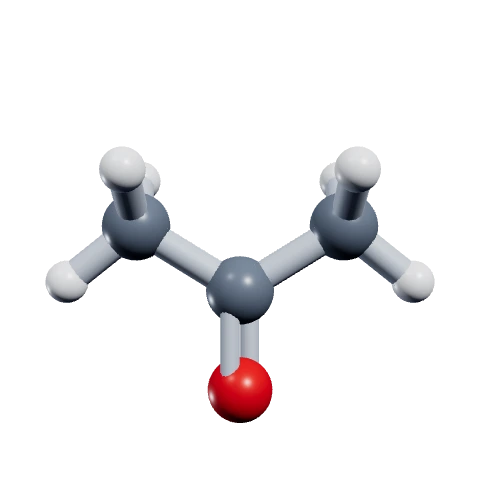


At the end of August, the Massachusetts Institute of Technology closed its chemistry building for four days after a graduate student reported a possible exposure. It resolved about as well as such things can. But one sentence from the reporting has nothing to do with exotic reagents and everything to do with drums that ship every week: “It goes right through typical common disposable gloves.”
We sell solvents. We do not sell gloves, and nothing on this page is an attempt to sell you any. But we ship acetone, MEK, toluene and xylene to people every week, and the single most common handling assumption we hear — that a box of blue disposables by the door counts as chemical protection — is wrong in a way that a chart can fix in about ninety seconds.
A glove is a barrier with a clock on it
Most people picture a glove failing the way a bucket fails: a hole appears, liquid comes through, you notice. That is one failure mode, and it is the least important one.
Protective-glove standards separate three distinct things, and conflating them is where most bad decisions start:
- Penetration is bulk flow through a physical opening — a pinhole, a tear, a failed seam. Visible, and usually obvious.
- Degradation is the glove material physically changing: swelling, softening, hardening, cracking, going tacky. Also visible, if you are looking.
- Permeation is the chemical dissolving into the glove polymer on the outside, diffusing through the material at a molecular level, and desorbing on the inside — against your skin. Nothing about this is visible. The glove has no hole. It has not changed colour. It looks exactly like it did when you put it on.
Permeation is measured under ASTM F739, which clamps a swatch of glove material between a chamber holding the challenge chemical and a chamber holding a collecting medium, then measures how long it takes for the chemical to show up on the clean side at a defined rate. That interval is the normalized breakthrough time. It is the number that matters, and it is the number almost nobody looks up.
The chart: breakthrough times for chemicals we actually ship
Below is published ASTM F739 data from Best Manufacturing, covering the chemicals we move in volume. Times are normalized breakthrough in minutes; longer is better. NR means not recommended — no usable breakthrough time was established.
| Chemical | Neoprene | Nitrile | Latex | PVC | Butyl | Viton |
|---|---|---|---|---|---|---|
| Acetone | 35 | 3 | 9 | 7 | >480 | NR |
| Methyl ethyl ketone (MEK) | 30 | NR | 12 | NR | 202 | NR |
| Methyl isobutyl ketone (MIBK) | 41 | NR | 38 | NR | 292 | NR |
| Toluene | 25 | 26 | NR | 19 | 7 | >480 |
| Xylene | 37 | 41 | NR | 23 | NR | >480 |
| Methanol | 64 | 28 | 82 | 39 | >480 | >480 |
| Ethanol | >480 | 225 | >480 | 66 | >480 | >480 |
| Ethyl acetate | 24 | 30 | 72 | 5 | 212 | NR |
| Perchloroethylene (PCE) | 40 | >480 | NR | NR | 28 | >480 |
| Kerosene | >480 | >480 | NR | >480 | 94 | >480 |
| Nitric acid 70% | >480 | NR | >480 | 240 | >480 | >480 |
| Sulfuric acid 97% | >480 | 180 | >480 | >480 | >480 | >480 |
| Hydrochloric acid 37% | >480 | >480 | >480 | >480 | >480 | >480 |
| Sodium hydroxide 50% | >480 | >480 | >480 | >480 | >480 | >480 |
| Hydrofluoric acid 48% | 210 | 60 | 45 | 110 | >480 | >480 |
| Acetic acid 84% | >480 | 240 | >480 | 300 | >480 | >480 |
Read this before you use the table. These figures are Best Manufacturing's published data and apply to those gloves only. Permeation varies with brand, formulation, thickness, temperature and whether the challenge is liquid or vapour. Two gloves both labelled "nitrile" can differ by an order of magnitude. Use this chart to know which questions to ask and which pairings deserve suspicion — then pull the permeation data sheet for the specific glove you actually own. It is not a substitute for your own hazard assessment.
Why butyl beats acetone and loses to toluene
Look at the acetone row and the toluene row together. Butyl rubber holds acetone off for more than eight hours, and gives up on toluene in seven minutes. Viton is the exact inverse: more than eight hours on toluene and xylene, not recommended for acetone at all.
That is not a quality ranking. Butyl is not a "better" glove than Viton, or worse. The pattern is chemistry, and it is the oldest rule in solvent science: like dissolves like.
Permeation begins with the challenge chemical dissolving into the glove polymer. How readily that happens depends on how similar the two are in polarity and intermolecular forces. Butyl rubber is a saturated, non-polar hydrocarbon elastomer with a very tight structure — polar, hydrogen-bond-accepting molecules like acetone have little affinity for it and struggle to dissolve in. Aromatic hydrocarbons like toluene, though, are chemically close cousins of the rubber backbone itself. They dissolve into it, swell it, and diffuse straight through.
Fluoroelastomers such as Viton are the opposite case. The carbon–fluorine backbone is highly resistant to the non-polar aromatics and chlorinated solvents that destroy butyl, which is exactly why it holds toluene, xylene and perchloroethylene for eight hours or more. Small polar ketones, though, get into it easily.
This has a direct operational consequence that catches out a lot of well-run shops: standardizing on one glove for the whole facility is itself a hazard. If you run acetone and toluene in the same building — extremely common in coatings, composites and print — no single elastomer on that chart protects both well. Butyl covers one and fails the other; Viton does the reverse. You need two stocks, labelled by chemical, not one stock labelled "solvent gloves."
What "NR" actually means, and why it is worse than a small number
People read NR as a cautious "probably not great." It is stronger than that. Not recommended means the test did not establish a usable breakthrough time — the material failed so quickly or so completely under challenge that the manufacturer will not put a number on it.
A glove rated 3 min against acetone is at least a known quantity: you have three minutes of margin for an incidental splash before contact must end. A glove rated NR against MEK gives you no margin you can plan around at all. "It is only a quick job" is not a control when you have no number to compare the job against.
The ANSI/ISEA 105 rating scale that accompanies these times is coarse on purpose, and it is worth knowing where the boundaries sit:
| Rating | Normalized breakthrough time | What it means in practice |
|---|---|---|
| 0 | Under 10 minutes | Incidental splash at most; change immediately on contact |
| 1 | 10 minutes or more | Brief handling only |
| 2 | 30 minutes or more | Short task with a defined end |
| 3 | 60 minutes or more | Routine handling |
| 4 | 120 minutes or more | Extended contact |
| 5 | 240 minutes or more | Sustained immersion-adjacent work |
| 6 | 480 minutes or more | Full-shift protection |
Acetone against nitrile scores a 0. Against butyl it scores a 6. Same chemical, same task, opposite ends of the scale — decided entirely by which box someone opened.
The disposable-glove trap: thickness is part of the answer
There is a second confusion sitting underneath the material question, and it accounts for a lot of the gap between what the chart says and what people experience: a disposable examination glove and a chemical-resistant glove are different products that happen to share a polymer name.
The blue box by the door is typically 4 to 6 mil. A chemical-resistant nitrile gauntlet is 15 to 22 mil, unlined or flock-lined, and often 13 inches long. Both are "nitrile." They do not behave the same way, because permeation breakthrough scales with membrane thickness.
The University of Pennsylvania's environmental health and safety office states the limits about as plainly as anyone. Nitrile has good general resistance to oils, fuels, some organic solvents, weak acids and weak caustics — with breakthrough not expected inside 15 minutes for a glove of 5 mil or greater. But against alcohols, ketones, halogenated hydrocarbons, aromatic hydrocarbons, esters, ethers, amines and concentrated acids, breakthrough may occur in under one minute on a glove of 5 mil or less.
Under one minute. That is not a margin; that is a change-immediately instruction. The corroboration from the other direction is instructive too: when Ansell launched a disposable specifically engineered to resist acetone, the headline specification was that it holds for at least 15 minutes — and that was marketed as a first. If fifteen minutes is a breakthrough achievement for a purpose-built disposable, the general-purpose box is not quietly doing better.
The practical read. Treat thin disposables as splash protection for a moment of incidental contact, changed the instant anything lands on them. They are not gear for a pour, a decant, a soak, a parts wipe-down or a spill response. For those, the question is not "am I wearing gloves" but "what is my breakthrough time and how long will this job take."
The 1996 case that produced this whole body of data
On 14 August 1996, Karen Wetterhahn, a professor of chemistry at Dartmouth College and a specialist in metal toxicology, was working in a fume hood, preparing a reference standard. She was wearing the gloves her safety data sheet called for. A few drops of the compound she was transferring slipped from a pipette onto the back of her gloved hand. She removed the gloves and washed her hands.
Roughly five months later she developed problems with balance and speech. In late January 1997 a blood sample showed a mercury level of 4,000 µg/L; a healthy adult sits between 1 and 8, and toxicologists consider anything over 200 a lethal dose. She died on 8 June 1997, at 48.
What happened next is why the tables in this article exist. Dartmouth's environmental health and safety office commissioned an independent laboratory to test the glove types found in her lab. The result was worse than anyone expected — the testing lab had to shorten its sampling intervals because the gloves were failing faster than the test was designed to measure. The compound passed through every brand of latex glove tested in under 20 seconds, most in under 15. Even neoprene lasted under 10 minutes.
Two details from that investigation have outlived the specific chemical involved, and both are the reason this page is worth your time.
The first is that she did what the label said. Investigators found three separate safety data sheets for that compound available in the lab. One recommended rubber gloves. One recommended "appropriate chemical-resistant gloves." One recommended neoprene. Three documents, three answers, and the one she followed was inadequate. The failure was not carelessness. It was documentation that named a category instead of a material and a time.
The second is that the fix, once identified, was not a better single glove. It was a neoprene glove worn over a laminated plastic glove — a layered system, chosen against measured data for one specific chemical. OSHA published a bulletin in 1998 passing on what Dartmouth had learned.
To be explicit about scope: the 1996 compound was an organomercury reagent that no ordinary industrial operation stocks, that we do not sell, and that most laboratories have replaced with safer alternatives. Nothing in the table above behaves like it. It is cited here because it is the case that established, at appalling cost, that glove material selection is a chemical-compatibility problem with a measurable answer — not a category to be satisfied by wearing something.
What a four-day building closure looked like in practice
The reason this is worth revisiting now: on the evening of 26 August 2026, emergency responders were called to Building 18 at the Massachusetts Institute of Technology — the chemistry department — after a graduate student went to an emergency room reporting they had synthesized that same organomercury compound. The building was closed the following day for decontamination.
It resolved about as well as such things can. By 29 August the university said new information had called into question whether the compound had actually been produced, and that an initial blood test on the student showed no sign of mercury exposure. Decontamination finished over the weekend and the building reopened at 6:00 a.m. on 31 August. The compound had not been authorized as part of the student's research programme.
Four days of a major chemistry department closed, an outside hazardous-waste contractor engaged, industrial hygienists consulted, and baseline testing offered to everyone who had been nearby — over a possibility. As the certified industrial hygienist C&EN spoke to put it, this class of material is a low-dose, high-consequence combination that shuts a building down until the risk can be properly evaluated. Reopening after only a few days was itself the positive signal.
But the sentence from that reporting that belongs on a bench, not in a news cycle, came from Craig A. Merlic, executive director of the University of California Center for Laboratory Safety, describing why the compound is so dangerous: "It goes right through typical common disposable gloves."
That sentence is not really about one exotic reagent. In its general form it is true of acetone, of MEK, of MIBK, and — depending on your glove — of toluene and xylene. Those are ordinary products. We ship them by the drum. The difference is only ever a matter of degree and consequence, and the degree is knowable in advance because someone measured it.
"Wear chemical-resistant gloves" is not an instruction
Section 8 of a safety data sheet — Exposure Controls and Personal Protection — is where the glove answer is supposed to live. Often what it contains is the phrase "wear chemical-resistant gloves," or "wear impervious gloves," and nothing else.
That phrase names a category. It does not name a polymer, a thickness, or a duration, which are the three things you actually need. A compliant SDS can contain it. A person following it exactly can still be unprotected. If you want to get more out of the document in front of you, our complete 16-section guide to reading a safety data sheet walks through what each section is obliged to tell you and what it routinely leaves out.
When Section 8 stops at the category, it has handed the decision back to you. Three questions close the gap:
- Which polymer, specifically? Not "chemical-resistant." Butyl, Viton, neoprene, laminate, nitrile — a named material with published data against your chemical.
- What is the breakthrough time for that polymer at that thickness? From the glove manufacturer's own permeation table, not a generic chart, and not this one.
- How long is the task? If the job runs longer than the breakthrough time, the glove is a consumable with a scheduled change interval, not a barrier you wear until it looks dirty.
How to specify a glove properly
A workable protocol, in the order that actually matters:
1. Start from the chemical, not the task
Write down every chemical the glove will contact, at the concentration you actually use. Mixtures are their own problem — permeation data is generated against single substances, and a blend can break through faster than any of its components. If you are handling a formulated product rather than a single chemical, treat published single-substance data as indicative only and ask the glove manufacturer directly.
2. Get the real breakthrough time, at the real thickness
Every serious glove manufacturer publishes ASTM F739 permeation data by part number. Use the part number you buy, not the polymer family. A 4-mil disposable and a 15-mil gauntlet in the same polymer are different answers to the same question.
3. Compare it against the task duration, with margin
If the task takes 45 minutes and the breakthrough time is 30, the glove does not work — even though it survives most of the job. Breakthrough is not failure-in-full; it is the moment measurable quantities begin arriving on the skin side. Build in margin, and set a change interval well inside the number.
4. Treat contamination as the start of the clock
Breakthrough time is measured from first contact. A glove that has been splashed and wiped is a glove with a partially spent clock, and there is no way to see how much is left. Change it. This is the single cheapest control on the list.
5. Handle the removal
A glove that did its job for the whole task can still transfer contamination to skin on the way off. Doffing technique is not fussiness — it is the last step where the chemical is still in play.
Where the layered approach earns its keep. Where no single elastomer covers a mixed job well, a thin laminate inner glove under a mechanically robust outer glove is often the answer — the laminate provides broad chemical resistance while the outer glove provides the grip and durability that laminates lack. This is the same logic behind the neoprene-over-laminate finding from 1996, and it is standard practice for mixed-solvent work today.
Where this matters most in our own catalogue
Four groupings account for most of the risk in what we ship.
Ketones: acetone, MEK and MIBK
The worst offenders on the chart, and the ones most likely to be handled casually because acetone in particular is so familiar. Acetone against nitrile is 3 minutes; MEK and MIBK against nitrile are not rated at all. Butyl is the answer for all three. If you are choosing between the first two on solvency and evaporation grounds, our comparison of MEK versus acetone covers where each earns its place — and note that on glove selection they behave the same way, which makes the choice easier, not harder.
Aromatics: toluene and xylene
The trap here is the inverse of the ketone trap. A shop that has correctly learned "butyl for solvents" from its acetone work will reach for butyl on toluene and get 7 minutes. Viton is the material that holds aromatics. Nitrile sits in an awkward middle — 26 and 41 minutes respectively, real but short, and fine only for genuinely brief handling with a change interval.
Chlorinated solvents
Perchloroethylene is the interesting case: nitrile holds it for more than 480 minutes while butyl manages 28. Anyone who has internalised "butyl is the heavy-duty solvent glove" has it exactly backwards here. Our PCE vapour-degreasing guide goes further into handling for that family.
Mineral acids
Genuinely good news, and worth stating because the rest of this page is cautionary: hydrochloric acid at 37% and sodium hydroxide at 50% return more than 480 minutes across every material on the chart, and nitrile is a perfectly sound choice for both. The exception that matters is nitric acid at 70%, which is not recommended for nitrile — an oxidising acid behaves nothing like a hydrochloric solution, and the reflex that works for one fails for the other. For storage segregation and the PPE that goes with each chemical class, our professional's guide to chemical storage is the companion piece to this one.
Common questions
Are nitrile gloves safe for acetone?
Not for sustained contact. Published ASTM F739 data gives acetone a breakthrough time of about 3 minutes through nitrile, an ANSI/ISEA rating of 0. A thin disposable nitrile glove is incidental-splash protection against acetone and must be changed the moment contact occurs. For pouring, decanting, parts cleaning or any task measured in more than a couple of minutes, butyl rubber is the appropriate material at more than 480 minutes.
What gloves should be used for MEK?
Butyl rubber, at 202 minutes. Nitrile is not recommended for MEK — no usable breakthrough time is established. The same applies to MIBK, where butyl gives 292 minutes and nitrile is again not rated.
Why do my gloves not look damaged if the chemical got through?
Because permeation is a molecular process, not a mechanical one. The chemical dissolves into the polymer, diffuses across it and desorbs on the inner surface without creating any opening. Visible swelling, softening or cracking is degradation — a separate and slower failure mode. A glove can be at full breakthrough and look brand new.
Is a thicker glove always better?
Thicker helps, within a material, because breakthrough scales with membrane thickness — this is why a 15-mil gauntlet outperforms a 5-mil disposable of the same polymer. But thickness cannot rescue a wrong material. No thickness of nitrile makes it a sound choice for extended MEK contact, because the polymer itself is the problem.
Can I standardize my whole facility on one glove?
Only if you handle one chemical family. Butyl is the best material on the chart for acetone and one of the worst for toluene; Viton is the reverse. A site running both needs both, stocked and labelled by chemical rather than by the generic description "solvent gloves."
Does this chart apply to the gloves I already own?
Treat it as directional, not definitive. The figures are Best Manufacturing's published data for their own gloves. Formulation, thickness, temperature and liquid-versus-vapour challenge all move the numbers, sometimes by a lot. Use the chart to identify which pairings deserve scrutiny, then pull the permeation data for your actual part number.
What is a normalized breakthrough time?
The interval, under ASTM F739, between first contact of the challenge chemical with the outside of the glove material and the point at which it is detected on the inside at a defined permeation rate. It is reported in minutes and is the basis of the ANSI/ISEA 105 rating scale, where 0 is under 10 minutes and 6 is 480 minutes or more.
Do you sell gloves?
No. We supply industrial and laboratory chemicals. We publish this because glove selection is the handling question we are asked most often about the solvents we ship, and because the correct answer is a look-up rather than an opinion. For the glove itself, buy from a safety distributor and ask for the permeation data sheet.
References & Authoritative Sources
Permeation figures are published ASTM F739 test data; the incident reporting is from Chemical & Engineering News, the American Chemical Society's news magazine.
- Chemical Resistance Chart: ASTM Breakthrough Times in Minutes and ISEA/CE Ratings — permeation data by Best Manufacturing Company, normalized breakthrough times per ASTM F739-96, rated against ANSI/ISEA 105-2000. Applicable to Best gloves only.
- Nitrile Glove Chemical-Compatibility Reference — University of Pennsylvania Environmental Health and Radiation Safety. Breakthrough may occur in under one minute against alcohols, ketones, halogenated and aromatic hydrocarbons, esters, ethers, amines and concentrated acids for a glove of 5 mil or less.
- MIT chemistry building reopens after hazardous material incident — Ana Georgescu and Brianna Barbu, Chemical & Engineering News, 31 August 2026. Source of the Craig A. Merlic quotation and the Building 18 timeline.
- 25 years after Karen Wetterhahn died of dimethylmercury poisoning, her influence persists — Chemical & Engineering News, 8 June 2022. Source of the 1996 incident timeline, the three-conflicting-SDS finding, and the Intertek glove permeation results.
- ASTM F739, Standard Test Method for Permeation of Liquids and Gases through Protective Clothing Materials under Conditions of Continuous Contact — ASTM International. The test method underlying every breakthrough time on this page.
- ANSI/ISEA 105, American National Standard for Hand Protection Classification — International Safety Equipment Association. The 0–6 rating scale mapped to breakthrough time.
Sourcing a solvent and want the SDS first?
Tell us the chemical, the grade and the container size and we will send the safety data sheet before you order, not after it lands on your dock. If you are scoping a new process and are not certain which solvent or grade it needs, describe the application — we would rather get it right than ship the wrong material.
Browse solvents by grade and sizeKey numbers and sources
| Fact | Value | Source |
|---|---|---|
| Acetone breakthrough, nitrile | 3 minutes (ISEA 0) | Best Manufacturing, ASTM F739-96 |
| Acetone breakthrough, butyl | >480 minutes (ISEA 6) | Best Manufacturing, ASTM F739-96 |
| MEK breakthrough, nitrile | Not recommended | Best Manufacturing, ASTM F739-96 |
| Toluene breakthrough, butyl | 7 minutes (ISEA 0) | Best Manufacturing, ASTM F739-96 |
| Toluene breakthrough, Viton | >480 minutes (ISEA 6) | Best Manufacturing, ASTM F739-96 |
| Nitric acid 70% breakthrough, nitrile | Not recommended | Best Manufacturing, ASTM F739-96 |
| Thin nitrile vs ketones/aromatics | May break through in under 1 minute at ≤5 mil | UPenn EHRS |
| ANSI/ISEA 105 top rating | 6 = 480 minutes or more | ANSI/ISEA 105-2000 |
| MIT Building 18 closure | 4 days, 27–31 August 2026 | C&EN, 31 August 2026 |
| 1996 latex permeation result | Under 20 seconds, most under 15 | C&EN, 8 June 2022 (Intertek testing) |
Related: Piranha Solution: Ratio, How It Works, Mixing Order, PPE and Disposal (Sulfuric Acid + 30% Hydrogen Peroxide) — why piranha procedures disagree on nitrile and which gloves they specify.
Frequently asked questions
Are nitrile gloves safe for acetone?
Not for sustained contact. Published ASTM F739 data gives acetone a breakthrough time of about 3 minutes through nitrile, an ANSI/ISEA rating of 0. A thin disposable nitrile glove is incidental-splash protection against acetone and must be changed the moment contact occurs. For pouring, decanting or parts cleaning, butyl rubber is the appropriate material at more than 480 minutes.
What gloves should be used for MEK?
Butyl rubber, at 202 minutes. Nitrile is not recommended for methyl ethyl ketone - no usable breakthrough time is established. The same applies to MIBK, where butyl gives 292 minutes and nitrile is again not rated.
Why do my gloves not look damaged if the chemical got through?
Because permeation is a molecular process, not a mechanical one. The chemical dissolves into the polymer, diffuses across it and desorbs on the inner surface without creating any opening. Visible swelling, softening or cracking is degradation, a separate and slower failure mode. A glove can be at full breakthrough and look brand new.
Is a thicker glove always better?
Thicker helps within a material, because breakthrough scales with membrane thickness, which is why a 15-mil gauntlet outperforms a 5-mil disposable of the same polymer. But thickness cannot rescue a wrong material. No thickness of nitrile makes it a sound choice for extended MEK contact, because the polymer itself is the problem.
Can I standardize my whole facility on one glove?
Only if you handle one chemical family. Butyl is the best material on the chart for acetone and one of the worst for toluene at 7 minutes; Viton is the reverse. A site running both needs both, stocked and labelled by chemical rather than by the generic description solvent gloves.
What is a normalized breakthrough time?
The interval, under ASTM F739, between first contact of the challenge chemical with the outside of the glove material and the point at which it is detected on the inside at a defined permeation rate. It is reported in minutes and is the basis of the ANSI/ISEA 105 rating scale, where 0 is under 10 minutes and 6 is 480 minutes or more.
Related Chemical Collections
About the author
Andre Taki
This article is for informational purposes only.


