

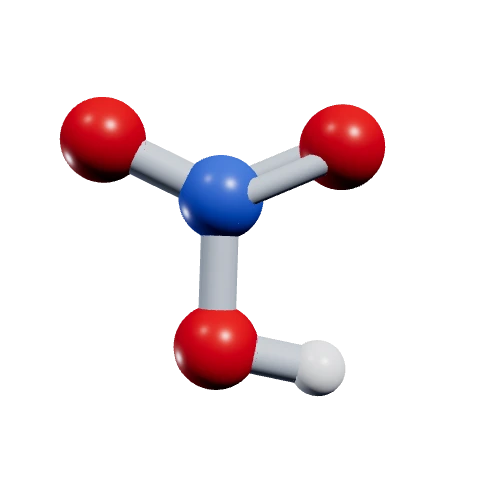


Search for nitric acid and you get an encyclopedia entry, a safety data sheet, and a forum thread from 2023. None of them answer the question you actually typed: can I buy this, do I need a licence, and which one do I need? We ship nitric acid every week, so here is the version written from the loading dock rather than the reference shelf.
Can you actually buy nitric acid?
Yes. Nitric acid is sold openly in the United States to businesses, laboratories, universities and institutional buyers, with no purchase permit and no application process. It is a commodity industrial chemical — roughly three-quarters of world production goes into fertiliser feedstock — and the supply chain that serves metal finishers, plating shops, dairies and analytical labs is entirely ordinary.
The people buying it are unremarkable too. Metal finishers and plating shops run it in passivation and bright-dip lines. Dairies and food plants use it as the acid half of a clean-in-place cycle. Analytical laboratories digest samples in it. Jewellers and refiners test and part precious metals with it. Electronics manufacturers use high-purity grades in wafer and substrate cleaning. None of these buyers hold a permit, because none exists to hold.
What confuses buyers is that nitric acid behaves like a restricted product at the checkout stage. You will be asked for a business address. You will not be offered next-day air. You may be asked what you are using it for. None of that is licensing. All of it is transport law, and it is the subject of most of this guide.
Do you need a license to buy nitric acid?
No. There is no federal licence, permit or registration required to purchase nitric acid in the United States. It is worth being precise about this, because the assumption that the most aggressive-looking acid must be the most tightly controlled is exactly backwards.
The relevant federal chemical-control regime is the DEA’s List I and List II framework in 21 CFR Part 1310, which covers chemicals diverted into illicit drug manufacture and imposes recordkeeping, reporting and threshold rules on the people who sell them. Nitric acid does not appear anywhere in Part 1310. Two acids that do:
- Hydrochloric acid — the muriatic acid sold in hardware stores — is a List II chemical, DEA code 6545, named in 21 CFR 1310.02 as “including anhydrous hydrogen chloride.”
- Sulfuric acid is likewise listed, with concentration thresholds set out in 21 CFR 1310.12 (15% by weight, 20% by weight or volume in an inert carrier).
The counterintuitive part: the acid you can buy off a shelf at a home-improvement store carries DEA chemical-control obligations. The one that requires a freight shipment and a business address does not. Regulatory burden here tracks what a chemical can be diverted into, not how dangerous it is to handle.
This is not the same as saying nitric acid is unregulated. It is regulated heavily — by the Department of Transportation for shipping, by OSHA for workplace exposure, and by the EPA for release reporting. It is regulated as a hazard, not as a controlled substance. Practically, that means a legitimate business buyer faces logistics requirements, not paperwork gates.
Does Home Depot or Walmart sell nitric acid?
Not in any practical sense, and the reason is worth understanding before you spend an afternoon calling stores. Big-box retailers stock muriatic acid because it moves in consumer volumes for pool care and concrete etching, and because it ships and shelves as a straightforward corrosive.
Nitric acid is a corrosive and an oxidiser. That dual character is what keeps it out of retail: it cannot be shelved next to organic products, it demands segregated storage away from solvents and combustibles, and above 65% it carries oxidiser characteristics that change how it must be packed and placarded. Marketplace listings do surface small bottles from third-party sellers, but those are drop-shipped from chemical distributors anyway — you are buying from a supplier either way, with an extra margin and less control over grade documentation.
If a retail listing does not state a grade and a concentration, treat that as missing information rather than a bargain. “Nitric acid” without an assay figure tells you nothing about whether it will work for passivation, digestion or gold testing — three jobs with three different requirements.
Which nitric acid concentration do you need?
Concentration is the first decision, and it is driven by the job rather than by a preference for stronger material. Buying 70% and diluting it on site is sometimes the right call and sometimes an expensive way to import a freight class you did not need.
| Concentration | Grade we stock | Typical use |
|---|---|---|
| 5% | Technical Grade | Dilute analytical work, sample preservation, and light acid cleaning. |
| 20% | Technical Grade | General metal cleaning and descaling where a mild oxidising acid is enough. |
| 25% | Technical Grade | Dairy and food-plant CIP acid wash; mineral-scale removal. |
| 40% | Technical Grade | Stainless passivation baths and heavier descaling duty. |
| 65% | ACS Reagent Grade | Lab reagent work, digestions, and trace-metal analysis. |
| 69% | ACS Reagent Grade | Drum-scale reagent supply for production labs and plating lines. |
| 70% | ACS Reagent Grade | Electronics and high-purity work where particle count matters. |
A few practical notes that the concentration number alone will not tell you. Commercial concentrated nitric acid tops out around 68% because that is the water azeotrope — a 68% mixture boils at a constant 121 °C and cannot be concentrated further by simple distillation. That is why 65%, 69% and 70% are the grades you see quoted everywhere and why nothing between 70% and fuming acid is routinely available.
Concentrated nitric acid also yellows with age. Light and warmth drive slow decomposition to nitrogen dioxide, which dissolves back into the acid and tints it. A yellow tinge in an older bottle is normal and is not by itself a sign the material is out of specification, though it does indicate storage conditions worth correcting.
Should you buy concentrated and dilute on site? Sometimes. Diluting reduces the volume of regulated material you receive and store, and if you already run a dilution station with the right containment it can simplify inventory across several processes. But it moves a hazardous operation into your building, it requires trained staff and dedicated equipment, and it puts the accuracy of your working concentration on you rather than on a supplier’s Certificate of Analysis. Acid is always added to water, never the reverse — the dilution is strongly exothermic and adding water to concentrated acid can boil and spatter it.
For a process that runs at a fixed concentration and cares about repeatability — a passivation bath working to a written specification, for instance — buying the concentration you actually use is usually the lower-risk purchase, and the documentation follows the material.
Technical Grade vs ACS Reagent Grade: which one do you need?
Grade is a statement about impurities, not about strength. A 40% Technical Grade and a 70% ACS Reagent Grade differ in how much acid is in the bottle and in what else is in there — and for most buyers the second question is the one that decides the purchase.
- Technical Grade meets a commercial purity specification suitable for industrial duty. If the acid is doing mechanical work — dissolving scale, cleaning metal, passivating a stainless surface, adjusting pH — trace metals in the parts-per-million range have no effect on the outcome.
- ACS Reagent Grade meets American Chemical Society specifications, with defined maximum limits on individual trace contaminants. You need it when the impurity itself would corrupt the result: trace-metal analysis, sample digestion, electronics work, or any process where you are measuring parts per billion of the very elements a lower grade might contribute.
The question that settles it: would a few parts per million of iron, copper or chloride change your outcome, or merely be present? If it would change the outcome, buy the reagent grade. If it would merely be present, the technical grade does the same physical job.
Our 70% ACS Reagent Grade is additionally specified as low-particle, which matters for electronics and high-purity applications where filtration and particle count are part of the acceptance criteria. That is a narrower requirement than reagent purity, and worth asking about rather than assuming.
If you are weighing the same decision on a different acid, the reasoning transfers almost unchanged — see our ACS Reagent versus Technical Grade guide for 37% hydrochloric acid.
Where do you buy nitric acid for gold refining and testing?
From a chemical distributor, in concentrated reagent grade, and this is the single largest group of people searching for nitric acid who are not industrial buyers. Two distinct jobs sit behind that search.
Acid testing uses dilute nitric acid to distinguish karat golds by how the surface reacts — the test relies on nitric acid attacking base metals and alloys while leaving high-karat gold unmarked. Refining uses nitric acid to dissolve base metals and silver away from gold, and in combination with hydrochloric acid it forms aqua regia, one of the few reagents that dissolves gold at all.
Grade matters more here than people expect. If you are recovering or assaying precious metal, dissolved trace metals from a technical-grade acid end up in your solution and then in your assay. This is the classic case for ACS Reagent Grade — not because the reaction needs it, but because your measurement does.
The practical buying note is that refiners tend to under-order. Dissolving base metal consumes acid stoichiometrically, and a litre goes quickly once you are working with any real mass of material. Because the hazmat fee is per shipment rather than per litre, the buyer who orders a single small bottle repeatedly pays that fee every time. Sizing the order to a few months of realistic consumption is almost always the better arrangement, provided you have segregated storage for it.
For the wider chemistry of separating and refining metals, including where nitric acid sits alongside other reagents, see our guide to refining precious metals with nitric acid.

Why does nitric acid cost more to ship than it does to buy?
Because it moves as regulated hazardous freight, and the cost of compliant packaging and ground transport does not scale down with order size. This is the single biggest surprise for first-time buyers, so here is the structure behind it.
Nitric acid ships under UN2031 (“nitric acid, other than red fuming”), assigned Emergency Response Guide 157. The UN2031 entry is itself banded by concentration, and those bands are not cosmetic — they change the description on the shipping paper:
- not more than 20% nitric acid
- more than 20% and less than 65% nitric acid
- at least 65% but not more than 70% nitric acid
Above 65%, nitric acid may act as an oxidiser in addition to being corrosive, which is why the concentrated grades attract a second hazard character rather than just a higher number on the label. Red fuming nitric acid is a different entry entirely (UN2032) and is not a general-commerce product.
What this means for your order. Nitric acid moves by ground freight to a business or institutional address, in UN-rated packaging, with a hazmat fee that is largely fixed per shipment. Small orders therefore carry a disproportionate freight cost, and consolidating into fewer, larger deliveries is usually the sensible move. Orders leave our Taylor, Texas warehouse in 1–2 business days.

Is muriatic acid the same as nitric acid?
No — they are different acids that do different jobs, and substituting one for the other is a common and costly mistake. Muriatic acid is a common name for hydrochloric acid, HCl. Nitric acid is HNO₃.
| Nitric acid (HNO₃) | Muriatic / hydrochloric acid (HCl) | |
|---|---|---|
| Character | Strong acid and strong oxidiser | Strong acid, not an oxidiser |
| On stainless steel | Passivates — builds the protective chromium oxide layer | Attacks it — chlorides pit stainless |
| DEA chemical control | Not listed in 21 CFR Part 1310 | List II chemical, code 6545 |
| Retail availability | Distributor / freight | Widely sold for pool and masonry use |
The stainless steel row is the one that costs money. Nitric acid is the classic passivating acid for stainless: it removes free iron from the surface and lets the chromium oxide layer reform, which is why it appears in aerospace and food-plant specifications. Hydrochloric acid does the opposite — chloride is precisely what pits stainless steel. Reaching for the hardware-store acid because it was available is how a passivation job becomes a corrosion job. We covered a related version of this error in the viral muriatic-acid concrete hack, and the passivation chemistry itself in our stainless passivation guide.
What should you never mix with nitric acid?
Anything organic, anything reducing, and anything finely divided. Nitric acid’s oxidising character is what makes its incompatibility list longer and more dangerous than a comparably strong non-oxidising acid.
Documented ignition on contact. Nitric acid ignites on contact with alcohols, amines, ammonia, hydrazines, hydrocarbons, powdered metals, silanes and thiols. It reacts violently with turpentine, charcoal and general organic refuse, and can react explosively with many reducing agents. Never pour waste nitric acid into a solvent waste container.
A second point that is specific to this acid: nitric acid attacking a metal does not generally evolve hydrogen the way a non-oxidising acid does. Nitrate is reduced preferentially, so what comes off is nitrogen oxides — including the reddish-brown nitrogen dioxide that makes the fumes visible. Those fumes are the principal inhalation hazard, and they are why ventilation is not optional. The OSHA permissible exposure limit is 2 ppm as an 8-hour TWA, with NIOSH adding a 4 ppm short-term limit.
On skin, nitric acid produces a characteristic yellow stain — the xanthoproteic reaction, in which the acid nitrates aromatic amino acids in keratin. It is a burn, not a dye, and the colour is a sign of protein damage rather than a cosmetic effect. Handle with acid-resistant gloves, splash goggles and a face shield, and store nitric acid segregated from solvents, bases and combustibles. Our acid storage guide covers segregation practice that applies here too.
Key numbers and sources
Every figure below is drawn from a primary or authoritative source, linked so you can verify it rather than take our word for it.
| Property | Value | Source |
|---|---|---|
| CAS Number | 7697-37-2 | PubChem CID 944 |
| Formula / molar mass | HNO₃ — 63.01 g/mol | PubChem CID 944 |
| Acid dissociation constant | pKa = −1.38 (a strong acid, fully dissociated in water) | PubChem experimental properties |
| Density (concentrated) | 1.5129 g/cm³ at 20 °C | PubChem experimental properties |
| Boiling point | 83 °C pure; 121 °C at the 68% azeotrope | PubChem experimental properties |
| Freezing point | −41.6 °C | PubChem experimental properties |
| OSHA PEL | 2 ppm (5 mg/m³), 8-hour TWA | NIOSH / OSHA exposure limits |
| NIOSH REL | 2 ppm (5 mg/m³) TWA; 4 ppm (10 mg/m³) STEL | NIOSH Recommendations |
| CERCLA reportable quantity | 1,000 lb (454 kg) — releases at or above this must be reported to the National Response Center | 40 CFR Part 302 |
| GHS classification | Danger — H272 (may intensify fire; oxidiser), H314 (causes severe skin burns and eye damage), H330 (fatal if inhaled) | PubChem GHS classification |
| DOT identifiers | UN2031 (other than red fuming) — ERG Guide 157; UN2032 for red fuming | PubChem DOT record / 49 CFR |
| DEA chemical control | Not listed. Nitric acid does not appear anywhere in 21 CFR Part 1310; hydrochloric acid is List II chemical code 6545 and sulfuric acid carries listed thresholds | 21 CFR 1310.02 / 1310.12 |
Buy nitric acid from Alliance Chemical
We stock nitric acid from 5% to 70%, in Technical Grade and ACS Reagent Grade, from 1-litre bottles through 55-gallon drums. Need the Certificate of Analysis for your drum or tote? Just ask — we send it at no charge. If you are not sure which concentration or grade your process needs, tell us the application — we will spec it with you, so you are not paying for purity you will never use or under-specifying a step where it matters.
Related reading
- Nitric acid passivation of stainless steel — the process the 40% grade is bought for.
- Refining precious metals with nitric acid — the gold and silver workflow in full.
- ACS Reagent vs Technical Grade, 37% hydrochloric acid — the same grade decision on another acid.
- Nitric acid chemical properties — the underlying chemistry in more depth.
- The various uses of nitric acid — an application-by-application tour.
- Bioreactor CIP chemistry — where the 25% grade earns its keep.
Frequently asked questions
Do you need a license to buy nitric acid?
No. There is no federal licence or permit required to buy nitric acid in the United States. It is not a DEA-listed chemical and does not appear in 21 CFR Part 1310. What restricts a purchase is transport law rather than permission: nitric acid is a DOT Class 8 corrosive that ships as regulated hazardous freight to a business or institutional address.
Does Home Depot or Walmart sell nitric acid?
Not in any practical sense. Big-box retailers stock muriatic (hydrochloric) acid, not nitric acid. Nitric acid is both corrosive and oxidising, which requires segregated storage away from organics and combustibles and keeps it out of general retail. Marketplace listings are generally third-party sellers drop-shipping from chemical distributors.
What is the difference between Technical Grade and ACS Reagent Grade nitric acid?
Grade describes impurities, not strength. Technical Grade meets a commercial purity specification and is suitable where the acid does physical work such as descaling, cleaning or passivation. ACS Reagent Grade meets American Chemical Society specifications with defined limits on individual trace contaminants, and is needed where an impurity would corrupt a measurement, such as trace-metal analysis or sample digestion.
Which concentration of nitric acid should I buy?
Match it to the job. Alliance Chemical stocks 5%, 20%, 25% and 40% in Technical Grade for dilute analytical work, metal cleaning, food-plant CIP and stainless passivation, and 65%, 69% and 70% in ACS Reagent Grade for laboratory reagent work, digestions and high-purity electronics applications.
Why is concentrated nitric acid only about 68 to 70 percent?
Because 68% nitric acid forms an azeotrope with water, boiling at a constant 121 degrees Celsius. A constant-boiling mixture cannot be concentrated further by simple distillation, which is why commercial concentrated nitric acid is quoted at 65 to 70 percent and why stronger material requires different production routes.
Is muriatic acid the same as nitric acid?
No. Muriatic acid is a common name for hydrochloric acid (HCl); nitric acid is HNO3. Nitric acid is also a strong oxidiser, while hydrochloric acid is not. The practical difference matters on stainless steel: nitric acid passivates stainless by letting the chromium oxide layer reform, while chloride from hydrochloric acid pits it.
What should you never mix with nitric acid?
Nitric acid ignites on contact with alcohols, amines, ammonia, hydrazines, hydrocarbons, powdered metals, silanes and thiols, and reacts violently with turpentine, charcoal and organic refuse. It can react explosively with many reducing agents. Never place waste nitric acid in a solvent waste container, and store it segregated from solvents, bases and combustibles.
How does nitric acid ship, and why is freight expensive?
Nitric acid ships under UN2031 as a DOT Class 8 corrosive, assigned Emergency Response Guide 157, in UN-rated packaging by ground freight to a business address. Above 65% it may also act as an oxidiser. Hazmat fees are largely fixed per shipment, so small orders carry a disproportionate freight cost and consolidating into fewer, larger deliveries is usually more economical.
Sources
- 21 CFR 1310.02 · Electronic Code of Federal Regulations
- PubChem Compound Summary: Nitric Acid (CID 944) · PubChem (NIH National Library of Medicine)
- 40 CFR Part 302 · Electronic Code of Federal Regulations
Related Chemical Collections
About the author
Andre Taki
This article is for informational purposes only.


