



The Role of Antifreeze and Coolants in the Battle Against Ice and Fire
A comprehensive technical reference covering ethylene glycol and propylene glycol coolant chemistry, freeze and boil protection curves, ASTM standards, concentration ratios, and maintenance protocols for automotive, HVAC, and industrial heat-transfer systems.
Understanding Coolant Chemistry: Why Water Alone Fails
Water is nature's most effective heat-transfer fluid. With a specific heat capacity of 1.0 BTU/(lb·°F) — higher than nearly any other common liquid — it absorbs and dissipates thermal energy with remarkable efficiency. So why does every internal combustion engine, industrial chiller, and HVAC system on the planet dilute this perfect heat-transfer medium with glycol-based antifreeze?
The answer lies in water's three critical weaknesses: it freezes at 32°F (0°C), boils at 212°F (100°C) at atmospheric pressure, and is brutally corrosive to the metals used in cooling systems. An engine operating in Minneapolis in January faces ambient temperatures of -20°F, while that same engine's combustion chambers produce temperatures exceeding 4,500°F. The coolant must protect against both extremes simultaneously — hence the term "antifreeze/coolant," a dual-purpose fluid that widens the liquid operating range from both ends.
Glycol-based antifreeze solutions address all three weaknesses. The glycol component depresses the freezing point through colligative properties (disrupting the hydrogen-bond network that forms ice crystals), elevates the boiling point through the same mechanism, and provides a medium for dissolved corrosion inhibitors that protect aluminum, copper, steel, solder, and gasket materials throughout the cooling circuit.
The Colligative Effect: How Glycol Depresses Freezing Points
When glycol molecules are dissolved in water, they physically interfere with the formation of the ordered crystal lattice structure that constitutes ice. Each glycol molecule inserted between water molecules forces a lower temperature to achieve the energy state required for crystallization. This freezing-point depression follows Raoult's Law in dilute solutions, though concentrated glycol mixtures deviate significantly from ideal behavior, requiring empirical freeze-point curves rather than simple calculations.
Critically, freezing-point depression is not linear with concentration. A 50% ethylene glycol solution freezes at -34°F (-37°C), but a 70% solution only depresses the freeze point to -67°F (-55°C) — and at concentrations above approximately 68%, the freeze point actually begins to rise again. This non-linear behavior means that more glycol is not always better, and there is a definite optimum concentration range for each application.

Ethylene Glycol vs. Propylene Glycol: Choosing the Right Coolant Base
The two dominant glycol chemistries in the coolant industry — ethylene glycol (EG) and propylene glycol (PG) — offer fundamentally different risk-benefit profiles. Understanding where each excels is essential for specifying the right coolant for your application.
Ethylene Glycol (EG): The Performance Standard
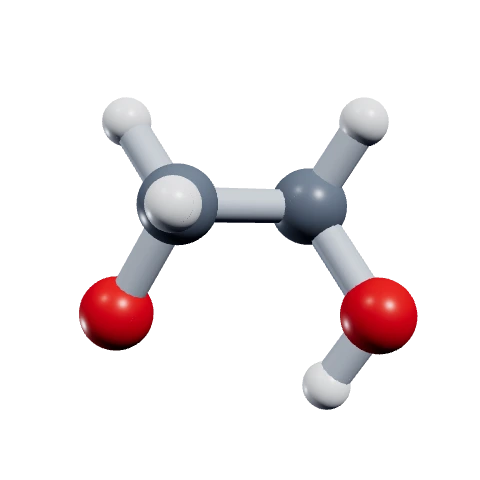
Ethylene glycol (CAS 107-21-1, C2H6O2) has been the dominant automotive and industrial coolant base since the 1930s. Its advantages are clear: superior heat-transfer efficiency, lower viscosity at cold temperatures (critical for pump performance), better freeze-point depression per unit concentration, and lower cost. A 50/50 EG-water mixture provides freeze protection to -34°F (-37°C) and boilover protection to approximately 265°F (129°C) at atmospheric pressure, extending to 330°F (166°C) under a standard 15 psi radiator cap.
The trade-off is toxicity. Ethylene glycol is acutely toxic to humans and animals, with a lethal oral dose of approximately 100 mL (about 3.4 fluid ounces) for an average adult. Its sweet taste makes it particularly dangerous to children and pets. EG is metabolized by alcohol dehydrogenase into glycolaldehyde, glycolic acid, and ultimately oxalic acid, which causes renal tubular necrosis (kidney failure) and metabolic acidosis.
Propylene Glycol (PG): The Safe Alternative
Propylene glycol (CAS 57-55-6, C3H8O2) carries FDA GRAS status and is the mandated coolant base for any system where incidental food contact is possible. Its oral LD50 in rats is approximately 20,000 mg/kg — roughly four times less toxic than table salt on a per-kilogram basis. PG is metabolized into lactic acid and pyruvic acid, both normal human metabolites.
The performance penalty is real but manageable. At equivalent concentrations, PG provides approximately 5–8°F less freeze-point depression than EG, has 10–15% lower heat-transfer efficiency, and exhibits significantly higher viscosity at low temperatures. A 50/50 PG-water mixture freezes at -28°F (-33°C) — adequate for most applications but notably worse than EG's -34°F. The viscosity difference is more impactful: at 0°F, a 50% PG solution has roughly double the viscosity of 50% EG, requiring larger pumps and more energy to circulate.
| Property | Ethylene Glycol (50/50) | Propylene Glycol (50/50) | Water (neat) |
|---|---|---|---|
| Freeze Point | -34°F (-37°C) | -28°F (-33°C) | 32°F (0°C) |
| Boil Point (atm) | 265°F (129°C) | 257°F (125°C) | 212°F (100°C) |
| Boil Point (15 psi cap) | 330°F (166°C) | 322°F (161°C) | 250°F (121°C) |
| Specific Heat at 200°F | 0.82 BTU/(lb·°F) | 0.87 BTU/(lb·°F) | 1.0 BTU/(lb·°F) |
| Viscosity at 0°F (cP) | ~45 | ~90 | N/A (frozen) |
| Toxicity (oral LD50, rat) | ~4,700 mg/kg | ~20,000 mg/kg | N/A |
| FDA Food-Contact Approved | No | Yes (GRAS) | Yes |
| Typical Cost (per gallon) | $5–$9 | $8–$14 | Negligible |
Concentration Ratios: Getting the Mix Right
Coolant concentration is arguably the single most important variable in system protection, and getting it wrong — in either direction — causes real problems. Under-concentration risks freeze damage, while over-concentration paradoxically provides worse freeze protection (above ~68% EG), dramatically reduces heat-transfer efficiency, and accelerates additive depletion.
Ethylene Glycol Freeze and Boil Protection Curves
| EG Concentration (% by vol) | Freeze Point | Boil Point (atm) | Boil Point (15 psi) | Application Zone |
|---|---|---|---|---|
| 0% (pure water) | 32°F (0°C) | 212°F (100°C) | 250°F (121°C) | Not recommended |
| 20% | 16°F (-9°C) | 216°F (102°C) | 256°F (124°C) | Mild climate, minimal |
| 30% | 4°F (-16°C) | 222°F (106°C) | 263°F (128°C) | Moderate climate |
| 40% | -12°F (-24°C) | 228°F (109°C) | 271°F (133°C) | Cold climate |
| 50% | -34°F (-37°C) | 236°F (113°C) | 330°F (166°C) | Standard automotive |
| 60% | -62°F (-52°C) | 243°F (117°C) | 339°F (171°C) | Severe cold / OTR |
| 70% | -67°F (-55°C) | 249°F (121°C) | 347°F (175°C) | Maximum protection* |
| 80% | -56°F (-49°C) | 255°F (124°C) | 354°F (179°C) | Over-concentrated* |
Propylene Glycol Freeze Protection Curves
| PG Concentration (% by vol) | Freeze Point | Viscosity at 32°F (cP) | Relative Heat Transfer | Common Application |
|---|---|---|---|---|
| 20% | 18°F (-8°C) | 5.2 | 96% | Mild HVAC systems |
| 30% | 4°F (-16°C) | 8.5 | 92% | Standard brewery glycol |
| 35% | -5°F (-21°C) | 11.2 | 90% | Cold-climate brewery |
| 40% | -13°F (-25°C) | 15.1 | 87% | Ice rinks, process cooling |
| 50% | -28°F (-33°C) | 28.4 | 82% | Extreme cold applications |
| 60% | -55°F (-48°C) | 56.7 | 75% | Sub-arctic installations |
How to Measure and Adjust Concentration
Three primary instruments measure glycol concentration in the field:
- Refractometer (optical): The gold standard for accuracy. Place a few drops on the prism, close the daylight plate, and read the freeze-point directly from the scale. Digital refractometers provide 0.1°F resolution. Ensure calibration with distilled water (zero point) before each use. Cost: $25–$300.
- Hydrometer (floating bulb): Measures specific gravity, from which freeze point is derived. Less accurate than refractometry, and readings must be temperature-corrected (most are calibrated for 60°F). Adequate for routine checks. Cost: $5–$20.
- Test Strips: Dip-style strips provide a rough freeze-point estimate. Useful for quick go/no-go screening but not for precise concentration management. Accuracy: ±10°F. Cost: $10–$15 per 50 strips.
ASTM Standards and Coolant Specifications
The American Society for Testing and Materials (ASTM) publishes the definitive standards for coolant quality, performance, and testing. Understanding these standards is essential for specifying, purchasing, and validating coolant products.
Key ASTM Standards for Glycol-Based Coolants
| Standard | Title | Scope | Key Requirements |
|---|---|---|---|
| ASTM D3306 | EG-Based Engine Coolant for Automobiles | Passenger cars, light trucks | Freeze protection, corrosion, water pump seal, foaming |
| ASTM D6210 | EG-Based Engine Coolant for Heavy-Duty | Diesel engines, commercial trucks | Cavitation, liner pitting, solder corrosion |
| ASTM D6211 | EG-Based Coolant for Low-Temperature Applications | Industrial heat-transfer loops | Viscosity limits, stability, inhibitor life |
| ASTM D5216 | PG-Based Engine Coolant for Automobiles | Non-toxic automotive coolant | Same corrosion tests as D3306, PG base |
| ASTM D1177 | Freezing Point of Aqueous Solutions | Test method for all glycols | Procedure for determining freeze point |
| ASTM D1384 | Corrosion Test for Engine Coolants | Glassware corrosion test | Weight loss on 6 metal coupons over 336 hr |
| ASTM D4985 | Low-Temperature Viscosity of Coolants | Pumpability assessment | Viscosity at specified sub-zero temps |
OEM Specifications: Beyond ASTM
Major automotive and equipment manufacturers publish their own coolant specifications that layer additional requirements on top of ASTM base standards:
- GM DEX-COOL (GM 6277M): Extended-life OAT coolant, 5 years/150,000 miles. Orange color. Requires organic acid inhibitors only — no silicates, phosphates, or borates.
- Ford WSS-M97B51-A1: Yellow or gold OAT coolant. Silicate-free, phosphate-free. Similar to DEX-COOL chemistry with Ford-specific additive requirements.
- Chrysler/Stellantis MS-12106: Purple/violet HOAT (Hybrid OAT) coolant. Contains organic acids plus a controlled amount of silicate for enhanced aluminum protection.
- VW/Audi TL 774 J (G13): Violet/pink Si-OAT coolant using a bio-glycol base (partially derived from glycerin). Phosphate-free for European water compatibility.
- Caterpillar EC-1: Heavy-duty diesel coolant specification. Requires supplemental coolant additives (SCAs) or a fully-formulated ELC (Extended Life Coolant).

Automotive Cooling Systems: From Radiator to Reservoir
The modern automotive cooling system is a pressurized, thermostatically controlled loop designed to maintain engine operating temperature between 195–220°F (90–104°C) regardless of ambient conditions. The coolant within this system must simultaneously protect against freeze damage during cold starts in sub-zero weather and prevent boilover under extreme heat loads (towing, mountain grades, stop-and-go traffic in summer).
System Components and Coolant Flow
Coolant circulates through a predictable path: water pump → engine block water jackets → cylinder head passages → thermostat housing → radiator (when hot) or bypass loop (when cold) → return to pump. Along the way, branches supply the heater core, EGR cooler (diesel), turbocharger coolant jacket (if equipped), oil cooler (if equipped), and transmission cooler (automatic transmissions with integral coolers).
Each component presents different metallurgical and thermal challenges. The engine block may be cast iron or aluminum. The cylinder head is almost universally aluminum. The radiator uses aluminum core with plastic end tanks (crimped, not soldered). The heater core is copper-brass in older vehicles and aluminum in modern ones. The water pump uses a mechanical seal with a ceramic face. The thermostat uses a wax-pellet expansion element. The coolant must be compatible with every material in this diverse system.
Pressurization and Boilover Protection
The radiator cap is not merely a lid — it is a precision pressure-relief valve that maintains 13–18 psi (typically 15 psi) of system pressure. According to the Clausius-Clapeyron relation, every 1 psi of additional pressure raises the boiling point of water by approximately 3°F. A 15 psi cap raises a 50/50 EG solution's boiling point from 265°F (atmospheric) to approximately 330°F — an 65°F increase that provides crucial margin against boilover during high heat-rejection events.
Maintenance Intervals by Coolant Technology
| Coolant Technology | Inhibitor Chemistry | Service Life | Color (typical) | ASTM Reference |
|---|---|---|---|---|
| IAT (Inorganic Acid Technology) | Silicate, phosphate, borate | 2 years / 30,000 miles | Green | ASTM D3306 |
| OAT (Organic Acid Technology) | Sebacate, 2-EHA, benzoate | 5 years / 150,000 miles | Orange, red, pink | ASTM D6210 |
| HOAT (Hybrid OAT) | OAT + silicate or phosphate | 5 years / 150,000 miles | Yellow, turquoise, purple | Various OEM specs |
| Si-OAT (Silicated OAT) | OAT + low silicate | 5 years / 150,000 miles | Purple, violet | OEM-specific |
| P-OAT (Phosphated OAT) | OAT + phosphate (Asian OEMs) | 5 years / 100,000 miles | Pink, blue | OEM-specific (Toyota, Honda) |
| NOAT (Nitrited OAT) | OAT + nitrite (HD diesel) | 600,000 miles or 6 years | Red, pink | ASTM D6210 |
Industrial HVAC and Process Cooling Applications
Outside the automotive world, glycol-based coolants serve as the backbone of industrial heat-transfer systems in HVAC chillers, data center cooling, food-processing plants, pharmaceutical manufacturing, and chemical process cooling. These applications differ from automotive use in several important ways: systems are larger (hundreds to thousands of gallons), temperatures are often lower (sub-zero for cold storage), fluid velocities are lower (reducing erosion but increasing fouling risk), and system life expectancy is 20–30 years rather than 10–15.
Closed-Loop HVAC Glycol Systems
Commercial HVAC systems in cold climates use glycol solutions to protect chilled-water and condenser-water loops against freeze damage. The typical HVAC glycol system operates at 25–40% concentration, providing protection to approximately 0°F (-18°C) to -15°F (-26°C). ASHRAE Handbook: HVAC Systems and Equipment provides detailed design guidance for glycol system selection, including correction factors for heat-transfer capacity, pressure drop, and pump sizing.
Data Center Cooling
Modern data centers reject enormous thermal loads — 5,000 to 30,000+ BTU/hr per rack — and many rely on glycol-chilled water for precision cooling. The Uptime Institute's Tier III and Tier IV standards require redundant cooling capacity, and glycol concentration must be carefully balanced between freeze protection (for exposed outdoor piping and dry coolers) and heat-transfer efficiency (to minimize energy consumption). Most data center operators target the minimum glycol concentration that provides adequate freeze protection for their climate, typically 25–35% EG.
Food and Beverage Process Cooling
Food-processing facilities must use propylene glycol exclusively in any cooling system that could contact food or potable water. The USDA and FDA mandate this requirement, and FSMA (Food Safety Modernization Act) auditors specifically verify coolant type during facility inspections. Brewery glycol chilling, dairy pasteurization cooling, meat-processing chiller systems, and cold-storage warehouse cooling all require USP-grade or food-grade PG.
Mixing Guidelines and Water Quality Requirements
The quality of water used to dilute glycol concentrate has a direct and significant impact on coolant performance, corrosion protection, and system life. Tap water varies enormously in mineral content across the United States, from ultra-soft Pacific Northwest supplies (<50 ppm TDS) to heavily mineralized Midwest and Southwest water (>500 ppm TDS). Using the wrong water to mix coolant can destroy an engine or industrial system within months.
Water Quality Specifications for Coolant Mixing
| Parameter | Maximum Limit | Ideal Range | Issue If Exceeded |
|---|---|---|---|
| Total Dissolved Solids (TDS) | 340 ppm | <100 ppm | Scale formation, reduced heat transfer |
| Hardness (as CaCO3) | 170 ppm | <100 ppm | Calcium/magnesium scale deposits |
| Chloride (Cl-) | 40 ppm | <25 ppm | Pitting corrosion of aluminum and steel |
| Sulfate (SO42-) | 100 ppm | <50 ppm | Corrosion, inhibitor interference |
| pH | 5.5–9.0 | 7.0–8.5 | Corrosion (low) or scale (high) |
| Iron (Fe) | 0.10 ppm | <0.05 ppm | Abrasive deposits, galvanic corrosion |
Pre-Mixed vs. Concentrate: Making the Right Choice
Pre-mixed (ready-to-use) coolant eliminates the water-quality variable entirely by using deionized or distilled water at the factory. This is the safer choice for most users, especially in areas with hard or mineral-rich water. The per-gallon cost is higher, but when you factor in the cost of purchasing distilled water separately and the risk of mixing errors, pre-mixed coolant is often more economical on a total-cost basis.
Concentrate is appropriate for large-volume users who maintain their own water treatment capabilities (deionization or reverse osmosis systems). The cost savings on bulk concentrate purchases can be substantial — up to 40% per gallon of finished coolant — but only if the water quality is rigorously controlled.
Testing, Monitoring, and Maintenance Protocols
Coolant does not last forever. Even extended-life formulations degrade over time as inhibitors are consumed by the corrosion reactions they are designed to prevent, as glycol oxidizes into organic acids under thermal stress, and as contaminants (combustion gases, dissolved metals, hard-water minerals) accumulate. A proactive maintenance program catches degradation before it causes damage.
Essential Coolant Tests
- Freeze Point (ASTM D1177): Measures the glycol concentration. Use a refractometer for field testing. Laboratory analysis uses the cryoscopic method. Test every 6 months or whenever fluid is added.
- pH (ASTM D1287): Fresh coolant pH is typically 9.5–10.5 for IAT and 8.0–9.0 for OAT. A pH drop of 1.0 or more from the initial value indicates significant inhibitor depletion or acid contamination. Test quarterly.
- Reserve Alkalinity (ASTM D1121): Measures the coolant's remaining buffering capacity against acidification. Fresh IAT coolant has a reserve alkalinity of approximately 10–15 mL. Below 3.0 mL, the coolant can no longer resist acid attack and must be replaced.
- Visual Inspection: Clear, bright-colored coolant is healthy. Cloudy, dark, or rust-colored fluid indicates contamination, degradation, or active corrosion. Oily films on the surface suggest head-gasket leakage, transmission-cooler breach, or oil-cooler failure.
- Supplemental Coolant Additives (SCAs): Heavy-duty diesel engines using conventional coolant require SCA replenishment at defined intervals to maintain nitrite, molybdate, and silicate levels that prevent cavitation-erosion (liner pitting). Test with SCA test strips at every oil change.
When to Flush and Replace
Complete coolant replacement is necessary when:
- Coolant has exceeded its service-life specification (2 years for IAT, 5 years for OAT/HOAT)
- pH has dropped below 7.0 (for any coolant type)
- Reserve alkalinity has fallen below the manufacturer's minimum
- The system has been contaminated with the wrong coolant type, oil, or fuel
- Visible corrosion products (rust, scale, green/white deposits) are present
- The system has been repaired (head gasket, radiator, water pump) and old coolant may be contaminated with sealant, debris, or flux
Environmental Regulations and Disposal
Used coolant is regulated at the federal, state, and local levels, and improper disposal carries significant penalties. The EPA does not classify used antifreeze as a RCRA hazardous waste by default, but it becomes hazardous if it contains sufficient concentrations of lead (from solder corrosion), benzene, or other listed contaminants. Many states classify used antifreeze as a special waste that must be collected and recycled by licensed haulers.
Recycling Options
Used glycol can be recycled through distillation, ion exchange, or filtration processes that remove contaminants and restore the glycol to near-virgin quality. Recycled coolant is reformulated with fresh inhibitors and can meet the same ASTM specifications as virgin product. Major recyclers include Safety-Kleen, Heritage Crystal Clean, and numerous regional processors. Recycling costs are typically $0.50–$2.00 per gallon, depending on volume and contamination level.
For small-volume generators (automotive shops, small HVAC contractors), many auto parts retailers (AutoZone, O'Reilly, NAPA) accept used antifreeze for free recycling. Municipal household hazardous waste programs also accept small quantities.
Frequently Asked Questions
Can I mix different brands of antifreeze?
You can mix different brands if they use the same inhibitor technology (IAT with IAT, OAT with OAT, etc.). Never mix different technologies (e.g., green IAT with orange OAT) as the inhibitor chemistries can interact, causing gelation, precipitate formation, and accelerated corrosion. When in doubt, flush completely and refill with a single product.
Is 50/50 always the right ratio?
Not necessarily. In mild climates (southern US, coastal areas), a 40/60 glycol-to-water ratio provides adequate freeze protection to about -12°F while maximizing heat-transfer efficiency. In extreme cold (northern states, Canada, Alaska), a 60/40 ratio provides protection to -62°F. Never exceed 70% glycol, as the freeze point begins to rise and heat-transfer efficiency drops dramatically.
What does it mean when my coolant turns brown?
Brown or rust-colored coolant indicates active corrosion within the system — typically iron corrosion from cast-iron engine blocks or steel components. This means the corrosion inhibitors have been depleted and the coolant is no longer protecting the system. Immediate action is needed: flush the system completely, identify and address the corrosion source, and refill with fresh coolant. Consider using a cleaning flush before the new coolant charge.
Can I use tap water in an emergency?
In a true emergency (imminent overheating, no distilled water available), adding tap water to prevent engine damage is the correct choice — engine replacement costs far more than a coolant flush. However, you should replace the diluted coolant with properly mixed coolant as soon as possible, ideally with a full flush. Hard tap water (>300 ppm TDS) will deposit scale on hot surfaces within weeks.
How do I dispose of used antifreeze?
Never pour used antifreeze down storm drains, into septic systems, or onto the ground. Ethylene glycol is toxic to animals and contaminates waterways. Most auto parts stores accept used antifreeze for recycling. Commercial facilities should use a licensed waste hauler. Many municipalities offer household hazardous waste collection events. Check EPA and state environmental agency guidelines for your specific location.
Why is my coolant foaming?
Foaming indicates either air entrainment (leak in suction side of pump, low fluid level, failed radiator cap allowing air ingestion) or coolant degradation (inhibitor dropout, contamination with incompatible fluid). Foam reduces heat transfer dramatically and can cause localized hot spots and cavitation damage. Identify and fix the root cause — simply adding anti-foam additives treats the symptom, not the problem.
References & Authoritative Sources
Chemical identity, properties, and safety data sourced from the U.S. National Library of Medicine's PubChem database — the authoritative open-chemistry data resource maintained by the National Institutes of Health.
- PubChem CID 174: 100% Ethylene Glycol Inhibited — National Center for Biotechnology Information, U.S. National Library of Medicine. CAS 107-21-1.
- PubChem CID 753: Glycerin Technical Grade — National Center for Biotechnology Information, U.S. National Library of Medicine. CAS 56-81-5.
- Ethylene Glycol — thermophysical data — NIST Chemistry WebBook, SRD 69, National Institute of Standards and Technology. Accessed 2026-09-04.
- PubChem Compound Summary: Propylene Glycol (CID 1030) — National Center for Biotechnology Information, U.S. National Library of Medicine. Accessed 2026-09-04.
- Propylene Glycol — thermophysical data — NIST Chemistry WebBook, SRD 69, National Institute of Standards and Technology. Accessed 2026-09-04.
Products in this guide: Ethylene Glycol 30/70 · Ethylene Glycol 50/50 · Ethylene Glycol 60/40 · Ethylene Glycol ACS Grade · Ethylene Glycol Inhibited ACS Grade
Key numbers and sources
| Fact | Value | Source |
|---|---|---|
| Ethylene glycol CAS number | 107-21-1 | pubchem.ncbi.nlm.nih.gov |
| Propylene glycol CAS number | 57-55-6 | pubchem.ncbi.nlm.nih.gov |
| Ethylene glycol chemical formula | C2H6O2 | pubchem.ncbi.nlm.nih.gov |
| Propylene glycol chemical formula | C3H8O2 | pubchem.ncbi.nlm.nih.gov |
| Ethylene glycol 50/50 mixture freeze point | -34°F | See article text |
| Propylene glycol 50/50 mixture freeze point | -28°F | See article text |
| ASTM D3306 recommended glycol concentration range for automotive applications | 40–60% | See article text |
Frequently asked questions
What is the difference between antifreeze and coolant?
Antifreeze is the concentrated chemical (ethylene glycol or propylene glycol) that lowers the freezing point and raises the boiling point of water. Coolant is the ready-to-use mixture of antifreeze and water (typically 50/50) with corrosion inhibitors. Never use straight antifreeze—it actually has worse heat transfer properties than a properly diluted mixture.
Can you mix different types of antifreeze coolant?
Never mix different antifreeze types—IAT (green), OAT (orange/red), and HOAT (yellow/turquoise) use incompatible corrosion inhibitor chemistries. Mixing causes inhibitor precipitation, gel formation, and accelerated corrosion. If you don't know what's in the system, flush completely with water before adding new coolant.
What ratio of antifreeze to water provides the best protection?
A 50/50 mix of antifreeze and water protects to about -34°F (-37°C) and boils at 265°F (129°C) at 15 psi system pressure. A 70/30 ratio provides protection to -84°F but reduces heat transfer efficiency. Never exceed 70% antifreeze—higher concentrations actually raise the freezing point and dramatically reduce cooling performance.
How often should antifreeze coolant be replaced?
IAT (green) coolant: every 2 years or 30,000 miles. OAT (orange/red): every 5 years or 150,000 miles. HOAT (hybrid): every 5 years or 150,000 miles. Extended-life formulations may last longer—check manufacturer specifications. Test coolant annually with test strips for pH, freeze point, and inhibitor levels regardless of age.
Related Chemical Collections
About the author
Andre Taki
This article is for informational purposes only.


