



For more than sixty years, chemists tried to make boron hold an oxygen atom with three bonds. Boron kept declining, in the least dramatic way available: it collapsed into rings and sheets of single bonds, the same bonding you find in a bag of boric acid flakes. On 27 October two research groups finally got the triple bond to sit still long enough to be photographed by X-ray. The interesting part, for anyone who buys boron chemicals, is why it was so hard.
This article takes no position on which group got there first; the two papers appeared on the same day in the same journal, and the Sichuan paper thanks the Würzburg chemists for comments on its manuscript. Nor is it about a product. Oxoboranes are laboratory molecules, made in milligram amounts under inert gas. What follows explains the bond, sets its length against the single bonds in a real boric acid crystal, and says what the news does and does not change on a specification sheet. Where a number is our arithmetic, it says so.
What did the chemists actually make?
Molecules with a boron–oxygen triple bond that survive at room temperature. In the Würzburg paper, the team led by Holger Braunschweig, with computational work from Ashwini K. Phukan’s group at Tezpur University, write: “Here we present a remarkably simple synthesis of three oxoboranes that are stable as crystalline solids at room temperature.” The route was close to an accident. Two doctoral students combined a boron compound called a diboracumulene with ordinary carbonyl reagents, two ketones and an amide, and got orange or yellow solids that turned out to be the long-sought molecules. Braunschweig’s comment in the university release explains the excitement:
The second paper, from Wei Lu’s group at Sichuan University, reaches a stable oxoborane by a different door: carbon monoxide triggers the rearrangement of a boron heterocumulene. Its abstract adds a result that matters for what comes next: “The resulting oxoborane exhibits ambiphilic reactivity, enabling access to both neutral and cationic derivatives.” Two routes to the same bond on the same day is a strong sign that the bond is real and reproducible, not a one-off crystal.
Sixty-plus years to a bottleable B≡O
Milestones as cited in the 2026 Würzburg paper’s own reference list.
- Early 1960s · The hunt startsDocumented attempts to make an oxoborane date back to at least here; the molecules show up only fleetingly, in gases and frozen matrices.
- 1985 · A precursor, not the prizePachaly and West report a ring compound described as an oxoborane precursor.
- 2005 · Half a stepCowley’s group holds a boron–oxygen double bond in place with a Lewis acid.
- 2010 · Triple bond, with helpBraunschweig’s group stabilises a B≡O unit on platinum, in Science.
- 2025 · Closer stillAn Edinburgh team isolates a two-coordinate oxoborane that still needs aluminium chloride bound to its oxygen.
- 27 Oct 2026 · Two papers, same dayWürzburg and Tezpur report three stable oxoboranes; a Sichuan University team reports another made with carbon monoxide. Both in Nature Chemistry.
Why is a boron–oxygen triple bond so hard to make?
Because boron and oxygen pull in opposite directions. The Würzburg release opens with the problem in one line: “The element boron does not like to form triple bonds”. On paper, an oxoborane looks like a nitrile, the C≡N group in acetonitrile, with the same number of electrons arranged the same way. In practice the paper names the difference: “the extreme polarity of the B≡O triple bond has thus far kept oxoboranes out of synthetic reach”. Oxygen hoards the electrons, which leaves boron short of them and eager to grab another oxygen from a neighbouring molecule.
That grab is where most attempts ended. An Edinburgh group summed up the failure mode in 2025: “Oxoboranes (R‐BO) are transient species that rapidly trimerise to form boroxines.” Three oxoborane molecules lock together into a six-membered ring of alternating boron and oxygen, B3O3, held by single bonds. Each boron ends up bonded to more oxygen, each bond is ordinary, and the energy is lower. The new molecules survive because their substituents are unusually generous with electrons, which, in the Würzburg team’s computational analysis, takes the edge off that polarity.
| Form | Boron–oxygen bonding | Where you meet it |
|---|---|---|
| Oxoborane, R–B≡O | One triple bond, boron bonded to one oxygen | Two 2026 papers; milligrams under inert gas |
| Boroxine ring, (RBO)3 | Single bonds in a B3O3 ring | Where oxoboranes usually collapse to |
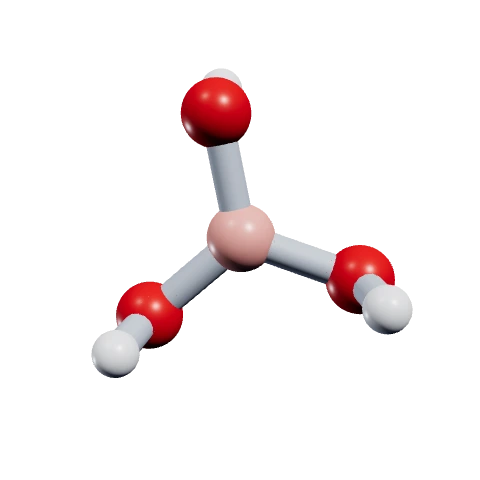
| Boric acid, B(OH)3 | Three single bonds per boron, flat, 120° apart | White flakes or powder, by the pound |
| Boric oxide and borate glass | Networks of single B–O bonds | Glass, glazes and enamels |
How much shorter is the triple bond?
About 15 picometres, or roughly 11 percent, on our arithmetic. The Würzburg crystal structures put the three new B≡O bonds at 1.208, 1.212 and 1.217 ångströms. For the single bond, we used an open crystal structure of boric acid: Shuvalov and Burns measured it at 297 K in 2003, and the Crystallography Open Database lists six boron–oxygen distances in that structure, from 1.349 to 1.377 ångströms. Their average is 1.361.
The triple bond is about 11% shorter than boric acid’s
Boron-to-oxygen distance, measured by X-ray crystallography, in ångströms (one ten-billionth of a metre). Hover or tap a dot.
The three new oxoboranes, 2026 · 1.208–1.217 Å
Oxoboryl on platinum, 2010 · 1.210 Å
Boric acid crystal, six bonds · 1.349–1.377 Å, average 1.361
Gap: about 15 picometres, or 0.15 Å
The platinum line in the chart is the earlier near miss. In 2010 Braunschweig’s group held a B≡O unit on a platinum atom, with a bond of 1.210 ångströms, which the new paper calls probably the shortest known B–O bond until now. The difference in 2026 is that nothing heavy is propping the bond up.
Where does boron end up when nobody is forcing it?
Bonded to oxygen, by single bonds, as often as it can manage. The Würzburg paper opens with exactly that: “boron is found in nature and in early consumer products (for example, borax) as its oxide”. Borax, kernite and colemanite are borate minerals, and boric acid is what borates give when they meet a stronger acid. In boric acid every boron sits at the centre of a flat triangle with three oxygens 120° apart, and every oxygen carries a hydrogen.
Where boron settles: flat triangles of single bonds
One sheet of a real boric acid crystal. Each boron holds three oxygens at 120°, and hydrogen bonds stitch the B(OH)3 molecules into a flat layer. Drag to turn.

The sheet: 12 B(OH)3 molecules, single B–O bonds averaging 1.36 Å
Those hydrogens are why boric acid comes as flakes. Each B(OH)3 molecule hydrogen-bonds to its neighbours in the same plane, so the crystal is built of flat sheets stacked on top of each other, with much weaker forces between sheets than within them. PubChem’s description of the solid notes that it is “Slightly unctuous to touch”, a texture consistent with sheets that slide. Its solubility in water is modest and climbs steeply with heat: PubChem lists 4.72% at 20 °C, against 2.52% at 0 °C.
That stability is what makes boron useful in bulk. PubChem lists boric acid among other things as “a soldering flux, a flame retardant and weatherproofing agent” and as an additive to glass and enamels. Our guide to boric acid’s industrial, ceramic and laboratory applications covers those uses in more depth. None of them needs a triple bond. All of them depend on boron being content where it already is.
What did the new molecules do once they were made?
They reacted, which is the point of making them. The Würzburg conclusion is careful: “Although stable at room temperature, initial probes show B–O-centred reactivity with amines.” When the team added pyrrolidine, a simple amine, it added straight across the triple bond and gave a product carrying a boron–oxygen–hydrogen group: the triple bond had become a single bond to an OH. In other words, the first thing the hard-won molecule did when given a partner was step toward the kind of bonding boric acid already has.
That is good news for chemists, not bad news for the molecule. A bond that is stable on the shelf but reactive on demand is what synthetic chemists want from a building block, and the Würzburg team says it is now testing how far the method can be pushed to other elusive molecules. For readers interested in how such molecules are named and judged, our coverage of the 2026 chemistry Nobel is a reminder that the field’s biggest prizes often begin as one strange crystal.
What this means on a specification
For anyone buying boron chemicals, the news changes the textbook and leaves the purchase order alone. The table sets the two side by side.
| Question | Oxoboranes (the news) | Boric acid (what you specify) |
|---|---|---|
| Bonding | One B≡O triple bond | Three B–O single bonds, B(OH)3 |
| Scale | Tens of milligrams per batch in the papers | Pounds to tons |
| Handling | Inert atmosphere, dry solvents | Dry storage, closed container |
| Grade | Not a commercial material | Technical, or ACS reagent for analytical work |
| Hazard on the label | Not classified as a product | GHS: may damage fertility; may damage the unborn child |
The grade question is the one that matters day to day. Technical grade suits fluxes, glazes and process use; ACS reagent grade is made to a published purity specification for analytical and laboratory work. Our guide to chemical grades explains the difference. The hazard line is not optional either: PubChem’s aggregated GHS classification for boric acid includes H360FD, “May damage fertility; May damage the unborn child”. Read the safety data sheet, wear gloves, and keep dust down.
The crystal data and properties in this article describe boric acid as measured in published studies and listed by PubChem; Alliance Chemical makes no claim about ours beyond the specification on each product page and the certificate of analysis supplied on request. For a different angle on where boron comes from, our report on soda ash and boric acid coming out of the same lake follows the borate supply chain.
Common questions
What is an oxoborane?
An oxoborane is a molecule in which a boron atom is joined to an oxygen atom by a triple bond, written R–B≡O. It has the same electron count as a nitrile, R–C≡N, but the bond is far more polar. Until two Nature Chemistry papers on 27 October 2026, free oxoboranes had only been detected fleetingly, in gases or frozen matrices.
Who made the first stable oxoboranes?
Two groups, reported on the same day. Holger Braunschweig’s team at the University of Würzburg, with computational work from Ashwini K. Phukan’s group at Tezpur University, made three oxoboranes from a diboracumulene and simple carbonyl compounds, two ketones and an amide. Wei Lu’s group at Sichuan University made another through a carbon-monoxide-triggered rearrangement. Both papers appeared in Nature Chemistry on 27 October 2026.
Why did it take more than 60 years?
The boron–oxygen triple bond is extremely polar, which leaves boron short of electrons and eager to bond to more oxygen. Unprotected oxoboranes quickly join up in threes to form boroxine rings of single bonds. The new molecules survive because their substituents feed electrons to boron and soften that polarity.
How long is a boron–oxygen triple bond?
The Würzburg crystal structures measure 1.208 to 1.217 ångströms. By comparison, the six boron–oxygen single bonds in a published boric acid crystal structure range from 1.349 to 1.377 ångströms, averaging 1.361. On our arithmetic, the triple bond is about 15 picometres, or roughly 11 percent, shorter.
Is boric acid related to oxoboranes?
They are opposite ends of the same chemistry. Boric acid, B(OH)3, holds each boron to three oxygens with single bonds in a flat triangle, which is the low-energy arrangement boron prefers. An oxoborane forces boron onto a single oxygen with a triple bond. When the new oxoboranes react with an amine, the triple bond becomes a single bond to an OH group.
Does this discovery change how boric acid is made or used?
No. Oxoboranes are research molecules made in milligram batches under inert gas, and the papers describe no commercial process. Boric acid is still specified by grade, purity and particle form, and it still carries a GHS reproductive-toxicity classification. The discovery changes what chemists know boron can do, not what is in a bag.
References & Authoritative Sources
The news is from two peer-reviewed papers and a university release. The boric acid structure is from a published crystallography study via an open database; properties and hazards are from PubChem. Calculations labelled as ours are our arithmetic.
- Synthesis and isolation of stable oxoboranes — Lubczyk, Markl, Jain, Kar, Kupfer, Dewhurst, Phukan and Braunschweig, Nature Chemistry, 27 October 2026. Open access.
- Crystalline neutral and cationic oxoboranes — Zou, Yang, Gao, Liu, Li, Li and Lu, Nature Chemistry, 27 October 2026.
- A 60-Year search is over: Würzburg chemists isolate long-elusive molecules — Julius-Maximilians-Universität Würzburg, 28 October 2026.
- A Base-Free Two-Coordinate Oxoborane — Millet, Willcox, Nichol, Anstöter and Ingleson, Angewandte Chemie, 2025. Boroxine trimerisation.
- Orthoboric acid, H3BO3-3T, COD entry 2013259 — Shuvalov and Burns, Acta Crystallographica Section C 59 (2003), via the Crystallography Open Database. B–O distances at 297 K.
- Boric Acid, PubChem CID 7628 — National Library of Medicine. Solubility, description, uses, GHS classification.
What we stock


Specifying boric acid for a process or a lab?
Tell us the application, the grade and the volumes. We will send the safety data sheet and, on request, a certificate of analysis for the lot, and quote by the bag or the pallet.
Read the boric acid applications guideKey numbers and sources
| Figure | Value | Source |
|---|---|---|
| First documented attempts | At least the early 1960s | Nature Chemistry, Würzburg paper |
| New B≡O bond lengths | 1.208, 1.212, 1.217 Å | Nature Chemistry, Würzburg paper |
| B–O single bonds in boric acid | 1.349–1.377 Å, average 1.361 | COD 2013259; average is our arithmetic |
| Triple bond shorter by | About 15 pm, roughly 11% | Our arithmetic |
| Boric acid in water | 4.72% at 20 °C | PubChem |
Frequently asked questions
What is an oxoborane?
An oxoborane is a molecule in which a boron atom is joined to an oxygen atom by a triple bond, written R–B≡O. It has the same electron count as a nitrile, R–C≡N, but the bond is far more polar. Until two Nature Chemistry papers on 27 October 2026, free oxoboranes had only been detected fleetingly, in gases or frozen matrices.
Who made the first stable oxoboranes?
Two groups, reported on the same day. Holger Braunschweig's team at the University of Würzburg, with computational work from Ashwini K. Phukan's group at Tezpur University, made three oxoboranes from a diboracumulene and simple carbonyl compounds, two ketones and an amide. Wei Lu's group at Sichuan University made another through a carbon-monoxide-triggered rearrangement. Both papers appeared in Nature Chemistry on 27 October 2026.
Why did it take more than 60 years?
The boron–oxygen triple bond is extremely polar, which leaves boron short of electrons and eager to bond to more oxygen. Unprotected oxoboranes quickly join up in threes to form boroxine rings of single bonds. The new molecules survive because their substituents feed electrons to boron and soften that polarity.
How long is a boron–oxygen triple bond?
The Würzburg crystal structures measure 1.208 to 1.217 ångströms. By comparison, the six boron–oxygen single bonds in a published boric acid crystal structure range from 1.349 to 1.377 ångströms, averaging 1.361. On our arithmetic, the triple bond is about 15 picometres, or roughly 11 percent, shorter.
Is boric acid related to oxoboranes?
They are opposite ends of the same chemistry. Boric acid, B(OH)3, holds each boron to three oxygens with single bonds in a flat triangle, which is the low-energy arrangement boron prefers. An oxoborane forces boron onto a single oxygen with a triple bond. When the new oxoboranes react with an amine, the triple bond becomes a single bond to an OH group.
Does this discovery change how boric acid is made or used?
No. Oxoboranes are research molecules made in milligram batches under inert gas, and the papers describe no commercial process. Boric acid is still specified by grade, purity and particle form, and it still carries a GHS reproductive-toxicity classification. The discovery changes what chemists know boron can do, not what is in a bag.
About the author
Andre Taki
This article is for informational purposes only.